The pregnant farmer, her 4-year-old and the breech delivery

At 5pm, Zoe and I checked the springers (cows soon to calve). Cow 535, a very strong cow in the prime of her life looked agitated. Off by herself in a corner of the paddock, 535 had her tail up and could barely decide whether to pace around or sit down. All of this is normal behaviour for a cow about to calve but I wasn’t sure. Nothing I could really put my finger on, just a sixth sense something was wrong.

Having been poked and prodded at my own 35-week exam today, perhaps I was a little paranoid?

After dinner, Zoe and I ventured out in the ute with the heater roaring. Where was 535? Still off in the far corner of the paddock, still pacing nervously, still no membranes. I’d expected some progress after two hours but I didn’t think it was a smart move to try assisting the labour myself and Wayne was in the city so we called Pete the vet.

Mother guilt kicked in. My cheerful little assistant was very keen to be involved but even as we yarded 535 it was already past Zoe’s bedtime. She’ll be tired tomorrow. On the other hand, I told myself, this type of experience helps to build resilience and she was learning lessons about taking responsibility for animals that you just can’t get in books.

It turned out that 535’s calf was trying to come out backwards but had not made it to the birth canal and her mum’s body was not getting a clear signal to push. If we hadn’t called Pete, both cow and calf might have been dead by the morning. Pete delivered the long and lanky heifer calf alive, then massaged her abdomen to help clear her lungs. We moved the pair to a dry, sheltered spot where 535 could do the all-important job of licking her calf dry and encouraging her to stand and drink. Can’t wait to see them in the morning.

Zoe was delighted and rang her Papa to relay the whole experience before falling asleep almost the moment her head touched the pillow.

No more twin calves please!

Laura the little survivor calf sleeps after a BIG feed

The good news is that our first batch of premmie twins – Ella and Bella – are absolutely thriving. The bad news is that we’ve now had four sets of twins out of 10 cows.

At first blush, you’d think I’d be overjoyed but lots of twins is not a cause for celebration on a dairy farm. Twins take their toll on the mother cow, who is more likely to have trouble calving, more likely to be sick afterwards and all this also affects her production and ability to get back in calf next season. The calves are also more likely to be unwell because they tend to be smaller and suffer more difficult births. The female twin of a male/female pair is nearly certain to be a freemartin, unable to breed.

One of our favourite cows, 771, gave birth to a small but gutsy heifer this morning and then we discovered another set of hoofs coming out. Sadly, Wayne had to give 771 help and, despite us acting immediately, the second little girl was stillborn. As I held the first little calf, Laura, while she had her first drink, I couldn’t help but feel a lump in my throat as I heard Wayne carry her dead twin away.

I wonder what’s causing this? I hope it’s just a run of bad luck but other farmers have reported increased twinning on their farms too this season. The research suggests that lots of great quality feed at breeding time might be the cause and, yes, nine months ago, the cows did have a wonderful diet. Maybe that’s the reason but it does leave a farmer scratching her head and crossing her fingers (if it’s possible to do both at once!).

Does grass grow on trees?

A few of the trees planted last spring

Trees Dad planted along a gully 12 years ago

Money may not grow on trees but I’m beginning to see that grass just might.

Our most productive pastures in summer are those that are sheltered on three sides by thick stands of willows. These are clapped out old ryegrass species but they outperform much newer pastures. I think that mostly it comes down to the relief the trees provide from those roasting NW winds. The cows also love the deep shade under the willows’ spreading branches, which must minimise heat stress. In other words, they create a more temperate micro-climate.

But willows are not universally loved, especially if you’re a native fish. Our farm draws water for cows and to clean the dairy machinery from the Albert River, so it is in our interests to protect the river’s health. I’m trying to see those shady willow windbreaks as “infestations” but without enough alternative shade, tearing them out is not a consideration.

So what are we doing? Planting hundreds and hundreds of native trees each year. If I had enough funding, I’d plant thousands every year! By doing this, we’re also creating wildlife corridors linking our gorgeous Land For Wildlife dam (which stretches over 8 acres) with two waterways and a wetland.

I’m so impatient. I can visualise the beauty of the farm in 20 years’ time, the cool oases of shade and the relief from the howling SW winter weather that these trees will bring. If the scientists are right, those refuges are going to be even more valuable as our climate becomes increasingly variable. If I’m lucky, I’ll be able to celebrate my 60th birthday in the summer of 2030 and Zoe’s 18th in the winter of 2024 in a very different and much more sheltered landscape to the one we enjoy now.

The art of caring for new mums

New mums deserve TLC courtesy of our researchers

There’s a real art and a science to looking after cows in the lead-up to, and just after, calving. As you can imagine, cows need an incredible amount of calcium to both grow their calves and to produce milk.

You’d think that adding extra calcium in their diets would be a good idea, wouldn’t you? Well, actually vets tell us that adding calcium is one of the worst things you can do to a cow that’s about to calve. It makes her much more likely to suffer from a life-threatening disorder called “milk fever”, where the body cannot produce enough calcium to power her muscles (including the heart).

Instead, we must choose feeds that encourage the cow’s body to draw calcium from her bones and that will help her adjust to the diet she’ll receive as a member of the milking herd. If we don’t get the feeding regime right during the two to three weeks before calving, cows are more likely to have trouble calving, develop lameness, lose weight, produce less milk and get sick with mastitis.

Ironically, too much grass at this time also spells big trouble. It generally has a high dietary cation anion difference (DCAD), which doesn’t help get precious calcium into the bloodstream. That’s why cows in our calving paddock have access to short but clean grass, anion salts in their drinking water, cereal hay and half the ration of grain they’ll get in the dairy. They’re too precious to treat with any less TLC.

Charlie and Lola the maremmas

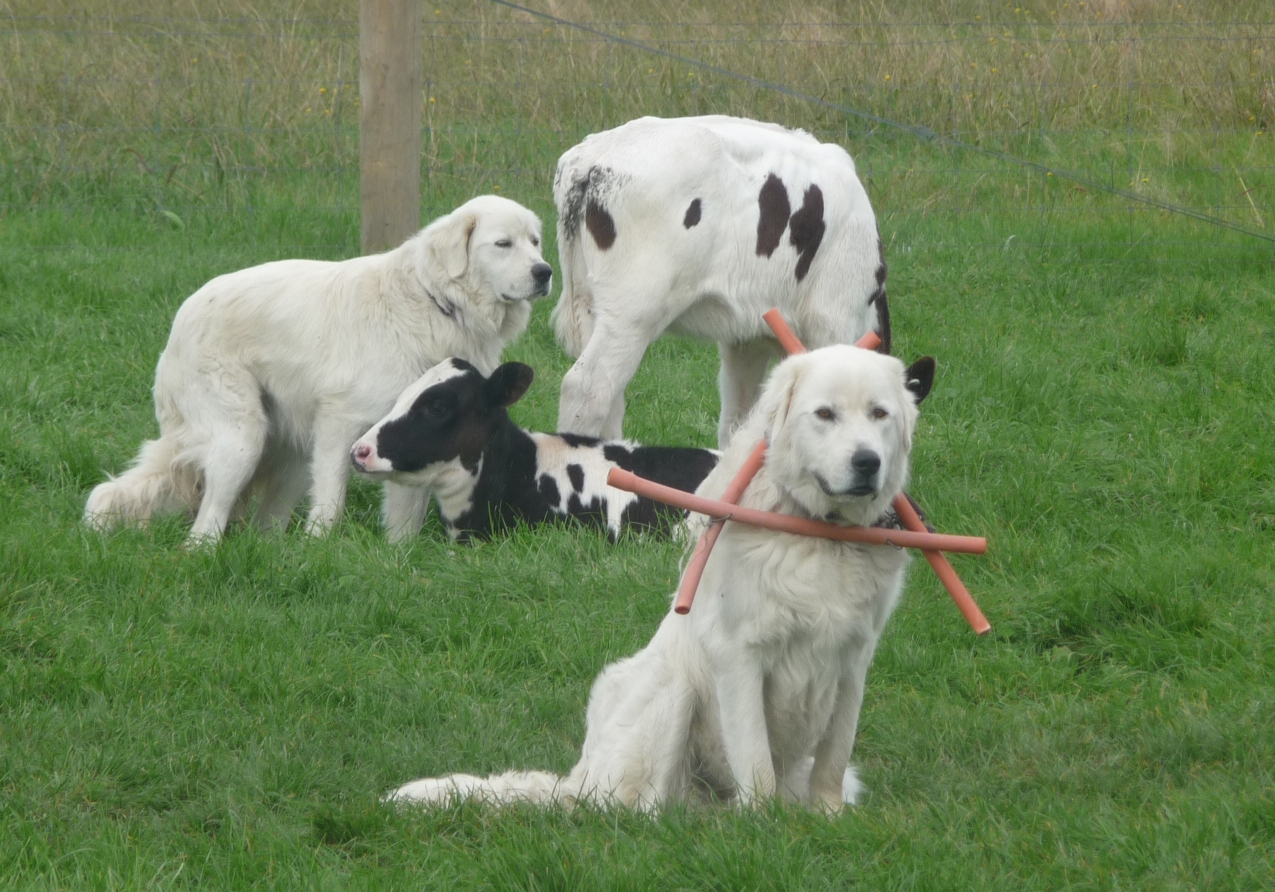
Charlie and Lola love their bovine friends


We’ve had Charlie and Lola since they were just 10 weeks old but, while they love us, we’re not their real family. The calves are. Now nearly two years old, they’ve slept, played and eaten alongside calves ever since they arrived.

The idea is that these beautiful Maremmas, bred as paddock-dwelling livestock guardians, will protect our calves from foxes and chase kangaroos and wallabies from the paddocks.

You see, I am a bit of a softie. Although I have a permit, I can’t bear to shoot at the 200 or more kangaroos and wallabies that visit us every day even while they’re decimating our fodder reserves and quite literally eating us out of house and home. The solution? I’m not sure I’m onto a winner yet but bonding the maremmas with the calves has been a two-year training phase in a grand Milk Maid experiment in macropod control. Over the last few weeks, we’ve been training Charlie and Lola to respect the 4km boundary fence and will soon let them out of the calf paddock to roam their 200-acre domain. I can hardly wait to see how they, the livestock and the wildlife respond and am practically twitching with excitement. Will keep you posted.