Whose fault is it?

Lots has changed since 1980. Milk production in Victoria has more than doubled despite cow numbers remaining the same and 35% per cent less land to graze.

Since then, we’ve had massive advances in cow genetics, understanding how to grow grass and exactly what cows need to eat. But we farmers are no better off. Despite it all, we’re very much poorer.

Everyone seems to have an opinion on why that is and just whose fault it is. Pretty much everyone has copped it online: the government, supermarkets, milk processors, agri leaders, farmers and consumers. What strikes me, though, is just how similar our situation is to that of farmers around the globe.

Milk has been sprayed at icons in France, the Brits have hit the barricades in desperation, and outgunned riot police in Brussels. Things are miserable in the US, too.  I think the reality is that affluent societies consider high-quality food a right. And you don’t value your rights until they are threatened.

Very few urban Australians would believe their access to fresh milk is at risk and, until they do, unsustainable food pricing will be “someone else’s problem”. I wonder whether it will be me or my children who will one day staff the barricades, wield the “milk cannon” or simply quietly try something else that’s truly valued by Australians.

What does a real farmer look like? Something exciting!

Exciting news item number 1: The lame and denigrating Dev and Dale ads seem to have vanished. I await the Co-op’s next breathless announcement regarding its marketing with great anticipation!

Exciting news item number 2: The perfect antidote to Dev and Dale has been created by the Brits. Reality show, Farmers Apprentice, follows 10 people (selected from 600 applicants) as they slug through a five-day bootcamp in a quest to win 10,000 Pounds.

Something like this can be done here in Australia. It’s a wonderful way to show people from all walks of life that farming is neither “McLeod’s Daughters”, “4 Corners” or “Dev and Dale”. It’ll build bridges, inspire new careers and provide an enormous morale boost to crusty types like me.

PS: This is me bathed in glory just the other day.

I declare this trough...open!

I declare this trough…open!

It only took five minutes to install the valve and float but this was the final step in opening up a new paddock that took 18 months to complete. For me, this is what real farming excitement is all about – the thrill of pulling off a big project.

The farmer’s wife

A really disturbing media story about a male-only farm succession plan set Twitter alight today. It’s so incredible I’ve been wondering if it’s a hoax but, then, maybe not. There are some pretty strange characters in any corner of society, so I guess it is possible there is a deluded beef farmer out there who thinks he’s a sheik.

Most of the comment on Twitter has been expressions of disbelief, which is reassuring, but quite a few people have drawn parallels with their own upbringings and perhaps I should not be surprised at all. In fact, Australian family farms are generally passed on from father to son.

While there’s a dearth of research on the topic, a 1996 University of New England study on farm inheritance found:

“Farmers approach succession within a distinct rural ideology where farming is seen as man’s vocation, with great value placed on self-reliance, independence and hard work. Central to this ideology is the concept of patriarchy whereby women are inherently viewed as dependents, being either the wife or daughter of a farmer (Poiner 1990, 33-52). Marriage has been the usual point of entry into farming for women. Although daughters are often required to participate in the work routine on farms, they are not often encouraged to think beyond the possibility of marrying a farmer, and to consider farming as a career (Nalson and Craig 1987). Patriarchy also entails the exclusion of daughters from inheritance of land (Voyce 1994).”

“The majority of respondents entered farming with some form of assistance from their parents (or the parents of their spouse). This usually involved parents bringing the respondent into the existing farm business or parents leaving land to respondents, or helping them to purchase land. We found that daughters are not, as a rule, involved in farm businesses. The proportion of families where daughters are working on the farm, are partners in the farm business or share in the ownership of land is less than ten per cent. We also found that sons are more likely to inherit land from their parents, and be helped by their parents to enter farming, than are daughters. This has the potential to cause ill feeling. As one respondent wrote:

“‘My parents are giving their farm to my oldest brother to maintain it as a viable business. This effectively disinherits me and my sister and other brother. This is not fair, but my father wants to keep the farm intact and in the family. There is very little by way of compensation. This is a common scenario in the rural community.’

“Of course, interest and commitment to farming varies among women. Some embrace the opportunity to farm with great enthusiasm and play an active role in the family enterprise. Others reject the notion of farming as a career. These women may continue with a career outside farming or confine their activities as far as possible to those equivalent to an urban woman in unpaid domestic work (Nalson and Craig 1987). Whether women are free to exercise their choice between these alternatives is debatable.”

I’d like to think that we have come a long way in the 16 years since this research was conducted but I’m certain we still have a long way to go. The local dairy expo still advertises a “Women’s Pavilion” full of crafts and preserves (well away from the machinery displays). Our own milk co-op thinks it’s funny to portray women on farms as fluffy accessories. Major banks publish ads trumpeting that even the farmer’s wife has a say in the business.

Perhaps these are examples of out-of-touch advertisers playing on dated stereotypes. Perhaps it reflects current reality. Either way, isn’t it time we told them we’ve had enough?

Will Curtis Stone come to the rescue of Aussie farmers and foodies?

Coles is pushing prices down, down, down to help the Aussie battler, right?

Actually, it appears the driving force behind Australia’s supermarket wars is something much more prosaic – supermarket ROI. According to the Sydney Morning Herald:

“A report released in March by the Merrill Lynch analyst David Errington warns that the big three retailers, Coles, Woolworths and Metcash, will need to boost their earnings by $1.3 billion in the next three years if they are to make an acceptable return on the billions of dollars of investments made on acquisitions and capital expenditure. This is on a total earnings before interest and tax (EBIT) pool of $4 billion for the retailers.”

“In the past year, the profit growth of the entire sector has shrunk. Errington’s report says that in the first half of this financial year, the three food retailers delivered a combined EBIT growth of $150 million, a far cry from the $400 million-a-year earnings growth required to make an acceptable return. It will be interesting to see what the full-year earnings will be when the sector reports in the next few weeks.

“If Coles, Woolworths and Metcash fail to generate suitable returns on capital in the next couple of years, investors’ patience will run out and the groups will suffer a significant de-rating.

“It goes a long way to explaining the intensifying price war among the supermarket chains as they try to snatch market share to justify their investments.”

Doesn’t sound like the hostilities will ease up any time soon, does it? In the meantime, we can expect more and more private-label products – especially dairy – to flood the shelves of Coles and Woolworths.

Research by IBIS World Australia reported in the International Business Times showed that, already, “Up to 68 per cent of butter sold in the two supermarkets is private label, while for sugar it is 67 per cent, 56 per cent for bread, 55 per cent for fresh milk and 53 per cent for eggs”.

Alarmingly, the researchers predicted that “by 2017, the share of such products would make up one-third of total supermarket sales”.

Why am I alert and alarmed? Because this is bad news for anyone who cares about good food. When price becomes the only differentiating factor, quality must suffer right along the food chain and the ones who will ultimately feel the pain will be the little people – the farmers who grow the food and the consumers who eat it.

So where does this leave the foodies of Australia? I’ll let you draw your own conclusions.

No need to worry, I guess. Celebrity chef Curtis Stone will save us all. His spin doctors, Thrive PR, say this:

“And don’t think that Curtis is just a face when it comes to his partners like Coles. He is an active contributor behind the scenes to their business and marketing function. Their success is his success.”

Then again, maybe he’s blissfully unaware of the damage to Australian food caused by “his success”. I intend to appeal for help by emailing him at contact@curtisstone.com and am sure he’d love to hear from you, too.

While you’re at it, don’t forget to sign Lisa Claessen’s petition to Coles CEO, Ian McLeod by visiting http://www.change.org/en-AU/petitions/coles-up-the-price-of-generic-brand-milk-to-a-sustainable-rate-of-return-for-all

Sustainable dairy farming

Sustainability isn’t about the environment, animal welfare, profitability, business succession or manageability. For me, the definition of sustainability is all of them.

Australia’s dairy farmers are good at environmental sustainability – we are the front line environmentalists behind the Landcare movement. I like to think we are also exceptional when it comes to caring for our animals too. Profitability, not so good. Business succession, woeful. Manageability, well that’s debatable.

City friends think I live an idyllic life, frolicking among the cows but this lifestyle can bring stressors urban Australians would never imagine. According to the University of South Australia:

UniSA Psychology PhD student Alison Wallis knows what can drive a dairy farmer to cry over spilt milk.
For the past four years Wallis has been investigating the work stress of South Australia’s dairy farmers.
It’s a group she says at the time of the research had one of the highest incidences of work-related stress in the nation.
“There hasn’t been a lot of research done on the stress levels of those who are self-employed,” Wallis said.
“But we found that dairy farming produced some of the highest distress scores of many Australian occupations.”

Reading Tom Phillips’ excellent dairy blog, Pasture to Profit, I discovered we are not the only ones. Our trans-Tasman counterparts are also studying dairy farmer burnout.

It’s all amplified in times like these – when the rain won’t stop falling here in the south and when the prices won’t stop falling up there in New South Wales and Queensland – and so much of your success or failure seems to be in the laps of the gods (whether Thor or Coles).

On the other hand, it’s times like these that faith in human nature is restored by the generosity of people who care. People like Queensland ag teacher, Lisa Claessen, who, seeing the distress of her students, has taken to social media to petition the Coles CEO for a sustainable milk price. If you would rather not have UHT on your cornflakes, please add your name to her cause.

I asked UDV president whether dairy farmers should tip their milk down the drain

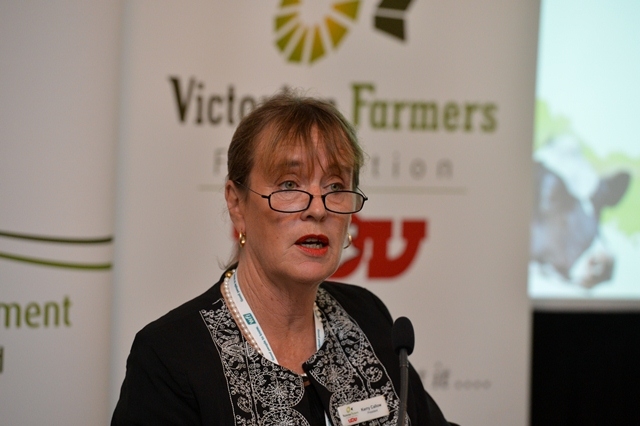
I’ve been asked a few times why dairy farmers don’t just refuse to supply supermarkets or tip our milk down the drain in protest at the unsustainable price of milk. Meanwhile, the actions of the Brits in blockading milk processors has been spectacularly successful. I thought I’d put a few “burning” milk price questions to the president of the United Dairy Farmers of Victoria, Kerry Callow, who kindly offered the following replies.

Kerry Callow

UDV president, Kerry Callow

MMM: We’ve all heard that $1 milk is a big deal for farmers but what about consumers? It sounds like a great deal, especially for families doing it tough!
KC: Milk at $1 is obviously attractive to consumers. Especially those with limited incomes and young families to feed. Dairy farming families understand limited incomes. They have had a cut in prices they receive – like having a salary cut. But this is not just about the here and now. It’s also about what’s sustainable. What will consumers have in years to come? Milk at $1 a litre retail is not sustainable for dairy farmers to produce. In Queensland it is reported that already 30 farms have left the dairy industry and more will follow. And consumers will have noticed the challenge in finding non-supermarket brand full cream milk in the dairy sections. This is a strategy for the supermarkets to dominate the supply of milk products industry. It is hard to see how consumers will keep the choices they currently enjoy. Farmers cannot afford to produce milk at the current price.

MMM: Why don’t farmers simply refuse to sell the milk at such low prices?
KC: Dairy farmers also have families to feed, children to educate and bills to pay (power has gone up 16% since the end of June, refrigerant gases required to cool milk have skyrocketed). And dairy farmers also have contracts to supply milk to processors to fulfil. The financial penalty to not supply is greater than the financial penalty to supply at a loss.

MMM: What about tipping the milk down the drain for a few days?
KC: Tipping milk out for a few days doesn’t fix the problem. (Disposing of milk that way does create added management challenges on farm). The problem is that supermarkets have decided to use milk as a ’loss leader’ and hold the price of milk down to ridiculous levels.

MMM: Is the VFF/UDV considering action like the farmers took in the UK? Would it work here?
KC: There is also discussion in New South Wales and Queensland about taking direct action. Because dairy farmers in those states rely heavily on the fresh milk market they are more exposed to the supermarkets pricing actions. Taking direct action is difficult because in this case the focus of dairy farmers angst is not a government or agency or authority, it is a commercial entity that has shown limited capacity to hear farmers concerns or acknowledge that their actions are directly and adversely impacting dairy farming families. That said, farmers are getting frustrated with the current situation.

MMM: Is there a silver lining to the $1 milk campaign?
KC: Not really. The supermarkets will point to milk consumption being higher now than before the retail milk price was slashed. But we think the consumer is heading down the road of less choice for milk products. And now we have other products like cheese and butter being marketed heavily on price. That is not a positive outcome.

Coles won’t rule out CCTV on Australian farms

Despite a barrage of requests on Twitter and emails to the Coles executive interviewed by ABC Radio, Coles has refused to rule out video surveillance of Australian farming families.

All it would say was that it has “no plans” for the cameras. It’s a remarkable turnaround given the enthusiasm for CCTV on farms so publicly expressed by one of its most senior executives on Wednesday. Either Jackie Healing was way out of line or Coles could do with a little more transparency of its own.

Seeing as the retail Goliath decided not to respond, here’s my best attempt at answering the questions Coles apparently found too hot to handle:

  1. What do you consider are the benefits of video cameras on farm?
    The presence of the cameras could lift the awareness of animal welfare, while reassuring the wider community that farm animals are well treated.
  2. Do you see any potential problems?
    A family farm is also a home and I will not have our little family watched by millions via spy cameras. Imagine CCTV on your backyard streaming live to the internet. Totally unacceptable.
  3. Do you have any concerns that practices in the best interests of animals (restraint for vaccinations or veterinary procedures, for example) could be misconstrued by viewers?
    The viewers would deserve an explanation for some of the practices they’d see. Veterinary treatment for an eye cancer, for example, could very well look like animal abuse on video.
  4. Do you anticipate Australian farmers will volunteer to host the cameras?
    No.
  5. Have you (Coles) discussed the possibility of cameras with farmer organisations? If so, what has been the response?
    I don’t know.
  6. If Australian farmers do not volunteer to host the cameras, how will Coles respond?
    I am guessing they would refuse to pay for the milk but Coles won’t say.
  7. Does Coles plan to offer education for consumers about animal husbandry practices?
    This would be critical but was not mentioned by Coles quality manager, Jackie Healing. It would be a gargantuan undertaking.
  8. Where would cameras be mounted on a typical 500-acre dairy farm?
    To be effective, they’d need to be in the dairy, the calf sheds, the yards, the ute, the quad bikes, the tractor and the paddocks. That’s around 50 cameras on my farm alone.
  9. How would the dairy supply chain need to be “remodelled”?
    If Coles does intend to follow the Tesco example, it will try to contract farmers directly, giving it incredible control over the food consumers get and the price farmers are paid.
  10. Will Coles install cameras in the food preparation areas of supermarkets?
    I suspect not.

I am hoping that, despite its silence, Coles has got the message. Please pass it on. The supermarket wants to become a superpower and it has to hear loud and clear that Australians from every walk of life reckon it’s gone too far this time.

Coles wants video cameras on Aussie farms

In an ABC Radio interview yesterday, Coles quality manager Jackie Healing called for video cameras on Australian farms. I asked the Twitterverse to add to my list of questions for the retail superpower and sent the following email to Ms Healing and Coles PR contact, Jon Church:

Hi Jackie,

As a dairy farmer and blogger, I was fascinated to see that you are advocating a Tesco-style approach, including video cameras on farm. Would you care to answer some questions for http://www.milkmaidmarian.com? The blog is now quite popular with both farmers and consumers who would, I am sure, be equally as interested in exploring the topic further.

  1. What do you consider are the benefits of video cameras on farm?
  2. Do you see any potential problems?
  3. Do you have any concerns that practices in the best interests of animals (restraint for vaccinations or veterinary procedures, for example) could be misconstrued by viewers?
  4. Do you anticipate Australian farmers will volunteer to host the cameras?
  5. Have you discussed the possibility of cameras with farmer organisations? If so, what has been the response?
  6. If Australian farmers do not volunteer to host the cameras, how will Coles respond?
  7. Does Coles plan to offer education for consumers about animal husbandry practices?
  8. Where would cameras be mounted on a typical 500-acre dairy farm?
  9. How would the dairy supply chain need to be “remodelled”?
  10. Will Coles install cameras in the food preparation areas of supermarkets?

I shall post the questions online tomorrow and would be delighted to add your answers, provided they are no more than 100 words each and reach me by COB tomorrow. If this doesn’t suit, please let me know and I will do my best to provide a balanced response.

It will be interesting to see whether Coles is happy to elaborate, don’t you think?
 

Milk money makes the town go round

They say our local town has a heart that beats on the 15th of every month – pay day for the milk co-op. While 98 per cent of Australian dairy farms are small family-owned businesses, they do turn over significant sums. My own books show it was almost $900,000 last year. It’s a shame we keep so little of that turnover (the average dairy farm enterprise makes 1 to 2% returns) but it’s great for the town.

Dairy Australia notes that: “Dairy is also one of Australia’s leading rural industries in terms of adding value through downstream processing. Much of this processing occurs close to farming areas, thereby generating economic activity and employment in country regions. ABARE estimates the regional economic multiplier effect to be roughly 2.5 from the dairy industry.”

Here on the farm, we employ one full-time local and two casuals directly but I think the biggest contribution our little business makes to the community is through our purchases. We spend a lot of money on grain, fertiliser and pasture renovation but there are also the vets, rural produce store, hay and silage baling, mechanics and even excavators.

This year will be a little different. I have to save almost $150,000 at a time when the price of grain is on the rise, sell silverware in the form of cows or borrow more money. Suffice to say, I will be as tight as a Yuletide Grinch.

It will be essential repairs only and the tractor will simply not be allowed to blow its gaskets like it did last year.

A challenge for the Gruen Transfer

Farmer: The salt of the earth; rich whinger; straw-chewing simpleton; or oik in the bush who only wants to joyride in a very thirsty V8, drink excessive quantities of Bundy’n’Coke, shoot guns at one another and abuse women?

I’m sure one or more of us fits into any one (or more) of those categories. Some of us won’t fit any of them. We’re just people after all.

There’s also a lot of talk about how we can attract young people into agriculture. ABC journalist, Warwick Long, asked Twitter how it can be made sexy enough and Graeme Nicoll (@Hoddlecows) responded with this:

“If you’re looking 4 a sexy job buy fish net stockings,if u want a job at the cutting edge of technology &the enviro get into ag”

I think Graeme’s hit the nail on the head. You just have to love the outdoors. It’s not glamorous but it is great.