Dairy Australia Chair Max Roberts answers a Milk Maid’s questions

One of the dairy community’s most prominent leaders is Dairy Australia chairman, Max Roberts. Thank you, Max, for answering the Milk Maid Marian’s questions and a thank you in advance to those of you reading this who can fire some more questions in via the blog!

Dairy Australia chairman, Max Roberts

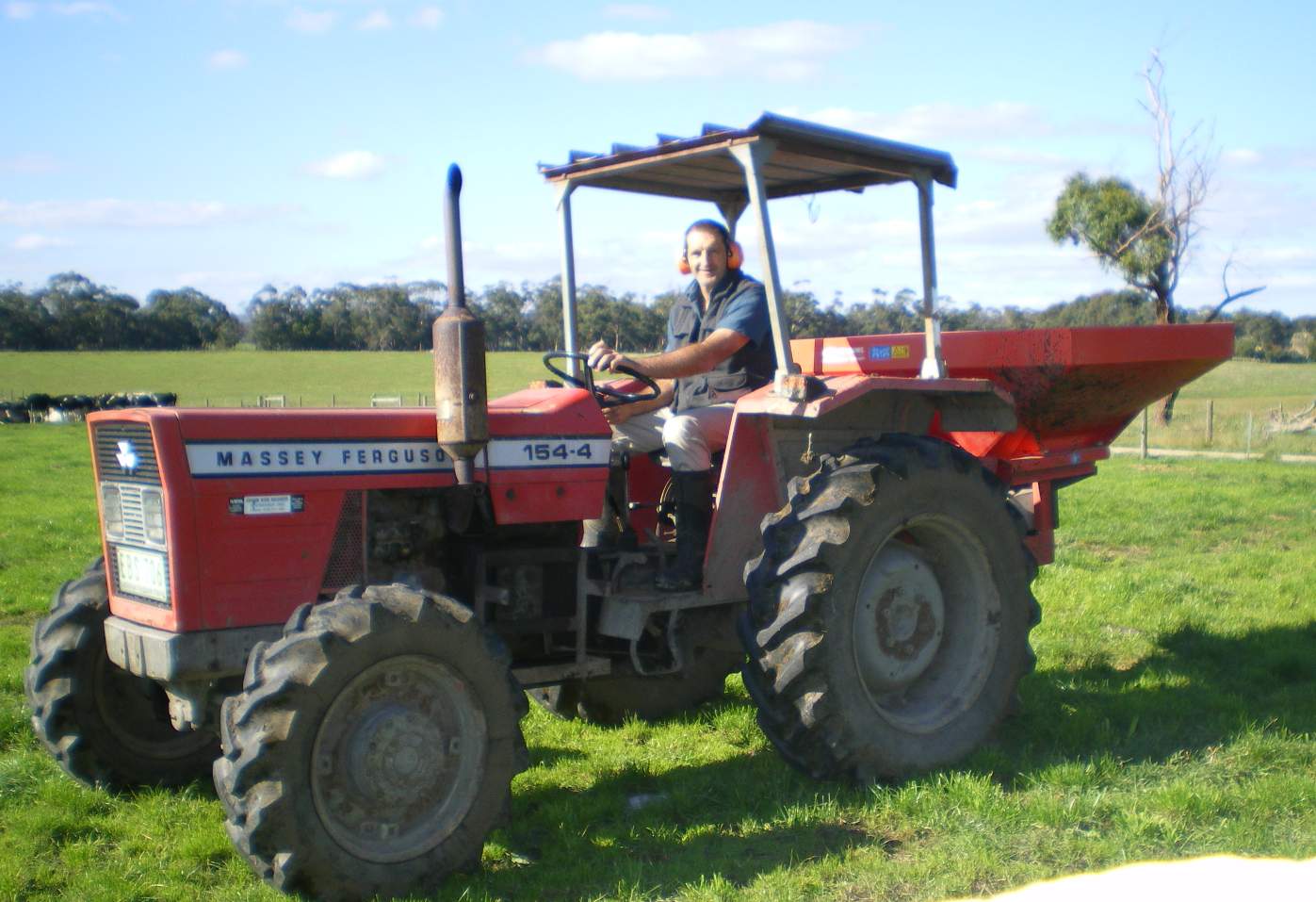
Max Roberts in his own dairy

MMM: Why are you a dairy farmer?
MR: In 1982 I had what many would call a good government job that said that I had to leave Bega and go to Sydney. Sue and I didn’t like that idea so we bought a dairy farm and have never regretted that decision. It had a few interesting moments with a couple of deep and meaningful conversations with the bank manager. Over time it has worked well for our family. It has given us a lifestyle we now enjoy, educated and given a good start to both the kids and we enjoy it.

MMM: What are the hot topics discussed by dairy farmers?
MR: This depends in what part of Australia you are in and we should never generically assume that one problem fits all. For example it could be water in the Murray Darling Basin, the supermarket pressure on domestic milk prices in the northern parts of our industry, the impact of drought or wet weather in other dairying areas. Milk prices will provide some common ground as will input costs and there may be a combination of the above issues dominating farmer discussion. It’s interesting to look at the last three or four outlook reports and the variation of emphasis placed on the varies topical issues.

MMM: What is not being discussed that should be?
MR: This is an interesting question and one that exercises our minds around the board table because DA needs to be ahead of the issues and not playing catch up. It will be interesting to see what comes back via your blog. One I would suggest is farmer succession but dealing with the issue from the older or grumpier end of the industry.

MMM: How would you describe the mood of dairy farmers at present?
MR: Dairy farmers are generally cautious in terms of sentiment. Our research shows the confidence levels among dairy farmers has remained relatively stable over the past 3-4 years. Confidence levels are currently around 66%. There is still a lot of rebuilding to do after the drought years of the past decade and we should not expect an instantaneous result from the better seasons that we have had.

MMM: What is the role of dairy farmers in the management of DA?
MR: DA is the service body of the dairy industry and therefore farmer involvement in what we do is essential. Farmer access to DA’s forward planning process is available through a number of channels. In no particular order they are via one of the eight RDP’s (Gipps Dairy, Dairy Tas, Sub Tropical Dairy and the five others) the state farmer organisations, the staff and directors of DA, the dairy company’s and the many dairy research facilities.

MMM: What are the biggest challenges and opportunities for the dairy community?
MR: The dairy industry is a producer of food and has a reputation second to none on the delivery of high quality foodstuffs especially as a source of protein. Food security is a growing international issue that creates headlines outside of Australia. There will always be demand for our product which creates the opportunity but the real challenge is at what price will that demand be at. We have to have farming systems and technologies that allows us to produce milk within the demand and price parameters . We also need resource policies that allow us to be profitable farming business’s. To have the right policies we need a strong farmer lobby voice to support the work of DA. So one of the key challenges is to have farmers involved in the future of our industry.

MMM: If you had a magic wand…
MR: My magic wand would iron out the volatility of milk pricing and input costs.

More questions for Max are welcome! Simply leave a comment.
Questions for Aus Dairy Farmers president, Chris Griffin

Australian dairy farmers are represented by the aptly named Australian Dairy Farmers Limited and I am very pleased that its president, Chris Griffin, was happy to be my guest on Milk Maid Marian. It is the first of a series of guest posts that I have planned featuring dairy leaders. If you would like to suggest more guests for MMM, please drop me a note!

Chris Griffin

Australian Dairy Farmers Limited president, Chris Griffin.

MMM: Why are you a dairy farmer?
CG: Growing up on a dairy farm I have always wanted to be a dairy farmer. I have always been interested in issues beyond my front gate that affect our industry and especially now as President of Australian Dairy Farmers (ADF) I want to ensure that our industry is given the recognition it deserves for all of the hard work that we do on a daily basis.

MMM: What are the hot topics discussed by dairy farmers?
CG: There are many topics that we farmers are concerned about, in particular Water, Carbon, Animal Health & Welfare and the retail supermarket milk price – not only what farmers receive but also the retail price that milk is being sold at in our supermarkets.

MMM: What is not being discussed that should be?
CG: Genetic Modification (GM) – there is potential coming out of the Cooperative Research Centre (CRC) on genomics and better pasture species. This is an exciting development and has the potential to have increased productivity gains for the industry. I also believe that we need to focus on the future of our industry and Australia’s need to produce high quality products. Our export ability will also continue to generate wealth for Australia.

MMM: What are the biggest challenges and opportunities for the dairy community?
CG: One challenge for farmers is returning our production to those of the pre-drought levels. As an industry, we also need to ensure that we continue to provide career paths for our younger generations. We also need to ensure that there are people continuing to contribute to our industry and understand the value and need for advocacy and representation at local, state and national levels.

MMM: If you had a magic wand…
CG: I would want to eliminate the urban/rural divide that has impacted our industry for some time. Farmers must be recognised for the value that they contribute in caring for their land, caring for their livestock and continually providing high quality products and nutritious food.

Chris Griffin

Chris on the farm

Carbon tax misfires

I imagined there would be riots when the average Australian family faced a 10% cut in income as a result of the carbon tax. But for some reason, nobody seems to be making a big deal about it.

I suspect it’s pretty quiet because although mine is a very average family (two kids and a dog), we’re not on the political radar.

The carbon tax is expected to slug us around $5000 per year – a whopping 10% of the average dairy farm family’s income. As reported in The Land and the Australian Financial Review:

The three majors that will pay the new tax from July 1 are already investing in low-carbon technologies but Murray Goulburn Co-operative estimates rising electricity prices will cut the annual income of the average farmer by $5000 a year, The Australian Financial Review reports.

“Profit in the average dairy business in recent years has averaged $50,000,” one MGC general manager, Robert Poole, said. “So that represents a 10 per cent cut. For the average dairy farmer, the tax is going to cut hard into their profits.”

How can this be? Well, because even though I plant 1000 trees or more on the farm every year and have built some of the most carbon-rich soils in the country (up to 22% organic matter content), I cannot participate in the poorly framed Carbon Farming Initiative.

The milk processor we supply, Murray Goulburn, will face increased costs of $10 million per annum and will pass those costs onto farmers – guaranteed. It is guaranteed to do so because MG is 100% farmer-owned so the buck quite literally stops with us. Our fertiliser, fuel and electricity prices will also rise.

Ironically, if MG was spewing out far more greenhouse gases, we might not face this crippling tax because “emission intensive” businesses that export just 10% of their products are considered “trade exposed” and given special concessions. MG exports around half of our milk but because it’s not that “emission intensive” (aka dirty), it misses out on concessions.

Please, can somebody explain the logic behind this?

Murray Goulburn Co-op sheds jobs: why it’s happening

The co-op we supply, Murray Goulburn, has made an announcement that immediately made me sad. In an email sent to its farmers yesterday, managing director Gary Helou, wrote:

“The change program embarked on by MG is even more critical given increasing cost pressure and the recent significant decline in world market prices due to higher global milk supply. This initiative will help reduce the impact of falling world prices and a high Australian dollar on our supplier/shareholders. As a result of these changes, MG’s total workforce is set to reduce by 12% or 301 roles.”

While it makes me sad, I’m not surprised. Farmers are struggling to survive (less water, increasing costs, horrible prices and now the carbon tax slug estimated to cost us $7,500 each) and milk flows have dropped as a result. When appointed as the new CEO a few months ago, Mr Helou announced he would cut the co-op’s operating costs by a whopping 25%. That’s a lot of money.

As he went on to write in yesterday’s email:

“We continue to employ more than 2,100 people, mostly in rural and regional Australia, and contribute an estimated $6 billion to the Australian economy. These changes will make a significant contribution to our goal of reducing operating costs by $100 million this year and set us on the path to becoming a world leader in dairy foods”.

To give you some background, MG is Australia’s last big dairy farmer co-operative and processes around 35% of the country’s milk. You can’t own shares in MG unless you supply the co-op milk, so all the profits go straight back to farmers. The other big players are privately owned and profit from buying milk at the lowest possible price and selling it at the highest possible price. In effect, this means that MG tends to set the benchmark for the price dairy farmers like me are paid for their milk.

This is why I feel torn about the “change program”. On one hand, I am worried that somewhere along the way, we will weaken MG’s co-op values but, on the other, we desperately need MG to be strong and efficient. Neither the 2,100 MG workforce or Australia’s dairy farmers can afford to lose this gentle giant. Please be careful, Mr Helou, and good luck.

Confidence to grow: could foreign ownership be a godsend?

Farmers are a little enigmatic.

On one hand, we must be the most optimistic people on earth: we don’t give up easily because a great season could be just around the corner. On the other hand, we’re not typically the type that goes out and buy lots of stuff in the good times: we know another bad season could be just around the corner.

One thing of which you can be certain is that we know how to pull our horns in and refuse to open the cheque book when times look a little shaky. This seems to be just one of those times. The bank tells me that business is “quiet”, dozens of farms are for sale but not selling and one rural financial counsellor noted that she’s seeing more and more depressed farmers.

The market for dairy farms is now so quiet that I can’t tell you how much our own farm is really worth because there’s simply no benchmark. This in itself leads to a lack of confidence and, so, a vicious cycle ensues.

It was with all this in mind that I read Jonathan Dyer’s (@dyerjonathan on Twitter) blog post on foreign ownership of Australian farmland this morning. Referring to the purchase of farmland near his own property by a Qatari corporation, Jonathan remarks:

“Perhaps because we don’t know just how amazing our natural wealth is we aren’t appreciative of it and are happy for it to be sold off. We don’t value it and look after it like we should. If that is the case, if we don’t value what we have and aren’t willing to develop it, then maybe it’s good that others who do value and need quality food production are getting a chance here in Australia.”

I couldn’t agree more. What I am hoping though, is that the interest of foreigners in our natural wealth will encourage Australians to reconsider the way we view our amazing land. If we are to remain one of the world’s leading food bowls, we must have the confidence to grow.

Ethical milk – which brand to buy?

There’s a feeling “out there” in the Twitterverse that milk aint what it used to be. So, what to choose?

The first piece of good news is that there’s lots you don’t need to worry about. Growth hormones are illegal on Australian dairy farms for a start. Free range cows are also the norm (I haven’t seen a housed herd in Australia and wouldn’t even know where to find one).

Thanks to what raw-milk advocates often call Australia’s “ridiculously stringent” food safety laws, you can be confident your dairy foods are safe for even your most frail family members; the Chinese melamine disaster won’t happen here. Despite the marketing campaigns of a large multinational corporation, permeate (check my all about permeate post to find out more) is also safe and nutritious.

If want farmers to receive a fair price for milk, you can still shop at the big supermarkets with a clear conscience if you buy a brand-name milk. It’s even better if you can buy the Devondale brand of dairy products because they are made by the 100% farmer-owned co-op, Murray Goulburn. If you can access a farmstead brand of milk, that’s okay too. Don’t feel guilty if you can’t find or afford a farmstead brand though – very, very few dairy farmers can afford to set up a milk processing plant after all and we are grateful that you are supporting us by choosing not to buy the generic stuff.

US dairy woman moves to Aus and a whole new way of dairying

Penny Cooper’s story of her life in dairy in the US and now Australia, shows just how different dairy is around the world and I’m delighted she agreed to write a guest post for Milk Maid Marian. Penny, who now trims cows’ hoofs for a living, will be running a lameness workshop in Toora on March 19. If you’re interested in attending, visit http://www.allstatehooftrimming.com or connect with Penny on Twitter at @allstatetrim.

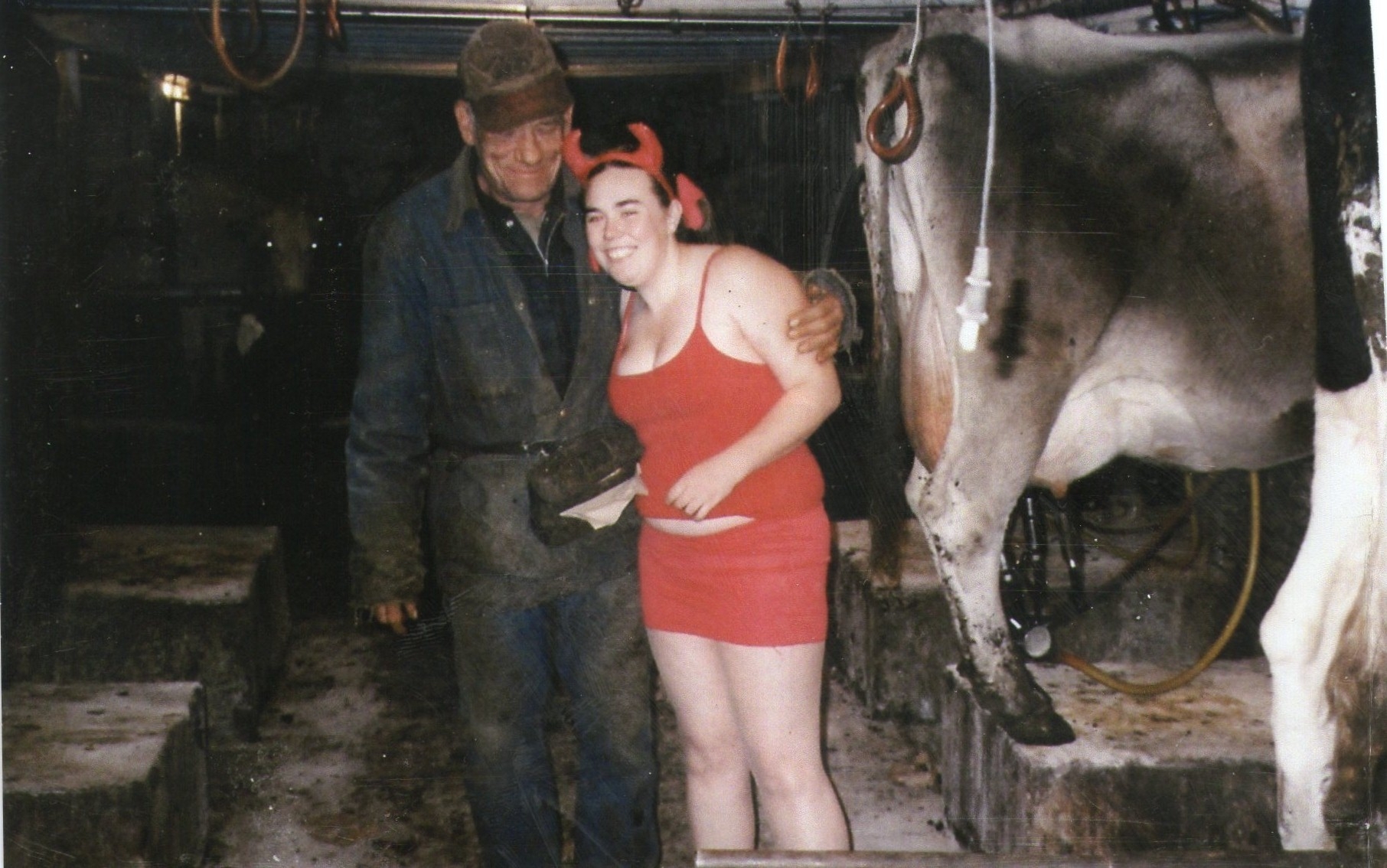
Penny celebrates Halloween in the dairy with her Grandad

Halloween in the dairy parlor with Grandad


I was raised on a 240 acre dairy farm in the heart of dairy country, Wisconsin USA. No one would imagine I would make it to South Gippsland, Australia, in the pursuit of helping lame cows. The differences between dairying in sometimes frozen tundra to the harsh Aussie summer are huge!

Growing up, we milked our cows in stantions and moved our milking units down the line, kneeling down to milk in between cows. Which was always made it fun when you had a particularly sassy heifer!!

We only had 80 cows, just like most other family farms in the area, but on a cold winter night when temperatures dropped to sometimes -20C it was plenty!! The cows usually heated the barn a bit but it was not unheard of to have to stop milking, run to the milk house get a bucket of hot water and pour it over the milk line because it had frozen solid before hitting the bulk tank!! In early 1999 we became quite “advanced”, installing a homemade step up/walk through parlor!

Making the change to rotational grazing brought about a new set of issues like frozen teats when the cows were sleeping with 4 feet of snow on the ground. People thought we were crazy and maybe we were but that’s okay too.

One thing that is constant, no matter where I travel in the dairy industry, is the kindness of the people and the amazing work ethic that is passed down from generation to generation. My Grandpa taught me that the Farm comes first no matter what, that I could do whatever I wanted on Friday night but I better be there to get cows on Saturday morning and to be proud of the job knowing that farming is the backbone to a great nation. I am so lucky to be involved in this great profession still today!

Milk war myths

This story from the ABC News on the impact of the price war suggests exports will allow dairy farmers to make a living.

It says China and South-East Asia, particularly India, will provide “huge opportunities” for Australian dairy. True, the February Dairy 2012 Situation and Outlook shows China’s whole milk powder imports have skyrocketed (see page 10).

It’s pretty misleading of the ABC news report to suggest, however, that exports will be our salvation.

First, not all Australian milk can be exported. Queensland, for example, does not have manufacturing facilities capable of producing product for export and it looks like there won’t be enough dairy farmers left there to support a factory in any case. Almost all of their milk is sold as fresh milk on Brisbane’s retail shelves.

Second, Victorian dairy farmers have long exported around half our milk; only 9 per cent of our milk ends up in cartons on the retail shelf and the ABC News report suggests we are doing better than those who supply the domestic market. The prices farmers are paid for a litre of milk in different Australian states tell a very different story. In 2008/09, Victorian farmers were paid 39 cents per litre while Queenslanders received 57 cents. In 2009/10, it was 34 cents versus 56 cents in the Queenslanders’ favour.

I am not suggesting the Queenslanders have been living it up but these numbers paint a far less rosy picture when it comes to exports, don’t you think?

The ABC also says raw milk prices have doubled in the last five years. Maybe so, but costs seem to have pretty much kept pace and the surging Australian dollar has meant that the average Australian dairy farmer has missed out on a fat pay cheque. Most of the farmers I know are struggling.

As Julian Cribb wrote in his SMH article “Huge shift in what we eat” today:

“If cities and the resources sector continue to take water and land from farmers, and supermarkets continue to punish them economically, much of our future food may be grown in factories, rather than on farms.”

Is that what Australians want?

What would you say to the trendy vegetarian?

We just had a young man staying with us who announced he’s become a vegetarian. When I asked why, he said it was because he liked what PETA says about not taking the life of another creature.

I try to be very open-minded but as soon as someone says “PETA says…”, I must admit that the fire doors of my mind slam shut. I was instantly infuriated. Just wanted him to leave but couldn’t say so. Instead, I told him he’d have to go a lot further than giving up chicken, pork and beef burgers.

As the weekend worn on, he ate copious amounts of eggs, dairy and…seafood. Quizzed a little more closely, he said his “vegetarianism” was really for health reasons. I urged him to see a dietician to make sure he has enough iron and vitamin B but he’s okay – he eats corn at least twice a week.

The experience has opened my eyes to the value of nutritional education when it comes to making food and lifestyle choices. Becoming a vegetarian or vegan is trendy. Thinking about supplements and vitamin B12 patches is not. Yet, according to experts cited in Wikipedia, “Poorly planned vegan diets may be low in vitamin B12, calcium, omega-3 fatty acids, vitamin D, iron, zinc, riboflavin (vitamin B2), and iodine.”

What would you say? In the meantime, grab a Coke and enjoy this hilarious clip on trendy diets from Mamamia.

Not just an old tree

With hands and faces stained purple, my brother and I perched in this old tree every summer of my childhood. The exquisite mulberries were just reward for a hard day’s labour in the scorching heat filling sacks with buttery yellow ragwort flowers.

I looked forward to hoisting Zoe up that very same tree this year but the tradition will stop with me.

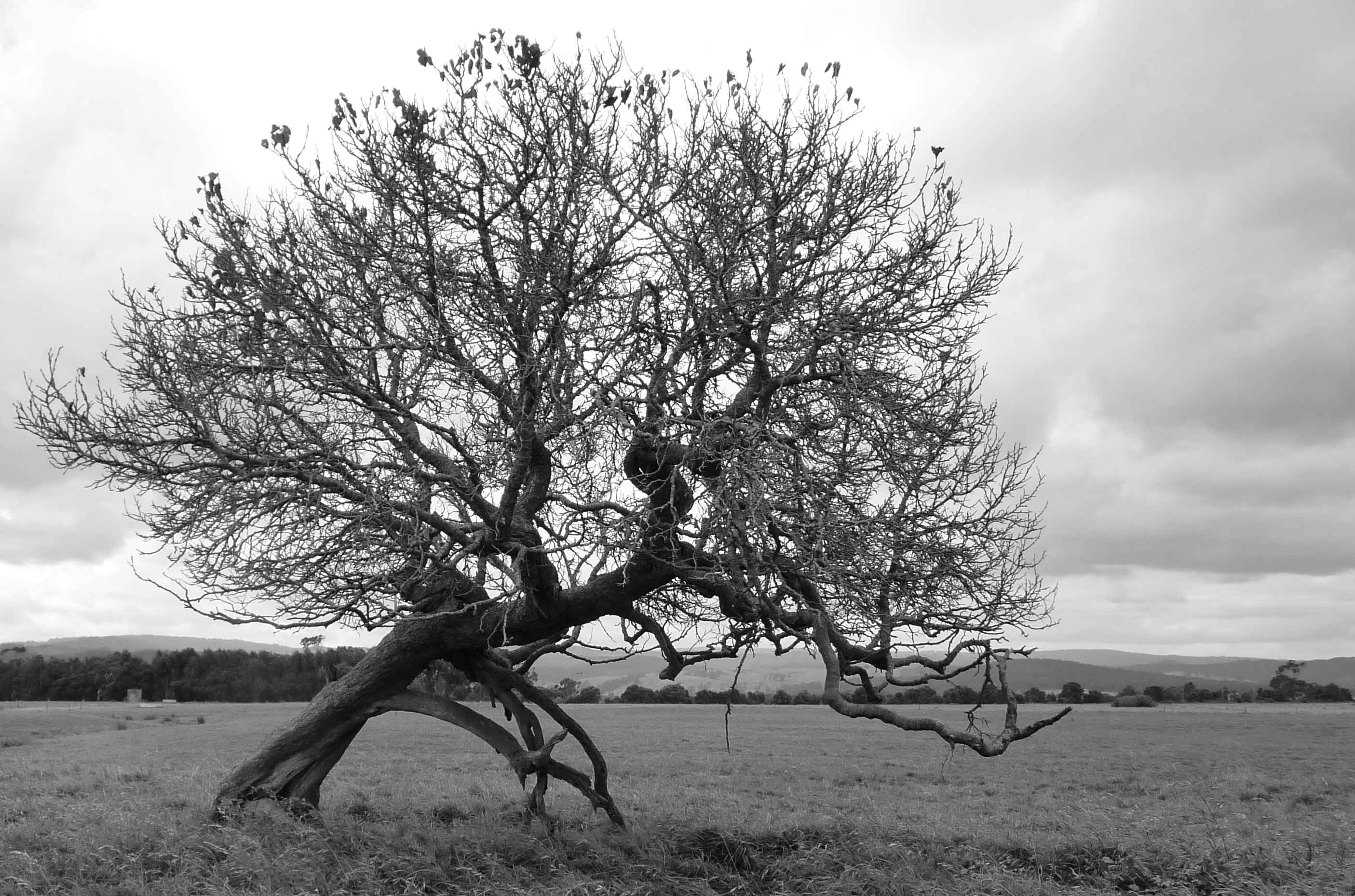
Old mulberry

She has at last succumbed

The tree has writhed across the landscape ever since I can remember but now she has a hideous crack right up the base of her trunk that must have made life not just tough but impossible. Normally, she would be covered in heart-shaped leaves hiding almost black fruit in early March. Instead, just a handful of leaves remain even though thousands of buds seem poised to burst open with new life.

She was the last productive member of an ancient orchard Dad told me was planted by the farm’s settlers before they realised it was an island on a floodplain. The house was later built a few hundred yards away, reached only by the worst floods. She could well be 100 years old.

Her death brings the cycle of life into stark focus. My Dad and brother are gone; Zoe and Alex walk beside me these days.  When Zoe turned one, we planted a mulberry tree in the garden to celebrate. It has borne its first fruit this year.