I just found out about greenhouse gases on my dairy farm

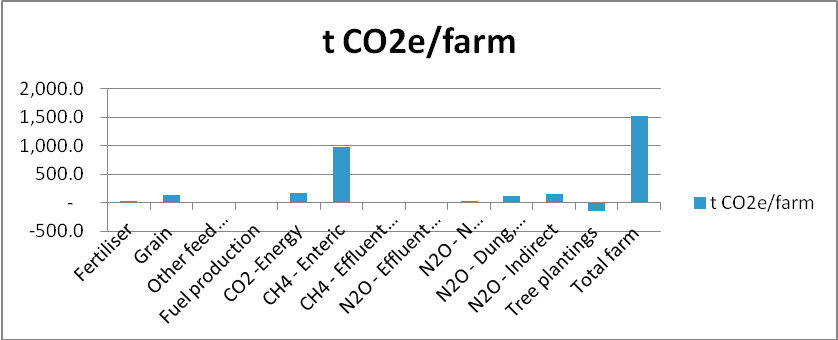
Well, that was an interesting exercise. Gillian Hayman took all our farm data and produced some colourful charts with the Dairy Greenhouse Gas Abatement Strategy calculator. Like most animal-centred farms, the vast majority of our emissions come from the methane burped up by the cows.

Source of farm greenhouse gas emissions

Where our greenhouse gases come from

In total, our farm produced 13.3T CO2e per tonne of milk solids in 2010/11 – quite a bit above the average 10.2T CO2e per tonnes of milk solids recorded by the DPI Farm Monitor Project of 2009/10. Why is it so? Ironically, it could well be because our cows eat so much grass rather than grain.

So, what should a dairy farmer do?
According to the authorities:

“Production improvement options and best management practices are most often linked to greenhouse gas emissions reduction. At present, well managed farms have few options to reduce emissions without significant changes to their farming or feeding system…A great deal of research is underway within the Australian dairy industry to decrease the release of methane and nitrous oxide from farming systems.”

In the meantime, we will keep planting trees and be judicious with our fertiliser use.

Why would an average Aussie give farms a second thought?

What does the average Aussie think of Australian dairy farming? Apparently, not much. They’re happy that their milk and other dairy foods are exceptionally safe and high quality and that’s about it. They know they are blissfully ignorant and most are happy to keep it that way.

This was the message from Neilson’s Courtney Sullivan when she addressed the Australian Dairy Conference last week. She’d selected some drawings made by milk drinkers to give us an insight into their thinking. A cow with eight teats and two udders produced milk that somehow got to a factory, then a warehouse, then into a massive shopping trolley that finished up in a massive house.

So, why are you here reading a dairy farmer’s blog, dear reader? You are obviously an exception from the norm and I’m very pleased that you are so far from average (still, it is very rare to meet an average Australian, who shares a home with 1.6 others and one-third of a dog).

Apparently, the Australian Year of the Farmer believes that the average Canberran family gets excited about loyalty cards when they think of farmers. Victoria Taylor took her family to the Canberra Show last weekend and you’d be amazed to read her blog post about the experience and the lasting impression made by the Australian Year of the Farmer stand.

Love to hear your thoughts on what makes farming interesting to those not currently up to their boots in it!

Today I have 5 minutes with Australia’s dairy elders

If you were given five minutes to address the Australian Dairy Conference, what would you say?

I have that honour today and was asked to speak about my experiences with social media. It’s not a lot of time, so I’ve opted for the “shock and awe” approach, beginning with a real-life case study showing how ordinary dairy farmers brave enough to wear their hearts on their sleeves won new friends in the face of scandal. I’ll close with a yet to be revealed threat and an offer to attend my social media workshop on Friday so we can deal with it together.

Before I take the podium, Neilson’s Courtney Sullivan will tell the conference that dairy has a great reputation in the wider community. Australian dairy foods are safe, nutritious and pure. That’s a priceless position of trust we should treasure and protect because it took decades to build and could be lost in the blink of an eye. If you’re not convinced, ask a beef farmer.

Farmers typically only appear in the media during drought, fire, flood, plague…or when a horrific case of animal abuse is uncovered. It’s hardly surprising then, that we are considered whingers and, in turn, city folk (including policy makers) have “no idea”. No longer. The rise of a new, grass-roots media (Twitter, blogs and Facebook) means we can tell our own stories. And what has amazed me is just how many ordinary Australians want to hear them.

Now, back to that question for you. If you had five minutes to speak at the ADC, what would you say?

Snakeoil and women in agriculture please pass the scones

When the local dairy expo advertised it would have a “Women’s Pavilion”, I pondered the possibilities. Striptease? Baby change tables and comfy armchairs for breastfeeding mothers? A new pseudonym for toilets? Surely not!

No, the Women’s Pavilion was chock-full of arts and crafts. Crochet, quilts, preserves. Delightful yet patronising to this farmer who happens to be female and is just as interested in cattle crushes as the next man.

Now I’ve heard on the grapevine that a very high profile ag event plans a nude calendar featuring hunky farming fellas while the women’s contribution will be…recipes. If it is true and I am asked to share my favourite recipe, let’s hope they catch me on a good day.

Speaking of recipes, I was stopped on the side of the road by a salesperson just the other day who had the “solution” for all my farming woes. His special mix will lift our milk solids (fat and protein for the uninitiated), get every single one of our cows in calf, halt mastitis in 48 hours and even cure any mistletoe in neighbouring trees. All I have to do is put 2.5kg of the magic powder in the water trough each day. Nothing else, he was keen to stress.

I asked what was in the magic powder. He would only say that it was humic and fulvic acids, probiotics trace elements and minerals and it was devised by a man in Holland. “It’s a secret recipe,” he explained when I questioned him further. When I quizzed him on the science, he got himself confused and pulled out an abstract of a “study” that I was welcome to read there on the roadside. Said I could Google it. Thanks.

He has no literature, no website and no farmer referees either but a lot of people around here are trying it, he says. What’s more, if it doesn’t cure all my woes, he will give me my money back.

Farm consultant John Mulvany often warns dairy farmers to be wary of spending money on “herbs and spices” for their feed but this takes the whole feed additive bandwagon to new lows.

Dairy farming is highly professional these days. Labs test the soils that grow our grass, the feed that sustains our cows and the milk that they produce for optimum environmental, animal and human wellbeing. So where does snake oil like this fit into that equation? I reckon it’s the agricultural equivalent of the Tattslotto ticket. We all want to dream.

Have Australian dairy farmers given up?

I know things have gotten tough for Australian dairy farmers but I’d hate to think of us as quitters. Still, as the Dairy Levy Poll roadshow tours the country, it seems a real possibility that in just a few weeks we will try to vote ourselves out of existence.

In just a few weeks, Australia’s dairy farmers will vote whether to increase the amount we pay in levies to research and development body, Dairy Australia, or have it abolished. I hate seeing any deduction from my milk cheque as much as the next farmer (believe me!) but I also know that I would not be farming here today without that Dairy Australia levy.

Twenty years ago, our farm looked greener but not all that different from the beef farm next door. Dad was more interested in his role as local councillor and, later, dancer and bushwalking pursuits than in making every blade of grass count. And he could afford to. Farming was more profitable then and his debt level was low.

One divorce and a drought later, things changed. Faced with a suddenly massive monthly interest repayment, it’s fair to say Dad’s initial response was to panic. He lost two stone off his already very slender frame, considered selling the farm and then sought help. His decision to enrol in a Dairy Australia levy funded Target 10 course and to seek the advice of farm consultant, John Mulvany, saved the farm.

Productivity soared as a rotational grazing system offered cows fresh, high quality grass every day. Dad also confessed a new enthusiasm for farming. After 50 years on the job, he was learning again. He then embarked on just about every DA funded course he could find: Feeding Dairy Cows, Fertilising Dairy Pastures, Feeding Pastures For Profit, Countdown Down Under and Cow Time are just some of the handbooks he left behind.

Today, my interest repayments are even higher than Dad’s and farm margins are even tighter but with the latest know-how, I will make it.

Australian dairy farmers have become some of the lowest paid in the world. That stinks but it’s the reality. If we are going to survive, we need to be smarter than the rest. And if we don’t vote for investment in the very research that keeps us going, can we really expect the Australian taxpayer to help? I think not.

If you want to send a message to the bureaucrats, ring them up and tell them you’re not happy. I do. But I’ll never tell them I’ve given up and that’s why I will vote yes.

Putting ourselves in the best position

In the lead up to the Australian Dairy Conference later this month, I’ve invited a few fellow speakers to do guest posts on Milk Maid Marian. One of them, Steve Spencer of the Freshlogic consultancy, issued this challenge to dairy farmers.

Steve Spencer

Steve Spencer


The world has changed in the last 5 years and with that so have the prospects for dairy producers. If you read the views of the global food gurus, we’re riding on the cusp of an ever-tightening world food shortage that puts the dairy industry in a great position. We’ll have plenty of competitors going after that future prize, and in the last decade dominated by the effects of drought, other exporters have emerged. But at the same time, decades of protectionism by major economies is steady evaporating, as governments admit they can’t afford to fund the high walls built around agriculture.

As we’ve seen in the past couple of years, the variables affecting our farmgate milk prices in Australia have become more complex, and the volatility in the future world that affects those prices, grain costs and weather will only increase.

As we step into the future, it has never been more important to make sure our industry is structured in the best possible way to make sure we optimise the flows from the market back onto farms. It isn’t something that we should steadily work on for a few years – this pressure now urgent!

I will be presenting a paper at the Australian Dairy Conference at Warragul, Vic (which is being held on 22-23 February) that will aim to stir up the debate on the agenda for getting that going. It will look at precisely what can be done to improve returns, and it should be no surprise to anyone to recognise that most of the things that can be done are within our own control.

So my paper will tour:
• How farmers do or can engage with the dairy market
• The value of the co-operative as a channel to that market
• How they perform in different industries
• What changes others are making and why
• What changes are most important in the Australian market
• How those can happen

We’ll discuss the elephant in the room. Murray Goulburn is the largest farmer-owned processor of milk in southern Australia, accountable to their shareholder-suppliers for performance through farmgate milk prices and dividends. In a highly competitive farmgate environment, prices paid by foreign-owned, privately owned or listed competitors will be set at or above MG’s price – others will only pay what they have to in order to get a secure milk flow. They are accountable to shareholders who may not be dairy farmers purely on their performance as a business.

It will be up to the co-op’s farmer shareholders to determine if the company is properly structured and managed to maximise performance, and the opportunities and risks of change.
Whether dairy farmers supply and own shares in MG or not and no matter where they farm, the performance of that largest co-op is an issue relevant to all Australian dairy farmers, as milk values are set by MG’s payment performance.

Like Australia’s competitors in the US and Europe will find as they embrace deregulation in the years to come, clinging to tradition is probably the worst thing farmers can do for the future of the industry.

I urge dairy farmers, their advisers and investors to attend the conference and get involved.
Left behind in the dust

The farm in February

Still looking green

It’s at this time of year that three distinct classes amongst dairy farmers around here become clear for all to see: the lax, the leaf counters and the irrigators.

The beautiful green pasture seen from our verandah is something of an illusion. Take a closer look and it’s sparser than it was just a few weeks ago when we were squirelling away silage. More importantly, it’s growing at about a third of the speed. In contrast, the irrigators are powering along, growing feed as fast as ever.

Why don’t I irrigate then, you ask? Because I cannot. There is an indefinite moratorium on new irrigation licences for the aquifer that flows beneath our farm because it is dropping unsustainably. According to a report by the Department of Sustainability and Environment:

“Levels of groundwater extraction from the Latrobe Aquifer, in Gippsland, are well in excess of annual recharge. Monitoring of groundwater levels indicates that, as a result, there has been a regional decline of approximately 1 metre per year over the last 30 years (SKM, 2004). It is forecast that this rate of decline will continue for at least the next thirty years.”

Ironically, that’s not because too much water is being used by farmers.

“Whilst detailed estimates vary, the proportions extracted by different users are estimated to fall into three broad categories (Hatton, 2004, Fig. 1):

  • 85,000 ML from oil and gas production in the Bass Strait;
  • 25,000 ML for coal mine stability purposes in the Latrobe Valley; and
  • 10,000 ML for irrigation and industrial purposes…”


Other potential impacts of the coal, oil and gas production are alarming. The report discusses potential land subsidence, sea water intrusion, reduced stream flow and running out of groundwater altogether.

The Australian and Victorian governments have established multi-million dollar assistance packages for irrigators but the rest of the community appears to have been left high and dry.

Nightmarish scenes on farm because dogs loved too much

The only thing worse for a young girl than the sight of a sheep mauled to death is knowing that there will be more laying by the riverside trying to breathe through open wounds in their throats.

The appearance of feral cats around our home and @OwdFred’s haunting description of his traumatised cattle stirred a terrifying memory of childhood autumn mornings at my grandparents’ sheep farm. For weeks, my father lay awake with his gun in darkened paddocks and for weeks, he returned with that gun and me in the crisp light of dawn to find and relieve the dead and dying of their suffering.

I must have been about 10 at the time and it was my job to stand in the back of the ute to spot striken sheep as he drove slowly back and forth along the riverbank. Some sheep simply drowned in their attempt to flee from the predators, others crashed through fences and, inevitably, the young and old suffered the most.

When a neighbour had 100 sheep penned and lost 30 overnight, the story hit the news with appeals for all dog owners to contain their pets at night but still the carnage continued.

Then, one night during Dad’s vigil, a pack of dogs appeared and began its ugly sport. Dad fired as many shots as he could, clipping one dog’s ear. It turned out these dogs were local pets who “wouldn’t hurt a fly”. Bored dogs allowed to roam free at night. Pampered pooches with blood lust.

Instead of fanciful schemes to track the “black panther”, one day I hope we will instead look to our own backyards.

Why you shouldn’t write a blog

It’s a lot of fun writing the Milk Maid Marian dairy blog and I’d love to see more Australian dairy farmers blogging too.

When I get a few minutes to talk to other dairy people at the Australian Dairy Conference in a few weeks, I’m hoping one or two will be inspired to begin the conversation online. But why should they? The 365-day commitment of dairying makes them very busy people by definition. And why should we constantly have to justify ourselves to everyone else as one reader of The Land asked?

“The Aussie Farmer has to wonder if he has any hope when people supposedly representing us – such as Matt Linegar in his role with the NFF perpetuate the idea that we need a “social licence to operate”. Wake up! Australian food is some of the best food in the world – grown at world quality standards. If you run off the Australian farmer through whatever measure – you are still going to need to eat. Where is the food going to come from then? Will they give two hoots about “social licences”? Truly hungry people care about not starving. Another cost we will be expected to bear.”
Posted by Frustrated Farmer, 9/01/2012 10:54:23 AM

The Frustrated Farmer makes quite a few points in this single paragraph. First, Australian food production is world-class and should be appreciated; second, we need to produce food; and then there’s the hint that maybe our leaders ought to be handling the advocacy on our behalf. All good points.

I write the blog because I am disappointed that there’s so little available online for consumers who don’t swallow the misinformation of extremist groups without asking questions. I’m really grateful that there are Aussies out there who care enough about the things that matter to me (animals, country living, the land and great food) to want to know more about what farmers do and why we do it.

I also admire the men and women who give up lots of their time to selflessly represent agriculture at endless meetings or, as @payntacow does, by inviting them into their farms (aka homes) to experience farming first-hand. Then, there are the thousands of other dairy farmers who donate their time to the CFA, the SES or the kindergarten fundraising committee. This is something I cannot do, so I write the blog.

The generosity of people from all walks of life is a constant source of inspiration. If you’re a dairy farmer thinking of blogging, do it if you want to but, for goodness’ sake, not if it’s just another impost.

Why some farmers bite

This might be the Australian Year of the Farmer but, sadly, it hasn’t stopped some rather nasty exchanges on Facebook between farmers and some others claiming to champion the causes of animal welfare and the environment.

Deeply personal vitriol: “You are a disgusting farmers wife!” gets mixed with more gentle: “i agree Lucy, although i dont eat meat i appreciate ethical and moral farming practice re: meat, but live export will be abolished”.

If you were in a room with someone screaming obscenities at you, it would be hard to concentrate on having a sensible conversation with the person discussing live exports and online it’s the same with one big difference – we tend to try to defend ourselves and end up in a virtual shouting match that we wouldn’t entertain face-to-face.

I get it – of course I feel the outrage that comes with being labelled unfairly by strangers.

But the vitriolic types deserve the same treatment in cyberspace as they would anywhere else, in my opinion. Once, I would have leapt in to defend myself. These days, I just let them go and have a proper conversation with the quieter people who actually want to talk to me.