The faraway tree: our little piece of forest on the farm

From the forest into the light

From the forest into light

This has been a tedious morning of fence repairs – bending staples in decades-old wobbly hardwood posts and untangling cantankerous strands of barbed wire – so when we found a tree over the fence in the bush block, the kids and I broke it with a little “adventure”.

Inside our boundaries lies just 11 hectares of largely unremarkable bush. But it is a wonder, too, full of secret paths, dripping lichen and toadstools. After early hesitation, the kids relished their chance to explore this forgotten forest, darting here and there down the wallaby tracks, ducking under monstrous spider webs and peering into mysterious hidey-holes.

Days like this, it’s great to be a milk maid!

Dairy pawn

Image from http://enos.deviantart.com/art/Cow-Chess-1353853 by enos of Deviant Art

These days, I feel a little like a chess piece; more pawn than queen.

The Australian federal government has rushed into a free trade agreement with Japan that does next-to-nothing to help Aussie dairy break through tariff barriers, even though Japan is hardly known for a growing dairy industry of its own that deserves protection. I don’t know why we were overlooked but a Sydney Morning Herald story quotes Warren Truss as citing “compromises”.

It’s been an interesting few days for dairy. Coincidentally, the ACCC forced supermarket superpower, Coles, to confess that it was lying when it claimed the $1 milk had not hurt dairy farmers.

At the same time, the media is littered with references to milk as “white gold” and so on, while our co-op, Murray Goulburn, contemplates a partial sell-off to raise capital.

And the milk maid? Yes, I’ve almost recovered financially from last year now but not emotionally.

A Kiwi who’s now dairy farming here in Victoria tells me that one of the differences he’s noticed is that there’s just not the “buzz” around our farmers in a good year that you get in NZ.

Why? First, we’re more battle-weary and risk averse after a decade of drought knocked us around. Second, we’re rightly a little more cynical. In NZ, dairying gets a lot of encouragement from a government that understands dairy’s huge economic impact on the entire nation. The sector accounts for about 3% of NZ’s GDP. Have a look at this economic statement:

“Rebounding dairy production drove a 1.4 percent increase in gross domestic product (GDP) for the September 2013 quarter — the biggest quarterly increase since December 2009, Statistics NZ (SNZ) said.”
The New Zealand Herald, 19 December 2013

Here in Australia, the dairy sector contributes $13 billion to our economy but that’s considered small fry, accounting for less than 1% of our GDP, which totalled $1451.1 billion in 2011–12.

If we are to realise our potential, we need a government that helps dairy grow rather than considering it as a tradeable concession. All eyes are now on the FTA negotiations with China.

Just keep putting one foot in front of the other

I woke to the alarming smell of smoke this morning and immediately felt anxious.

But a gentle breeze stirs only the leaves of the eucalypts and there are no malevolent plumes on the horizon. We’re safe for now. The haze blanketing the farm most likely contains the ghosts of the great trees burning at Goongerah, far to our east. There, like here, it is tinder dry and just about everything is flammable.

All the same, the dry here is nothing compared to the drought conditions in New South Wales, where, judging by the news reports, there would be little left to burn.

Wayne shrank back in his seat last night as pictures of gaunt cattle hung on the screen and muttered, “Well, we’ve got nothing to complain about then”.

Just now, I came across an opinion piece titled Australian farmers should not be treated as a protected species and found it painful to read. A drought is like a fire that goes on and on and on and on, eating through a farmer’s soul over months and years. The economics of it – the main focus of the article – are like burns: the real hurt goes much deeper and lasts far longer. Buried in the comments that follow the story is this, from “Australian Pride”:

Well, speaking as a genuine Australian farmer, things couldn’t really get much worse right now.

The seasons have been poor for years now, the climate has gone to hell and it’s getting harder and harder to keep the soil nitrogenised. Morale is pretty bloody low to be honest.

I would think about packing it all in, but farming is all I know. Farming is hard, I lost my father Chaffey was crushed to death while he was fixing some equipment in November. I suppose I feel that I have to go on for him, but when do I say enough is enough eh? That cold beer at the end of the day doesn’t taste so good when you know that your crops are dying and the hand-outs are all you have to live on.

I have kids of my own. One of them watched their grandfather getting crushed in the machinery. How can I tell them that the farm is the best place for them? What kind of future are they going to have? Sometimes I despair. Maybe we should just give it all back to the aborigines?

I wish I had the heart to illustrate so eloquently what the story’s author could not see. But farmers do get through it, somehow. My Dad used simply to say: “You just keep putting one foot in front of the other, one foot in front of the other”.

Please, don’t say you no longer care.

What inspires a young man to become a dairy farmer?

We received an unusual phone call the other week. A vet student with no family connections to dairy, Andrew Dallimore rang out of the blue saying he was keen to become a dairy farmer and wondered if he could ask us a few questions.

Well, what a series of questions! What were the challenges we faced becoming dairy farmers, why did we choose it, the ups and downs, where we look for knowledge and what are the pros and cons of raising children on a farm? At least, these are the ones I remember. And he took notes.

It felt like being at confessional, somehow. You have to be totally honest with someone so earnestly and diligently researching his future. Wayne and I were both immensely impressed, then gobsmacked when he offered to do a few hours work on the farm with the payment of just our thoughts and a banana!

Later, I had a look at the extraordinary “project” Andrew undertook last year and was impressed all over again. Andrew is a truly remarkable Australian so I was very pleased when he agreed to write a guest post about what inspires him to become a dairy farmer. Maybe we can learn a little about how to attract other young Aussies to follow in his footsteps. If you’re on Twitter, follow Andrew on @Farmer_vet.
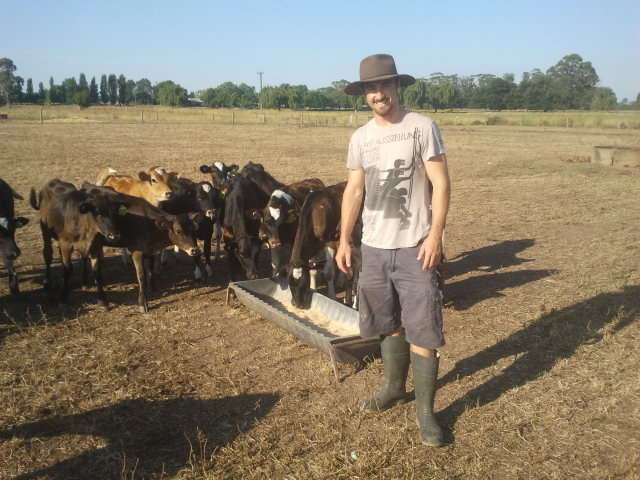
Aspiring dairy farmer, Andrew Dallimore

Aspiring dairy farmer, Andrew Dallimore

I admit, that when Marian asked me if I would like to write a post for her blog that I was flattered, albeit worried. If you’ve read any of the content on here, you’ll realise that she is a bit of a bright spark (not that she’ll admit it). So hopefully I don’t kill too many of your brain cells (with my drivel) that you have spent so much time refining.

As a vet student at the University of Melbourne I have had the privilege to visit many different agricultural enterprises. Yet, dairy farmers and their families standout as some of the most inspiring people in Australia. It’s not their dashing flannelette shirts, crap splattered wellies, or even their everlasting pursuit to race the sun up every morning (and beat it!), but something else extraordinary.

Over the past 3 months I have been on a pilgrimage of sorts. I’ve been hunting down dairy farmers to hear about their pathway to farming. I feel inextricably drawn to dairy, and I’ve found these people are to be tough, dedicated, and generous beyond measure. Without knowing me from a bar of soap, dairy farmers have welcomed me into their homes, sat down and had targeted chinwags with me, and treated me as an equal while their kids watched telly, ate their tea, or just run amok.

Any question I had, as basic as it was, they answered and discussed enthusiastically. Eagerly, I listened to the trials and triumphs they went through to be successful while working, raising a family, settling into a completely different lifestyle, or turning a rundown farm into a thriving business and family home. From inherited farms, to sea-changers, and sharefarmers, they all shared similar traits. The stories were incredible.

For example, on a farm I visited up in northern Victoria I was completely blown away. A family of four milking about 300 cows on an inherited farm, with grins bigger than you can measure were some of the most astounding farmers I had met. It wasn’t the adults (who were the typical intelligent, driven, and happy dairy farmers), but the kids!

At the ripe old age of 14 their son had well over $10K in his bank from selling cow poo by the roadside, a part-time employee who helped him bag up the stuff (one of the kids from school, who unfortunately got the sack after his 3rd warning for not filling up the sacks properly), and a brilliant work ethic. His younger sister, at age 11, was being given orphaned merino lambs to her by farmers (otherwise the poor little buggers usually die in the paddock), was rearing them at home, and then selling them back to the farmers for a good profit.

These kids had impeccable manners, were bright, charismatic, and treated people as respectful equals.

Hearing and reading about people’s pathways to dairy farming has made me realise something incredible. Dairy farming isn’t just a way of life; it is life itself. It is survival by learning, adapting, producing, recycling, cooperating, and teaching on a day-to-day basis.

It is working with spectacular animals to feed the world sustainably, and support Australia. It is about raising a strong, healthy, intelligent, and generous family with humane ethics and values. There are few causes in our country that are greater than these.

Marian asked me what inspired to me start pursuing a life in dairy, and the answer is simple: Dairy farmers.

Marian also asked me what my dream is, and this answer more complex: I want to own and run my own rural veterinary practice; help run a dairy farm; heavily invest in the community I live with; and raise a strong, healthy, intelligent, and generous family on the land.

How I will get there on the other hand, is another question altogether… Hopefully with a large smile, a strong work ethic, good mentors, a little time, and plenty of elbow grease!

It’s late

The story of Cliffy Young has just finished on the tele but Wayne is still slogging through his own ultra-marathon at the dairy. It’s 10pm and it’s been a tough day that started at 5am.

As I was rattling the kids around the house in readiness for Nippers this morning, Wayne was having some youngster trouble of his own. A freshly-calved heifer simply sat down on the milking platform behind her neighbour. Now, if you’ve worked in or watched a herringbone dairy in action, you’ll say that doesn’t happen.

dairydisaster

It did.

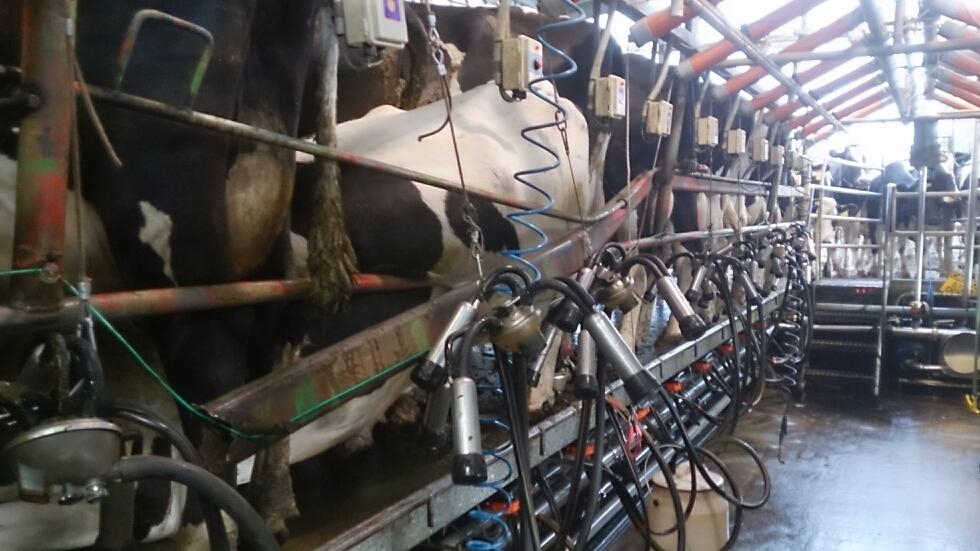
The cows are lined up at right angles to the pit we stand in to position the cups, with their buttocks against a “bum rail” that’s designed to guide them into position for milking and prevent a cow from falling onto a milk maid.

It didn’t.

A cow spooked by her reclining sister leapt up and backwards, falling rear-first into the pit, brushing Wayne’s cheek with her hoof on the way down as a weld in the bum rail gave way under the strain of this 550kg crowd-surfer. Thankfully, Wayne and the two cows-a-leaping are fine but the machinery was not. With four machines out and the broken bum-rail, milking took hours longer than normal and the clean-up and repair job was a 6-hour undertaking.

I’m really grateful to Clarkie, who broke his long weekend to come and help wield a welding stick, feed the cows and round up at 6pm.

Wayne will up again at 5am tomorrow. It’s 10.30pm now and, finally, the dairy lights have gone out. What will tomorrow bring, I wonder?

Protecting farmers from ourselves

Apparently farmers cannot be trusted with anything. Not even to want the highest farm gate milk price for ourselves.

Bega has just sold its stake in Warrnambool Cheese & Butter to Saputo, putting the Canadian billionaire on the brink of controlling WCB even though a higher price was on offer from Aussie farmer co-op, MG.

This happened because our co-op hasn’t been allowed to bid during the bidding period.

Australian farmers who want to invest in their own futures and who are willing to pay the highest price for WCB have been stymied by a government artifice in the name of protecting…you guessed it…farmers from themselves. Apparently, another processor that thrives on a low farmgate milk price is better for us farmers than having an efficient farmer-owned co-op.

This Aussie dairy farmer will never forgive Joe Hockey for sitting by and watching.

So, where to now? That, my fellow source of low-cost milk, is up to us, for although Saputo can buy WCB’s stainless steel, it cannot buy our future. Only Australia’s dairy farmers decide where our milk flows and our fortunes lie.

Thank you

Happy New Year from all of us at the farm

Happy New Year from all of us at the farm

Thank you. When I began writing Milk Maid Marian in a fury two years ago, I had no idea whether anyone would be interested. It’s turned out to be incredibly fulfilling, thanks to the often unexpectedly feisty discussions sparked by stories from the farm.

I can’t tell you how encouraging your comments are as I thump away at the keyboard.

Please, tell me what you’d like to see more of in 2014 and what bugs you about the blog. Best wishes to all (even the relentless people who want me to advertise ugg boots) for the New Year.

Australian dairy: does it matter if it’s sold to China?

Worth saving?

Worth saving?

Does Australian milk matter? We have to decide.

It seems two of Australia’s milk processors, United Dairy Power and Warrnambool Cheese and Butter, are about to be sold to China. Firms backed by the Chinese government are having unofficial talks that would put the price of WCB at a staggering $10 per share.  Meanwhile, the ruthless but charming Canadians continue to acquire a bigger stake of WCB.

Here, close to home, another Chinese firm has already purchased a formerly decommissioned factory and is repackaging milk powder to send back to China. (It’s been a debacle, with outraged and distraught workers regularly featured in the local papers desperate to be paid.)

It’s not limited to the dairy processing sector, either. The Chinese have been buying up our breeding stock for years and now, they want our farms, as Brett Cole reports in the Business Spectator:

“For more than a year, China Investment Corporation has contemplated acquiring Van Diemen’s Land Co, which owns and operates 25 dairy farms with 30,000 dairy stock. Other Chinese companies have moved decisively amid concerns about their nation’s safety standards.”

All this while our Australian farmer co-op, currently the highest bidder for WCB, languishes in the competition tribunal as it ponders – for months – whether we are allowed to bid at all.

Do you care? If you’re a dairy farmer, hell yes, you should. No foreign company cares about your future like you do or your co-op does. Perhaps worse still, once these assets are sold, the fragmentation and inefficiency of our processing sector is locked in, forever limiting the price farmers are paid for our milk.

If you’re not a farmer but an Aussie, there’s an awful lot to be lost. These international companies and governments so keen to pay more than twice the value of WCB are not irrational. They want control of their food. Does that matter to you?

The heart of the co-op

Devondale

I have to share what I’d anticipated would be a fairly dry discussion, and was instead a conversation that I am unlikely ever to forget.

Ahead of today’s AGM where our co-op’s board is expected to announce it is considering a partial share market listing, I phoned Professor Tim Mazzarol to discuss the implications of different ownership structures for co-operatives. Around 18 months ago, the professor wrote a story for The Conversation about Fonterra’s restructuring, which may well become a model for our own Murray Goulburn Co-op and I wanted to learn more.

Tim’s title is but he and his team have done some remarkable research on the nature of co-operatives. What it reveals is that co-operative members wear four “hats”:

  1. Patron
    As patron, we are concerned mostly with the transactions we have with the co-op. In my case, that’s sending milk, buying goods at the trading store and so on.
  2. Investor
    As investor, I look at the financial returns offered by the co-op. Once the emphasis is placed heavily on this aspect, Prof Mazzarol notes, there’s often pressure to demutualise.
  3. Ownership
    Quite unlike the traditional investor (or shareholder of a listed company), I have a sense of ownership over the direction of the co-op and a much higher involvement with it.
  4. Effective community
    The co-op provides a feeling of belonging to a broader community.

In other words, a farmer co-operative is much, much more than just a farmer-owned company.

“Co-operatives need to keep reminding themselves of their original purpose,” says Professor Mazzarol. “When managers don’t share the vision, they can shift from a proper co-op to a farmer owned business. If you own the business and have substantial capital in it, you are interested in control.”

Professor Mazzarol believes the Fonterra TAF model, which allows farmers to trade their shares, weakens the role of the co-operative.

“If you separate investment from ownership, you raise the spectre of decisions being made by a board dominated by people with no interest in the members.”

In practical terms, he says, that could mean refusing to collect milk from less profitable suppliers, for example.

What co-operatives offer Australian farmers

“The average Australian farmer has increased productivity by 50% or more in the past decade but captured very little of that,” Professor Mazzarol says.

“The value of that investment is siphoned off by choke points in the supply chain, where there is a concentration of market power. The only way producers can deal with that is to circumvent those choke points by value adding and selling direct or belong to a co-operative with increased bargaining power that will return the value to farmers.”

“MG is acting like a pace-maker co-op, ‘keeping the bastards honest’, and if it disappeared from the market tomorrow, prices would start to fall. ‘Suppliers are treated with respect’ is very different from ‘we exist to maximise returns for our members’.”

The co-operative as community canary

The steady disappearance of co-operatives, Professor Mazzarol says, signals a change in Australian society.

“Co-operatives are a bellwether of social capital,” he says. “A co-operative needs three things: trust, reciprocity and a network. If these break down, so do co-ops.”

A gloomy observation, indeed. Let’s hope that when push comes to shove, trust, reciprocity and community are still alive and well among Australia’s farmers.

Life in the farm lane

Image courtesy of Dynamite Imagery / FreeDigitalPhotos.net

Image courtesy of Dynamite Imagery / FreeDigitalPhotos.net

Something has shifted in me. Standing on the footpath on a balmy Melbourne evening only last month, I was afraid.

Just a couple of metres and a shallow gutter was all that separated our tender little family from a roaring battery of motorbikes, cars, buses and even semis bouncing along the bitumen at 80km/hr. I gripped Alex’s still baby-soft hand protectively and found that despite his fascination with the unfamiliar lights, sounds and smells, I could take it no longer.

It wasn’t always like this. I lived in the city for a decade or so, growing my career and establishing a flourishing micro business that fed my curiousity. True, it always felt as though I were on a camping trip rather than at home but I had my bearings.

Perhaps it was the fear that comes with being a mother that propelled me to usher the little people back to our hotel room. Perhaps it was simply that I am now acclimatised to life in a different lane: the farm lane.

The background sounds tonight are the chorusing of frogs and the intermittent bellowing of bolshie bulls. The scent that wafts through my office window is pure freshly cut grass. Gentle, calming, natural.

But don’t be fooled. Nature sets the pace here, where a sense of urgency courses through the day. She demands the farmer rises before dawn to gather the cows, who must also be fed and protected from her vagaries, only to congregate once again at sunset. And if something goes awry, whether mechanical, physical or personal, Mother Nature is unforgiving.

We, too, know deadlines, budgets, the rat race and all the anxieties they bring. Like most parents, we worry that our children are somehow missing out, and, like most children thrust into the realities of adult responsibilities, we despair that so much is passing us by.

Don’t imagine we are so different: what binds us is so much stronger than that which divides us.

Rush hour in the farm lane

Rush hour in the farm lane