This cow cannot take a trick

The last cow into the dairy on Friday morning had Wayne stumped. It had been an uneventful milking, she’d gobbled up her ration of grain for breakfast but, when Wayne turned to spray the teats, there she was calmly sitting underneath her neighbour. No matter what we tried, there she stayed, refusing to budge. This little cow is only five years old, six months in calf and in great health. We didn’t want to lose her.

SheShallNotBeMovedFriday

Sarah the vet was duly called but could find nothing wrong. We figured she’d just slipped and was gathering her nerves before trying to get back up. She didn’t. She wouldn’t, even to follow a tempting trail of wheat.

Mmm, you smell nice

Mmm, you smell nice

When the time for afternoon milking came around, Wayne had to slither her along the platform and then lift her over a fence with the hip clamps. We sat her in the shade with grass, silage and water. She ate well, looked bright and feisty but her legs just wouldn’t work. It was an enormous relief to see her up and about at daybreak on Sunday morning, pushing against the gate to get back with her herd mates.

She still looked a bit tottery yesterday afternoon, so we let her have the afternoon off but felt really confident she was going to be alright.

So when I had to move the cows unexpectedly at lunchtime and saw her being pushed backwards down a slope towards the gully by a big bully cow, my heart leapt into my mouth. With the bully heaving low under her belly, the poor little cow toppled sideways – seemingly in slow motion – into this ignominious position.

UpsideDown

Now, this crazy-looking pose called “dorsal recumbency” is deadly for a cow. I had minutes to get her upright. For emergencies like this, I carry a heavy drag chain in the Bobcat and had her sitting upright again in less than five minutes. It’s a delicate job that has to be done with a lot of grunt and that’s always a risky combination.

Thank goodness, it worked. After some gentle coaxing from me and enthusiastic yapping from Patch, she struggled to her feet and joined the herd. Fingers crossed, little cow.

Is Woolies the dairy farmer’s white knight?

Woolworths has announced it plans to contract dairy farmers directly, with the promise of better farm gate returns. While a first for Australian dairy, this is not new in the UK where many of our supermarket executives earned their stripes. On a study tour of the UK, prominent Victorian dairy farmer Roma Britnell spoke to many English farmers about their experiences, so I was delighted when she agreed to answer a few questions for Milk Maid Marian.

Roma Britnell

Roma Britnell


MMM: What are the supermarkets proposing?
Roma: The supermarkets are thinking about setting up direct supply contracts with a select group of farmers in response to the public’s concerns that they are hurting farmers.

I saw a really good example of this in England after coops failed and processing companies became dominant. The supply contract I looked at was with Waitrose, a boutique up-market supermarket. Only a small number of farmers had the opportunity and got a few cents more than the rest of the English dairy farmers. They have to have a very flat supply and the quality standards are very demanding.

When I first explored this concept, the farmers were not too unhappy. Now, the supermarket’s demands are getting too difficult to accommodate. A lot depends on the relationship between the negotiators of the group and the company manager but because the group is small, the farmers are at a disadvantage.

MMM: Is this common overseas?
Roma: I didn’t see this anywhere other than in the UK. What I did see and look for were ways the farmer could maintain influence up the supply chain. I found the answer was simply to own as much of the supply chain as possible so long as this was managed efficiently and monitored carefully.

This is what has traditionally gone wrong, and the “co-op” model is wrongly blamed as the reason instead of the inefficiency and lack of the owners (farmers) making sure the business performed.

Co operation comes in many forms and I looked at companies like Glambia that are part co-op and part company.

I found many good businesses that were going well operating as a co-op, including Arla. Neither co ops or companies are immune from failure. The management rather than the structure is key. On the other hand, the farmers that sit on co op boards need to be highly skilled business operators at an international level.

MMM: What do you expect will be the opportunities and threats for dairy farmers who contract directly with the supermarkets?
Roma: The farmers who have a direct supply contract will earn more than the rest of Australia’s dairy farmers. Eventually, however, the increased costs are likely to match the added reward.

Consumers will buy the milk believing they are doing the “right thing” by dairy farmers but the reality is that direct supermarket contracts are rarely truly in the farmer’s favour. As with all things, the ones in early will initially get some benefits short-term but long-term it’s unlikely to be the case.

Such a small group of farmers has little chance of negotiating on an equal footing – brute strength is needed to deal with giants the size of Australia’s supermarkets.

MMM: What are the opportunities and threats for Australian dairy farming as a whole?
Roma: This opportunity for a favoured few poses enormous threats to Australian dairy. If the English experience is repeated here, the often unrealistic demands supermarkets impose on their contracted farmers will become the norm over time. They will say its customer driven. Its supermarket driven; to get the edge on their competitor and in turn the long-term costs to the industry are too large to keep the industry viable. Do we need more of this?

There are many other threats that take a long-term view of the situation to consider.
However the principle remains that dairy farmers are individual businesses who seem to struggle to work as a team. If we did, we would have the clout to position ourselves ready for the oncoming food boom. It has been a long time since the demand for food was greater than the supply. Dairy industries around the world are positioning themselves in readiness for this. Us …well I don’t think we are going to be in a position ready to pounce. Sad really to miss opportunity but a good strong group of focused farmers would be the way to achieve success.

My last comment to demonstrate my findings is cemented from my experience just this week whilst in New Zealand. The country has a minimal domestic market with a strong, well organised cooperative that exports a large amount of milk. So very like Australia in that respect. Yet they have the highest domestic milk price of any country in the world. Go figure!

I’m a rich farmer

Back before the beginning of time, when Wayne told an acquaintance he was soon to marry a dairy farmer’s daughter, her response was, “Ker-ching! You’ve found the pot at the end of the rainbow there!”

She was a city-slicker who thought simply being farmers qualified our family as wealthy. There’s some truth in that, according to the Australian Bureau of Statistics (ABS). In its feature on Australian farms and farmers, the ABS points out that:

“…the average weekly disposable income of farmers in 2009-10 ($568) was considerably lower than that of people working in other occupations ($921)…”

“While the reported income of farmers might have been relatively low, it is important to recognise that income is only one aspect of economic wellbeing. Wealth, in the form of bank accounts, shares, superannuation or property, is another important component, and can be drawn upon to smooth and support consumption over time, including during periods of low income. Indeed, wealth is particularly crucial for farming families given that farming income is often at the mercy of climatic conditions. The average equivalised net worth (taking into account both assets and liabilities) of farming households in 2009-10 was $1.3 million, much higher than the average across other households ($393,000). However, such high levels of wealth are not enjoyed by all farming households. In fact, 10% of farming households could be classified as having relatively low levels of wealth (i.e. in the lowest 40% of the wealth distribution). However, the bulk of farming households (71%) were in the top 20% of the wealth distribution. The high levels of wealth explain why, despite relatively low income, only a fraction (5%) of farming households are classified as having low economic resources, compared with a fifth (21%) of other households.”

One day, if my children decide not to become farmers and sell the place, all that wealth will come in handy! And while my postcode may not be prestigious, my home boasts a rather large backyard, unparalleled privacy and stunning views. But I have something even more priceless: a vocation, as the ABS explains.

“Farming as a vocation tends to be characterised by a high degree of self-employment and long working hours. In 2011, half (50%) of farmers worked 49 hours or more a week. Only 17% of other workers put in such long hours. More than half (56%) of Australia’s farmers were self-employed owner managers (compared with 15% of other workers), with a further 17% working as employees managing farms owned by someone else.”

“Although people who are self-employed generally work longer hours than others, this only goes part of the way to explaining the working hours of farmers. Even when comparing just among the self-employed, farmers were still much more likely to work long hours, with 56% farmers working 49 hours or more a week, compared with 30% of self-employed people in other occupations. This may in part reflect the nature of farm work which can necessitate tending to crops and animals at various times of the day and night.”

I think the last sentence is a little twee, don’t you? All sorts of people must attend to their work around the clock – firefighters, police, nurses, chefs, to name a few – but they share the workload with colleagues. The unvarnished truth is that because farm incomes are so low, few farmers can afford to employ enough help. That, my friend, is the downside of farming.

Still the upsides are pretty darned glorious and something a statistician could never hope to capture.

Is autumn really here? No, it’s coming, so cows are going

AutumnLeaf

Golden leaves carpet the farmhouse driveway. Yes, it’s autumn at last but I’m not sure whether the ash are superbly tuned into the seasons or simply too water stressed to hold onto their leaves any longer. The crisp autumnal mornings are yet to arrive – it was already 26 degrees Celsius when Alex and I checked the weather outlook just before six this morning – and the farm is again desperately dry.

But a dairy farmer is always planning ahead. Last weekend we sent a handful of cows on their annual two-month maternity leave, with a dozen or so more to join them in a fortnight.

The summer millet crops are getting their final grazing today and tomorrow so we can prepare for sowing new perennial pastures when the “autumn break” finally arrives. We’re testing the soils of each paddock so we can apply just the right levels of nutrients – enough to maintain fertility without risking leaching into the river or water table.

In anticipation of rain (and mud), our cow tracks are also about to get a makeover to help prevent two of the most troublesome afflictions for dairy cows: lameness and mastitis.

Autumn is the time when dairy farmers lay the foundations of a successful season and it’s strangely exciting. I wonder what will mark this year?

Modern farming and nostalgia

Although I was just a tween during the 82/83 drought, I remember it vividly. That was the year the school bus was overwhelmed by a dust storm and the year my parents cancelled the newspaper deliveries just so they could be sure they’d saved every dollar they could.

It was also the first year we fed our cows grain and, gosh, it taught us a lot. Cleaning up, I stumbled across some notes written by my father’s farm consultant (and even a farm consultant was a new concept) that December:

“Feed grain, increasing slowly to 4kg, watching carefully for signs of grain poisoning.”

Grain poisoning is not funny but that little sentence make me laugh out loud. These days, cows start the season on 4kg, which is seen as pretty much a minimum supplement level, even in the flush of spring. No risk of grain poisoning there.

We manage dry spells so much better now than we did then and the cows, the farmers and even the environment are the winners. No longer are paddocks stripped bare, exposing the topsoil and all the life in it to the cruelties of the Australian summer. We graze just enough to keep the grass from becoming stalky.

This modern way of farming also means the pastures are quicker to respond to the rains when they do come. Just look at it.

Just add water...

Just add water…

Modern farming attracts plenty of critics but I think that, in many ways, the way we farm now would make our early environmentalists very proud indeed.

Love at the circus

Two miniature horses, two sleek chocolate goats, two barrel-shaped red cows and two donkeys were the stars of the circus yesterday. The team of eight struck impossibly cute and clever poses in an incredibly endearing performance.

It all felt very familiar. Circus acts have barely changed since I was six years old, except (and it’s a BIG except) that the animals are far less exotic than the stunning Siberian tigers I remember. The resourceful circus folk have adapted artfully to changing community expectations, shifting the role of performance animals from that of mesmerising danger to beguiling charm.

Of course, some animal activists believe there is no place for animals in a circus at all. I don’t really understand why not. The faces of the two trainers were as much a delight as those of the animals. They coaxed, were proud of their little charges and, when something went wrong, swapped understanding tiny smiles rather than tight-lipped grimaces. In other words, they loved.

Those four-legged circus performers are clearly among the globe’s most treasured creatures – hardly exploited and overworked.

“Exploitation” is a charge often directed at the human carers of working animals, including farmers. But is it a bad thing? Yes, we do exploit the cow’s amazing ability to nourish us, just as the heightened senses of search and rescue dogs are exploited to rescue victims. Working together, humans and animals can achieve so much more than alone. The fundamental question is this: what do the animals rightfully deserve in return for their help?

GPS on the farm

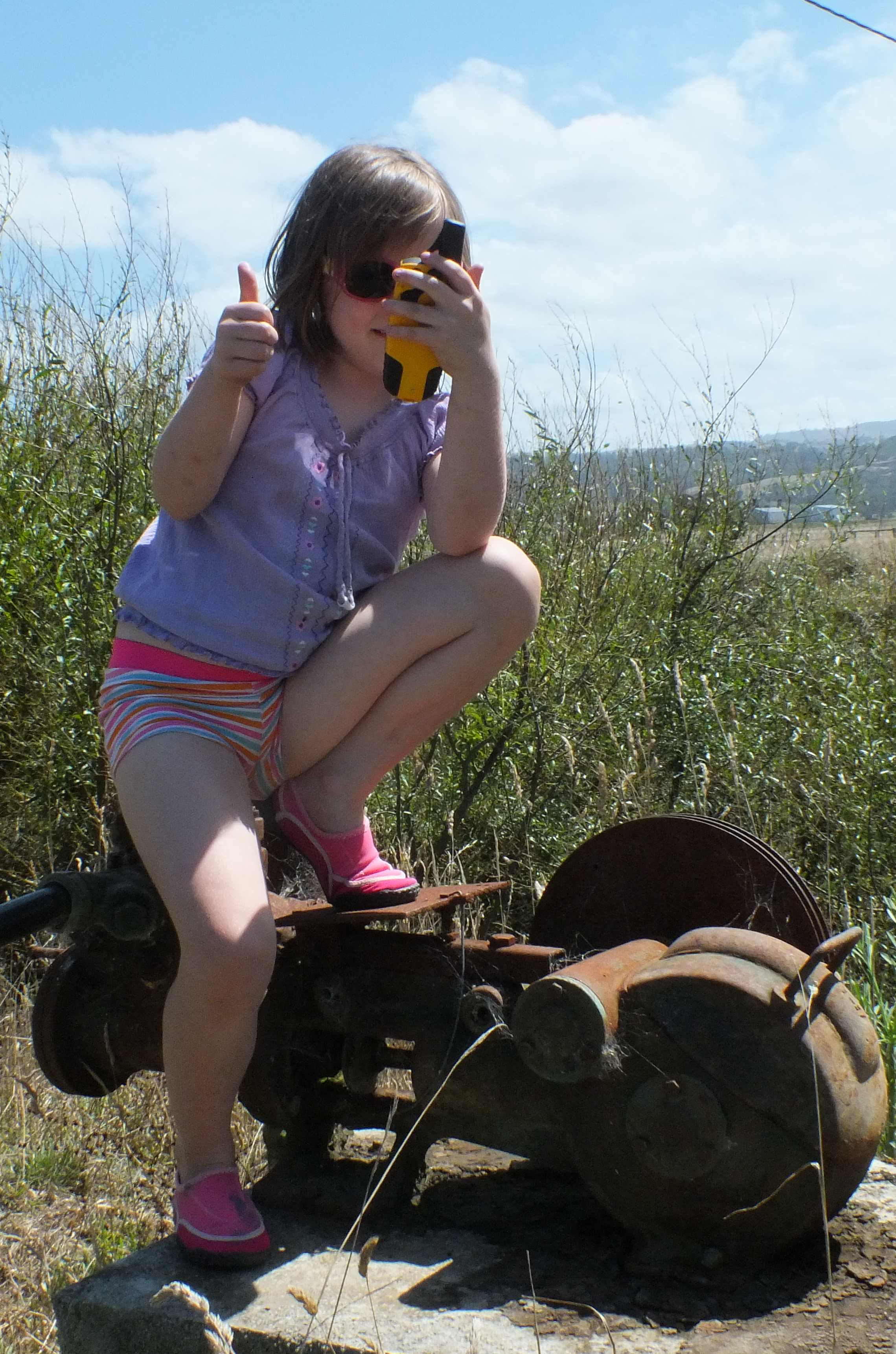
A GPS comes in handy on the farm. We use it to plot farm infrastructure and maps, while contractors use them to fertilise and sow our pastures. Today, it did another very important job: science teacher for Zoe.

"We've got four, no, FIVE satellites!"

“We’ve got four, no FIVE satellites!”

With 250 cows drinking up to 200 litres of water each on a hot day, we need a pump we can rely on, so when the pressure began to fall, we were quick to investigate. Bugger. Faithful old Davey is getting pretty tired. An inch has been worn off his venturi and the jets need replacing. It’s a major overhaul, so we’ve decided to buy a second pump to keep Davey Senior company in semi-retirement.

To make sure Davey Junior is right for the job, it’s important to check how high he needs to suck water out of the river and then how high he needs to push it around the farm, which is where the GPS and its six-year-old pilot came in.

The GPS is magical to my little girl, and why not? It’s covered in buttons and talks to satellites whizzing through space at thousands of kilometres an hour. She was practically an astronaut today!

Suck it up, princess and a farmer’s election year wishlist

There’s been a bit of biffo on Twitter and on dairy farming forums of late. Some people are clearly very angry with our leaders. Others are polite but rather bluntly say “suck it up, princess”.

I’m in between.

I want to be among the top 10 per cent of Australia’s dairy farmers. Not because I am a nutty type A personality but because only the top 10 per cent make a good living. So, tonight I’m up late wrangling spreadsheets, casting a sharp eye over our budgets and trying to benchmark our performance.

That doesn’t stop me from wanting better from our politicians so that Victorian dairy farmers get a fair go. We’re not subsidised like our US or European competitors and we don’t have a free trade agreement with China like the world’s best dairy farmers across the Tasman, so we need to be lean, efficient and smart to survive.

To do that, we need:

  • relief from the carbon tax that puts us at an instant disadvantage
  • a more level playing field. Forget subsidising cars and get on with the China FTA.
  • to deal with the duopoly
  • most of all, to invest in ag R&D.

Being smart has historically been our strength, but no longer. Sue Neales of The Australian reports that:

“Australia’s spending on agricultural R&D has also dropped internationally from 9th to 16th place, according to a global study presented at the same conference.”

“Treasury last year predicted the value of agriculture to the nation could grow from its current size equivalent to 2.5 per cent of national gross domestic product, to 5 per cent by 2050, surpassing the manufacturing sector.”

If we are destined to become agricultural dunces, dairy farmers battling to survive on a tilted playing field will never manage the growth needed to make Australia Asia’s food bowl.

NFF Blueprint written with a thumbnail dipped in tar

The NFF Blueprint is finally here and it’s a great document. I’ve only dedicated half an hour of speed reading to the report but, really, the report is so well laid out, you don’t need much more time than that to get the gist of it.

There are just seven themes: Innovation, Research, Development and Extension; Competitiveness; Trade and Market Access; People; Agriculture in Society; Natural Resources and Transformational Issues.

It’s big picture stuff and so high-level that it could be accused of having about the same level of meaning as most corporate mission statements. For example, there are three goals set for Agriculture and Society:

“Build better community understanding of and trust in agriculture”

“Improve credibility, cooperation and goodwill, including with activist groups”

“Develop coordinated and proactive approaches to communication”

All three are rated as high priority. The matching strategies are equally as broad and after reading the report, I have little idea of who, what or how these will be achieved.

I don’t think that’s a bad thing. As the NFF says:

“The launch of the final Blueprint report is not be (sic) the end of the road for the Blueprint. The Blueprint document will provide a starting point for the discussion of the key issues and for collaborative action on those issues that are shared across the sector.”

“The NFF will work with key stakeholders across the Australian agriculture sector and government to host a series of forums scheduled for 2013 onwards, designed to drive the Blueprint forward. These forums will develop specific strategies, assign responsibilities, provide resources and set timelines for the next stage of the Blueprint – the legacy phase.”

As it stands, the Blueprint is just a rough map written with a thumbnail dipped in tar. The legacy phase will be telling: can the NFF harness enough energy to make sure that once the rubber hits the road, we gain traction and will it be able to steer the course? It’s in everyone’s interests to make sure it does.

I’m not a member of the NFF but this report signals that Australian agriculture may be developing just the leadership farmers so desperately seek. You’ve won a fan!

The smoking gun: the numbers reveal Coles’ dairy damage

Please, just read this article by dairy analysts, xCheque, on the damage caused by the supermarket war. Some excerpts for you:

“The supermarket’s pricing strategy has squeezed the processors to near death and they have responded in the only way they can – attack their single largest cost of production – the milk price. In turn, the dairy farmers of northeast Australia have turned off the tap.”

“It is undeniable that Central & Northern NSW and Queensland milk production has dropped dramatically in the past two years.

“It is also undeniable that the southern exporting states are seeing no such effect – this is despite seeing a downturn in the global dairy industry over the last year.

“It is also undeniable that we haven’t seen a production drop like this since the period after dairy deregulation more than a decade ago.”

“Stop and think what you are doing Colesworths. You have taken a very blunt axe to the Australian dairy supply chain. In our view you are definitely in denial if you think that you and your shareholders have no responsibility for the long term social health and economic wealth of Australian agriculture.

“Editor’s note: Apart from the confirmation in milk production data, not much is new in this debate. Our subeditor (and all of us) were however particularly incensed at the most recent example of ignorance and insensitivity by Wesfarmer’s boss Richard Goyder. Clearly denial of responsibility goes right to the top of that organisation and there are no remaining traces of empathy with the company origins.”