How much did you get?

“How much did you get?” will be the standard greeting in town for the next week or so.

What a downpour

Bikini weather

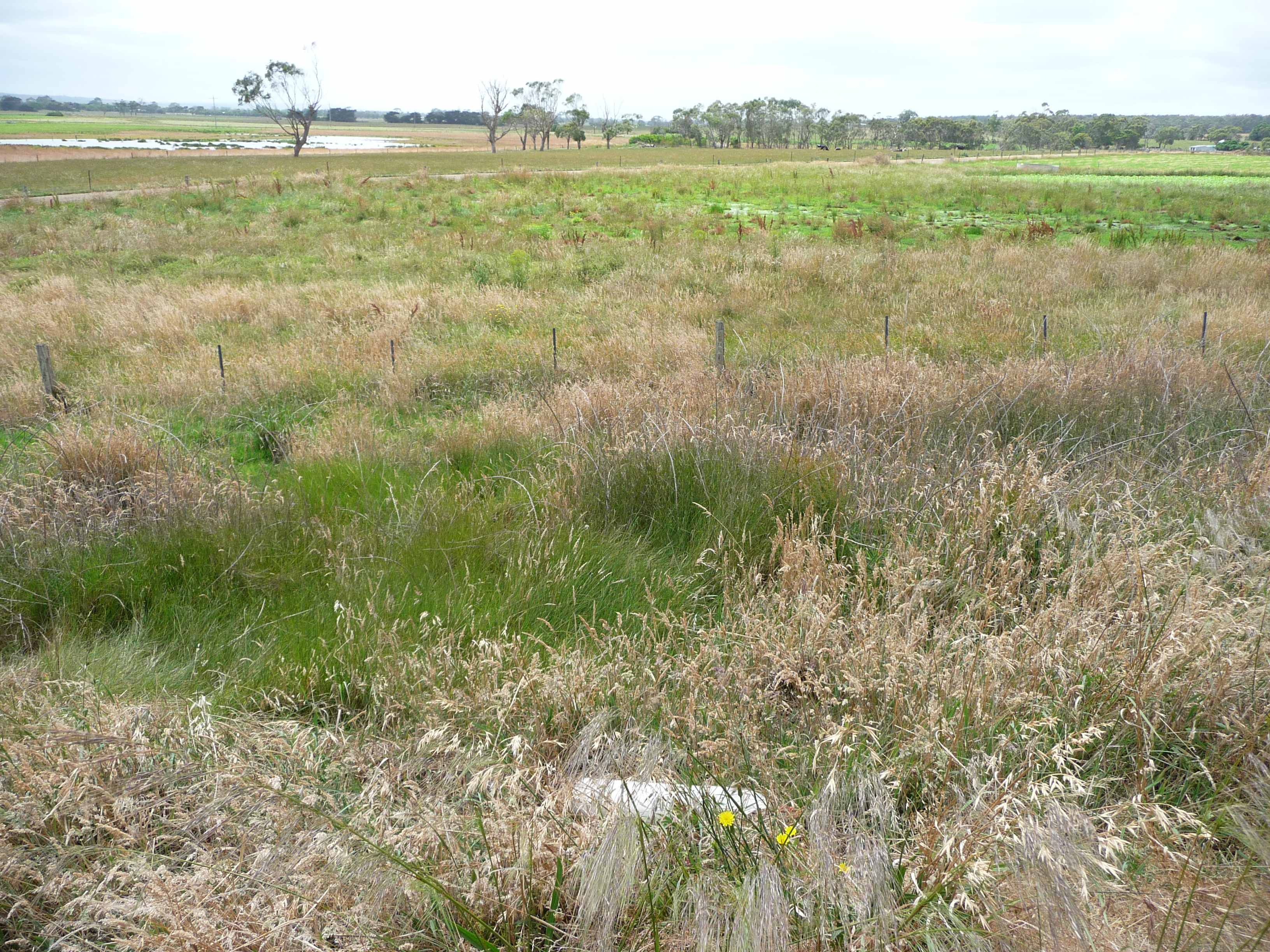
If not for Alex, I would have stripped off and run outside when the thunderstorm hit this afternoon. Until today, we’d been well settled into a very dry weather pattern typical of a traditional scorching summer. The grass was going backwards fast and the amount of milk we’ve been sending has been shrinking every week. My trusty forecasting website, Oz Forecast, had seen it coming for almost a week though and I was ready.

Feeling bold but a little nervous, I’d laid thousands of dollars on the line by having urea (a fertiliser that is 46% nitrogen) spread across a swathe of paddocks last Friday. Nitrogen is amazing stuff, more like water than fertiliser really: its effect lasts only a few weeks so you need continual top-ups but under the right conditions, it makes grass grow like nothing else.

It’s not cheap though and the wrong conditions can see it quite literally evaporate, or “volatilise”. A fact sheet by esteemed University of Melbourne scientist, Richard Eckard sums it up this way:

What is Volatilisation?
This occurs when urea fertiliser is converted to ammonia gas, a process which takes place in the first 48 hours after application. Conditions during that first 48 hours are critical to the amount of nitrogen lost.
How much is lost?
Trials conducted recently at Ellinbank showed losses to volatilisation are highest in February and are commonly around 14% on the nitrogen applied as urea. However, loss between May and November are substantially less, being between 3 and 6% of the nitrogen applied as urea. Other sources of nitrogen do not volatilise under our conditions, although on DAP would justify the price difference if only 14% is lost from urea.
How to minimise volatilisation losses?
1) Low wind speed: In one experiment a 14% loss was reduced to around 4% the next week where there was almost no wind. One strategy, adopted by some farmers, is to apply nitrogen a few days before grazing. This reduces wind speed at ground level almost zero due to the longer grass and any surplus ammonia gas produced is absorbed direct into the leaves of the pasture.
2) Lime application: In a similar experiment a loss of 12.5 % of nitrogen from urea was increased to 22.5 % by applying urea where 2.5 t/ha of lime had recently been applied. A simple solution where both urea and lime are required would be to apply the urea first, then apply the lime a week later.
3) Rainfall: In another experiment at Ellinbank rainfall was simulated in February by irrigating after applying urea. Urea volatilisation losses were only 4 % where 23 mm ‘rain’ was applied within 24 hours of the application of urea. Likewise with 9mm ‘rain’ losses were 7 % and with 3mm ‘rain’ losses were 14 %. However, applying urea the day after 23mm ‘rain’ resulted in a 21% loss!

Those nerves when I ordered the urea were justified. I would have lost a lot of nitrogen in those first 48 hours but I’d paid an extra $15 per tonne of “insurance” in the form of Green Urea. According to its manufacturer, Green Urea is “treated with the urease inhibitor, N-(n-butyl) thiophosphoric triamide (NBPT), to delay hydrolysis of urea into nitrogen forms that may be lost to the atmosphere”. In other words, we had seven days to get the weather right rather than 48 hours.

If the forecasters continue to excel and deliver the promised mild conditions over the next week, the grass will rocket away, pleasing the cows, the farmer and her banker no end!

Don’t you get bored so far from the city?

Life three hours from the CBD is not for everyone. You can’t just nip down to the city to get a funky new outfit, watch an art house film or see the latest Melbourne Theatre Company production. Yep, I like that stuff.

But, having spent the last day and a half in the city, it’s great to be home listening to a chorus of crickets. Open skies, quiet and a fresh sea breeze keep me sane, even when life on farm is at its most manic.

Manic? Oh yes. There is always something to do and, often, far too many things. Still, it’s never a rat race.

The perfect poo – a noble quest

Just like the mother of a newborn babe, dairy farmers spend a lot of time examining the poo of their charges.

The perfect patty?

Perfection in poo is a noble quest

It’s not easy to live on grass. The stuff is very hard to digest and that’s why cows have developed an amazing digestive system that this really nice little video explains beautifully in a little over a minute. As you’ll see, the rumen and its helpful bugs play a vital role.

Manure is the dairy farmer’s window into the rumens of the cows. If their diet gets out of balance, they can get “acidosis”, which means the bugs die off and the cows find it very hard to digest their food. Not surprisingly, this is bad news! If it gets bad enough, the cows get extremely sick but it can also be subclinical, only affecting milk production. One of the first signs is the wrong type of poo.

According to Dairy Australia’s informative Feed Fibre Future Quick Checks Fact Sheet D (c’mon DA, couldn’t you have come up with a more friendly name?):

“Manure has a porridge-like consistency. Forms a soft pile 40–50 mm high, which may have several concentric rings and a small depression in the middle. Makes a plopping sound when it hits concrete floors and will stick to the toe of your shoe. This is what you are aiming for.”

Because we’ve increased the cows’ grain ration with the onset of spring, we’ve matched that with extra fibre in the form of silage to prevent acidosis and I’ve been Chief Manure Monitor to check we’ve got it right.

I thought that when our farm consultant, Matt, arrived earlier this week he’d be proud of me. Well, he was but said that, if he was to be really picky, perhaps the poo was slightly too firm. As a consequence, we’ve upped the grain a little and backed off the silage by one roll.

Oh, the road to perfection has no end!

Crunch time

The pastures are still green but they’re barely growing and, now, we must make hard decisions about what to feed and to whom.

Already, we’re feeding seven rolls of silage (each weighing about 800 kg) and a very hearty meal of grain to the milkers and if I want to keep the cows milking really well, I’ll need to step that up even more in the next few weeks. Any cow who is not producing at least 10 litres of milk per day is not paying her way. If she’s in calf, we will let her take a holiday. If not, we must sell her. Fortunately, the vast majority of cows are in calf, so we should be able to keep almost every one.

The reality that farm animals are working animals rather than pets is one of the hardest lessons of life but a valuable one, I think. Farm kids learn from an early age that the circle of life is inescapable but it is in a farmer’s power, though, to make every life a good one. What an awesome privilege.

How many kids die on Australian farms each year? Each week?

You can see from my blog that I take our children pretty much everywhere with me on the farm. The thing is, there are places I no longer go, so they can stay safe. I don’t milk, I don’t get into the yard when it’s full of cows and I avoid situations where cattle of any age are moving quickly in confined spaces.

I can make these choices because we can afford to pay other people to help but not every farmer can. And out here, the town’s youngest children have access to just two hours’ formal care per week.

If you don’t have an extended family willing and able to help, you might feel there’s little choice but to leave the kids playing by the gate or sitting in the ute while you do a risky job. This is how farm safety and childcare are so tightly connected. There’s nothing bourgeoise about needing childcare to drench the heifers or build a fence.

The impact of a lack of childcare on a farming community is tricky to gauge but the unfathomable grief that seeps through a community after the death of a child is something that resonates in your bones for many years. According to the stats, one child is killed on an Australian farm every fortnight.

I wouldn’t normally include a whole slab of stats but these, from the Aghealth Australia site, are so telling:

A recent study by the National Farm Injury Data Centre (NFIDC) based at AgHealth of on-farm fatalities for the 2001-2004 period found that:

Children (0-14yrs) make up 15-20% of farm injury deaths, around 2/3 are male. Main agents are:

  • Drowning in dams (mostly under five year olds)
  • Quad bikes or 4 wheeled motorbikes
  • Farm vehicles (cars, utes)
  • Around quarter of all child deaths were visitors to the farm, but for quad bikes around ½ are visitors
  • Drowning accounts for around 35-40% on child farm deaths, with farm dams being by far the most common site.

There has been an improvement in the reduction of toddler drowning on farms in recent years – particularly a reduction of dam drownings, which have halved since the early nineties. However, drowning is still the number one cause of child farm fatality in Australia. A common scenario is that a toddler wanders away from the home un-noticed into farm water bodies or toward other farm hazards (vehicles, mobile machinery). Apart from dams, children can find their way into creeks, troughs, dips and channels. Children under five years are at greatest risk.

For non-fatal injury of children on farms, older children (5 -15 yrs) figure more prominently – particularly in relation to injury from 2 and 4 wheeled motorbikes (and horses). Whilst there tend to be more hospital ED presentations for 2 wheeled motorbikes, injuries from quad bikes are likely to be more severe or fatal, with 4 times as many children being killed off ATV’s than 2 wheel motorbikes on farms (NFIDC 2007).

Sprinkle the cow track with rose petals

If I could, I’d sprinkle the cow track with rose petals! The cows average a 3.6km walk to and from the dairy every day and can easily become quite tender-footed, so the surfaces they walk on are incredibly important. If you can’t walk on it barefoot, you can’t expect your cows to walk on it either.

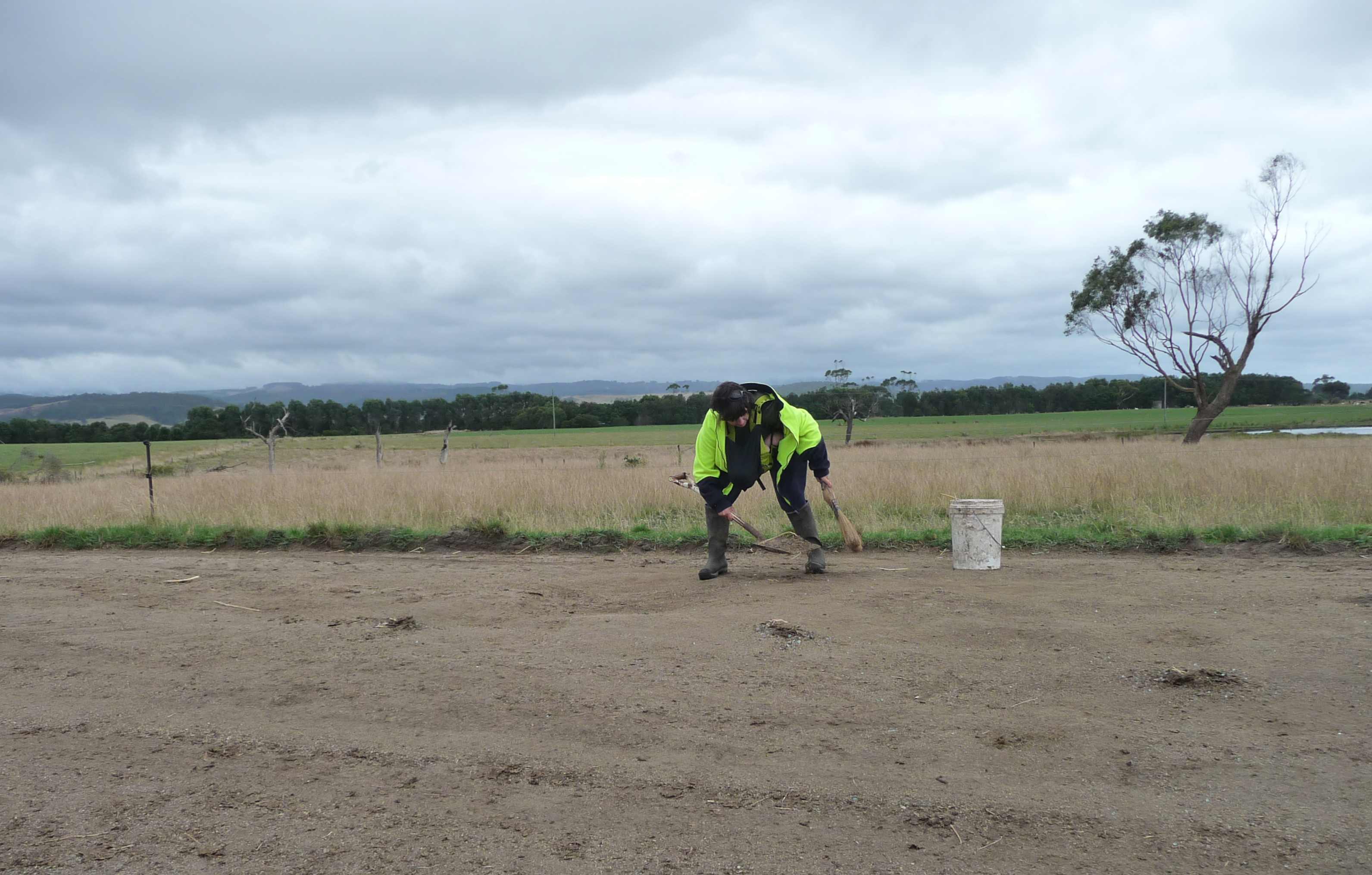
When a tractor window got smashed on the track, the only thing for it was to sweep all the glass up. Nearly broke Old Macdonald’s back!

Sweeping the cow track

Sweeping the track as Alex enjoys a hammock ride

The track is soft gravel for maximum cow comfort while providing a relatively mud-free surface. Last year, when the wet was at its worst and the cows’ feet were extra soft, we had loads of pine mulch spread on the tracks to provide more cushioning. Mulch works really well but unfortunately traps mud and eventually breaks down into a horrible mushy gumboot-gobbling goop.

The dairy yard is concreted for durability. Because smooth concrete can get too slippery for the cows, one of our first farm improvements was to have diamond-shaped grooves cut. The grooves help to drain the concrete and make it more grippy without becoming abrasive.

Grooved yard

What a groovy place to hang out

Take to the tractor if you can’t get baby to sleep

At 8pm, which happens to be “acid hour” for Alex, a truck carrying four pallet loads of calf feed arrived. The calf feed comes in unsealed bulk bags and forecast drizzle would wreck it, so the stuff had to be moved to shelter before long.

I was singing “Pop goes the Weasel” for the millionth time and Wayne had fallen asleep cuddling Zoe.

Wayne had told the feed guy it was okay to deliver late but when push came to shove, he couldn’t be woken despite repeated attempts. On the other hand, Alex couldn’t sleep. The only thing to do was put on the baby carrier and jump in the tractor.

Milk Maid Marian and baby Alex brush up their loader skills

Alex and I brush up our loader skills

But, jeepers, it took me forever and I was like a jack in the box, checking and double-checking I wasn’t skewering a bag in the pitch black driveway. Alex was fast asleep by the time I had the first pallet loaded up though and I might just blow stockfeed Scott a kiss for the unconventional but effective baby soothing lesson.

Night-time feed delivery

All done!

Dining on data is good for the bottom (line)

Farm planning meeting

Farm management meeting


Depending on how you look at it, dairy farmers are very trusting, natural exhibitionists or visionaries. I say this because I have always been amazed by how readily we share the most confidential of our information with our counterparts – right down to the profitability of our farms per litre, hectare and even per cow.

I have just joined the ranks of these exhibitionists by submitting our farm’s data to Frank Tyndall, who oversees a project called Tracker that benchmarks dairy farms across all sorts of productivity measures.

The results offer an incredible amount of information that require some very thoughtful interpretation. Great fodder for discussion with our farm consultant, Matt Harms.

Unsurprisingly, we have achieved a lowly rank. Our dryland (or “rain-fed” if you’re feeling optimistic) farm is being compared to those in the Macallister Irrigation District (MID), where water when you need it is pretty much assured. We have just come out of an impossibly wet year that has depressed production in the growing season and, now, the dry has set in.

We may end up winning the wooden spoon but I’m not concerned. The race here is to a greater discipline when it comes to farm management, which should reap efficiency dividends and make our farm more resilient.

Simple stupidity reigns supreme

The paddock wrapped around the dam has suffered from months of saturation – to the point where about half a hectare has been unusable. It sits in the path of the dam spillway and the record wet of 2011 left the dam overflowing all year.

Spillway mess

The spillway "swamp"

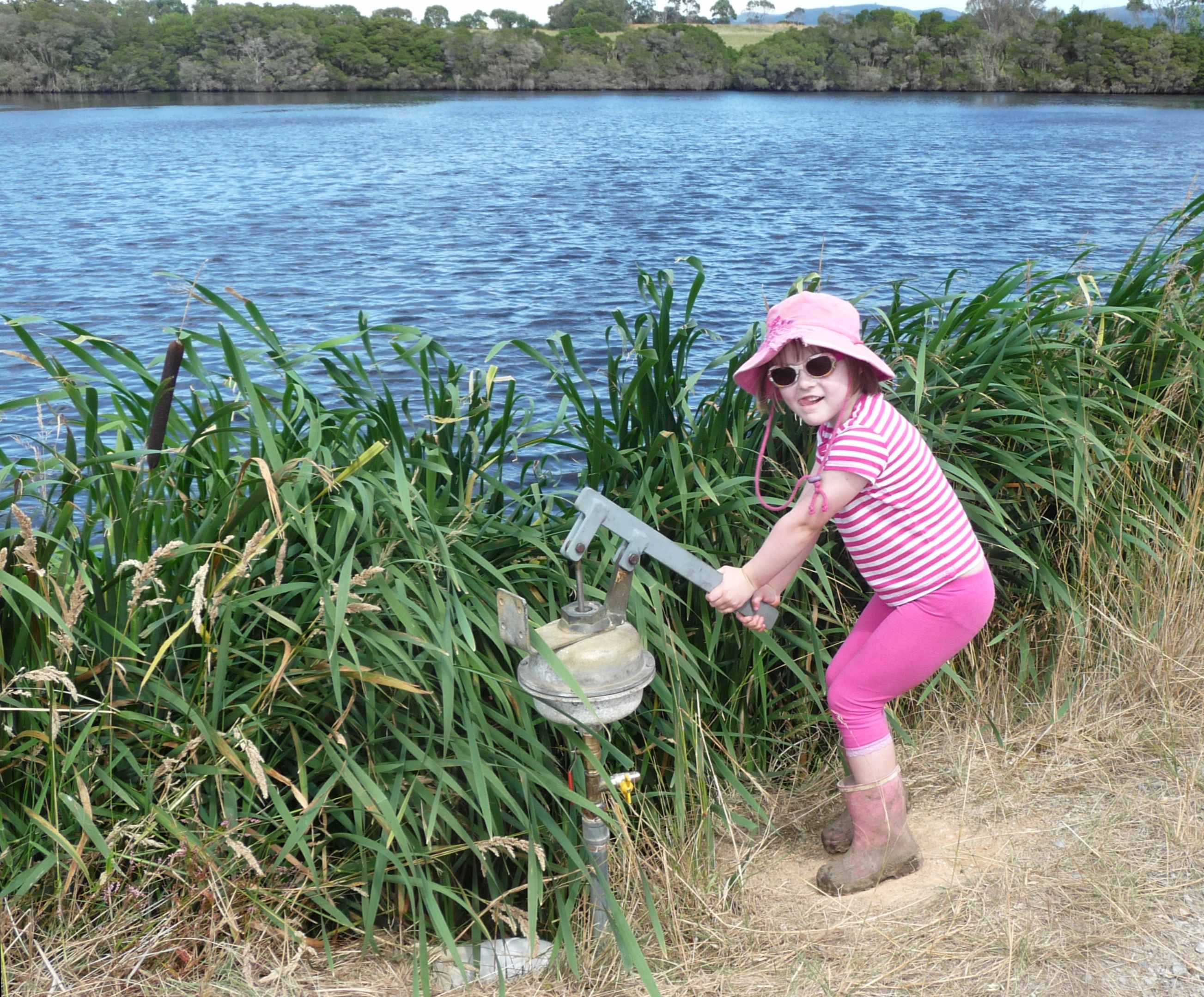
Now, there’s a way to avoid this. A small manual diaphragm pump sits on the dam wall and allows us to siphon water over the edge through the natural waterway that runs through the heart of the farm.

It hasn’t been used for years but I have memories of my thin elderly father getting it going very easily. When Wayne and I had a go last autumn though, the thing just flipped up and down so ridiculously easily we knew it wasn’t sucking properly. A quick investigation revealed a perished rubber diaphragm, which we had replaced. Then the PVC pipe through the dam wall turned out to be broken. Fixed that. Ready, set, still no go. It was so hard to pump that Wayne turned beetroot red with the effort and finally, the cast lever arm snapped in the willing arms of Rob the plumber.

Turns out the diaphragm was upside down and now even Zoe can work it.

Working the siphon is much easier now

Working the siphon is much easier now

Hallelujah!

Flowing siphon

At last, the water flows (where we want it)

And the stupidity? If this whole litany of mini-disasters wasn’t enough, I was soooo excited to get it going today that I forgot I was flooding tonight’s paddock and had to stop it again a mere 45 minutes after doing a victory dance. Ah well. As @Sam_Grains would say, “Keep calm, farm on”.

Nightmarish scenes on farm because dogs loved too much

The only thing worse for a young girl than the sight of a sheep mauled to death is knowing that there will be more laying by the riverside trying to breathe through open wounds in their throats.

The appearance of feral cats around our home and @OwdFred’s haunting description of his traumatised cattle stirred a terrifying memory of childhood autumn mornings at my grandparents’ sheep farm. For weeks, my father lay awake with his gun in darkened paddocks and for weeks, he returned with that gun and me in the crisp light of dawn to find and relieve the dead and dying of their suffering.

I must have been about 10 at the time and it was my job to stand in the back of the ute to spot striken sheep as he drove slowly back and forth along the riverbank. Some sheep simply drowned in their attempt to flee from the predators, others crashed through fences and, inevitably, the young and old suffered the most.

When a neighbour had 100 sheep penned and lost 30 overnight, the story hit the news with appeals for all dog owners to contain their pets at night but still the carnage continued.

Then, one night during Dad’s vigil, a pack of dogs appeared and began its ugly sport. Dad fired as many shots as he could, clipping one dog’s ear. It turned out these dogs were local pets who “wouldn’t hurt a fly”. Bored dogs allowed to roam free at night. Pampered pooches with blood lust.

Instead of fanciful schemes to track the “black panther”, one day I hope we will instead look to our own backyards.