Why the system is broken

The interaction between processors and farmers is bizarre to outsiders. The way it works is this:

Out of a handful of processors in the district, you ask one to collect your milk, although, if you’re unlucky and live somewhere a little remote, you might not actually have a choice at all. We’ll call this processor “your” processor for convenience.

Whichever processor you choose, they tell you what they will pay for your milk on July 1 – sometimes after July 1. This “opening price” is meant to be the lowest anticipated price, the one you can budget on. The only other time the price has fallen below the opening price in the last couple of decades was during the global financial crisis and even then we had a couple of months’ notice.

The price generally goes up along the way from there, though, unless you are one of the very few farmers who gets a fixed price, nothing is actually guaranteed after that.

It all depends on the exchange rate, global commodity prices, the performance of the biggest processor in the market and the success of “your” processor’s particular product mix.

What’s the performance of the biggest processor in the market and the success of your processor’s particular product mix got to do with the amount farmers are paid, you ask? Everything.

And it’s a system that used to work brilliantly. Once upon a time – not too long ago for those sporting the odd grey hair – there were not one but two major dairy co-operatives in the southern states: Bonlac and Murray Goulburn.

Every cent of profit the two co-operatives earned was returned to their farmer-shareholders and, because their whole reason for being was to maximise profits for their farmers, they effectively set a base for the farm-gate milk price.

Neither co-op could get too lazy or arrogant because there was strong competition from the other. Then, disaster struck, as reported by The Age:

“Crucially, Bonlac is processing only 1.6 billion litres of milk. Over the past 10 years, its share of Victorian milk production has declined from about 40 per cent in 1992 to 16 per cent in 2002.”

“Bonlac’s milk plants are running at only 75 per cent of manufacturing capacity. Particularly underused are the factories at Darnum in West Gippsland and Stanhope in northern Victoria.

“Debt, the result of an ambitious expansion into value-adding branded products in the 1990s, is still crippling the company, despite asset sales creating paper profits in the last couple of years, and the repayment of $185 million of debt.”

Now, in the midst of an ambitious expansion into value-adding branded products on the back of a partial listing, MG is in turmoil. Its MD and CFO have resigned and the milk price has collapsed, triggering ASIC and ACCC investigations, at least one class action and a share price meltdown.

Bonlac is long gone and, in the eyes of many farmers, MG has lost the title of reliable pacemaker. The system is broken.

It’s no longer acceptable for dairy leaders to tell farmers to concentrate on their farm businesses and blindly follow their calls for growth. It’s time we actively forged a new era for Australian dairying.

 

What The Project didn’t have time for me to say

TheProject

The Project delivered a powerful story last night about the turmoil we face that included footage of Wayne recounting my unvarnished reaction to the price drop.

I’m upset and I’m anxious about the future but I’m okay.

The price drop felt like the last straw. We’ve been battling a horrid drought that has already drained much of my emotional reserves over the last year. To hear that we would now have to face this on top of what’s pretty much guaranteed to be a rotten milk price next financial year was just overwhelming. The light at the end of the tunnel suddenly became very dim.

But Wayne and I are a strong unit and we’re not giving up on anything.

We will get through this. We are luckier than many others and I am inexpressibly grateful to the people around me, especially Wayne.

I’m grateful to the generous dear people who have rung out of the blue just to ask “how’re you going?” over the last few weeks. I’m grateful to the strangers who have been moved to write notes of encouragement for farmers on Facebook forums. I’m grateful to the journalists who have helped share our stories.

What you didn’t hear me tell The Project was that we are resilient and we do this because we love it. That hasn’t changed.

What I do hope is that from this seismic shock will come seismic change. There has to be a better way both for our little family and the thousands of other farming families across the country. We cannot let the opportunity to reshape the future slip through our fingers now.


What the Fonterra Friday 13 announcement means in plain English

This plain English explanation is for anyone as confused as I was on Friday following Fonterra’s second announcement.

The May and June milk price is still slashed to $1.91kgMS
The prices outlined in the original announcement still apply. Friday’s announcement concerns milk to be supplied in 2016/17 but the amount you receive hinges partly on how much milk you supply in May and June 2016. Baffled? Stay with me for a minute.

Loans are still available in the same format
Nothing has changed in terms of the loans announced on May 5.

Why the latest announcement?
Although nobody came out of the May 5 announcement a winner, if your peak milk production was in May and June, you suffered far heavier losses than farmers whose herds peak in Spring.

Fonterra’s Friday May 13 announcement is designed to even out the impact.

July and August milk now attracts extra for the volumes you supplied in May and June
Fonterra will pay $2.50 kgMS extra for July and August milk in 16/17 but only for up to the same volume of milk you supplied in May and June.

Here’s an example: if Old Macdonald supplies Fonterra 10,000 kgMS in May and 10,000 kgMS in June but 15,000 in July and 15,000 kgMS more in August, she will be paid the extra $2.50 on 20,000kgMS rather than on 30,000 kgMS.

The remaining 10,000kgMS will be paid at the normal July and August rates (that’s base price + quality + production + seasonal incentives). So, Old Macdonald would find $2.50 x 10000 = $25,000 extra in each of the milk cheques that arrive on August 15 and September 15.

If, on the other hand, Old Macdonald supplies Fonterra a total of 20,000 kgMS for May and June but only 15,000 kgMS for July and August, she will still be paid the extra $2.50 kgMS on 20,000 kgMS.

The money is coming from the rest of the year
The milk price Fonterra pays farmers is made up of four components:

  • A base price paid at the same rate every month of the year for fat and protein (fat + protein = milk solids)
  • Quality incentives
  • Production payments
  • Seasonal incentives – which are apply in the “off-season” months of January to July.

To pay for the extra money announced on Friday, Fonterra will lower the base component of the milk price by 19 cents per kgMS. In other words, you may receive extra money in your August and September milk cheques but money will also be deducted every month for the whole of 16/17.

About this post and me: Milk Maid Marian supplies milk to Fonterra and this post was checked by Fonterra Australia for accuracy.

Why don’t dairy farmers just…?

Comment

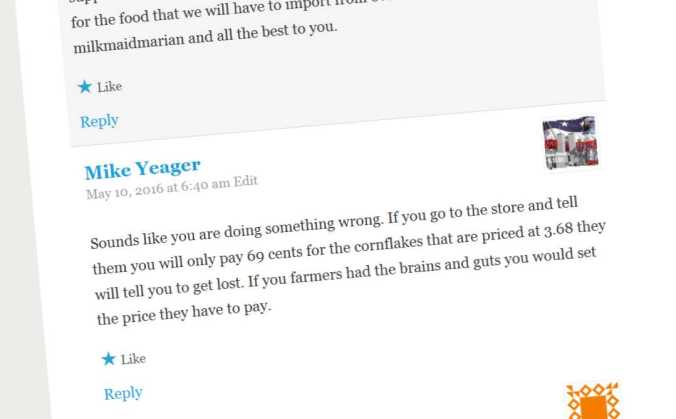
Of course, Mike is right. You can’t walk into a shop and demand a box of cornflakes at a fraction of the cost.

You can’t cut someone’s wage because your business is losing money. Nor can farmers choose to pay less for stockfeed, electricity or shire rates just because the price of milk has fallen.

We dairy farmers are in a uniquely vulnerable position. We shoulder almost the entire risk in the dairy supply chain. It stinks. It’s grossly unfair. And when you read stories like Appreciating Australian Agriculture‘s below, it’s harrowing, too.


AppreciatingAusAg

So, if we have both guts and brains, why do we let others set the price for our milk? The reality is that dairy farmers have little choice in the matter.

Why not stop sending milk? You cannot switch cows on and off. You have to milk them every day, no matter what, and their milk needs to be sold within two days. It can’t be stockpiled until buyers offer a reasonable price. Of course, you could sell all your cows but then how would you pay your mortgage?

Why not find a buyer who will pay more? Because there are only a handful of buyers and they all offer about the same deal. They tell you the price of your milk. If their sales strategy goes sour, you get paid less. Anyhow, right now, few milk processors around here are willing to take on new farmers. You’re stuck right where you are.

Why not sell the milk direct? Yes, a few farmers do. It costs a six-figure sum to set up a processing plant and takes about a year to get it approved by the regulators. Running that plant and marketing your dairy products is another full-time job on top of dairy farming. It’s also another completely new skill set. In any case, not many farmers have deep enough pockets to establish the plant and endure the inevitable losses during the time it takes to become commercially successful.

Why not just sell the farm and do something else? Well, that’s a question plenty of farmers are asking, too, but it can take years to sell a farm and we do it because we are good at it and we love being farmers.

The reality is that when a few thousand small family businesses sell a highly perishable commodity to a handful of very large corporations, the playing field is anything but even.


Straight-talking UDV president Adam Jenkins on milk price cuts

In the confusion that’s followed the cuts to milk prices, I asked the president of the United Dairyfarmers of Victoria, Adam Jenkins, how the UDV was responding.

Adam had some very clear messages for milk processors, politicians and bankers. A big thank-you to Catherine Jenkins for filming Adam’s answers to my questions in their calf shed on a very windy day.

This video is the first in a short series addressing the milk price crisis.


Decisions, decisions, decisions

CowsDairyTrack

It’s happened. Fonterra Australia, the factory that processes our milk announced yesterday that it, too, would pay farmers less.

Already five days into May, Fonterra announced the price for May and June’s milk will be $1.91 kgMS, which equates to about 14 cents per litre. Milk costs about 42 cents a litre to produce. At least it does normally, when you haven’t been in a drought for a year or so.

So what does a dairy farmer do? Here are our choices:

  1. Send the cows on holiday for two months
    This option has immediate appeal. We would let the cows due to calve later this year go dry early. It’s much cheaper to feed a cow who’s not milking but because we’re in drought, we still need to pay for feed to keep them going. We still also need income to pay the mortgage!
  2. Sell cows
    We’ve already sold a lot of cows in the face of the drought but any cow that is not in calf and is not producing a lot of milk will have to be sold immediately. Why not sell the lot? Because that would make it very difficult to pay the mortgage for long. It takes years to rebuild a herd.
  3. Sell other assets if you can
    Maybe not Murray Goulburn shares…
  4. Feed the cows less and cut other costs
    We are currently feeding the milkers as much grain as we dare because of the drought. It’s ridiculously expensive. Maybe we can turn the dial down a little bit. They will produce less milk but they may not lose weight if we are careful.
    We’ve already cut a lot of other costs to find our way through the drought but I will be doing all the little things we can.
  5. A combination of all of the above
    The best strategy is often multi-pronged.
  6. Take on more debt
    Recognising that survival on 14 cents per litre is not feasible, Fonterra has offered farmers loans to be paid back (with interest, mind you) over the next few years. Or you can of course visit your friendly bank manager.
  7. Sell the farm
    This will be the final straw for some but it’s likely to take a year or two to sell a farm so you’d still have had to suffer the losses.

In the last post, I wrote that we’d been advised not to lose our vision for the farm. We’re still on course but the perfect storm has well and truly hit with more force than I ever imagined.


Despair, anger, disbelief.

3wisecowspsycho

Lots of dairy farmers are naturally cynical and, let’s face it, we’re never entirely happy with the weather forecast. But we are optimists at heart because things will always be better next season.

Not this season.

I have never seen my fellow dairy farmers so subdued as they were at a meeting last night. Dinner at the local pub was laid on – a rarity that normally guarantees a festive mood – but somehow it felt like more like a last supper. Nor have I seen such anger online.

Partly, I think, it comes down to being battle-weary. Around here, it’s been a disastrous season. Dry-land farmers have not been able to grow grass and the La Nina we were hoping for still hasn’t arrived. By now, we should be building a wedge of grass to get the cows through winter. Instead, paddocks are eaten to the boards while farmers wait for resown paddocks to fire up.

The conventional wisdom is to apply nitrogen now while the soil’s still warm enough to grow grass. Many farmers at last night’s meeting had not applied any urea yet despite its unusually attractive cost this year because the soil is still too dry.

We can buy in more fodder or sell more cows. Fodder is getting hard to find and expensive, too. Many of us have already culled hard. The options are narrowing. We need something to go right.

It isn’t. Farmers seem sure that the milk price for 16/17 won’t be good. Will it be devastating? We’re all wondering and worrying.

On top of all this came the Murray Goulburn announcement that it had overspent this year and will have to claw money back from farmers for the next three years. None of it makes sense. Many farmers had hailed the MG plan as visionary, something that would transform our industry to create sustainable prosperity. But the loss of so much money in so little time is incomprehensible.

It’s a blow from left field that will leave barely a Victorian dairy farmer untouched. MG is the pacemaker for the entire industry. Processing half our state’s milk and 38% of Australia’s, it sets the benchmark for the southern farmgate milk price. When it falters, we all do.

In the face of all this, the message from last night’s speaker was simple: seek help, watch out for your neighbours and don’t lose sight of the vision for your farm. Good advice.

What MG’s announcement means in plain English

This is a post written purely for my fellow dairy farmers in light of the MG announcement today. After speaking with the people at MG, this is what I have learnt:

Why the price must fall
MG opened at $5.60/kgMS. Its lower than expected sales, the rising Australian dollar and the fall in the value of its larger than normal (which are routinely high anyway) inventories mean it has a shortfall of between $170 and $200 million. This means the price paid to farmers must fall.

How far the price must fall
Depending on how the last two months of this financial year pan out in terms of sales and exchange rates, Murray Goulburn will finish the season between $4.75 and $5.00.

But the price can’t fall that far in two months…
To do that, it would need to pay farmers virtually nothing for milk supplied in May and June. Some rough numbers sent to me by an industry analyst puts those figures at about 4.75 cents per litre. Clearly, that would be disastrous for many suppliers. It would also cripple MG because farmers would have little choice but to leave MG and supply any other processor that would take their milk.

…so, here’s what will happen
MG will pay farmers for milk supplied in May and June as if the price was $5.47 all along. In other words, the price for May milk will be $3.38 for fat and $7.42 for protein. For June’s milk, it will be $3.45 for fat and $7.59 for protein.

If MG’s sales and the currency fall in line with the worst case scenario and MG really should have paid farmers just $4.75 for the year, it will mean there is a shortfall of 47 cents for every kilogram of fat and $1.03 for every kilogram of protein.

This money will be deducted from the price paid to farmers evenly over the next three years. It means the milk price will be lower for each of the next three years than it otherwise would have been by about 15 cents for fat and 34 cents for protein.

But it’s NOT a debt carried by individual farmers
The money to be deducted over the next three years will simply come out of the milk price. If a farmer leaves MG and moves to a different supplier during the next three years, no debt will follow that farmer. If a farmer joins MG in the next three years, that farmer will have a lower milk price than they would have received in a normal year.

MG will not apply a loan against an individual supplier and will not respectively apply terms and conditions to suppliers.

About this post and me:
I am a former MG supplier who still holds some MG shares and currently supply Fonterra Australia. This post is not designed to do anything other than clarify confusion surrounding the situation because I am fearful for the mental health of my fellow farmers. This post has been checked by MG for accuracy.


When Old Macdonald retires, who should own the farm?

milk-carton-thumbnail

Him (distracted by his new iPhone 6): A litre of milk, please.
Me: That’s $1.20, thanks.
Him: $1.20? No way, I can’t afford that. We go through four litres of milk a week. I’ll get it at $1.00 down the road.
Me: But $1.00 isn’t enough!
Him (wanders off, still looking at the iPhone)

Me (in 10 years): I’m tired of trying to make ends meet. I’m retiring.
Him (looks up from new iPhone 60): You’re selling the farm?
Me: Yep. Got a good price from a guy who says he can see the farm’s potential. I’m finally able to retire.
Him: But where will I get my milk from?
Me: The new owner, I guess.
Him: But he might sell it to someone else!
Me: Just get it from down the road then, like usual.
Him: But what if they decide to retire as well and sell it to this bloke?
Me: Relax. Not everyone’s going to sell to the same bloke.
Him (waving arms, stamping feet): But what if they do? It’s not fair. You are not to sell to him. This is MY milk. I demand food SE-CU-RI-TY!!!
Me: Maybe you could just offer him $1.20 for it?

Banning foreign ownership of Australian farms sounds nice in theory but it’s just not fair. Not to the farmers who want a fair price for their land and not to international investors who appreciate the true value of our farms.

There are two main arguments against foreign ownership of farms: ethical practices and food security.

Ethical practices are important and Australia has stringent rules governing almost every aspect of farm operations. In 2014, I wrote about my concerns regarding an overseas firm publicly railing against those laws but, even so, am dismayed to see Milk Maid Marian used as a rationale for preventing any foreign ownership. Farming well, no matter who by, should be supported. Farming badly, no matter who by, deserves concern.

Food security, on the other hand, is a privilege, not a right. Australians – among the globe’s wealthiest people – are in a great position to compete for our share of the world’s abundance of food. And there is no place for a peasant underclass here in Australia.

It’s dazzlingly hypocritical to gleefully buy cheap, high quality electronics from poor nations on one hand but refuse to allow them to buy affordable, high quality food from us in return. If Aussies really want food security, they need to start putting their money where their mouths are.


A quad bike helmet that really, truly works for dairy farmers

HQHelmet

This new helmet for quad-bike-riding farmers will save lives because it works. Not just because it’s tough and protective but because it’s not the sort of helmet you rip off as soon as you’re out of sight of the boss.

Most farmers refuse to wear helmets and I can understand why. I’ve tried wearing a road bike helmet (in line with official expectations) to bring the cows home on a sweltering Sunday afternoon. A road bike protects your head alright – that is, for the few minutes before heat exhaustion sets in.

Road bike helmets are made for riding motor bikes on a road, fast. Not at 2km/hr behind 250 cows, each throwing out the same body heat as a 1500kW hair dryer (I’m not joking, they do).

As a result, we’d decided to wear equestrian helmets compliant with AS/NZS 3838. Designed to protect a rider from a nasty fall at speed, they provide more protection than a pushbike helmet and better ventilation than a motor bike helmet.

Why hadn’t we chosen a helmet rated for agricultural quad bike use, you ask? Because there wasn’t one. New Zealand has developed such a standard – NZS 8600 All Terrain Vehicle Helmets – but, for reasons I can’t fathom, Australia has not adopted it or chosen to follow suit. Australian inspectors will still expect you to wear a road bike helmet, unless you can prove you have done a proper risk assessment.

Despite it all, the Quadbar people have finally designed and made a helmet especially for Australian farmers, the HQ Stockman 2. We were sent a complimentary sample helmet to test on the farm. Suffice to say, Wayne’s old equestrian helmet is gathering dust and we’ll be buying another Stockman.

The helmet is light and comfortable enough to forget you’re wearing it and the ventilation is just as good as the equestrian helmets we’ve been using.

Equestrian helmet (left) vs Stockman (right)

Equestrian helmet (left) vs Stockman (right)

What it has over the equestrian helmets is added protection. The HQ Stockman 2 meets NZS 8600 standard as recommended by both the Queensland and NSW coroners.

The helmet is so strong, it passes the test used to gauge the protectiveness of road bike helmets, although only based on one impact, rather than two, as Quadbar’s Dave Robertson explains:

“The ‘Impact energy attenuation test’ is the same test for the Australian motorcycle (and USA DOT motorcycle) standards however the test is repeated a second time on each location on the helmet for motorcycle helmets,” Mr Robertson said.

“Helmet expert, Dr Terry Smith form California USA, at the Qld coroner’s inquest went to a lot of trouble to explain that the second test is to ensure protection in a case where the ‘head strikes twice in the same location’ and MUST not be interpreted as providing double the protection. The speed impact is the same on both tests and the protection must be below 300g. The level of protection of a motorcycle helmet is in the fact that it can withstand a second impact on the same location on the helmet which is more likely at higher speeds. It (motorcycle helmet) is not tested at a higher speed than NZS 8600 however will most likely withstand multiple impacts.”

If you’re riding a quad on the farm without a helmet, get a Stockman. It’s the sort of helmet you forget to take off and it might just save your neck.

EDIT: A helmet compliant with NZS 8600 called the AgHat came on the market a couple of years ago but we didn’t adopt it at our farm because it had no ventilation.