Pregnancy a man’s job today

Wayne, Clarkie and vet Pete are down there at the dairy right now with half of our cows for the second day in a row. I suspect none of them are having fun.

It’s preg test and vaccination time. This is not a job for someone carrying a baby on her stomach because it is intense and there’s the risk of being hit by a kicking cow but it’s a must.

The “7 in 1” vaccinations protect the cows from a multitude of diseases. According to the supplier:

Blackleg, tetanus, malignant oedema, pulpy kidney and black disease are all clostridial diseases and are amongst the most common causes of death of cattle around Australia.

In all cases unvaccinated stock contracting these five diseases have very little chance of recovery. In fact often the first clinical signs seen by producers are dead cattle.

It also protects anyone working with our animals from a very nasty cow-borne disease called leptospirosis that can leave people ill for months – even hospitalised.

The preg tests let us know when to send each cow on her annual two-month holiday before calving. This rest helps her through late pregnancy and sets her up for a whole new season in great health.

Quad bike manufacturers look like Big Tobacco

Quadbar

Crush protection devices will save farmers' lives

Just like Big Tobacco before it, the quad bike industry has been adamant its machinery is not responsible for the deaths of Australian farmers – rather that they got themselves killed.

The Weekly Times and SafetyOzBlog have reported the gyrations of the manufacturers and their representatives, the FCAI, which even included forcing some sponsored riders to remove crush protection devices. They claimed that the only answer was more rider education and that rider error was almost invariably the cause of the 23 deaths on farm ATVs in 2011 so far.

I thought it was all over bar the shouting match when The Weekly Times reported that the FCAI had dropped its opposition to Australia’s crush protection device, the Quadbar. Then I heard that at least one manufacturer has advised its dealers that its position is unchanged.

Now, the SafetyOzBlog carries this media release from the respected and independent Australian Centre for Agricultural Health and Safety tearing strips off the FCAI for failing to correct what the ACCC described as misleading and deceptive conduct.

“Embarrassing or not, the families of those people killed and permanently injured in such rollover events have a right to know why the FCAI, as suggested by the ACCC, has not only misrepresented the evidence but why they have not addressed this issue in a timely manner. The inaction and questionable approach of both the FCAI and manufacturers is showing complete disregard for the safety of their customers.”

People on our farms are dying. No matter who is responsible for the rollovers, the Quadbar is estimated to protect between one in four and one in three people. It’s worth it.

For more information on quad bike safety, call the Australian Centre for Agricultural Health and Safety (02 6752 8210) or visiting the website at www.aghealth.org.au

Jonas on what ethical farming means to consumers

Tammi Jonas, who is writing her PhD on the role of food in a cosmopolitan, sustainable society, always has some wonderful insights into the expectations of farmers and consumers, so I was thrilled when she agreed to write this guest post for Milk Maid Marian.

In a number of recent discussions amongst farmers and with non-farmers, there has seemed to be an impasse. It goes something like this:

Non-farmer: ‘how can you treat animals that way?’

Farmer: ‘we love our animals, you’re just being misled by activists showing you worst practice’

Non-farmer: ‘I just want you to be kind to the animals while you raise them, and to kill them with as little stress as possible’ [many vegans snort at this point, though not all]

Farmer: ‘we treat our cows/sheep/etc better than our children! They’re pampered! We love them!’

Non-farmer: ‘but you handle them roughly and slaughter bobby calves young after starving them!’

Farmer: ‘what do you want us to do with all the bobby calves? We can’t afford to raise them all? But we send them to a nearby abattoir to minimise stress and time off feed…’

Non-farmer: ‘but the poor calves!’

Non-farmer then in most cases goes and purchases milk from Coles or Woolworths at $1 per litre for private label, or slightly more for ‘branded’ milk. They also consume meat and dairy daily, yet don’t want their meat to come from intensively-raised animals.

Who’s right here? And what’s at stake?

To get to the heart of the matter, I asked a very simple question on the twitterz yesterday:

Non-farmy (meat-eating) types – what do you want from farmers in the raising of the animals you want to eat? Be specific!

Here were the replies:

@trib: animals get more open space than legislated, only necessary drugs, healthy, natural food, capacity to behave naturally, eg herding

@FreeHugsTommy: I want the animals to be living a life as close as possible to the one they would live if they weren’t being farmed.

@hadrian33: Happy animals (allowed to roam and eat what they like best) As stress-less a death as possible

@andrewfaith: Organic, free range, humanely treated. Treat them the way we would like to be treated – with care and respect.

@katgallow: For animals 2 have chance of self-expression. Eg pigs root around, wallow etc as expressn of ‘pighood’

@drnaomi: I would like food animals to have good living conditions, good natural food and to not be traumatized by transport and slaughter.

@th3littleredhen: the best possible quality of life (& death) before it becomes food.

@graceonline: Truly pasture-raised, pasture-fed; no feed or plants with GMO or animal parts or slurry; respectful butchering; clean;

@abbystorey: to know where & how animals are raised. Sounds obvious but pics of happy farmyards & slippery terms like freerange are misleading.

@stillmansays: want cows raised in deep pasture w cow/calf herds & slaughter in pasture to allow cows opp to grieve & re-form herd dynamics

@EmpiricalBaker: reasonable prices, animals raised outdoors in nature, open communication with farmers

Now, my communities of interest on the twitterz are overrepresented with food-focused folks, and many of them are much more conscious of ethical consumption than average. But by and large, what they said they want is roughly what I believe most people would actually say they want in the treatment of farm animals. As @kirsty_l pointed out, it would make one appear and feel ‘not good’ to suggest one doesn’t care about the treatment of animals.

And yet in the supermarket, where the average consumers’ interactions with food take place, people are confronted with the constant appeal of ‘lower prices’. ‘Consumers win!’ ColeWorths and their mates at the Institute of Public Affairs tell us. But do we? Actually, the only winners here are the shareholders and highly paid execs of the duopoly.

The rest of us consumers lose – we lose choice as they label everything with their own brands, further obscuring an already impenetrable barricade of marketing spin – where are the farmers behind these products? The traceability of our food in supermarkets is now so clouded is it any wonder consumers have forgotten that there are real people out on the land working hard so they can purchase their daily bread in bright, shiny packages?

So back to the farmers – the majority of Australian farmers I believe do care for their animals, but they are very aware that they are raising these animals for slaughter. There is an inescapable level of pragmatism when handling animals destined for dinner plates, but that doesn’t mean most farmers are treating their animals in ways consumers wouldn’t like.

For example, the average dairy cow in Australia grazes happily in the paddock, coming in for milking twice a day (some dairies have gone to three, I understand, due to intense financial pressures in this deregulated market). Yes, on most dairies the calves will be taken off the mother between 12 hours and three days after birth, and some 700,000 calves will go to slaughter between 5 and 30 days old. There are concerns about how long these animals are left without feed in their final day of transport and while waiting at the abattoir, just as there are concerns about their handling throughout. We farmers would do well to listen to those concerns and always aim for best, humane practice, as I believe the majority do. And if we know or hear of farmers, drivers or abattoirs who are treating the animals poorly, rather than responding like the Catholic church and remaining silent or being defensive, we should be the loudest voices denouncing their behaviour.

Australia is lucky – this isn’t America – our beef and dairy cattle and sheep are still living out their lives in the full glory of cowness and sheepness (except in the case of ‘grain fed’ cattle, who are kept in feedlots for long periods even in Australia) – I only wish I could say the same for pigs and poultry, the vast majority of whom are raised intensively.

But I’ll finish by returning to consumers. We vote for humane treatment of animals with our dollar. So long as we over-consume meat and dairy while seeking the cheapest prices, we’ll get what we pay for – intensively farmed animals. If everyone decreased their meat and dairy consumption and paid more for it, farmers could afford to give the animals the space we say we want them to have. Next time you’re not sure you can afford that free-range pork, eat a couple of vegetarian dinners and then splash out and eat the tastiest shoulder you’ve ever had. Everyone will be happier, from your taste buds to the farm critters to your grandchildren. Ethics requires all of us.

Live conference post: Why so few farmers blog, straight from the horse’s mouth

Animal activists accuse farmers of being secretive and I’ve just asked attendees at the Future Focused AgOz conference why they aren’t blogging their personal farm stories. Here were their responses:

  • Scary
  • Just want to get on with the business of farming – maybe it’s someone else’s job
  • Lots of farmers don’t realise that what they do is amazing, that it’s newsworthy. There’s a perception that the daily grind is not interesting and that we may not be capable of presenting the bigger picture
  • Is it worth it? Will anybody read the blog?
  • The confidence they have the skills
  • Don’t feel they need or want to do it
  • Need to find the farmers who are interested in blogging and who will present farming positively
  • A desire to maintain privacy. You’re letting them into your private place
  • Uncertainty about who you are writing to
  • Uncertainty of how to handle attacks.

As Lynne Strong says, there is a need for a circle of support people behind farmer bloggers. Maybe the agvocacy community needs to spread its wings beyond the net and reassure aspiring bloggers that they are not alone.

Why are farmers so secretive? I’ll ask them at 9.30

There is a dark side of dairying that is hidden from the average milk drinker.” – RSPCA

“Do you want to know a secret?…next week Animals Australia is going to do some advertising of their own, only this time, they’re letting people in on a little secret — the dark side to dairy that they *won’t* tell you about in their ads. Click here to download the new ad, or sit back and watch this video to discover the truth” – Animals Australia

Actually, we don’t talk much about ourselves unless there’s a drought or a flood and I’ve got a golden opportunity to find out why. From 9.30 this morning (Sydney Australia time) I’ll present a webinar to the Future Focused AgOz conference and ask the farmers there about the hurdles they see to farm blogs and will report back to you.

In the meantime, if you write, or read Australian farm blogs, please do share them with us on Twitter at @milkmaidmarian.

One farm blogger, Fiona Lake, reckons there are few Aussie blogs written by full-time farmers and has an explanation:

“It’s much harder to locate well-explained rural blogs written by people running fulltime agribusinesses, long-term – with information on the nitty-gritty facts of large scale farming and livestock raising, environmental and agribusiness issue discussions. (Full time) farmers work long hours most or all days of the week and are generally exhausted when they knock off. So naturally it’s hard to find any hands-on fulltime farmers dedicated enough to voluntarily spend some of their scant spare time, writing about what they do, for no other reason than to help people unfamiliar with the industry, understand how their food and fibre is grown and encourage thought on topical issues.”

Fiona’s certainly right but is that it? Are we all simply too pooped to tell our stories? I suspect there are other factors too and would love your thoughts.

When the wheel falls off – literally

What a day. We have our heifers (teenage cows) on agistment an hour’s drive east of the farm and it’s time for the girls to meet their beaux.

The plan was to tow two of the four Jersey bulls up in the tandem trailer and return with two immature heifers. Well, for a start, the bulls had grown since last year (wouldn’t have been surprising if I’d thought a bit about it) and there’s only room for one. “Never mind,” say I as Fernando the bull leaps aboard greedily following my trail of grain, “at least we’ll manage to draft out the two young heifers and bring them back. We can send the other bulls up in a truck another day.”.

About 60 kilometres into the trip, the jolly bull leans on the back of the stock crate and sways like a Hawaiian dancer. Not just a little but a lot. Singing stops.

“Sorry Zoe, Mama has to concentrate for a bit.”

After a few deep breaths, the frightening fishtail irons itself out and I gently up the revs. Fishtail again. Ease off again to 60km/hr and Fernando stands up straight.

“Holy cow!”

After one more repeat, I decide it best to play it cool and nurse the flaming bull into town.

“This is bull#$%t” (muttered under breath)

Get to the yards – padlocked.

“What the?”

Turn around to have a think and, wow, an apology to Fernando is certainly in order. One of the trailer wheels is hanging on by a single nut. No wonder nobody dared tailgate me, even at 60km/hr. I’d figured the cowards were wary of an Aussie (green and gold) shower over their gleaming duco.

Dig out the car’s spare (thankfully the tandem has Ford Falcon hubs), borrow one nut from each of the other three wheels, find another gate for Fernando and limp home in the rain. Feeling blonde but blessed tonight.

What a farm upbringing brings

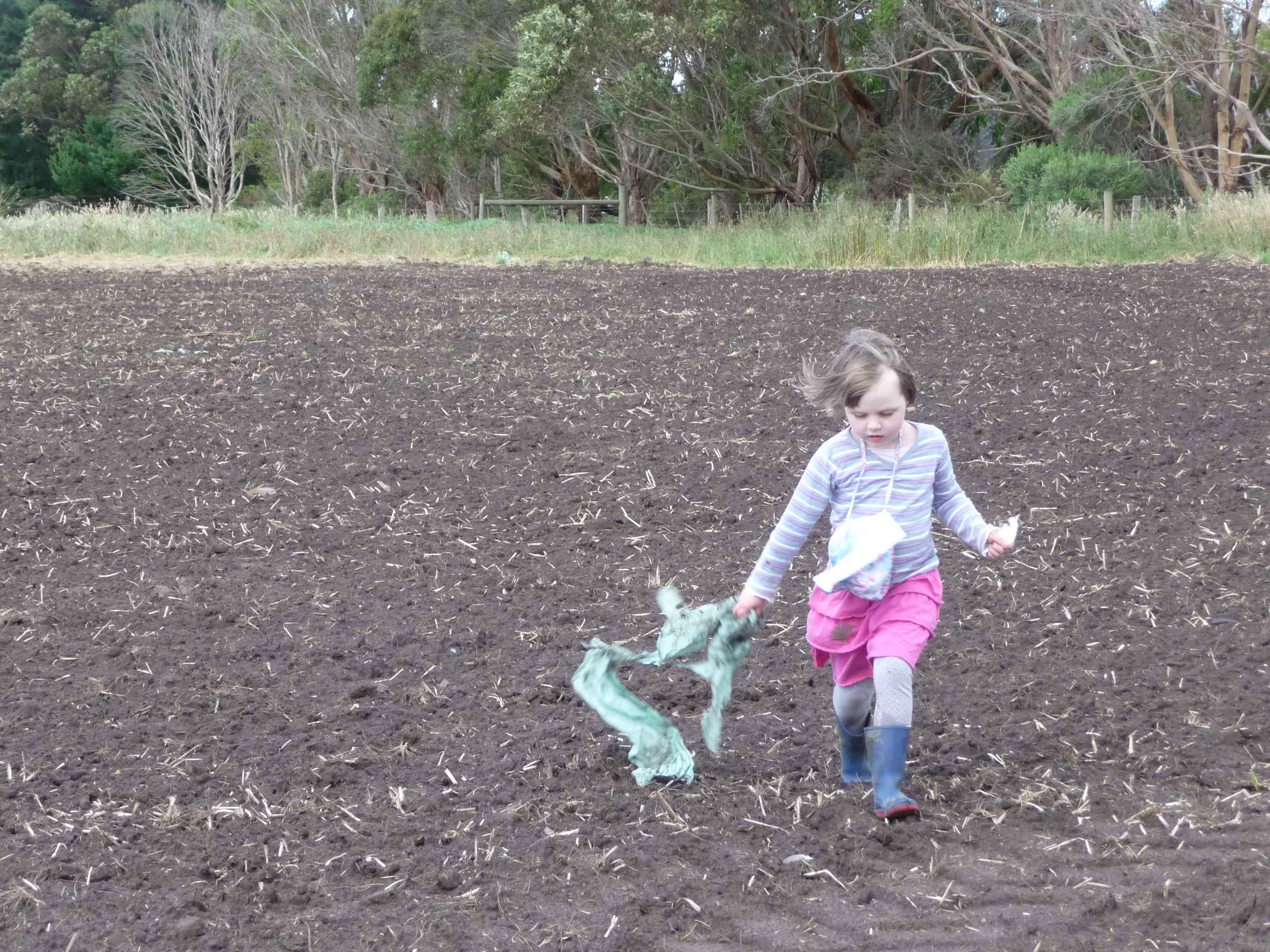
I am a very proud mama. Zoe loves to run and while I was setting up a paddock for the cows, she galloped off along the track and challenged me to beat her to the next gate. I watched the little dot bob along the track and reckoned she might just win, too. Instead, I found her three-quarters of the way to the “finish line”, doing this:

Picking Up Rubbish

"Rotten rubbish"

Just being part of farm life teaches children responsibility, care for animals, respect for the environment and a sense of pride in their own work. We are very, very lucky.

Would I advise my kids to become farmers? Country Hour asks the question

Do farmers want their kids to be farmers? A Victorian parliamentary inquiry is looking at why young people don’t want to further their education in agricultural studies. Early submissions says farming parents are one of the greatest deterrents… Hear more on the Country Hour today, and tell us, would you advise your kids to get a career in farming?

In just a few minutes, ABC Radio’s Country Hour will ask the million-dollar question: if life is so good on the land, would you recommend farming to your children?

I would, so long as Zoe and Alex have a passion for animals and the land and don’t have expensive tastes. Farming is nothing if not exciting and challenging. On the other hand, it’s anything but lucrative, particularly if you’re still struggling with a large debt burden as many young farmers must.

Even if they decide to become farmers, I wouldn’t recommend ag studies. The tradition of many farming families is to “get another trade to fall back on first” and it’s wise, whether that trade is boiler making or journalism. It makes sense to learn from other workplaces, acquire fresh skills, make new circles of friends, establish an independent identity and to experience being an employee before you become a manager.

Perhaps even more importantly, second jobs for farmers are incredibly common and the average Australian dairy farming family makes about as much income off the farm as on it. Employment helps us survive the bad years and ride out cash flow droughts.

And, if the worst happens, there are always options.

Farmers twice as likely to suicide

Farming is an addiction for many. Once you’re in it, you can hardly imagine another life. Sadly, it seems that is quite literally true for some. According to research reported in The Weekly Times, farmers are twice as likely to commit suicide than other Australians.

Research in 2010 showed farmers are among three occupations with significantly higher risk of male suicide, alongside transport and construction workers.

Between 1997 and 2002, suicide rates among Australian farmers were between 1.5 and 2.2 times higher than among the general population.

The researchers want to know why and so do I. My suspicion is that part of the cause may lie in one of the legendary strengths of the farmer psyche: resilience. We deal with drought, floods, price collapses and huge workloads by just getting on with it. I’ve often heard people refer to these stressful events by saying, “Ah, but that’s just part of farming”.

But what happens when they all happen at once, coincide with a tragedy or simply become too much? Does that mean we’re “not made of the right stuff to cut it”? Absolutely not. The flip side of the resilient farmer is the whinger. Maybe we ought to value those “whinges” more than we do. They might just save lives.

Farming with a baby in the summer sun

Keeping a baby safe, cool and protected from the sun while doing farm work is something of a challenge. And we all know how farmers rise to a challenge, equipped with hay band, tape and either WD40 or silicone!

In my case, it was half a dozen paper lunch bags taped onto the top of the baby carrier to form a “verandah” of sorts that got the fashionistas talking. I’ve since moved on and think I have achieved perfection.

Peeping out of a baby carrier

Peeping out

Some of Wayne’s old XXL cotton shirts have been seconded for a noble mission and you can see the result in the pic above. I just put one of these oversize shirts on over my singlet and the carrier and do up the bottom few buttons. Little man can be nudie rudie under the shirt and safe from the stinging sun.

Sun protection is equally as important for Zoe, who has just got a new hat and sunnies for summer (yes, I know it’s not strictly summer quite yet but it sure feels like it!).

Zoe in new farm hat and sunnies

Slip, slop, slap and splash with the yard hose makes for a cool farm girl