It’s even confused the Chaser team at The Checkout

Last night’s episode of The Checkout tackled the supermarket milk war in all its bewildering glory. They did a pretty good job but I reckon even the very clever Craig Reucassel got a little confused.

The problem with The Checkout’s closing argument is this: while processors don’t pay farmers more for each litre of branded milk they sell, they do pay farmers less when there is less money to go around (as Craig mentioned). So, when the processors sell less branded milk at lower margins because of the stiff competition from homebrand milk, they have to cut their costs.

Now, if you were a multinational processor, would it be easier to protect your profits by negotiating a better deal with the duopoly or simply tell dairy farmers that the price of milk had fallen? You guessed right, and they did, with disastrous consequences for farmers in NSW, Queensland and Western Australia in particular.

In other words, if you are among the one in four Aussies who buys branded milk, good on you! Until Murray Goulburn and Norco get their new efficient and 100% farmer-owned factories operating in Sydney and Brisbane, the $1 supermarket milk war will continue to hurt farmers in those states. Sadly, there seems to be no light at the end of the tunnel for farmers in WA and the milk supply there is so small now that it’s being trucked across the Nullabor to keep Perth going. There is a real possibility that UHT will become the new norm there, as it is in many parts of Europe.

The second area of confusion for The Checkout comes in its update about the MG deal with Coles. Here’s an extract:

“Coles is currently run by a coterie of former Tesco employees so it is perhaps unsurprising that this latest step mimics the approach in the UK. British supermarkets have moved to contract with farmers and cut the margin the processors make. This has led to higher farm gate prices for the farmers contracting with Tesco – but also more expensive requirements for them. Similarly, a lot of additional costs are expected for Australian farmers collectives, with Murray Goulburn spending $120 million on milk processing plants.”

The additional costs that come with Tesco deals are not in processing plants. It’s in on-farm compliance costs as Tesco dictates some aspects of how the small number of contracted farms are run.

In our case, the Coles deal is with the farmer-owned processor, Murray Goulburn, and nobody is talking about Coles making demands about the colour I paint my dairy door or how I raise my calves. Why is it different? A handful of (relatively powerless) farmers supply Tesco direct (and Woolies under its new Farmers Own scheme) whereas Coles is picking on someone closer to its own size in Murray Goulburn, which boasts annual revenues of $2.29 billion.

Co-operatives have never looked so vital to the survival of Australian farmers and the ability of Australians to take fresh food for granted.

Coles has forged this deal with MG because, contrary to Craig’s opinion, Australians aren’t stupid. They know $1 milk is not sustainable and they’ve started voting with their wallets: yes, the share of homebrand milk is falling.

This is a huge win for the little people of Australia – dairy farmers and milk drinkers alike. We truly are what we eat.
The co-op does a deal with the devil and keeps its soul

I never thought I’d say this but some of my milk will be sold on Coles’ shelves in both homebrand and Devondale cartons from next year. And I’m pleased.

You see, the co-op we supply, Murray Goulburn, is a giant too. It processes around 35 per cent of Australia’s milk and earns $1.17 billion in exports, making MG one of the largest container exporters from the Port of Melbourne. In other words, it doesn’t have to sell to Coles and Woolies, giving it much greater leverage with the supermarket duopoly. It also has the scale needed to be an efficient processor. Most importantly, its number one goal as a 100% farmer owned co-op is to maintain the profitability of its farmers.

All the same, it is confronting when “our” co-op does a deal with the devil. Has it sold out on us?

I asked dairy analyst, Jon Hauser of Xcheque for his thoughts. “My view is the news is very, very positive,” he said. “This is one of the few things that has the potential to lift the returns for farmers by maybe two or three cents per litre and, perhaps more importantly, it can reduce the volatility of farm gate prices.”

The thing is, while Murray Goulburn exports around half of its milk, reducing our reliance on the supermarkets, that exposure to international commodity prices and the exchange rate can be painful, too. International commodity prices rise and fall like a cork in a bottle and the average Aussie dairy farmer loses about $9,000 (according to my back of the envelope sums) with every cent the Australian dollar rises against the US dollar. Of course, it’s at record highs right now and not looking like falling below parity any time soon. The uncertainty that comes with that volatility makes it very hard for farmers to attract finance and invest with confidence in their businesses.

On the other hand, I wondered why Murray Goulburn could make a profitable $1 milk deal with Coles when Lion, the company currently processing Coles’ homebrand milk, cannot. Jon Hauser thinks it’s largely an issue of supply chain efficiency.

“Leaving aside the aberration of $1.00 discount milk, branded milk retails at about $1.60 per litre and supermarket private label at about $1.20 per litre,” Hauser says.

“Farmers are getting 25 – 35 % of the consumer dollar. In the UK and the US farmer share is closer to 50%. Direct supply by a farmer co-op removes the middleman that is adding cost in marketing and collecting additional value from their brands.

“It is true that the supermarkets will become ‘the brand’ but the farmer co-op should also able to retrieve some of this value. In the case of the Coles/MG deal, MG will get part of that return from the ranging of their own Devondale brand.

“What is most critical in maintaining a balance of commercial power is the ability of farmers to sell their milk to a range of alternate customers. Murray Goulburn has the diversity of product and markets to do that and can now genuinely claim that they have a balanced portfolio of domestic and export sales”.

It all sounds very positive for existing Victorian Murray Goulburn dairy farmers like me. But what about for farmers near Sydney, who have been supplying Lion and Parmalat and who traditionally get so much more for their milk than we do yet depend almost exclusively on supermarkets?

Mike Logan, the head of Dairy Connect, which represents the NSW dairy sector, describes today’s announcement as a “game changer” and in a letter to farmers, had this to say:

“We have three big changes on the table at once;
1. The manufacturing milk price rise
2. The drop in production so that NSW and Qld are now short of fresh milk
3. New models of supply to the supermarkets

“This all adds up to change.

“For the NSW dairy industry it may mean:
1. Investment in new processing capacity
2. A new pricing model for the whole fresh milk industry
3. Re-energising brands such as Devondale and Norco
4. Relocation of a large number of farmer dairy suppliers from one supplier to another
5. Changing role of the processors and processing capacity
6. A risk for the milk vendors as the processing sector changes.

“…the supermarkets have been true to their word and have been looking for new ways to create a sustainable future for the NSW dairy industry. We have to look past the $1/litre milk and build a new future.”

“However, these changes will be at considerable cost to some people. We need to be careful and respectful of the impact of these changes. We do not want to create a situation of winners and losers.”

The reality is, though, that there will be losers. Commenting on the future of the current processor of Coles’ milk, Lion, prominent NSW dairy farmer, Lynne Strong (@CHDairies) said on Twitter that “They have lost QLD plus NSW Coles contracts Cant see them surviving this one #sadbutrue”.

Lion is almost certainly not going to be the only loser in what all agree will be massive upheaval in New South Wales. But there will be winners and maybe, just maybe, represented by an increasingly powerful co-operative, dairy farmers will claw back a little dignity. And you, dear milk drinker, will soon be able to buy 100 per cent farmer-owned fresh milk knowing that all the profits stay right here in Australia.

Co-op does fresh milk deal with Coles

Murray Goulburn, the co-op that processes our milk, sent out an email this morning that will have a huge impact on dairy farming: it will supply Coles fresh milk for the homebrand and our own Devondale milk. Here’s an excerpt from MG’s press release:

“• Devondale announces 10-year private label daily milk partnership with Coles
• The Co-operative will also relaunch Devondale branded daily pasteurised milk
• Devondale cheese will return to Coles’ shelves
• Deal will deliver additional profits to Devondale dairy farmers
Devondale (Murray Goulburn Co-operative Co. Limited), the Australian farmer Co-operative, today announced a landmark, ten-year partnership to supply Coles with daily pasteurised milk for its private label brands in Victoria and NSW from July 2014.

Separately, the Co-operative will also relaunch Devondale-branded daily pasteurised milk, through an initially exclusive agreement with Coles, and Devondale cheese will return to Coles’ shelves.
The milk price paid by Coles under this unique agreement locks in a premium that will deliver additional profits to Devondale dairy farmers over the life of the contract. The premium is not affected by price fluctuations in international dairy markets or movements in the Australian currency and the contract
contains rise and fall provisions to protect the premium farmers receive.
As a Co-operative, Devondale will return 100% of the profits from this agreement to its farmer-shareholders through higher farm-gate returns.

Devondale Managing Director, Gary Helou, commented, “The daily pasteurised milk segment is currently mainly supplied by foreign owned companies that repatriate their profits to overseas shareholders. The entry of Australia’s farmer owned Co-operative into this market segment cuts out the middle man and delivers profits directly to farmers.

“This is a logical growth opportunity that extends Devondale’s domestic presence in consumer markets and is expected to lock in returns that will be paid to farmers through higher farm-gate prices. These higher prices will benefit all dairy farmers.”

It goes on to say that:

“We appreciate that there has been considerable public concern about the pricing policy for private label milk. Under the contract agreed with Coles the retail shelf price for milk does not determine the profits that will be received by MG supplier-shareholders.”

“MG expects to receive returns that represent a premium over and above the price available in other markets such as commodity dairy ingredients. The contract is expected to lock in this premium for ten years, regardless of what is happening in international dairy markets or movements in the Australian currency. All profits on this contract will be returned to all supplier-shareholders through improved farmgate returns. This new revenue stream will also reduce volatility by providing an additional domestic earnings stream as a balance to fluctuating export earnings.

“As part of this expansion MG will be taking on new supplier-shareholders across existing and new supply zones to meet the growing demand on our milk supply. This includes growing a local milk supply in the Sydney region. The Sydney milk pricing arrangements are yet to be finalised but importantly, the arrangement provides sufficient flexibility for MG to offer a fair farm-gate price which will be supported by Coles. In other words it is expected that all profits from this project will be returned to our total supplier-shareholder base.”

Will have more on this for you later today.

A very special present from a dairy farmer’s son

Our new pastures were sown in the rain into lovely moist soil the first day after Easter. Nothing’s come up yet and although the farm is pretty green, it’s stopped raining! I can’t help checking in on the forecast every day hoping that a deluge is on its way.

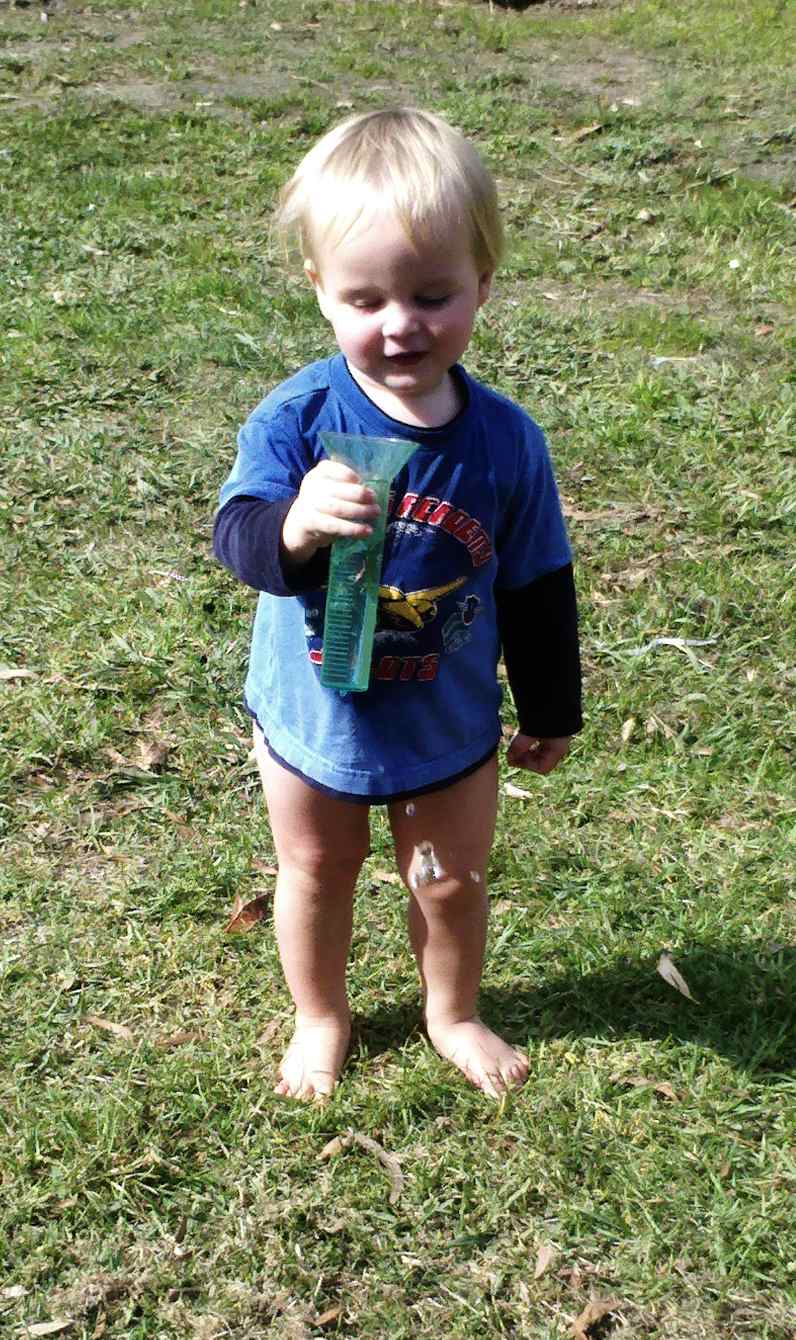
Even one-year-old Alex seems to know how exciting a trip to a full rain gauge is during Autumn and, this afternoon, he arranged a special present for me.

"Mama! Mls!"

“Mama, Mama! Mils!”

Alex ran up with the “rain” he’d prepared, shouting “Mama, Mama, mills!”.

“How much?”

“Four!”

“Great work, Alex, keep it up!”

Our farm is rain-fed rather than irrigated and I must admit that I often look enviously across the valley towards neighbouring farms soaking in water during summer and critical times like these.

Typically, Aussie dairy farmers also daydream of the seemingly perfect New Zealand climate. While Australia’s dairy exports stagnated during our 12-year drought, Kiwi exports soared. This year is different. The Kiwis have had a drought of their own and without a grain industry to help them maintain their cows’ diets, milk production has plummeted.

It’s a cruel irony that the misery of our Kiwi counterparts has already begun to see the international milk prices rise and with it, our hopes for the next season.

Am I in a dairy crisis?

A group of young Gippsland dairy farmers say times are tough but not at crisis point, said well-known dairy consultant John Mulvany during an ABC Radio interview yesterday.

When I ask myself whether it feels like I am in a “dairy crisis”, the answer is a perplexing “yes and no”.

We will get through this year battle-weary but pretty much unscathed and the bank is still very supportive. The co-op recently delivered us a modest price increase, which included back-pay and that was very helpful. I hope I’m not jinxing myself by saying this but the autumn break has arrived, everything is green and growing and new seed is in the ground.

But when I look at why things are undoubtedly “tough”, that’s when it feels like a crisis.

International dairy commodity prices are good
Right now, we are actually being paid very well. It just doesn’t feel like it for two reasons. First, those excellent prices are in US dollars, which means that by the time you convert those prices into Aussie dollars, the prices are a lot less spectacular. Second, the cost of making milk has increased faster than milk prices have risen.

Given that international dairy commodity prices are notoriously volatile, I’m not looking forward to the next cycle, when they are considered “weak”.

The strong Aussie dollar is not going away anytime soon
Business commentators are telling Australian exporters (and around half of our milk is exported) to get used to a strong Aussie dollar. It’s here to stay.

Input costs are tipped to keep rising
The price of power, refrigerants and fuel is only going to keep rising, along with wages and, in the long term, fertiliser. Interest rates cannot be expected to remain so low forever, either.

Smart farming programs withering as R&D slashed
There have been savage cuts to agricultural R&D right around the country, with massive job losses here in Victoria. We are going to have to look further afield for innovation leadership.

Conflicting messages about the future of farm-gate prices
We are constantly told a massive protein shortage will transform dairy farmers from paupers to princes. As dairy industry commentator, Steve Spencer, writes in the latest edition of the Farm Policy Journal:

“One of the significant challenges faced by the industry – especially export manufacturers who can’t keep up with customer demand – is that too few of their milk suppliers have bought into the story that the future holds great opportunity.”

Glad you noticed, Steve. And little wonder we’re not buying the story. Not only are we no more profitable now than we were a decade ago when “the story” was first floated, just a few weeks ago, ABARES forecasted a 36 cents per litre farm-gate price within five years – well below our cost of production.

Steve goes on to say that the dairy industry is missing many key ingredients “…building confidence, showcasing success, positive esteem…” and then poses a “…critical question for all parts of the industry: how to motivate people to look long, adjusting their businesses and attitudes to accept the cycles of the market and cashflow as inevitable?”.

Steve, I think that is what we have done and that is why some call it a dairy crisis. Rhetoric no longer cuts it. But I reckon you’re right that we farmers do need to start thinking about the big picture beyond the farm gate so we are ready not only to face the future but to recast it before it’s too late to find our feet in the new world order of dairying nations.

My paddock handbag

Look into a woman’s handbag and you see deep into her soul. Tucked into its folds, you’ll find clues about what makes her feel secure, competent and even sexy. Oh, and boring stuff like grocery lists.

That’s how I like to think of my paddock handbag. Escaped heifers, broken fence, tired kids on board? No problem – with my paddock handbag, I’m Superwoman. Compartment A (the glovebox) is kitted out with wipes, toys, snacks and drinks. Compartment B has just about every tool to deal with almost every agrarian contingency.

TailgateTools Ready for surgery

Toolbox top A good girl scout is always prepared…

The big guns

And if all else fails, the big guns

I guard my paddock handbag with my life. Yes, the fellas are allowed to borrow select items from time to time but must promise to return said item on pain of death. Call me a drama queen with control issues? Maybe so, but I dare you to return toddler on the verge of a meltdown to within cooee of home “just to grab another set of pliers” and then whisk him away again. It had better be an exciting agrarian emergency with helicopters (aka “copot”), trains and whooshing irrigators aplenty or we’ve already lost the battle.

On second thoughts, maybe I’ll get a padlock fitted to that paddock handbag.

What would Dad think of the farm?

It’s at family occasions like Easter that I think of Dad most often.

Dad died at Christmas-time in 2006 when Zoe was just six months old. A new mum with a thriving micro-business and a husband from the city, I had to decide whether I would take on the family farm. Michael, the wise local accountant, advised to sell – I was doing well, farms are far from the most lucrative investment choice and why work so hard, anyhow? After all, my parents had invested in a great education so I didn’t have to be a farmer.

But I love the place. And the cows. And fresh air and the contentment that sore muscles bring. Even though I thoroughly enjoyed my career, a working life spent wholly indoors would be unimaginable. When I said I just couldn’t bear to lose the farm, Michael clicked his tongue, shook his head and said, “Well, don’t say I didn’t warn you”.

Michael was right, of course. It’s been a tough few years. The farm was run down and it’s taken a mighty effort to restore it to manageability, so now and then, I like to imagine what Dad would say if he could see it now.

With a lot of help, we’ve removed tonnes of old stuff, repaired kilometres of fencing, renewed kilometres more of the water system, installed 21 new troughs and a couple of water tanks, renovated 200 hectares of pasture and planted 8000 trees.

I thought I’d take a few photos to remind myself how far we’d come and discovered something humbling. For all we have achieved, it was Dad’s accomplishments that stole the show.

Dad planted the tall trees in 1999. The small ones went in two years ago.

Dad planted the tall trees in 1999. The small ones went in two years ago.

Dad built this wildlife haven in 1984 and planted the trees

Dad built this wildlife haven in 1984 and planted the trees

This is what would have taken Dad's breath away

This is what would have taken Dad’s breath away

Woolies the white knight unmasked by dairy defenders

Sometimes it’s what you read between the lines that’s the most important. In the cause of reporting about supermarket giant Woolworths’ formal announcement today confirming it’s arranging to directly contract dairy farmers to supply it milk, the most interesting comments are those that appear below the line.

Dairy farmers have shared their concerns about the move but now the ball is well and truly in the corner of Australian shoppers. If the comments from readers of Melbourne newspaper, The Age, are anything to go by, Woolworths’ attempt to mitigate the growing public distaste for supermarket ethics may have backfired.

I’ve picked out a few to summarise the tone of discussion online (my subheadings):

Squeezing the life out of the producers
“This is how they make the real money, had this explained by an insider recently to me. They find a producer and ask them to make their home brand for them along with their own branded premium product. People buy the cheaper version and the premium product disappears so they then just give them the second quality product in their packaging. Then supermarket owns them, they then turn on them and say, now we will pick it up, give u the packaging and labels you just give us the raw product. This means the producer the gets no profit on packaging, transport etc for the goods, and they are cut to the bare minimum of profit, this is how the supermarkets are squeezing the life out of the producers so they have no profit and no hope of improving. I won’t buy home brand, I like choice and supporting Aust companies.”
Commenter: Newcastle Gal

The admission of guilt
“Surprise, surprise I thought it was only several months ago that the supermarket giants (media) told us that the milk companies etc were not being disadvantaged and that the supermarket chains were picking up the losses, now it turns out that the supermarket chains are ripping off our suppliers after all..”
Commenter: Mik of Melbourne

Part of a bigger plan to screw consumers
“I ‘m sure the money that Woolies gets from their gaming machine can well and truly subsidies the milk (* bread). Instead, pay the real price for branded milk and cease this war. The only outcome will similar to Europe where fresh milk is now a luxury, mainly God awful UHT milk on shelves.”
Commenter: nm4047

It’s all about control
“Woolies and Coles will only rip off farmers because you let them. Note the success of Norco on the NSW North Coast, their milk is still selling for a fair bit more than $1 a litre and has withstood the “home brand” assault. Sales only dropped by 1-2% compared to the 25% drop of brands in the cities. Norco and the communities they support care for farmers, because they are farmers. Woolworths don’t care about farmers, by dealing directly with farmers they are hoping to break up the co-op models that are beating them in the rural areas and drive the farm-gate price down.”
Commenter: dude

And then there’s this from someone who obviously knows the dairy industry very, very well:

“Actually, it’s a combination of marketing ploy and the knowledge that Queensland and Western Australia are close to real domestic supply troubles if they keep losing dairy farmers.
Not being privy to Woolworth’s strategy in this move, this is what I suspect will occur.”

“(1) They’ll target large scale farmers or encourage investment in large scale farming for their direct supply. Good economics on their part but increases the exposure for the suppliers since return on their investment will be solely dependent on Woolworth’s assessment of a fair price.

“(2) They’ll concentrate on areas where they aren’t up against strong competition and where’s there’s excess manufacturing capacity available. Both WA and Queensland fit the bill here.
Victoria would be a less attractive option with its reliance on export markets and dominance by co-operatives and farmer owned supplier groups. South Australia has a small localised industry and is attracting interest from Victorian based co-operative Murray Goulburn. Tasmania has good production prospects but transport is an ongoing issue. So probably WA and Queensland.

“(3) Once they’ve got a foothold, it’ll be a balancing act. Do they squeeze their fresh milk suppliers or do they loss-lead and extend their range of products by trying to increase both their supplier base and their range of manufacturing options? More ‘supermarket own’ brands would probably be their ultimate goal but not at the cost of having to carry the brands for a long time before a return on investment. I’d say their ideal is complete vertical integration but they know that can backfire big time if you don’t control enough of the market.

“One thing for sure. This is about Woolworths not about the farmers. And let’s face it, that’s what all businesses are about- not just supermarket owners”
Commenter: David of Leongatha

All in all, I’d call it an unmitigated PR flop. On the other hand, those commenting online on a story in The Age are hardly a representative sample of Australians. It’s inevitable that farmers will be recruited by Woolies (and Coles, in turn, no doubt) but whether Aussies will buy either the rhetoric or the “fair” home-brand milk is far from a sure thing.

This cow cannot take a trick

The last cow into the dairy on Friday morning had Wayne stumped. It had been an uneventful milking, she’d gobbled up her ration of grain for breakfast but, when Wayne turned to spray the teats, there she was calmly sitting underneath her neighbour. No matter what we tried, there she stayed, refusing to budge. This little cow is only five years old, six months in calf and in great health. We didn’t want to lose her.

SheShallNotBeMovedFriday

Sarah the vet was duly called but could find nothing wrong. We figured she’d just slipped and was gathering her nerves before trying to get back up. She didn’t. She wouldn’t, even to follow a tempting trail of wheat.

Mmm, you smell nice

Mmm, you smell nice

When the time for afternoon milking came around, Wayne had to slither her along the platform and then lift her over a fence with the hip clamps. We sat her in the shade with grass, silage and water. She ate well, looked bright and feisty but her legs just wouldn’t work. It was an enormous relief to see her up and about at daybreak on Sunday morning, pushing against the gate to get back with her herd mates.

She still looked a bit tottery yesterday afternoon, so we let her have the afternoon off but felt really confident she was going to be alright.

So when I had to move the cows unexpectedly at lunchtime and saw her being pushed backwards down a slope towards the gully by a big bully cow, my heart leapt into my mouth. With the bully heaving low under her belly, the poor little cow toppled sideways – seemingly in slow motion – into this ignominious position.

UpsideDown

Now, this crazy-looking pose called “dorsal recumbency” is deadly for a cow. I had minutes to get her upright. For emergencies like this, I carry a heavy drag chain in the Bobcat and had her sitting upright again in less than five minutes. It’s a delicate job that has to be done with a lot of grunt and that’s always a risky combination.

Thank goodness, it worked. After some gentle coaxing from me and enthusiastic yapping from Patch, she struggled to her feet and joined the herd. Fingers crossed, little cow.

Is Woolies the dairy farmer’s white knight?

Woolworths has announced it plans to contract dairy farmers directly, with the promise of better farm gate returns. While a first for Australian dairy, this is not new in the UK where many of our supermarket executives earned their stripes. On a study tour of the UK, prominent Victorian dairy farmer Roma Britnell spoke to many English farmers about their experiences, so I was delighted when she agreed to answer a few questions for Milk Maid Marian.

Roma Britnell

Roma Britnell


MMM: What are the supermarkets proposing?
Roma: The supermarkets are thinking about setting up direct supply contracts with a select group of farmers in response to the public’s concerns that they are hurting farmers.

I saw a really good example of this in England after coops failed and processing companies became dominant. The supply contract I looked at was with Waitrose, a boutique up-market supermarket. Only a small number of farmers had the opportunity and got a few cents more than the rest of the English dairy farmers. They have to have a very flat supply and the quality standards are very demanding.

When I first explored this concept, the farmers were not too unhappy. Now, the supermarket’s demands are getting too difficult to accommodate. A lot depends on the relationship between the negotiators of the group and the company manager but because the group is small, the farmers are at a disadvantage.

MMM: Is this common overseas?
Roma: I didn’t see this anywhere other than in the UK. What I did see and look for were ways the farmer could maintain influence up the supply chain. I found the answer was simply to own as much of the supply chain as possible so long as this was managed efficiently and monitored carefully.

This is what has traditionally gone wrong, and the “co-op” model is wrongly blamed as the reason instead of the inefficiency and lack of the owners (farmers) making sure the business performed.

Co operation comes in many forms and I looked at companies like Glambia that are part co-op and part company.

I found many good businesses that were going well operating as a co-op, including Arla. Neither co ops or companies are immune from failure. The management rather than the structure is key. On the other hand, the farmers that sit on co op boards need to be highly skilled business operators at an international level.

MMM: What do you expect will be the opportunities and threats for dairy farmers who contract directly with the supermarkets?
Roma: The farmers who have a direct supply contract will earn more than the rest of Australia’s dairy farmers. Eventually, however, the increased costs are likely to match the added reward.

Consumers will buy the milk believing they are doing the “right thing” by dairy farmers but the reality is that direct supermarket contracts are rarely truly in the farmer’s favour. As with all things, the ones in early will initially get some benefits short-term but long-term it’s unlikely to be the case.

Such a small group of farmers has little chance of negotiating on an equal footing – brute strength is needed to deal with giants the size of Australia’s supermarkets.

MMM: What are the opportunities and threats for Australian dairy farming as a whole?
Roma: This opportunity for a favoured few poses enormous threats to Australian dairy. If the English experience is repeated here, the often unrealistic demands supermarkets impose on their contracted farmers will become the norm over time. They will say its customer driven. Its supermarket driven; to get the edge on their competitor and in turn the long-term costs to the industry are too large to keep the industry viable. Do we need more of this?

There are many other threats that take a long-term view of the situation to consider.
However the principle remains that dairy farmers are individual businesses who seem to struggle to work as a team. If we did, we would have the clout to position ourselves ready for the oncoming food boom. It has been a long time since the demand for food was greater than the supply. Dairy industries around the world are positioning themselves in readiness for this. Us …well I don’t think we are going to be in a position ready to pounce. Sad really to miss opportunity but a good strong group of focused farmers would be the way to achieve success.

My last comment to demonstrate my findings is cemented from my experience just this week whilst in New Zealand. The country has a minimal domestic market with a strong, well organised cooperative that exports a large amount of milk. So very like Australia in that respect. Yet they have the highest domestic milk price of any country in the world. Go figure!
