Whose fault is it?

Lots has changed since 1980. Milk production in Victoria has more than doubled despite cow numbers remaining the same and 35% per cent less land to graze.

Since then, we’ve had massive advances in cow genetics, understanding how to grow grass and exactly what cows need to eat. But we farmers are no better off. Despite it all, we’re very much poorer.

Everyone seems to have an opinion on why that is and just whose fault it is. Pretty much everyone has copped it online: the government, supermarkets, milk processors, agri leaders, farmers and consumers. What strikes me, though, is just how similar our situation is to that of farmers around the globe.

Milk has been sprayed at icons in France, the Brits have hit the barricades in desperation, and outgunned riot police in Brussels. Things are miserable in the US, too.  I think the reality is that affluent societies consider high-quality food a right. And you don’t value your rights until they are threatened.

Very few urban Australians would believe their access to fresh milk is at risk and, until they do, unsustainable food pricing will be “someone else’s problem”. I wonder whether it will be me or my children who will one day staff the barricades, wield the “milk cannon” or simply quietly try something else that’s truly valued by Australians.
Hot milk

Remember yesterday’s 41 degree Celsius heat? Now, imagine you were standing outside in it being blasted by 250 1500-watt hair dryers. How do you feel now? Ready to do athletics?

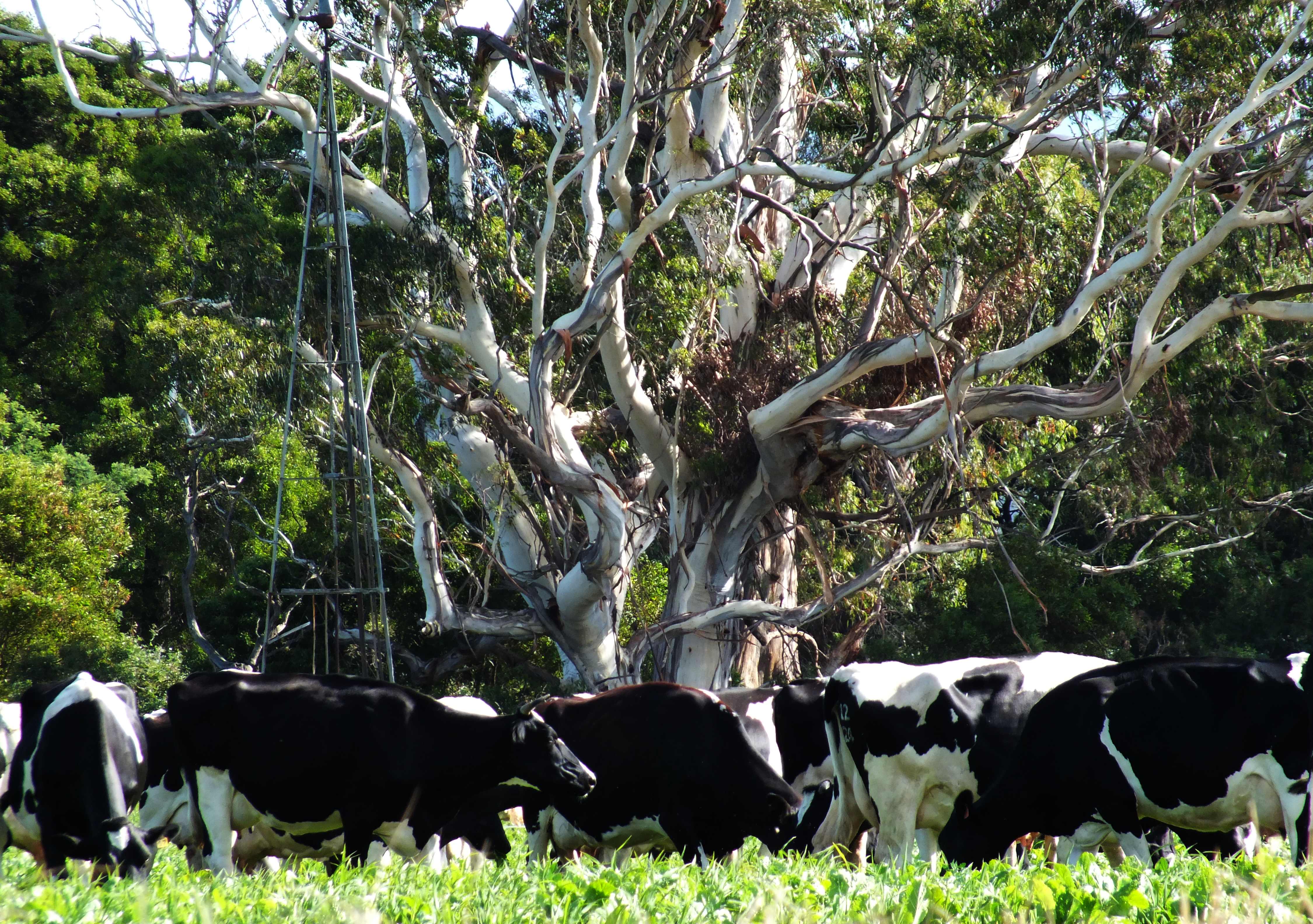
Grazing the lush crop

Icy poles for cows

Believe it or not, each of our dairy cows gives off body heat equivalent to a 1500-watt hair dryer on a hot day. Yet, incredibly, each still made an average of 29 litres of milk for us yesterday. We nursed them through with some very careful planning based on the principles of the Cool Cows program.

  • Wayne got up an hour earlier to milk before the sun’s rays began to sting and milked two hours later than usual. This meant that the cows spent less time in the sun on the concrete yard waiting to be milked.
  • We hosed the whole yard down about 45 minutes before the afternoon milking. It’s amazing how much cooler the yard felt afterwards.
  • The yard sprinklers were activated as the cows came towards the yard. (You remember the fun of dancing through sprinklers on the lawn!)
  • The cows’ diet changed a little for the day. The cows got a little more grain, a little more green crop and a little less hay yesterday. It takes more energy to digest high-fibre foods, which adds to heat stress. Rather than feeding out the hay during the day, Wayne stayed up late and offered the cows a “night-cap” in the relative cool of the evening.
  • We chose the coolest paddock on the farm, ringed by the deep shade of mature willow trees.
  • On a hot day, dairy cows can slurp up a staggering 250 litres each. Our extra-large troughs ensured they had plenty of fresh, cool water to drink when they chose to emerge from their hideouts.

Poor girls. According to the Cool Cows program leader, Dr Steve Little, dairy cows start to seek out shade when it gets to about 25 degrees C. I think the farm’s cows, dogs and humans all felt the need to go into summer hibernation yesterday.

Farm meets laboratory

It takes a lot of science to make our dairy farm tick these days. Our place is no factory farm either. With around 250 free-range milking cows, it’s a very typical Australian dairy farm.
Yet, only today, I have been keeping four different labs busy:

Environmental lab: what’s in our water?

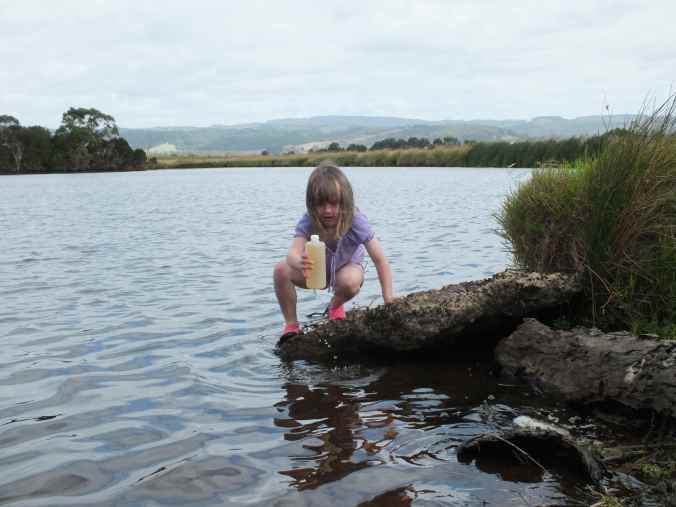
Sampling water from the farm dam

Don’t fall in!

We’re considering moving the water supply from the river to the dam but need to be sure the water is up to scratch first. While we don’t irrigate our farm, we need high quality water for the cows to drink and to keep the milking machinery hygienic and sparkling clean. We’re having it tested for minerals and nasty bugs like e-coli.

Animal health testing lab – looking for hand grenades in the grass

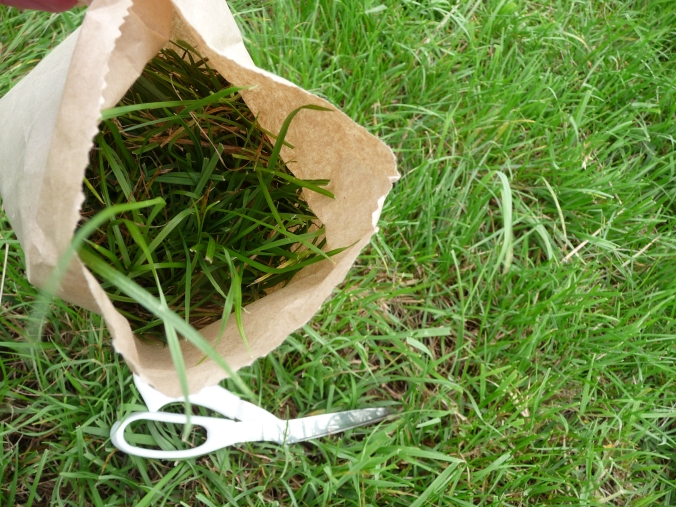
GrassClippingsOur farm has volunteered to be a ‘sentinel’ for the spores that cause the life-threatening condition of facial eczema. Collecting samples from a couple of paddocks only takes a few minutes but it could save hundreds of cows untold suffering.

Dairy nutrition lab – feeding the bugs that feed the cows

Yesterday, someone on Twitter asked Dr Karl how cows manage to get fat on grass while humans lose weight on veggies. The secret lies in four-chambered guts filled with life-giving bugs that do a lot of the work for the cows.

Our bovine ladies are athletes – each gives us around 7,000 litres of milk per year – and they and their bugs demand nothing short of perfection from us as chefs! Feed reports allow me to balance the cows’ diets with the right mix of fibre, energy and protein.

Soil nutrient lab – getting the dirt on our soils

Soil data allows me to apply the right fertiliser in the right amounts to the right places – lifting the productivity of our farm, reducing costs and preventing leaching into the river. I test the soils of all our paddocks every year. Some would regard that as wildly extravagant but a $110 test is nothing compared to the cost of a tonne of excess fertiliser.

Dairy farming is still the earthy, honest lifestyle it always has been but, these days, it pays to be a touch tech-savvy as well.

EDIT: Oh my goodness! Mike Russell (@mikerussell_) just pointed out that I forgot the bleeding obvious: the testing of our milk! It’s tested to an inch of its life – fat and protein content, sugars and cell counts are all tracked daily. Thanks Mike!

Farm fit


Before Bed Bike Safari

Before Bed Bike Safari

At my local primary school, I was an okay runner but at the big regional secondary school an hour’s drive away, I was a star. The townies were no match for a fit farm girl.

Farm kids get a natural workout every day as my little girl’s muscular legs will attest. On Boxing Day, she urged me along 10kms of forest tracks on her new pushie, complete with a “passenger” to match mine. Tonight, she was desperate to go on a ride before bed, so I said “just around the boundary then”.

The boundary ride was a nice little adventure and a good chance to check the fences and more far-flung paddocks. We are besieged by kangaroos and wallabies who are very charming but give fencing and pastures close to the forest a beating.

The kangaroos are welcome to some of the west-facing paddocks, which are already quite desiccated. The others won’t be far away. In fact, I can say with some confidence, Friday will cast a new hue over the farm. The first summer stinker of 2013 is forecast to be 40 degrees in the shade and the Bureau says not to expect any rain for at least the next eight days.

Time to figure out a new rain dance, I guess.

The dairy farmer’s calendar

Summer is the laziest time of year for a dairy farmer but when Wayne and I started writing a “to do” list yesterday, my head began to spin a little. Not satisfied with a mild head rush, I went on to draft a rough calendar:

The Annual Milk Maid’s To-Do List

Lazy Summer Days

  • Milk cows
  • Pay bills
  • Deal with crises (pump breakdowns are popular this season)
  • Begin drying cows off for their annual holiday
  • Make hay
  • Have we conserved enough fodder? Consider buying more
  • Begin feeding silage, crops and hay
  • Return cow effluent back to pastures
  • Spend a day changing rubberware in the dairy
  • Control blackberries
  • Vaccinations, drenching, branding, preg testing
  • Big maintenance projects (the stuff you put off the rest of the year)
  • Dream of the next Great Leap Forward

Autumn Anxieties

  • Milk cows
  • Pay bills
  • Deal with crises (milk quality issues popular this season)
  • Continue drying cows off for their annual holiday
  • Special feeding regime for expectant cows
  • Welcome and nurture new calves
  • Test soils for nutrient levels
  • Repair cow tracks
  • Sow new pastures
  • Fertilise pastures
  • Return cow effluent back to pastures
  • Chase revegetation grants and order trees
  • Maintenance
  • Still feeding silage and hay
  • Nude rain dancing in full swing

Winter Woes

  • Milk cows
  • Pay bills
  • Deal with crises (calving emergencies popular this season)
  • Welcome and nurture new calves
  • Fence and spray areas for revegetation
  • Spend a day changing rubberware in the dairy
  • Feed three groups of cows different rations
  • Mating program in full swing
  • Consider another drenching
  • Buy new gumboots and practise rain dancing in reverse
  • Redo budgets after milk factory announces opening price
  • Keep chin up

Supercharged Spring

  • Milk cows
  • Pay bills
  • Deal with crises (unpredictable weather popular this season)
  • Train the new members of the herd
  • Visit the accountant (and maybe the banker)
  • Fertilise, fertilise, fertilise
  • Vaccinate and wean calves
  • Thoroughly clean and disinfect the calf shed
  • Plant trees
  • Control thistles
  • Make silage
  • Sow summer crops
  • Make grass angels

I know I’ve missed stuff – lots of it – but it should give you an idea of what happens day-to-day and season-to-season on our very average Australian dairy farm. So, dear Reader, as we head into 2013, what do you want to know more about?

Not because I’m a nasty farmer

A grainy video of people holding their children down while they were being stabbed with pins would cause outrage around the world…until someone explained they were lucky kids receiving lifesaving vaccinations.

It’s a similar thing with farming and that’s one of the reasons I write a dairy farmer’s blog – so you have the explanations about our practices that you deserve.

Since I started writing Milk Maid Marian almost two years ago, I’ve had people express their relief about the truth about all sorts of topics but one that never seems to go away is: “why do you take the calves away from their mothers?”.

The reasons why we raise the calves away from the herd are compelling. And, if you thought the risk of animal wasting disease, Bovine Johnes Disease was remote and a poor justification, read this heart-breaking news story about a Queensland cattle station, where BJD is new.

Farmers are cautious, yes, but it would be cruel to be anything less than scrupulous about the way we raise our youngsters, don’t you think?

Painful fall as Ball Face ousted as king of the bulls

The farm’s most aggressive bull has reigned for about two years as no other bull, even those who stood several inches taller, were as mean as Ball Face.

Wayne put him in the bull paddock last night. This morning Ball Face was missing. We discovered snapped wires along the laneway and figured the grader had clipped the fence, shorting out the power, so after the afternoon rounding up, it fell to me and the kids to restore the circuit and find the errant king while Wayne milked.

I fixed the laneway and found Ball Face and Fernando in the newly planted-out wetland. Aargh! Not my precious revegetation!!! The pair of them had left a trail of sagging wires and were busily roughing up some melaleucas. Can you spot them?

BullsInWetland

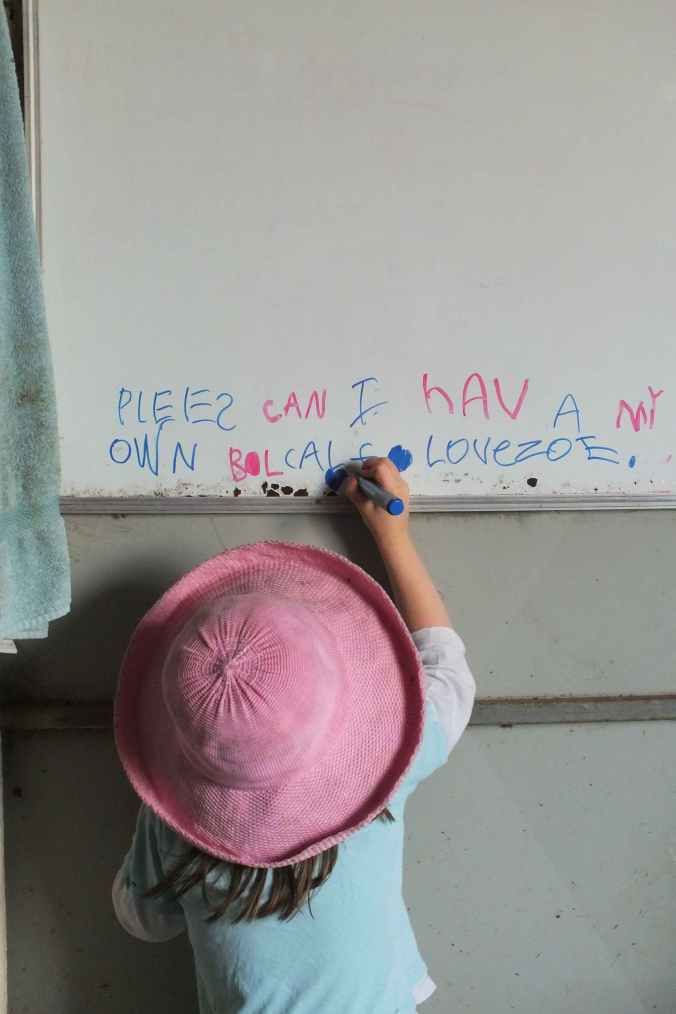
I sallied forth armed with a pigtail post and a long piece of poly pipe, leaving strict instructions for Zoe to stay on top of the Bobcat. I tried to look big and summoned my growliest voice. Magically, the two of them hopped out quite obediently. All that was left was to strain the three wires and turn the fence back on. Until this.

BallFaceChase

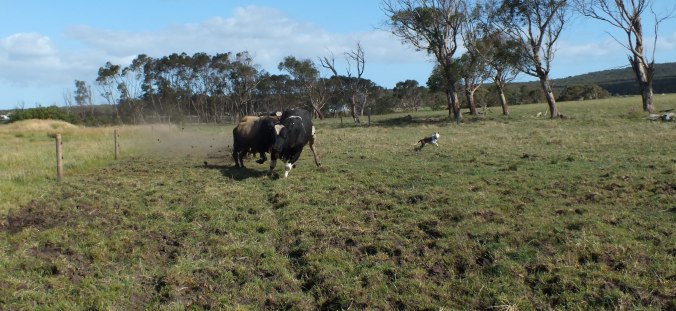
No one bull may have been game to take Ball Face on but a pack of them wanted him dead. Shrieking but quick, Zoe snapped this pic as the group charged towards us and I scrambled back onto the Bobcat. They thundered right around us and pursued Ball Face, literally pushing him through the fence (again) a hundred metres further up the paddock.

The fence strainer got a workout and then it was off, again, with pigtail post and poly pipe to remove Ball Face from his refuge. The gang stayed close to the fence and it was painfully obvious they would give him the medicine all over again, so I put him on the far side of the wetland, nine strands of hotwire away.

I don’t think I’ve ever seen a king deposed by a gang. Normally, it happens when an upstart matures, challenging the patriarch to a one-on-one duel with the rest watching. But then, Ball Face is something extraordinary. Maybe it really is time for him to go.

The hard lessons of life on farm

Message for Papa

Every farmer is by nature a philosopher. You must live for the big picture, cherish the little things and remember that, no matter what, the wheel continues to turn.

This week, a cow died in labour and two more gave birth to bulls. We felt sad about the death of a favourite but welcomed two of her sisters back into the herd. Farmers know that death is an inescapable fact of life.

Even so, it was different when a friend’s dog was killed in a freak tree-felling accident. It’s much harder to be philosophical about a the passing of a man’s best mate and I felt sick just hearing about it.

It’s times like these that throw the delineation between farm animal and pet into stark relief. Animal activists often ask farmers and meat eaters whether they would eat their own pets. Of course not. Does that make a compelling case for veganism?

Not in my view. All our animals will die one day, irrespective of the cause. What makes us ethical custodians is the quality of life we provide.

What does a real farmer look like? Something exciting!

Exciting news item number 1: The lame and denigrating Dev and Dale ads seem to have vanished. I await the Co-op’s next breathless announcement regarding its marketing with great anticipation!

Exciting news item number 2: The perfect antidote to Dev and Dale has been created by the Brits. Reality show, Farmers Apprentice, follows 10 people (selected from 600 applicants) as they slug through a five-day bootcamp in a quest to win 10,000 Pounds.

Something like this can be done here in Australia. It’s a wonderful way to show people from all walks of life that farming is neither “McLeod’s Daughters”, “4 Corners” or “Dev and Dale”. It’ll build bridges, inspire new careers and provide an enormous morale boost to crusty types like me.

PS: This is me bathed in glory just the other day.

I declare this trough...open!

I declare this trough…open!

It only took five minutes to install the valve and float but this was the final step in opening up a new paddock that took 18 months to complete. For me, this is what real farming excitement is all about – the thrill of pulling off a big project.

The farmer’s wife

A really disturbing media story about a male-only farm succession plan set Twitter alight today. It’s so incredible I’ve been wondering if it’s a hoax but, then, maybe not. There are some pretty strange characters in any corner of society, so I guess it is possible there is a deluded beef farmer out there who thinks he’s a sheik.

Most of the comment on Twitter has been expressions of disbelief, which is reassuring, but quite a few people have drawn parallels with their own upbringings and perhaps I should not be surprised at all. In fact, Australian family farms are generally passed on from father to son.

While there’s a dearth of research on the topic, a 1996 University of New England study on farm inheritance found:

“Farmers approach succession within a distinct rural ideology where farming is seen as man’s vocation, with great value placed on self-reliance, independence and hard work. Central to this ideology is the concept of patriarchy whereby women are inherently viewed as dependents, being either the wife or daughter of a farmer (Poiner 1990, 33-52). Marriage has been the usual point of entry into farming for women. Although daughters are often required to participate in the work routine on farms, they are not often encouraged to think beyond the possibility of marrying a farmer, and to consider farming as a career (Nalson and Craig 1987). Patriarchy also entails the exclusion of daughters from inheritance of land (Voyce 1994).”

“The majority of respondents entered farming with some form of assistance from their parents (or the parents of their spouse). This usually involved parents bringing the respondent into the existing farm business or parents leaving land to respondents, or helping them to purchase land. We found that daughters are not, as a rule, involved in farm businesses. The proportion of families where daughters are working on the farm, are partners in the farm business or share in the ownership of land is less than ten per cent. We also found that sons are more likely to inherit land from their parents, and be helped by their parents to enter farming, than are daughters. This has the potential to cause ill feeling. As one respondent wrote:

“‘My parents are giving their farm to my oldest brother to maintain it as a viable business. This effectively disinherits me and my sister and other brother. This is not fair, but my father wants to keep the farm intact and in the family. There is very little by way of compensation. This is a common scenario in the rural community.’

“Of course, interest and commitment to farming varies among women. Some embrace the opportunity to farm with great enthusiasm and play an active role in the family enterprise. Others reject the notion of farming as a career. These women may continue with a career outside farming or confine their activities as far as possible to those equivalent to an urban woman in unpaid domestic work (Nalson and Craig 1987). Whether women are free to exercise their choice between these alternatives is debatable.”

I’d like to think that we have come a long way in the 16 years since this research was conducted but I’m certain we still have a long way to go. The local dairy expo still advertises a “Women’s Pavilion” full of crafts and preserves (well away from the machinery displays). Our own milk co-op thinks it’s funny to portray women on farms as fluffy accessories. Major banks publish ads trumpeting that even the farmer’s wife has a say in the business.

Perhaps these are examples of out-of-touch advertisers playing on dated stereotypes. Perhaps it reflects current reality. Either way, isn’t it time we told them we’ve had enough?