Early morning greeting as the farmer tends her animals

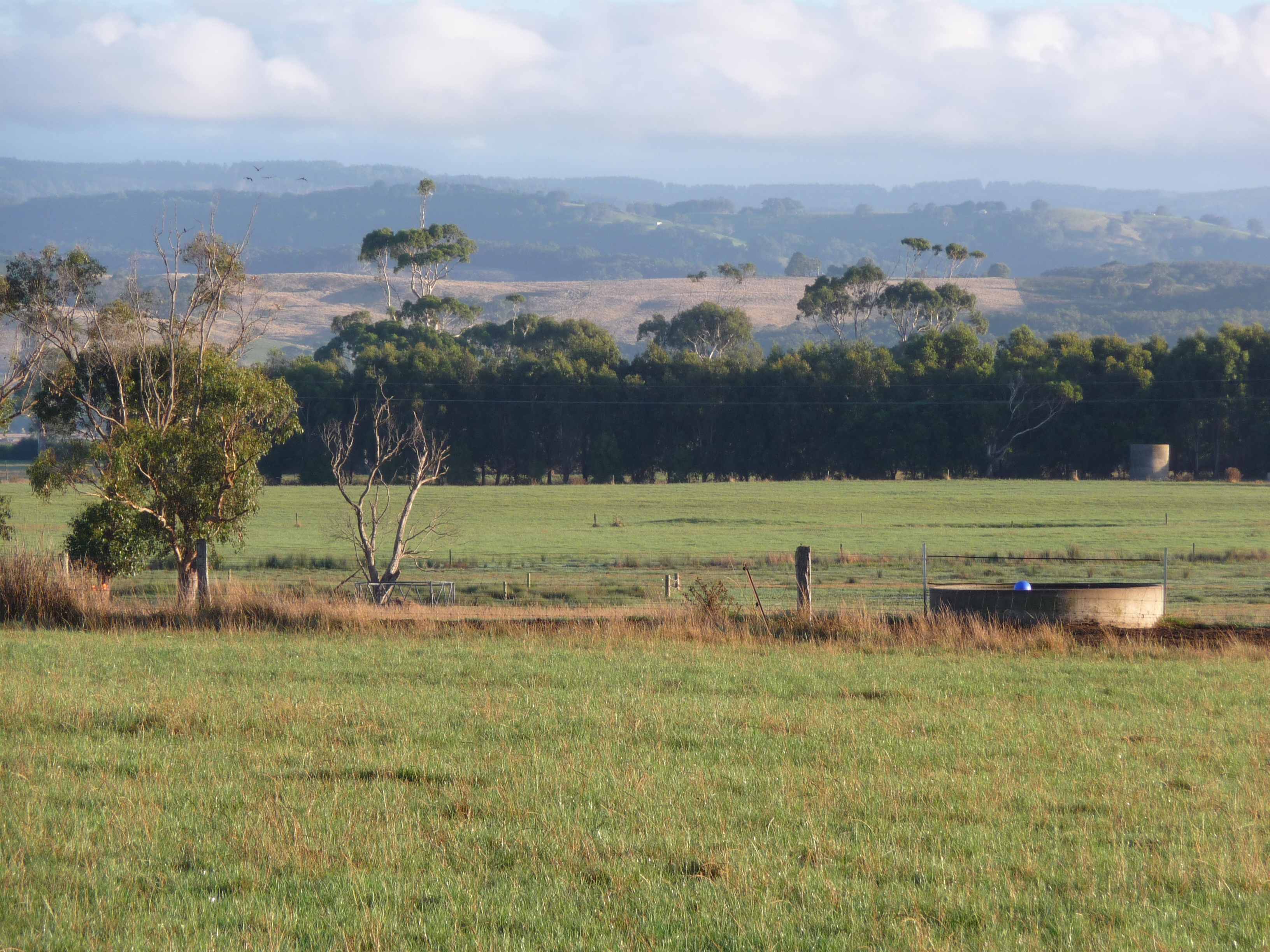
With a scorching 36 degrees Celsius forecast today, Zoe and I decided to get out on the farm nice and early. Amazingly for mid summer, it still looks lovely and green.

Cool morning

Cool before we cook

One of the first things we did was check on a calf in the sick bay. Dubbed “Pinky” by Zoe, this calf is about the same age as my own baby Alex – eight months – and is thriving but had an umbilical hernia that vet Pete operated on last week. We are spraying her with a pink disinfectant and fly repellant to keep her wound nice but it looks horribly inflamed as a result. She’s camping in a small paddock by the shed with a friend to minimise the amount of running around she does for the next week or so.

Pinky

Pinky recovers in the company of a friend

Zoe and I also stopped to top up Charlie and Lola’s pantry and say good morning to our semi-nocturnal Maremma guardians.

Charlie the sleepy Maremma

Good morning sleepy head

But it was a far less cuddly creature that greeted me when I went to check the milk chart.

Chart

Aaaargh...look who came out to greet me!

Yikes! Got to take the good with the bad!

Today I have 5 minutes with Australia’s dairy elders

If you were given five minutes to address the Australian Dairy Conference, what would you say?

I have that honour today and was asked to speak about my experiences with social media. It’s not a lot of time, so I’ve opted for the “shock and awe” approach, beginning with a real-life case study showing how ordinary dairy farmers brave enough to wear their hearts on their sleeves won new friends in the face of scandal. I’ll close with a yet to be revealed threat and an offer to attend my social media workshop on Friday so we can deal with it together.

Before I take the podium, Neilson’s Courtney Sullivan will tell the conference that dairy has a great reputation in the wider community. Australian dairy foods are safe, nutritious and pure. That’s a priceless position of trust we should treasure and protect because it took decades to build and could be lost in the blink of an eye. If you’re not convinced, ask a beef farmer.

Farmers typically only appear in the media during drought, fire, flood, plague…or when a horrific case of animal abuse is uncovered. It’s hardly surprising then, that we are considered whingers and, in turn, city folk (including policy makers) have “no idea”. No longer. The rise of a new, grass-roots media (Twitter, blogs and Facebook) means we can tell our own stories. And what has amazed me is just how many ordinary Australians want to hear them.

Now, back to that question for you. If you had five minutes to speak at the ADC, what would you say?

I’m a greedy parent

I’m something of a greedy parent. I want my children to be strong but gentle, thoughtful yet bold and big picture thinkers who care about the small stuff (maybe Zoe will one day point her shrink to this post as evidence).

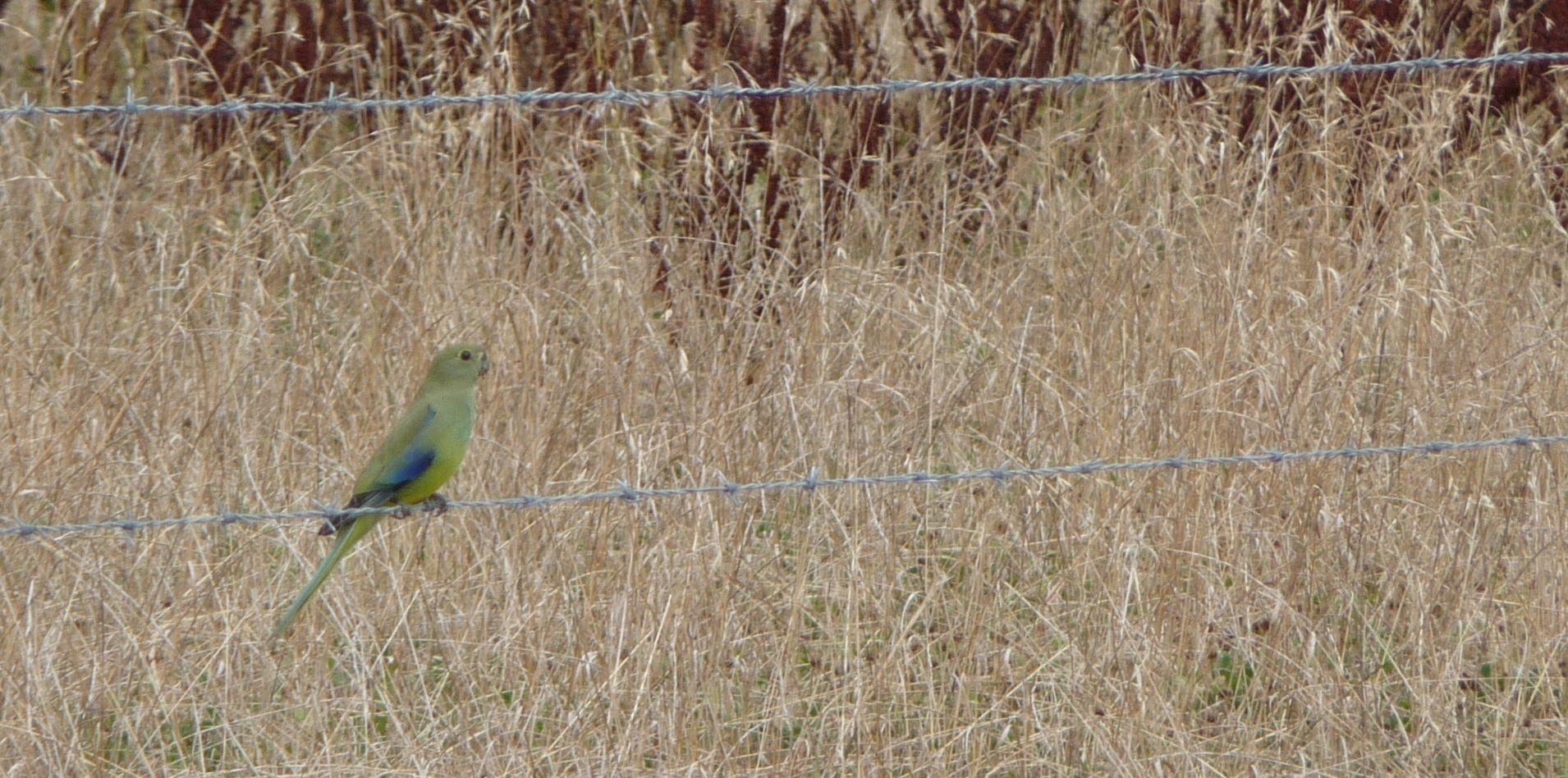
Blue winged parrot

The critically endangered orange-bellied parrot?

I’m a fairly excitable type and nearly crashed into a fence post when I saw this little bird and its mate on the farm because I had only that morning read this description of just such a bird by the Parrot Society:

“Australia’s Orange-bellied Parrot can be ranked with the Giant Panda, Whooping Crane and Siberian Tiger as amongst the rarest and most endangered of the Wildlife. Only 100 to 200 individuals still exist.”

I managed to snap a pic before the timid pair flitted away and breathlessly told the Little Farmer how lucky we were to see it. As an idealistic 20-something, I even trudged through the mangroves down near Wilson’s Prom in a fruitless search back in the 90s.

Having turned to Pizzey’s Field Guide to the Birds of Australia though, my excitement evaporated. I think instead, we have slightly atypical blue-winged parrots. Lovely and thankfully, in good numbers.

Just as Berenson’s Father Bear’s stuff-ups were the makings of a great Baby Bear, though, I hope my enthusiasm counts for something in the parenting stakes.

Are our dairy cows “forcibly artificially impregnated” each year?

Not for the last two years, no, we’ve gone au naturale. We will return to annual artificial inseminations but our experience of natural matings shows that’s really not out of the ordinary if you have the body of a cow.

In response to our changing weather patterns, I decided to start the cows calving on April 21 (also the date of our wedding anniversary but, honestly, no connection!) rather than our traditional mid-July. Now that winter is milder, an autumn calving means we’ll have more lush green grass just when the cows need it the most.

Moving calving in this direction is tricky. Cows have nine-month gestations and it’s at least three weeks after calving before they are ready to conceive again. For example, a cow that calves in August won’t conceive until September at the absolute earliest and her calf would be due in May or June.

It also requires a very keen eye to see who is in the window of fertility that lasts just hours and, often, we miss it.

For all of those reasons, I bought a host of pedigree bulls and introduced them to the cows in July. The bulls are on the job 24/7 and nobody is more expert at detecting the fluttering of long bovine lashes.

The result is that our conception rates have lifted and we have moved the herd’s calving date forward by a month each year.

In other words, left to their own devices with suitable Romeos, the cows don’t need to be “forcibly impregnated” (to borrow an alarmist vegan phrase) each year because it happens naturally. When we go back to annual artificial insemination, it will be with a clear conscience.

Snakeoil and women in agriculture please pass the scones

When the local dairy expo advertised it would have a “Women’s Pavilion”, I pondered the possibilities. Striptease? Baby change tables and comfy armchairs for breastfeeding mothers? A new pseudonym for toilets? Surely not!

No, the Women’s Pavilion was chock-full of arts and crafts. Crochet, quilts, preserves. Delightful yet patronising to this farmer who happens to be female and is just as interested in cattle crushes as the next man.

Now I’ve heard on the grapevine that a very high profile ag event plans a nude calendar featuring hunky farming fellas while the women’s contribution will be…recipes. If it is true and I am asked to share my favourite recipe, let’s hope they catch me on a good day.

Speaking of recipes, I was stopped on the side of the road by a salesperson just the other day who had the “solution” for all my farming woes. His special mix will lift our milk solids (fat and protein for the uninitiated), get every single one of our cows in calf, halt mastitis in 48 hours and even cure any mistletoe in neighbouring trees. All I have to do is put 2.5kg of the magic powder in the water trough each day. Nothing else, he was keen to stress.

I asked what was in the magic powder. He would only say that it was humic and fulvic acids, probiotics trace elements and minerals and it was devised by a man in Holland. “It’s a secret recipe,” he explained when I questioned him further. When I quizzed him on the science, he got himself confused and pulled out an abstract of a “study” that I was welcome to read there on the roadside. Said I could Google it. Thanks.

He has no literature, no website and no farmer referees either but a lot of people around here are trying it, he says. What’s more, if it doesn’t cure all my woes, he will give me my money back.

Farm consultant John Mulvany often warns dairy farmers to be wary of spending money on “herbs and spices” for their feed but this takes the whole feed additive bandwagon to new lows.

Dairy farming is highly professional these days. Labs test the soils that grow our grass, the feed that sustains our cows and the milk that they produce for optimum environmental, animal and human wellbeing. So where does snake oil like this fit into that equation? I reckon it’s the agricultural equivalent of the Tattslotto ticket. We all want to dream.

Have Australian dairy farmers given up?

I know things have gotten tough for Australian dairy farmers but I’d hate to think of us as quitters. Still, as the Dairy Levy Poll roadshow tours the country, it seems a real possibility that in just a few weeks we will try to vote ourselves out of existence.

In just a few weeks, Australia’s dairy farmers will vote whether to increase the amount we pay in levies to research and development body, Dairy Australia, or have it abolished. I hate seeing any deduction from my milk cheque as much as the next farmer (believe me!) but I also know that I would not be farming here today without that Dairy Australia levy.

Twenty years ago, our farm looked greener but not all that different from the beef farm next door. Dad was more interested in his role as local councillor and, later, dancer and bushwalking pursuits than in making every blade of grass count. And he could afford to. Farming was more profitable then and his debt level was low.

One divorce and a drought later, things changed. Faced with a suddenly massive monthly interest repayment, it’s fair to say Dad’s initial response was to panic. He lost two stone off his already very slender frame, considered selling the farm and then sought help. His decision to enrol in a Dairy Australia levy funded Target 10 course and to seek the advice of farm consultant, John Mulvany, saved the farm.

Productivity soared as a rotational grazing system offered cows fresh, high quality grass every day. Dad also confessed a new enthusiasm for farming. After 50 years on the job, he was learning again. He then embarked on just about every DA funded course he could find: Feeding Dairy Cows, Fertilising Dairy Pastures, Feeding Pastures For Profit, Countdown Down Under and Cow Time are just some of the handbooks he left behind.

Today, my interest repayments are even higher than Dad’s and farm margins are even tighter but with the latest know-how, I will make it.

Australian dairy farmers have become some of the lowest paid in the world. That stinks but it’s the reality. If we are going to survive, we need to be smarter than the rest. And if we don’t vote for investment in the very research that keeps us going, can we really expect the Australian taxpayer to help? I think not.

If you want to send a message to the bureaucrats, ring them up and tell them you’re not happy. I do. But I’ll never tell them I’ve given up and that’s why I will vote yes.

How to get into social media without it taking over your life

I’ve been talking to lots of farmers in preparation for the free social media workshop I’m running at the Australian Dairy Conference on February 24 and three things seem to hold them back from getting into blogging or Twitter:

  • I don’t have time or want to make that kind of commitment
  • I don’t know where to start/not good with computers
  • I don’t want to “put myself out there”

They’re three really good reasons not to jump in the deep end and write a blog but there are two much easier ways to participate in online discussions.

1. Get a Twitter account, upload a profile and start making tweets and contacts
2. Comment on other blogs

Facebook is also very popular (especially with young people) but I’d recommend dabblers leave that until later if it appeals.

How to make use of Twitter

Victorian dairy farmer and UDV Vice President, Ron Paynter, recently wrote of his experiences with Twitter on dairy forum Udderly Fantastic and allowed me to use this excerpt:

“I’d heard of Twitter, and despised the concept of people slavishly following the every banal scrap of information from some air headed celebrity who only survives off the oxygen that being continually noticed gives them. Honestly, who cares what Kim Kardashthingy had for breakfast. I had recognised that during emergencies like the Qld floods, Twitter had played a part in keeping people informed, then later in the year, we had that powerful image of a massive social movement, co-ordinated through Twitter being instrumental in the Egyptian Government change.

Still, despite these clues about the potential of the ‘tweet’, I was a non-believer. Didn’t need it! No time to set up an account or learn a new way of communicating. Besides, what can you say that is at all useful in less than 140 characters?

“What changed was a ‘call to arms’ from some people already involved in Twitter. On a Tuesday night, between 8 and 10 pm, there was going to be a ‘Twitter Forum’ on issues around animal welfare in our industry. We needed people, real farmers, on Twitter to put our case forward and not allow the discussion to be hijacked by activists or the uninformed. So, @payntacow was born and @payntacow, along with several other new conscripts joined in on #agchatoz, the discussion forum location to see what transpired.

There was no abuse, no searing accusations, no threats of coming around and giving you a fat lip . The discussion, formed around six or seven key moderated questions, was sensible and civil and the activists were notable in their absence. The people who were there were interested, some had opinions, some were happy to lurk and learn, but all were supportive and looking for information or genuine debate. I was so impressed by the thoughtful fellow twitterers I met, that I went back to the #agchatoz forum the next week, and have kept on coming back.

Access to a smartphone or tablet like an iPad makes tweeting as easy as checking your watch. Twitter people who I am following include dairy identities such as Milkmaidmarian, Graeme Nicoll, Esther Price and Lynne Strong. Twitter lets you expand the source of ideas well outside your local area though. I’m following an ag teacher in QLD who is passionate about agriculture, a dairyman in Arizona, and a vegan activist in the US. Each day, there are new people or groups to follow if you think they may have something of merit to listen to, and each day, I pick up followers who want to listen to my views. It’s a really  interesting ongoing conversation that you can pick up on whenever you have a spare minute and phone handy.

“So, I’ve fessed up. I am a twitterer. And I was wrong about tweeting as being shallow and not interesting. What Twitter provides is a rapid way of sharing ideas and information, and the chance to have a real dialogue about the ideas, albeit in 140 character chunks.

I really believe that as an industry, we need to be involved in the discussions. I’d encourage anyone who can try Twitter to give it a go.”

Twitter’s limit of 140 characters is its strength. It’s easy to contribute in short bursts of time and you can still make more complex points by using it as a signpost to other information. In fact, Twitter is the number one way people find my blog.
Comment on other blogs
Commenting on other people’s blogs is a fantastic way to dip your toe in the water of social media without committing. It takes as much or as little time as you like and you can add valuable new information or perspectives right where the discussion is already happening.
Just a few words of advice:
• Of course, be polite, thoughtful and add to the discussion
• Save your energy for forums where people are genuinely interested in different points of view (I tried reasoning with activists and learnt my lesson the hard way).
Anyone is free to attend my workshop, Blogging and Twitter Made Simple, (even if you’re not registered for the conference) on February 24 at Ellinbank. We’ll get you up and running online whether you want to dip your toe in the water or jump in at the deep end!

Rain post

Bah humbug! I am going to hang washing out on the line this morning, despite the Bureau’s flash flooding warnings because my diligent preparations for yesterday’s forecasted deluge seems to have put a hex on the arrival of the huge east coast low.

For a week now, the forecasters have been issuing dire alerts, urging us to get hay into sheds and move cattle to high ground. I duly grazed out the flats and arranged for the cows to go to the slopes, cranked the dam siphon into action for a day (flooding the swamp paddock in the process), brought in all the loose garden furniture and watched the radar.

A huge storm raged all day in Bass Strait but nothing arrived here. Even the easterly wind faded away to nothing and small puffy clouds arrived from the south-west. Disgusted, I finally drove up the dam wall to turn off the siphon. When I turned to see how much of a mess I’d made of the paddock in the siphon’s path, this is what I saw:

It had snuck up on me

It had snuck up on me

Wheeling around towards the south-east, I was astonished to see it even had its own “twister”!

Twister

The finger of doom?

Well, I reckon we’d be lucky to see 3mm in the gauge this morning.

The thinking behind this post is that the more public I go with my disbelief, the more likely the weather gods will shame me. So, please tell everyone you know that Milk Maid Marian says it’s not going to rain today. I dare you!

Why we raise calves away from the herd

We don’t leave calves with the herd because, if we did, many would die and I’ve discovered that, sadly, many do die on hobby farms in the district despite the best intention of their carers.

On our farm, we take calves into a shed when they are one day old. They are kept in a pen on a bed of clean sawdust with one or two other newborns so we can make sure they suckle well and get enough colostrum (special antibody-rich milk produced by a cow immediately after calving) in the first vital 48 hours of life. This long-time farming practice has been supported by studies, which show colostrum intake affects the health and milk production of a cow right thoughout her life.

We can’t take for granted that the calf will get enough colostrum in the paddock because some calves just don’t get the idea of suckling early enough and some cows (often the youngest) are not the most attentive of parents.

Another good reason to keep the calves separate from the herd is to prevent the transmission of Bovine Johnes Disease (BJD). Calves are the most likely to be infected by this horrible and fatal wasting disease, described this way by DPI Victoria:

“Cattle are usually infected when less than 12 months of age. However, due to a long incubation period, clinical disease is often not seen until the affected animal is 4 or 5 years or older. Signs may appear after a period of stress such as calving, poor nutrition, heavy milk production or any other cause.

As the bacteria lodge and multiply in the wall of the small intestine, the cow responds by producing inflammatory cells. This combination of bacteria and cells leads to a thickening and distortion of the gut wall. Eventually the gut fails to absorb water and nutrients. In dairy cattle, the first sign is often a drop in milk production. Affected animals then develop chronic diarrhoea. Cattle gradually lose weight and become emaciated, while still maintaining a good appetite. They may also develop ‘bottle jaw’, a swelling under the jaw.”

After about a week, most calves are really good feeders, so we take them out into a small grassy sheltered paddock with a group of about 20 other calves. From there, they “graduate” to a larger paddock with up to 40 other calves. After they are eating about 1.5kg of pellets or grain each per day plus hay, they are weaned. Well fed and in the company of their peer group, this is a stress-free and exciting time for the calves.

The calves are fed a special high protein (18%) ration of grain, together with grass to keep them growing at their optimum. They are split into size groups so that none of the little ones miss out. Left in the herd, the smaller ones would not be able to compete for this essential food for growing bodies.

The herd is also a tough place for little creatures. Our cows are classed as medium-stature Friesians, yet weigh in at an average of 550kg each. I’d hate to have calves weighing just 40kg in a yard with 250 car-sized cows twice a day.

Putting ourselves in the best position

In the lead up to the Australian Dairy Conference later this month, I’ve invited a few fellow speakers to do guest posts on Milk Maid Marian. One of them, Steve Spencer of the Freshlogic consultancy, issued this challenge to dairy farmers.

Steve Spencer

Steve Spencer


The world has changed in the last 5 years and with that so have the prospects for dairy producers. If you read the views of the global food gurus, we’re riding on the cusp of an ever-tightening world food shortage that puts the dairy industry in a great position. We’ll have plenty of competitors going after that future prize, and in the last decade dominated by the effects of drought, other exporters have emerged. But at the same time, decades of protectionism by major economies is steady evaporating, as governments admit they can’t afford to fund the high walls built around agriculture.

As we’ve seen in the past couple of years, the variables affecting our farmgate milk prices in Australia have become more complex, and the volatility in the future world that affects those prices, grain costs and weather will only increase.

As we step into the future, it has never been more important to make sure our industry is structured in the best possible way to make sure we optimise the flows from the market back onto farms. It isn’t something that we should steadily work on for a few years – this pressure now urgent!

I will be presenting a paper at the Australian Dairy Conference at Warragul, Vic (which is being held on 22-23 February) that will aim to stir up the debate on the agenda for getting that going. It will look at precisely what can be done to improve returns, and it should be no surprise to anyone to recognise that most of the things that can be done are within our own control.

So my paper will tour:
• How farmers do or can engage with the dairy market
• The value of the co-operative as a channel to that market
• How they perform in different industries
• What changes others are making and why
• What changes are most important in the Australian market
• How those can happen

We’ll discuss the elephant in the room. Murray Goulburn is the largest farmer-owned processor of milk in southern Australia, accountable to their shareholder-suppliers for performance through farmgate milk prices and dividends. In a highly competitive farmgate environment, prices paid by foreign-owned, privately owned or listed competitors will be set at or above MG’s price – others will only pay what they have to in order to get a secure milk flow. They are accountable to shareholders who may not be dairy farmers purely on their performance as a business.

It will be up to the co-op’s farmer shareholders to determine if the company is properly structured and managed to maximise performance, and the opportunities and risks of change.
Whether dairy farmers supply and own shares in MG or not and no matter where they farm, the performance of that largest co-op is an issue relevant to all Australian dairy farmers, as milk values are set by MG’s payment performance.

Like Australia’s competitors in the US and Europe will find as they embrace deregulation in the years to come, clinging to tradition is probably the worst thing farmers can do for the future of the industry.

I urge dairy farmers, their advisers and investors to attend the conference and get involved.