Why I welcomed Four Corners to our dairy

I’m looking forward to watching Four Corners tonight with all the enthusiasm of a patient awaiting the lancing of a boil. Will it be fun? No. Will it be good for me? I guess so.

It’s almost four months since Murray Goulburn called a trading halt, followed by the infamous “clawbacks” of both MG and Fonterra that rocked the dairy community.

In a state of confusion and panic, farmers called out for help. Ordinary Australians did what they could, ditching cheap unbranded milk in a show of solidarity with farmers that continues to hearten.

Four months on, panic has given way to a sense of aimlessness and loss. Helou and Tracy’s vision had offered a shining path towards security and prosperity but now Gary the Great has vanished and nobody has filled the role of white knight. Leadership is lacking at the time we need it most.

We farmers have a fleeting once-in-a-lifetime chance to fix things. Politicians want to know how they can help but we don’t seem to be able to articulate a coherent answer other than to cry for something, anything, to dull the pain.

Meanwhile, there’s a puerile optimism amongst some elites, reckoning that every casualty improves the prospects of the survivors. It’s a sentiment that disgusts me and simply doesn’t stack up.

Floods of milk generated by the powerhouses of Europe, NZ and the USA sink or float the export market – not the farm next door. We’ve already lost thousands of Aussie dairy farmers since deregulation. More of the same won’t solve our problems.

The first step towards a cure is to work out exactly what ails us and, at the moment, all we’re doing is bandaiding a festering sore. If there’s anybody who can sniff out and lance a boil, it’s Four Corners.

That’s why we welcomed Deb Whitmont and her team to our farm. Sure, I’ll be cringing on the couch but Four Corners’ Milked Dry might just reveal the bitter pill we need to swallow.


Meet your MG board candidates

UPDATE 31/08/16: Congratulations to Lisa Dwyer, Craig Dwyer, Kelvin Jackson and Harper Kilpatrick for being elected to the MG board and to all the other candidates for putting their hands up.

Murray Goulburn farmer shareholders will soon vote to elect new members to the board of directors. The dairy processor accounts for a huge chunk of Australia’s milk and tends to set the benchmark for the milk price, so its performance is important to most farmers in the south-eastern states.

The candidates have been touring the country to introduce themselves but since only a small percentage of shareholders attend the meetings, Milk Maid Marian offered this post as an added platform to help MG farmers make an informed choice.

The candidates were invited to answer two questions in a video that is three minutes or less:

Q 1:  Tell us about you, how you farm and your roles outside the farm

Q 2:  What would you work to change at MG if elected and why?

Three of the candidates, Lisa Dwyer, Raelene Hanratty and Harper Kilpatrick sent in their videos. Here’s your chance to learn a little more about them!

Lisa Dwyer

Raelene Hanratty

Harper Kilpatrick


Go home, Mother Nature, you’re drunk

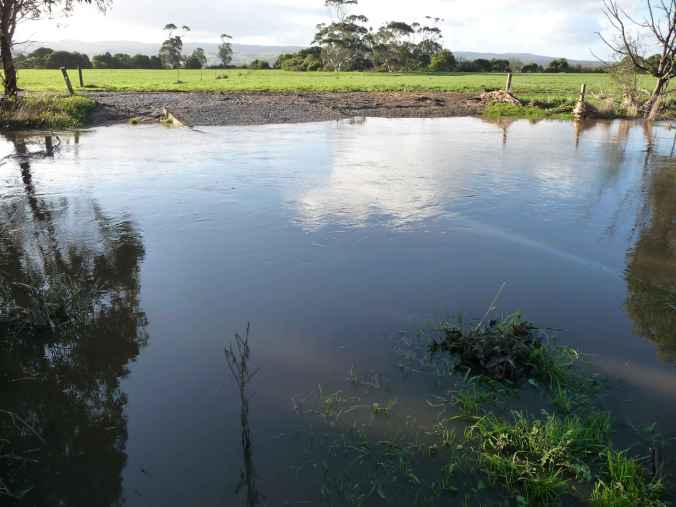
WaterDryIn April and May, we were using the very last of our dam water in a desperate attempt to get grass out of the ground. Two weeks ago, we had floods and the cows missed two milkings, trapped on the flats despite valiant attempts to bring them home.

FloodJune22fjord

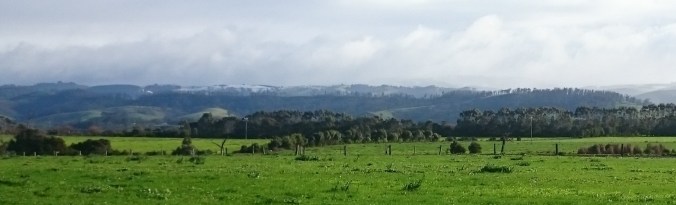
Then, just last week, we had snow.

SnowyHills

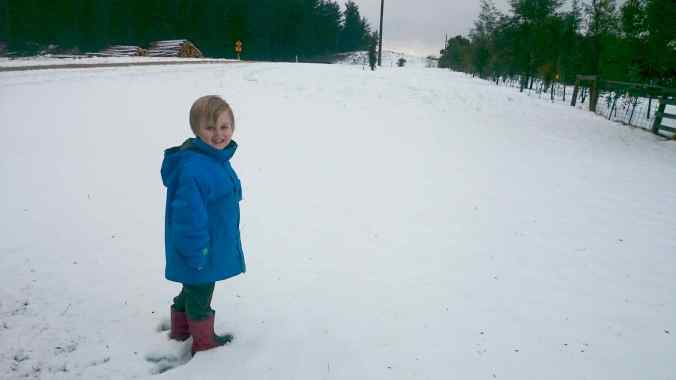
We even went up to the nearby hills so five-year-old Alex could see snow for the first time.

SnowAlex

It’s been a crazy year so far but I refuse to be cowed by mud.

mud

I’m celebrating the recharging of our dam for summer. It got very, very low but now is back.

DamSun

I’m also celebrating the snatch of spring we felt between the floods and the snow. With it came the magic of balloonists and their silks drifting across the river flats.

Most of all, it’s bringing the hope of a good season when we need it so desperately. We cannot afford to buy in hundreds of tonnes of hay again this year. A failed season like last year would spell disaster in the jaws of a crushingly low milk price. To survive, we need to grow more grass than ever.

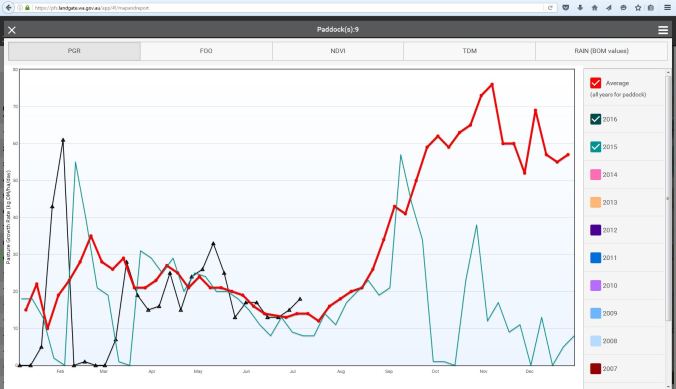
Landgate’s Pastures from Space tool confirms it’s been a difficult start to the year, with pasture growth rates actually even worse than last year’s failure. The thick red line represents an average year, the blue one is last year and the black one is the year to date.

PasturesFromSpacePGR

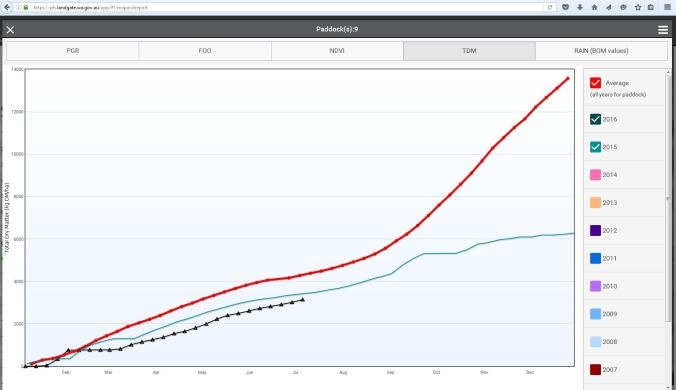
The outcome is even more stark when you look at the cumulative amount of feed grown. Again, red is average, blue is last year and black is this year. Last year the farm grew half the amount of grass it grows in an average year and this year sits below even that low water mark – so far.

PasturesFromSpaceTDM

As you can see from the two charts, things need to get better, fast. I’m really optimistic that we are seeing a turnaround.

Up until now, the rain we’ve had has been simply replenishing the parched subsoil rather than growing much grass. It needs to happen because unless the subsoil is moist, the root zone dries out in the warmth of Spring as soon as there’s any halt in rainfall.

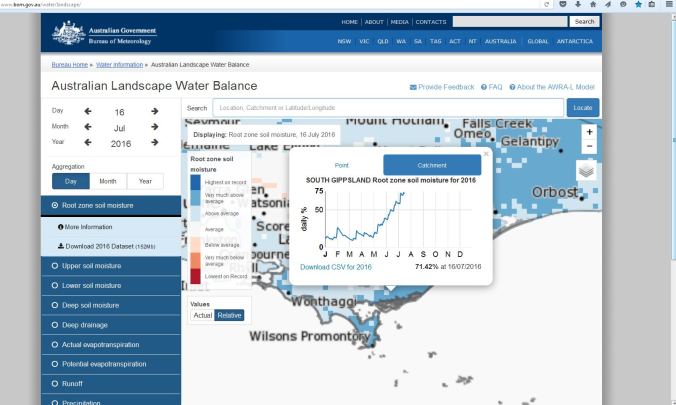
So, how is the soil moisture looking? Check out these Australian Landscape Water Balance charts. The first one shows just how recently the soil moisture in the root zone has returned to normal. This means that, finally, the grass can grow if there’s enough sun, nutrients and warmth.

AWAProotzone

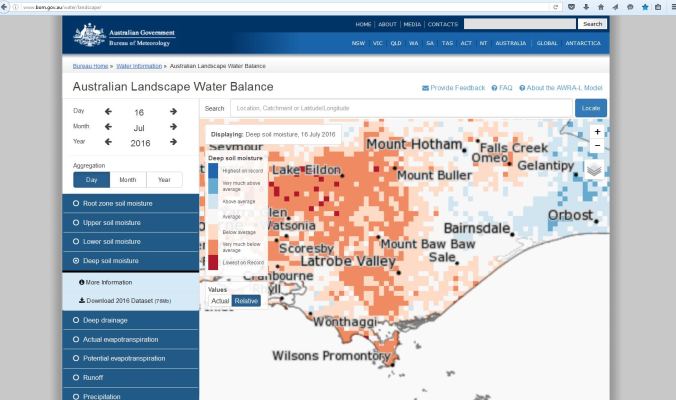
The good news is that while the subsoil is not as wet as the root zone, it’s returned to about average. The one to watch still is the deep soil moisture, which as you can see from the chart below, still has a way to go.

AWAPdeep

Mother Nature may be behaving like a drunk but, while it’s raining, I’m not complaining.

Theo was too right…

keep-calm-let-s-cut-the-cake-and-eat-it

Here’s an unpalatable truth: when Fonterra head Theo Spierings said the milk price was unsustainable back in August last year, he was right. He also said the way milk prices are set needs to change. Correct again. Then he started talking about the need for, “a good debate with farmers … about how are we going to share – how are we going to cut the cake.”.  That’s what really matters right now.

At the time, Fonterra Australia head, Judith Swales responded to Milk Maid Marian’s request to clarify what Theo had meant by “sharing the cake” and said:

“We have always said that the best dairy industry model is the one where everyone can get a sustainable return. Farmers need to be able to make money, processors need to make money and so do customers, like retailers. And that’s what he means by sharing the cake.”

It’s hard to disagree with that sentiment. The problem is that we’ve learnt one more lesson in the last couple of months: if you’re stranded on a desert island with a hungry gorilla and a small cake, you’re in very big trouble indeed.

This post is not intended as an attack on Fonterra. After all, things are no better at Murray Goulburn. The reality is when there are thousands of small businesses selling a highly perishable product to a handful of large corporates and multinationals, the playing field is anything but even.

Just 12 months before Theo was talking about cake, the majority owner of Warrnambool Cheese and Butter, Lino Saputo, was quoted as wondering:

“…what will it take for the dairy farmers to be optimistic about the dairy industry and investing in their farms and what kinds of programs can we put in place that will assist them.”

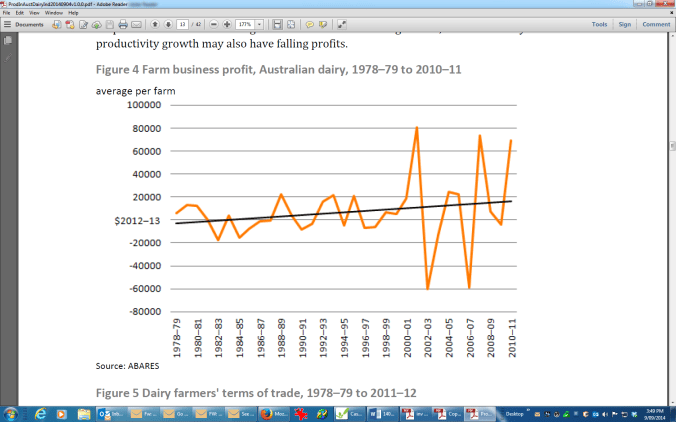
At the time, I summarised my answer as “reliable profitability”. I posted the charts below showing just how far dairy farmers’ terms of trade had slipped and the wild fluctuations in profitability.

DairyTermsTrade

DairyBusinessProfit

“Productivity in the Australian Dairy Sector”, ABARES, September 2014

There’s one more factor I missed: confidence.

Writing for the latest edition of The Australian Dairyfarmer magazine, Dairy Australia managing director Ian Halliday notes that :

“In 2015, confidence among dairy farmers was at 75 per cent. In February this year, confidence had fallen to 65 per cent reflecting the dry seasonal conditions and also what milk prices were looking like for 2016-17 when considering the global price outlook.”

“Following the sudden milk price cuts in late April, which affected up to 65 per cent of all dairy farmers, we conducted another survey to get an understanding of changes in farmer confidence. This sample, although smaller, indicated confidence nationally had droppedd to 45 per cent.”

I’m willing to bet that confidence has fallen to historic lows after the Murray Goulburn opening price announcement.

What’s needed now is:

  • Transparency
  • Risk management strategies to deal with volatility
  • A more level playing field that provides farmers with real choices when dealing with processors.

These are the ingredients of reliable profitability and, without it, we’ll be continually wrestling the gorillas for the crumbs of a perpetually shrinking cake.

The haves and have nots of Australian dairy

CowTongue

I’ve had requests from farmers, investors, the media and even politicians for an explanation of how milk prices work (or don’t). I’m going to start with the factors that affect the price a dairy farmer in Australia’s south-eastern states receives.

  1. Who buys Old Macdonald’s milk?

The opening prices of most of the processors are in:

ACM $5.30
Bega $5.00
Lion (variable option) $5.00
NDP $5.00
Warrnambool Cheese & Butter $4.80
Fonterra $4.73
Longwarry $4.60
Burra Foods $4.40 to $4.60
Murray Goulburn $4.31
ADFC To be advised

It’s a massive spread of prices, with the top almost 25 per cent higher than the bottom. And it doesn’t stop there. The pricing systems are incredibly complex, with the prices no more than weighted averages. I know of a farmer supplying MG, for instance, who will receive just $3.79kg MS for his milk. I’ll explain that later in this post.

But, why, you ask, doesn’t Old Macdonald simply choose the buyer with the highest price?

It’s easy to change factories. You just call, make an appointment, fill in some forms and voila, a new sign hangs on the gate! But the reality is that there are lots of other factors in play:

  • Not all processors collect milk in every region. ACM, for example, does not collect milk from Milk Maid Marian’s district.
  • Many farmers are tied up with debts to their current processor or incentives for flat milk supply that would see them penalised tens of thousands of dollars for leaving.
  • Some farmers are contractually bound to the processor as part of share acquisition or “Next Gen” programs.
  • Then, there’s the waiting list. Processors tell me that since the opening prices were announced, there are hundreds of millions of litres of milk on waiting lists for new homes right now. The processors will cherry-pick those that suit their ideal profiles. In fact, many processors already have too much milk and have simply closed their books.

2. The breed of cows and what they’re fed
As a rule of thumb, if you’re not familiar with this industry pricing, you can convert prices expressed in kilograms of milk solids (kg MS) into cents per litre (cpl) by dividing by 13. So, $5.30 per kg of milk solids equates to 41 cents per litre and $4.31 equates to 33 cents.

It’s a formula that works pretty well for the 80% of Australian dairy cows that are the classic black-and-white Holsteins.

But not if your cows are Jerseys. Around 11% of Australian dairy cows are Jerseys, which produce around 30% less milk than Holstein Friesians but a lot more fat for every litre. According to ADHIS statistics, HF cows’ milk contains an average 3.83% butterfat and 3.24% protein, while Jersey milk is creamier at 4.76 % fat and 3.67 % protein. This means that returns from Jerseys appear higher than those of HF in terms of cpl and lower in terms of dollars per kg MS.

3. When the cows give the most milk
Every cow produces no milk for two months until she calves, then her milk production increases steeply for a couple of months before tapering off again. We call this her “lactation curve” and when you add together all the herd members’ curves, you get a farm’s “milk supply curve”.

It makes sense to have the herd’s milk production peak when there is the most grass in the paddocks. Inevitably, that’s in Spring. Of course, if all herds peaked in Spring, it would cause big trouble for the processors. The entire Australian dairy milk supply is getting less and less seasonal over time because the processors offer more money for “off peak” milk.

Here’s an excerpt from my own farm’s income estimate to show you just how much the price changes over the year with Fonterra.

FonterraTotal

For MG suppliers, the shift can be far more dramatic if suppliers elect to provide “flat milk” but I would need to dedicate a blog post to explaining this aspect of its system.

The differences in payment systems mean that even if a farm receives the average milk price from one processor, it might not from another.

4. Compulsory charges and levies
Most processors have compulsory charges that come off the headline price. These are not trivial and amount to tens of thousands of dollars. In my farm’s case, we pay a transport levy that amounts to 35 cents for every kilogram of milk solids we sell. On top of these, there are Dairy Australia and Dairy Food Safety Victoria levies.

5. Bonuses for the big and beautiful
If you think you’re across all that, don’t forget there are productivity incentives that favour larger farms and MG still has a growth incentive for farms supplying more milk than the year before. These can be very significant. There are also quality bonuses (and/or penalties) with different processors having different benchmarks.

6. Clawbacks
As you might already know, both MG and Fonterra dramatically dropped their prices for May and June to bring back the overall price. They have both come up with “support packages” for suppliers. Farmers are now beginning to pay for those. Fonterra suppliers are on interest-only this year and principal repayments will begin in the next financial year. MG suppliers are paying off their packages in the form of an artificially-lowered milk price already.

7. Special deals
Farmers were outraged back in 2012 when it was revealed that even the co-op was offering special deals for the really big farms. Nobody can say for sure how common these are today.

The bottom line is that every farmer needs to get an individual income estimate from processors to be sure what their milk price really is and what it would be if they supplied a different factory. Not all milk is created equal.
Which dairy farmers will survive?

Damocles

The Sword of Damocles. Pic credit: Moritz Aust

I was digging a post hole today when my phone binged a message in my pocket. And binged again and again and again and again.

I paused to check the messages, still with the post hole digger under my shoulder and stared in shock at the Murray Goulburn announcement.

As the biggest milk processor, MG tends to set the benchmark price and, in the new financial year, it will be $4.31 per kilogram of milk solids or about 33 cents per litre. After you take off the compulsory fees the processor charges for milk collection, it’s around 30 cents. Even less again for the many Gippsland farmers whose cows calve in Spring in line with Mother Nature.

It costs a farmer like me about:

  • 40 cents to produce a litre of milk when the season is good and nothing goes bust and the bank is happy with interest-only; or
  • 42 cents to make milk and maintain the farm; or
  • 45 cents to breathe and grow.

On top of the drought we’ve just endured, this fresh set of bad news will finish many farmers off. Not just the inefficient producers, either. Far from it.

Those coasting along with little debt will emerge at the end of the year with the fewest scars. In fact, it will be the youngest, most ambitious farmers who heeded the calls for growth from Murray Goulburn, Fonterra and the banks just 18 months earlier and invested accordingly who are the most vulnerable.

We stand to lose the innovators, the future leaders of our industry. They are also those who were in line to buy the properties of retiring farmers.

I am not a Murray Goulburn supplier but the opening price announcement left me reeling. The phone rang. In a daze I answered it but found I simply could not speak.

Words fail me and with Fonterra yet to announce the price it will pay us for our own milk, the sword of Damocles hangs low. Fonterra’s behaviour over the last few weeks has been inconceivable. Will it be able to rebuild any trust tomorrow?

An EGM for MG: who, what, where, when and how

Devondale logo

Understandably, there’s been a lot of angst among Murray Goulburn’s farmer-supplier-shareholders.

At the heart of debate in dairy circles has been a proposal for an extraordinary general meeting (EGM). But few MG suppliers feel sure of what an EGM really entails, especially since the massive changes to MG after the co-operative was partially listed last year.

I am grateful to  MG’s Executive General Manager Supplier Relations, Robert Poole, for answering some important questions for Milk Maid Marian.

Q: What’s needed to trigger an EGM at Murray Goulburn?
RP: Calling a General Meeting is a fundamental right of all supplier/shareholders. To call a General Meeting, supplier/shareholders require 5% of shareholder votes – as defined under our Constitution and in line with the Corporations Act. For any resolution to pass at such a meeting, a 50% vote of shareholders is required, unless it is a constitutional amendment which requires 75% support.

Q: Where are EGMs held and can they be shared electronically (eg: via video link) for those unable to attend?
RP: Murray Goulburn’s general meetings are normally held in Melbourne. Typically we don’t provide remote access to these meetings due to cost considerations.

Q: How long after an EGM is triggered must it be held?
RP: If shareholders with at least 5% of the votes that may be cast at the general meeting request that Murray Goulburn convene a general meeting, the meeting must be called within 21 days and must be held no later than 2 months after the request is given to the company.

Q: Who pays for an EGM called by supplier shareholders? What is an indicative cost?
RP: If shareholders with at least 5% of the votes that may be cast at the general meeting request that Murray Goulburn convene a general meeting, it is expected that the costs of the meeting would be borne by Murray Goulburn.  The cost varies depending on venue availability and number of attendees, so it is hard to define until closer to the event.

Q: What is the format of an EGM? Can questions be asked unannounced from the floor? Do resolutions need to be submitted in advance or can they be proposed from the floor on the day?
RP: It is expected that questions will be allowed from the floor.  However, any resolutions to be proposed at the meeting must be set out in the formal request given to Murray Goulburn to convene the general meeting. Effectively, this is to ensure that shareholders will know what business is to be dealt with at the meeting, and can decide whether to attend or not, or if they attend by proxy, they can instruct their proxy how to vote.

Q: For a resolution to pass, does the 50% vote of shareholders apply to those at the meeting or the entire shareholder group? What is the voting process on a resolution?
RP: An ordinary resolution must be passed by at least 50% of the votes cast by shareholders entitled to vote on the resolution. A special resolution (eg. for proposed changes to Murray Goulburn’s Constitution), generally must be passed by at least 75% of the votes cast by shareholders entitled to vote on the resolution.

At a general meeting, a resolution put to the vote must be decided on a show of hands (where each shareholder present who is entitled to vote has one vote), unless a poll is demanded (where each shareholder present shall have one vote for each ordinary share held). In the event that a poll is called, this means that all the vote will include the proxies received prior to the meeting as well as those voted on the day.

Declaration: Marian’s farm no longer supplies Murray Goulburn but she does hold non-voting shares in the unit trust.

Plain English guide to the dairy concessional loans in Victoria

Victoria

Like just about everything else involving the dairy debacle, the facts surrounding the Commonwealth concessional loans for dairy farmers and their roll-out in Victoria has been clouded in confusion.
A big thank you to the office of Minister for Agriculture and Regional Development, Jaala Pulford, for answering Milk Maid Marian’s questions.

  1.        Who can apply?

The Commonwealth Government has indicated the loans will be available to farm businesses that supplied milk to Murray Goulburn and/or Fonterra in 2015-16. Evidence of a milk supply contract and/or statement in 2015-16  to Murray Goulburn and/ or Fonterra will be required to prove eligibility.  The Victorian Government has sought changes to eligibility requirements to enable suppliers of other processors to access the scheme. Changes have also been sought to ensure share farmers and young farmers can access loan arrangements. The Commonwealth has not made the requested changes.

  1.       $30 million is available while the Federal government is in caretaker mode. This won’t cover many farms. Why must the rest wait until after October?

The Commonwealth Government’s Dairy Support package includes $55 million in Dairy Recovery Concessional Loans until 31 October 2016.  The Commonwealth has offered loan amounts of $30 million to Victoria; $10 million to New South Wales; $10 million to Tasmania; $5 million to South Australia.

Victoria has sought advice from the Commonwealth on loans available after 31 October 2016 arguing that Victoria’s allocation of the total $550 million pool should reflect that 70% of Australian dairy farms are located here. The Commonwealth have not provided advice on future allocations.

  1.        How much can individual farmers access? Originally, media reported that half a farmer’s debt up to $1 million  could be borrowed but recent media reports indicate a cap of $200,000.

The Commonwealth Government has determined loan amounts will be up to 50 per cent of total eligible debt to a maximum of $1 million. Eligible debt means debt that has been established upon commercial interest rates, terms and conditions and/ or debt to a dairy processor.

  1.        What is the interest rate and is it fixed or variable?

The interest rate is variable and set by the Commonwealth Government.  As at 1 June 2016 the rate is 2.71 per cent.

The Commonwealth Government variable interest rate will be calculated based on the average of the daily 10 year Commonwealth bond rate over a specified six month period. The concessional interest rate will be reviewed and revised if necessary in accordance with material changes to the Commonwealth 10 year bond rate, where a material change is taken to be a movement of 10 basis points (0.1 per cent). The rate will be published on Rural Finance’s website.

Victoria has sought changes to the scheme so that farmers can access lower interest rates available under the Natural Disaster Relief and Recovery Concessional Loans scheme. This scheme provided rates of 1.67% to storm affected farmers in the Sunraysia in 2014. The Commonwealth has not made the requested changes.

  1.        What if banks hold land titles as security for loans and don’t want to relinquish it to Rural Finance?

Based on previous experience with other Commonwealth Government Concessional Loans scheme, this scenario is rare.

  1.        Many farmers are reluctant to apply for drought loans because the process and criteria are too difficult. Have you been able to make it simpler for farmers to apply for these concessional dairy loans? If so, how will they be different and are the criteria publicly available?

The Commonwealth Government determines the eligibility and requirements for the Dairy Recovery Concessional Loans. Victoria has sought a number of changes to improve eligibility criteria but the Commonwealth has not made the requested changes.

  1.        Minister Pulford quoted as saying only 70 farms will access the loans. What is the basis for that figure?

The estimate is based on the experience of other previous and current Commonwealth Government concessional loans schemes in Victoria. The figure assumes full subscription and the average loan amount of previous comparable schemes being around $450,000.

NOTE from Milk Maid Marian: At the time of writing, Rural Finance was taking registrations of interest for the concessional loans. Call 1800 260 425.

What it means to me when you buy branded milk

Photo credit: ABC Rural

Every time you reach into the supermarket fridge and choose branded over unbranded, I say a little thank you.

Those pictures of empty supermarket shelves buoy my spirits – and those of so many farmers I know – during what is otherwise a crushing experience.

It’s impossible not to be moved by the support of friends and strangers alike. To know that people are doing what they can to help makes us feel less helpless, too.

You are the people who made dealing with our plight a political priority. You are the ones sending the message to supermarkets that milk has a value and that farmers do, too.

Thank you from all of us here on the farm.
– Wayne, Marian, Zoe and Alex


Will the storm clouds clear?

With this week’s east coast low, the drought may be over but a new milk price drought seems set to linger, with some analysts even calling the downturn a “long term significant reset of dairy economics across the globe“.

I asked Rabobank senior analyst Michael Harvey for the bank’s take on what has caused prices to fall and what it will take to restore farmer fortunes. I’m grateful for his explanation below.

HARVEY_Michael_41961R

Uncertainties have surfaced about the true shape of the global market and its medium-term proposition. Are there factors at play that will continue to plague the market and do we need to reset our interpretation?

This is where Rabobank can provide some independent insights. There have been some changes to the market which I will explore and this commodity crunch is what Rabobank defines as a super-cyclical caused by a number of events leading to a perfect storm:

•    The ‘floor’ price in the global market is weaker, and lower
•    The EU has removed a structural handbrake on milk supply – the rate of growth in Europe has surprised even us, and was the main reason we missed our original expectations for a price recovery!
•    There is a downshift in the speed of growth in the Chinese economy (and with it the world economy)
•    The slowdown of Chinese dairy demand growth (this occurred before the crash in prices)
•    The reduction in the prices of key commodities (and expectation that they will probably be lower in the medium term that we expected) which impacts feed prices
•    The end of the Chinese corn price support scheme
•    The failure of states in the Middle East

Political impacts on pricing
When gauging the global price floor, you need to look at intervention pricing systems.  A few years ago the United States industry removed its intervention system and replaced it with a margin protection program. The floor is already weaker because of this.

The EU still operates a public intervention system and its wholesale market is weak enough right now that product is moving into intervention stores quickly. The price in Europe is set in Euro per tonne. Shifts in currencies have seen the intervention fall US$500/tonne when converted to US dollars which means the global floor price is not only weaker but lower.

A removal of a 30-year milk quota system is no doubt structural adjustment. It was always going to lead to an uncomfortable period for the global market. However, global markets have simply been overwhelmed by the sheer volumes. A slowdown in Europe milk supply will be the biggest factor to help correct the ship.

In the first year without quotas, the EU produced 153 billion litres of milk in total. This was just shy of 4% more than the same corresponding period (or in other terms 5.5 billion litres). That’s a lot of extra milk.

The growth in milk supply growth across Europe has not been uniform. Twelve of the 28 EU members had 2% or less growth and the Dutch and Irish sectors have been responsible for 45% of the growth.

But the signs of a slowdown in overall EU milk production growth are emerging. It will take a few more months yet but, by late 2016, this growth should grind to a halt. Rapidly falling milk prices and poor weather will be key to supply correction.

Other factors will also be at play. For example, in the Netherlands the introduction of ‘phosphate rights’ will force Dutch dairy farmers to reduce herds. The pressure won’t kick in until next year when new rules are enforced but there will be a need to reduce herds.

The good news
Rabobank is confident the global market will turn around and this is within sight. There will be other supporting factors helping to rebalance the global market including:

•    Global supply growth outside of Europe – major exporters of dairy (Australia included) have seen lower farmgate prices and milk supply growth slow. But stocks do exist and need to be run down
•    Sluggish dairy demand – macro headwinds and weak consumer confidence linger in many economies; but are now being offset by retail price relief and increased dairy promotion
•    China’s well-documented ‘rebalance’ – China buyers have mostly worked through excess stocks and are likely to increase import volumes over the course of 2016
•    Oil prices – a recent rally signals the end of the global surplus. Oil prices will increase again – but remember this is a good thing (for dairy importers) and bad thing for dairy (production costs)
•    The cost of production for many dairy producers is lower right now due to cheap feed costs and a period of low fertilizer and interest rates

What about Russia – one of world’s largest importers of dairy? Russia’s trade ban is coming up for a two-year anniversary with no immediate end in sight. But Russia will eventually end the embargo.

Questions remain as to Russia’s long-term role in global markets. European cheese exporters may be cautious in rushing back in to this market. Meanwhile, Russia continues to build alternative supply chains – the success of this strategy is yet to be proven successful. Also, the collapse of the Russian economy means dairy demand and consumer purchasing power is weak irrespective of the trade ban.

Global pricing will get substantially better in the medium term
In Rabobank’s opinion there has not been any major shift in the medium-term fundamentals. The global market will present good opportunities to deliver profitable returns for Australia’s dairy sector – with the right export strategies. Here is our logic:

•    Demand growth is still expanding the quickest across the developing world, including Asia
•    These economies are net importers of dairy; and self-sufficiency will continue to be challenging going forward
•    The cost of producing in many of these regions is expensive. The case in point resides in China where the cost of producing good quality milk can be as high twice as expensive as in Australia. So there is an incentive to buy imported milk
•    Consumers in these markets also trust and prefer imported products which strengthens the trade opportunities
•    Australia and New Zealand will simply not supply all the milk these market needs. This means the global market needs more milk from Europe and the US in the medium term
•    Dairy producers in Europe and the US are structurally higher cost producers of milk than Australia.
•    Current global prices are not sustainable for any dairy producers anywhere in the world and simply need to improve.

Better times do still lay ahead. Weak global market conditions are at the core of the current problem but by early 2017 the global market will be in better balance. However, the market will remain volatile and under current pricing models dairy producers will continue to absorb this risk.

Hopefully trust along the supply chain can be restored, as the viability and sustainability of the sector remains healthy beyond the current crisis.