Who wants to sue who and who will pay?

DevondaleTwirl

One of the first things farmers asked about the Murray Goulburn and Fonterra announcements was: “Can they really do this? Is it legal?”.

The lawyers have duly arrived.

I know of three firms circling Murray Goulburn right now. While Slater & Gordon was the first to announce it was opening an investigation into a class action against MG, it has not yet confirmed whether it will proceed.

Last week, a so-called “maverick” lawyer, Mark Elliott, reportedly filed a class action against MG on behalf of unit holders who had bought shares in the listed part of MG.

At the same time, another lawyer, David Burstyner of Adley Burstyner working together with Harwood Andrews, is building a list of farmers affected by the sudden milk price collapse who might be interested in one or more of the three legal strategies:

  • a “group claim” against a range of processors to recover financial loss;
  • steps to change and take back control of MG management, and;
  • an urgent court order stopping the claw back.

The big question on farmers’ lips is: if MG gets sued, won’t farmers ultimately pay the price?

The stakes are high because MG farmers face a double whammy:

  1. Now more than ever, farmers are acutely aware that when processors don’t do well, the answer is to slash the price paid to farmers.
  2. Every farmer who supplies milk to MG must own MG shares, so its falling share price is robbing many retirement nest eggs. Some are even facing margin calls on loans they took out to buy more shares.

The targets
The Elliott class action is targeting the MG unit trust and its directors. The good news is that the trust and directors should already have insurance that deals with such a claim.

There’s likely, however, to be an excess they will have to pay, which the lawyers call “deductibles”, which means the insured party has to cover part of the loss out of its own resources as “self insurance”.

On top of that, director’s insurance is no silver bullet. This type of insurance is complex and it’s quite possible that out of court settlements won’t be covered.

The proposed action from David Burstyner could target any of the processors who stepped down: MG, Fonterra, Lion and NDP. Mr Burstyner expects to know in the next few weeks. If launched, class actions usually play out over several years, so buckle yourselves in.

Will it help farmers?
Because there’s likely to be plenty of coverage of the Elliott class action for unit holders, I’m concentrating on the Adley Burstyner proposal for farmers and its potential impact on MG, the hybrid co-op.

Speaking with Milk Maid Marian on the weekend, Mr Burstyner said his firm is investigating an injunction to halt the milk price drops.

“An injunction is difficult to secure but the situation is urgent,” he said. “We are prepared to try if it is achievable, but it depends on what we learn from farmers”.

He also plans a “group claim” against processor(s) funded by a litigation funder, which roughly works on what some people call a no win no fee arrangement (see more at http://www.adleyburstyner.com.au/group-claim-faq). This arrangement minimises the risk to participating farmers but, as a guide, around 30% of the proceeds after costs is likely to go to funders. Mr Burstyner said the participation of thousands of farmers is necessary but that it’s possible because more than 3000 supply MG and Fonterra alone.

At the same time, Mr Burstyner said he hopes there will be no need for “all-out war” and that a class action could be avoided with the processors reaching a settlement with farmers that could also improve the way milk prices are set in future.

MG, however, is not a normal company. The fundamental ways it interacts with farmers must be put to co-op members and voted on rather than hastily negotiated on the court house steps.

But what if “all-out war” is the only option? Mr Burstyner acknowledged the possibility of short-term pain for the processor (which may carry through to its supplier shareholders) but the long-term benefit would be a “clean up” of the industry.

Asked why farmer shareholders could not simply reshape their co-operative by voting on special resolutions rather than litigation, Mr Burstyner strongly agreed that strategies along those lines could be very useful, saying, “Although MG is no longer the cooperative it was prior to July 2015, we would like to assist farmers with the solutions which could be possible in the newly formed corporatised structure, using farmers’ significant rights as shareholders which we think could really improve their position.”.

In notes he offered to Milk Maid Marian, Mr Burstyner clarified his point:

o    Murray Goulburn Co-operative Co Limited ACN 004 277 089 is an unlisted public company. It is controlled by its shareholders who for present purposes are the farmers. MG is no longer the same cooperative structure it was before July 2015.

o    Shareholders with more than 5% of votes can call a meeting or ask the company to call one.

o    They can sack the board and appoint alternatives by ordinary resolution.

o    There is a 2-month notice requirement for certain resolutions, for example, sacking board members.

o    The Company (under new management) may even be able to bring a claim against former Directors for not satisfying their director’s duties.

Mr Burstyner is keen to hear from farmers who would like to be kept updated on these three types of potential legal action (in the short term an injunction or challenging management, or the long term solution of a class action to recover financial loss and bring about systemic changes).

You can register your interest at http://www.adleyburstyner.com.au/farmers-farm-gate-milk-price-action.

Mr Burstyner stressed that he has no interest in any legal strategies if farmers don’t want them. Without interest from significant numbers of farmers, Adley Burstyner and Harwood Andrews will close their file.

Important: this post is general commentary only, please seek legal advice before considering any action.



MG and Fonterra on how to prevent this happening again

DuskRainbowDark

If there is a silver lining to the cloud over dairy farmers’ heads at the moment, I hope that it is change. So, with this in mind, I asked the two big processors at the heart of the storm, Murray Goulburn and Fonterra, to answer one simple question in 250 words or less:

“What needs to be done to make sure this never happens again?”

A big thank you to MG acting CEO David Mallinson and Fonterra Supply Manager, Matt Watt, for their answers below.

Murray Goulburn acting CEO, David Mallinson:

“Our co-operative structure remains fundamentally important because it enables us to act with a sole and unwavering purpose – paying the strongest farmgate milk price possible. Optimising milk intake to deliver the most profitable products rightly belongs at the heart of every decision we make.”

“In the short-to-medium term, we will remain susceptible to fluctuations in global commodity markets while our shift to value-add output continues. Rigorous planning is required to support suppliers during periods of downturn, given the intrinsic influence of commodity markets on the overall milk price.

“To ensure suppliers can sustainably manage their farm businesses, the Board is committed to providing clear farmgate milk pricing notifications across each season. We will implement a mechanism that provides regular and accurate full year forecast guidance but includes an opening price designed to absorb the sort of downturn seen in FY16. 

“The Board and management is united in its drive to ensure MG has the right strategy, executes it well and provides suppliers with consistent, reliable farmgate milk price notifications.”

Fonterra Australia General Manager, Australian Milk Supply, Matt Watt

There are a number of factors that have led to this “perfect storm” for dairy, so the answer is complex.”

“First and foremost, the industry needs a transparent milk price that is reflective of market realities. Farmers can manage their businesses through low prices and volatility, but only if they have timely, clear, and accurate information about milk price based on market signals so that they can make decisions to help manage volatility. Further, having a market-based milk price will facilitate innovation in pricing and risk management practices. For example a “one size fits all” pricing system, like those that our industry has seen in the past, may not be the best fit going forward. The industry needs to identify new ways to factor market volatility into price, to manage risk and bolster confidence during a downturn.

“In addition, we need to ensure:

  • A closer link between on-farm production and the realities of the market – our industry cannot continue to promote growth of the industry at a time when there is an oversupply of dairy globally. Our industry needs to listen to the market and adjust production to meet demand.
  • Improved efficiencies across the industry so that everyone can benefit – we need to find newer and greater ways of doing more with less, from the farm right through to the factory.”


Why the system is broken

The interaction between processors and farmers is bizarre to outsiders. The way it works is this:

Out of a handful of processors in the district, you ask one to collect your milk, although, if you’re unlucky and live somewhere a little remote, you might not actually have a choice at all. We’ll call this processor “your” processor for convenience.

Whichever processor you choose, they tell you what they will pay for your milk on July 1 – sometimes after July 1. This “opening price” is meant to be the lowest anticipated price, the one you can budget on. The only other time the price has fallen below the opening price in the last couple of decades was during the global financial crisis and even then we had a couple of months’ notice.

The price generally goes up along the way from there, though, unless you are one of the very few farmers who gets a fixed price, nothing is actually guaranteed after that.

It all depends on the exchange rate, global commodity prices, the performance of the biggest processor in the market and the success of “your” processor’s particular product mix.

What’s the performance of the biggest processor in the market and the success of your processor’s particular product mix got to do with the amount farmers are paid, you ask? Everything.

And it’s a system that used to work brilliantly. Once upon a time – not too long ago for those sporting the odd grey hair – there were not one but two major dairy co-operatives in the southern states: Bonlac and Murray Goulburn.

Every cent of profit the two co-operatives earned was returned to their farmer-shareholders and, because their whole reason for being was to maximise profits for their farmers, they effectively set a base for the farm-gate milk price.

Neither co-op could get too lazy or arrogant because there was strong competition from the other. Then, disaster struck, as reported by The Age:

“Crucially, Bonlac is processing only 1.6 billion litres of milk. Over the past 10 years, its share of Victorian milk production has declined from about 40 per cent in 1992 to 16 per cent in 2002.”

“Bonlac’s milk plants are running at only 75 per cent of manufacturing capacity. Particularly underused are the factories at Darnum in West Gippsland and Stanhope in northern Victoria.

“Debt, the result of an ambitious expansion into value-adding branded products in the 1990s, is still crippling the company, despite asset sales creating paper profits in the last couple of years, and the repayment of $185 million of debt.”

Now, in the midst of an ambitious expansion into value-adding branded products on the back of a partial listing, MG is in turmoil. Its MD and CFO have resigned and the milk price has collapsed, triggering ASIC and ACCC investigations, at least one class action and a share price meltdown.

Bonlac is long gone and, in the eyes of many farmers, MG has lost the title of reliable pacemaker. The system is broken.

It’s no longer acceptable for dairy leaders to tell farmers to concentrate on their farm businesses and blindly follow their calls for growth. It’s time we actively forged a new era for Australian dairying.


What The Project didn’t have time for me to say

TheProject

The Project delivered a powerful story last night about the turmoil we face that included footage of Wayne recounting my unvarnished reaction to the price drop.

I’m upset and I’m anxious about the future but I’m okay.

The price drop felt like the last straw. We’ve been battling a horrid drought that has already drained much of my emotional reserves over the last year. To hear that we would now have to face this on top of what’s pretty much guaranteed to be a rotten milk price next financial year was just overwhelming. The light at the end of the tunnel suddenly became very dim.

But Wayne and I are a strong unit and we’re not giving up on anything.

We will get through this. We are luckier than many others and I am inexpressibly grateful to the people around me, especially Wayne.

I’m grateful to the generous dear people who have rung out of the blue just to ask “how’re you going?” over the last few weeks. I’m grateful to the strangers who have been moved to write notes of encouragement for farmers on Facebook forums. I’m grateful to the journalists who have helped share our stories.

What you didn’t hear me tell The Project was that we are resilient and we do this because we love it. That hasn’t changed.

What I do hope is that from this seismic shock will come seismic change. There has to be a better way both for our little family and the thousands of other farming families across the country. We cannot let the opportunity to reshape the future slip through our fingers now.


What the Fonterra Friday 13 announcement means in plain English

This plain English explanation is for anyone as confused as I was on Friday following Fonterra’s second announcement.

The May and June milk price is still slashed to $1.91kgMS
The prices outlined in the original announcement still apply. Friday’s announcement concerns milk to be supplied in 2016/17 but the amount you receive hinges partly on how much milk you supply in May and June 2016. Baffled? Stay with me for a minute.

Loans are still available in the same format
Nothing has changed in terms of the loans announced on May 5.

Why the latest announcement?
Although nobody came out of the May 5 announcement a winner, if your peak milk production was in May and June, you suffered far heavier losses than farmers whose herds peak in Spring.

Fonterra’s Friday May 13 announcement is designed to even out the impact.

July and August milk now attracts extra for the volumes you supplied in May and June
Fonterra will pay $2.50 kgMS extra for July and August milk in 16/17 but only for up to the same volume of milk you supplied in May and June.

Here’s an example: if Old Macdonald supplies Fonterra 10,000 kgMS in May and 10,000 kgMS in June but 15,000 in July and 15,000 kgMS more in August, she will be paid the extra $2.50 on 20,000kgMS rather than on 30,000 kgMS.

The remaining 10,000kgMS will be paid at the normal July and August rates (that’s base price + quality + production + seasonal incentives). So, Old Macdonald would find $2.50 x 10000 = $25,000 extra in each of the milk cheques that arrive on August 15 and September 15.

If, on the other hand, Old Macdonald supplies Fonterra a total of 20,000 kgMS for May and June but only 15,000 kgMS for July and August, she will still be paid the extra $2.50 kgMS on 20,000 kgMS.

The money is coming from the rest of the year
The milk price Fonterra pays farmers is made up of four components:

  • A base price paid at the same rate every month of the year for fat and protein (fat + protein = milk solids)
  • Quality incentives
  • Production payments
  • Seasonal incentives – which are apply in the “off-season” months of January to July.

To pay for the extra money announced on Friday, Fonterra will lower the base component of the milk price by 19 cents per kgMS. In other words, you may receive extra money in your August and September milk cheques but money will also be deducted every month for the whole of 16/17.

About this post and me: Milk Maid Marian supplies milk to Fonterra and this post was checked by Fonterra Australia for accuracy.

Why don’t dairy farmers just…?

Comment

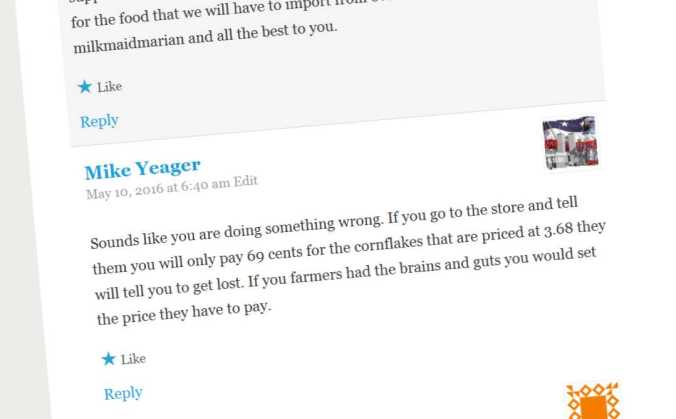
Of course, Mike is right. You can’t walk into a shop and demand a box of cornflakes at a fraction of the cost.

You can’t cut someone’s wage because your business is losing money. Nor can farmers choose to pay less for stockfeed, electricity or shire rates just because the price of milk has fallen.

We dairy farmers are in a uniquely vulnerable position. We shoulder almost the entire risk in the dairy supply chain. It stinks. It’s grossly unfair. And when you read stories like Appreciating Australian Agriculture‘s below, it’s harrowing, too.


AppreciatingAusAg

So, if we have both guts and brains, why do we let others set the price for our milk? The reality is that dairy farmers have little choice in the matter.

Why not stop sending milk? You cannot switch cows on and off. You have to milk them every day, no matter what, and their milk needs to be sold within two days. It can’t be stockpiled until buyers offer a reasonable price. Of course, you could sell all your cows but then how would you pay your mortgage?

Why not find a buyer who will pay more? Because there are only a handful of buyers and they all offer about the same deal. They tell you the price of your milk. If their sales strategy goes sour, you get paid less. Anyhow, right now, few milk processors around here are willing to take on new farmers. You’re stuck right where you are.

Why not sell the milk direct? Yes, a few farmers do. It costs a six-figure sum to set up a processing plant and takes about a year to get it approved by the regulators. Running that plant and marketing your dairy products is another full-time job on top of dairy farming. It’s also another completely new skill set. In any case, not many farmers have deep enough pockets to establish the plant and endure the inevitable losses during the time it takes to become commercially successful.

Why not just sell the farm and do something else? Well, that’s a question plenty of farmers are asking, too, but it can take years to sell a farm and we do it because we are good at it and we love being farmers.

The reality is that when a few thousand small family businesses sell a highly perishable commodity to a handful of very large corporations, the playing field is anything but even.


Straight-talking UDV president Adam Jenkins on milk price cuts

In the confusion that’s followed the cuts to milk prices, I asked the president of the United Dairyfarmers of Victoria, Adam Jenkins, how the UDV was responding.

Adam had some very clear messages for milk processors, politicians and bankers. A big thank-you to Catherine Jenkins for filming Adam’s answers to my questions in their calf shed on a very windy day.

This video is the first in a short series addressing the milk price crisis.


Decisions, decisions, decisions

CowsDairyTrack

It’s happened. Fonterra Australia, the factory that processes our milk announced yesterday that it, too, would pay farmers less.

Already five days into May, Fonterra announced the price for May and June’s milk will be $1.91 kgMS, which equates to about 14 cents per litre. Milk costs about 42 cents a litre to produce. At least it does normally, when you haven’t been in a drought for a year or so.

So what does a dairy farmer do? Here are our choices:

  1. Send the cows on holiday for two months
    This option has immediate appeal. We would let the cows due to calve later this year go dry early. It’s much cheaper to feed a cow who’s not milking but because we’re in drought, we still need to pay for feed to keep them going. We still also need income to pay the mortgage!
  2. Sell cows
    We’ve already sold a lot of cows in the face of the drought but any cow that is not in calf and is not producing a lot of milk will have to be sold immediately. Why not sell the lot? Because that would make it very difficult to pay the mortgage for long. It takes years to rebuild a herd.
  3. Sell other assets if you can
    Maybe not Murray Goulburn shares…
  4. Feed the cows less and cut other costs
    We are currently feeding the milkers as much grain as we dare because of the drought. It’s ridiculously expensive. Maybe we can turn the dial down a little bit. They will produce less milk but they may not lose weight if we are careful.
    We’ve already cut a lot of other costs to find our way through the drought but I will be doing all the little things we can.
  5. A combination of all of the above
    The best strategy is often multi-pronged.
  6. Take on more debt
    Recognising that survival on 14 cents per litre is not feasible, Fonterra has offered farmers loans to be paid back (with interest, mind you) over the next few years. Or you can of course visit your friendly bank manager.
  7. Sell the farm
    This will be the final straw for some but it’s likely to take a year or two to sell a farm so you’d still have had to suffer the losses.

In the last post, I wrote that we’d been advised not to lose our vision for the farm. We’re still on course but the perfect storm has well and truly hit with more force than I ever imagined.


Despair, anger, disbelief.

3wisecowspsycho

Lots of dairy farmers are naturally cynical and, let’s face it, we’re never entirely happy with the weather forecast. But we are optimists at heart because things will always be better next season.

Not this season.

I have never seen my fellow dairy farmers so subdued as they were at a meeting last night. Dinner at the local pub was laid on – a rarity that normally guarantees a festive mood – but somehow it felt like more like a last supper. Nor have I seen such anger online.

Partly, I think, it comes down to being battle-weary. Around here, it’s been a disastrous season. Dry-land farmers have not been able to grow grass and the La Nina we were hoping for still hasn’t arrived. By now, we should be building a wedge of grass to get the cows through winter. Instead, paddocks are eaten to the boards while farmers wait for resown paddocks to fire up.

The conventional wisdom is to apply nitrogen now while the soil’s still warm enough to grow grass. Many farmers at last night’s meeting had not applied any urea yet despite its unusually attractive cost this year because the soil is still too dry.

We can buy in more fodder or sell more cows. Fodder is getting hard to find and expensive, too. Many of us have already culled hard. The options are narrowing. We need something to go right.

It isn’t. Farmers seem sure that the milk price for 16/17 won’t be good. Will it be devastating? We’re all wondering and worrying.

On top of all this came the Murray Goulburn announcement that it had overspent this year and will have to claw money back from farmers for the next three years. None of it makes sense. Many farmers had hailed the MG plan as visionary, something that would transform our industry to create sustainable prosperity. But the loss of so much money in so little time is incomprehensible.

It’s a blow from left field that will leave barely a Victorian dairy farmer untouched. MG is the pacemaker for the entire industry. Processing half our state’s milk and 38% of Australia’s, it sets the benchmark for the southern farmgate milk price. When it falters, we all do.

In the face of all this, the message from last night’s speaker was simple: seek help, watch out for your neighbours and don’t lose sight of the vision for your farm. Good advice.