Australian dairy: does it matter if it’s sold to China?

Worth saving?

Worth saving?

Does Australian milk matter? We have to decide.

It seems two of Australia’s milk processors, United Dairy Power and Warrnambool Cheese and Butter, are about to be sold to China. Firms backed by the Chinese government are having unofficial talks that would put the price of WCB at a staggering $10 per share.  Meanwhile, the ruthless but charming Canadians continue to acquire a bigger stake of WCB.

Here, close to home, another Chinese firm has already purchased a formerly decommissioned factory and is repackaging milk powder to send back to China. (It’s been a debacle, with outraged and distraught workers regularly featured in the local papers desperate to be paid.)

It’s not limited to the dairy processing sector, either. The Chinese have been buying up our breeding stock for years and now, they want our farms, as Brett Cole reports in the Business Spectator:

“For more than a year, China Investment Corporation has contemplated acquiring Van Diemen’s Land Co, which owns and operates 25 dairy farms with 30,000 dairy stock. Other Chinese companies have moved decisively amid concerns about their nation’s safety standards.”

All this while our Australian farmer co-op, currently the highest bidder for WCB, languishes in the competition tribunal as it ponders – for months – whether we are allowed to bid at all.

Do you care? If you’re a dairy farmer, hell yes, you should. No foreign company cares about your future like you do or your co-op does. Perhaps worse still, once these assets are sold, the fragmentation and inefficiency of our processing sector is locked in, forever limiting the price farmers are paid for our milk.

If you’re not a farmer but an Aussie, there’s an awful lot to be lost. These international companies and governments so keen to pay more than twice the value of WCB are not irrational. They want control of their food. Does that matter to you?

Dear Joe, how will you be remembered?

Dear Joe,

Why have you betrayed me so cruelly?

You came to me in September with promises of fatherly love and affection. You described me as your pillar and that, after mining’s bloom had faded, I would be your everlasting rose. You said you needed me and that, without me, you would forever be insecure.

But now that my fate lays in your hands, you act swiftly to hasten the courtship of WCB by Saputo whilst locking me in the cellar, dressed in rags. I implore you to at least allow me to attend the ball so that I may win the hand of my beloved.

Your faithful Milkmaid

Okay, I never really fell for you, Joe, but here it is:

  • Before the election, you described agriculture as one of the five pillars of the economy and said that food security was important. I’ll hold you to that.
  • For Australia to have a dairy sector, it must be able to compete with the international goliaths. That means we need a big processor with scale.
  • Australia’s dairy farmers are sticking together and want to grow so we can be more resilient. We absolutely have to because we don’t have the subsidies, FTAs, cheap labour or government support enjoyed by most of our competitors.
  • Our 100% Australian farmer-owned cooperative exists to maximise farm gate prices and consolidation rather than competition is what’s needed. We are prepared to step up to the plate and invest in our futures.
  • You gave the giant, privately-owned, foreign Saputo a huge leg-up with swift clearance, declaring Australia “open for business” with a grin on your face.
  • Don’t hide behind the ACCC or the slow-as-a-snail tribunal. Where there’s a political will, there’s a way. Your Kiwi counterparts knew that doesn’t make sense and cast their equivalent aside to allow the much-admired Fonterra to take shape.
    To pin us to such a protracted process while ushering though our foreign competitor is to drive a stake through the heart of the co-op’s bid.
    You surely understand the irony of thwarting MG’s bid based on competition policy when it is Australian farmers themselves desperate to become more competitive who are driving this bid and, in turn, are being rendered non-competitive in this fight to keep WCB Australian-owned by you, our own government!
  • You are the biggest impediment to Australian farming families taking a greater stake in our own futures by keeping WCB Australian owned.
  • If you insist on holding us back, you will be remembered as the man who sold Australia’s dairy farmers down the river. And for what? The love of Lino?

Joe, it’s time you stepped out of the way and gave us a fair go.

How the political parties responded to a Milk Maid’s questions

For the first time in my life, I really don’t want to cast a vote, such is my disenchantment with the politics of our times. It seems more about point scoring and personalities than ever before. And now, perhaps more than ever before, ag needs leadership: we are on the cusp of a food boom with the promise of new golden agrarian age. An age that may never dawn for Australian farmers as we struggle with inadequate investment coupled with a tilted trading field (more on that soon).

So, waaaay back in February, when the election was but a twinkle in Julia and Tony’s eyes, I invited Joe Ludwig (the then Minister for Ag) and John Cobb (the Coalition’s Shadow Minister for Ag) to answer four fundamental questions here on Milk Maid Marian:

1. What are the three biggest challenges facing Victorian dairying?
2. How will you as a government address each of these?
3. What are our three most significant opportunities?
4. Please outline the top three policies that will help us seize those opportunities

After countless phone calls and emails to both politician’s offices, I received two recycled and general media releases from John Cobb’s office that didn’t answer my questions. Earlier this week, I did, however, get this post and pic from Joe Ludwig’s successor, Joel Fitzgibbon.

Good luck making the right choices tomorrow and over to Joel Fitzgibbon!

Joel Fitzgibbon meets a Hunter farmer

Joel Fitzgibbon meets a Hunter farmer


My deep thanks to Marian for the opportunity to speak directly with dairy farmers, families and their communities through her blog. It is a great project and as an MP from a country seat, and as Agriculture Minister, I appreciate the chance to outline Labor’s support for the dairy industry.

Labor’s strong plan for Australian agriculture will help dairy farmers become more productive, competitive and profitable. This is important for both those with a domestic focus and those looking to grab the opportunities of the Asia-led ‘Dining Boom’.

Challenges like drought, a high Australian dollar and falling prices have given the industry a tough decade and farmers are rightly looking to Government for assistance.

In response we have done a number of things. Our $420 million farm debt relief is now starting to help farmers who are viable but in need of a bit of short-term help. Our additional $20 million to help fight our war on weeds will help maintain pastures. Our ‘Fair Go For Farmers’ package seeks to redress the power imbalance between the supermarket chains and producers. Our ‘Planting the Seeds for Australian’s Farming Future’ will encourage young people into agriculture and give them the skills they will need. We have also committed more than $20 million to promote agriculture in primary and secondary schools. The Food in the Australian Curriculum initiative helps students better connect with food and appreciate the important role of producers. We must make sure there is a ‘next generation’ of Australian dairy farmers.

Each year the Government provides $18 million for dairy research and development. We have also invested $28 million into the Dairy Futures Cooperative Research Centre to invest in large-scale research projects and, more recently, $1 million through the Energy Efficiency Information Grants program for Dairy Australia to conduct on-farm energy assessments to help reduce energy costs for a number of dairy farmers nationally.

For those with an eye to export markets, our National Food Plan and our efforts to improve market access are important. Since 2005-06, Australian cheese exports to China have grown from less than $10 million to nearly $37 million in 2011-12. Cheese exports to Japan during the same period have grown from $298 million to over $422 million in 2011-12. The value of skim milk powder exported to China has grown from $14 million to $49.6 million at the same time. We can build further on this success.

Infrastructure, both soft and hard, will help everyone in regional Australia. That’s why we are building the National Broadband Network (NBN). It will transform the way dairy businesses operate, as well as the way your health services are delivered, and how students and your children (of all ages) access educational opportunities.

Road, rail and port infrastructure will be vital to help the dairy industry grow as new markets are opened, so Labor has delivered a record $60 billion towards transport infrastructure. Much of this investment occurs in regional Australia and dairy and other agricultural industries will benefit from resulting infrastructure improvements.

Australia is a great producer of milk and dairy product. Together we must ensure it stays that way.

You can find more on Labor’s strong plans for agriculture and regional Australia at http://www.alp.org.au

Hon Joel Fitzgibbon MP
Minister for Agriculture, Fisheries and Forestry

Is Woolies the dairy farmer’s white knight?

Woolworths has announced it plans to contract dairy farmers directly, with the promise of better farm gate returns. While a first for Australian dairy, this is not new in the UK where many of our supermarket executives earned their stripes. On a study tour of the UK, prominent Victorian dairy farmer Roma Britnell spoke to many English farmers about their experiences, so I was delighted when she agreed to answer a few questions for Milk Maid Marian.

Roma Britnell

Roma Britnell


MMM: What are the supermarkets proposing?
Roma: The supermarkets are thinking about setting up direct supply contracts with a select group of farmers in response to the public’s concerns that they are hurting farmers.

I saw a really good example of this in England after coops failed and processing companies became dominant. The supply contract I looked at was with Waitrose, a boutique up-market supermarket. Only a small number of farmers had the opportunity and got a few cents more than the rest of the English dairy farmers. They have to have a very flat supply and the quality standards are very demanding.

When I first explored this concept, the farmers were not too unhappy. Now, the supermarket’s demands are getting too difficult to accommodate. A lot depends on the relationship between the negotiators of the group and the company manager but because the group is small, the farmers are at a disadvantage.

MMM: Is this common overseas?
Roma: I didn’t see this anywhere other than in the UK. What I did see and look for were ways the farmer could maintain influence up the supply chain. I found the answer was simply to own as much of the supply chain as possible so long as this was managed efficiently and monitored carefully.

This is what has traditionally gone wrong, and the “co-op” model is wrongly blamed as the reason instead of the inefficiency and lack of the owners (farmers) making sure the business performed.

Co operation comes in many forms and I looked at companies like Glambia that are part co-op and part company.

I found many good businesses that were going well operating as a co-op, including Arla. Neither co ops or companies are immune from failure. The management rather than the structure is key. On the other hand, the farmers that sit on co op boards need to be highly skilled business operators at an international level.

MMM: What do you expect will be the opportunities and threats for dairy farmers who contract directly with the supermarkets?
Roma: The farmers who have a direct supply contract will earn more than the rest of Australia’s dairy farmers. Eventually, however, the increased costs are likely to match the added reward.

Consumers will buy the milk believing they are doing the “right thing” by dairy farmers but the reality is that direct supermarket contracts are rarely truly in the farmer’s favour. As with all things, the ones in early will initially get some benefits short-term but long-term it’s unlikely to be the case.

Such a small group of farmers has little chance of negotiating on an equal footing – brute strength is needed to deal with giants the size of Australia’s supermarkets.

MMM: What are the opportunities and threats for Australian dairy farming as a whole?
Roma: This opportunity for a favoured few poses enormous threats to Australian dairy. If the English experience is repeated here, the often unrealistic demands supermarkets impose on their contracted farmers will become the norm over time. They will say its customer driven. Its supermarket driven; to get the edge on their competitor and in turn the long-term costs to the industry are too large to keep the industry viable. Do we need more of this?

There are many other threats that take a long-term view of the situation to consider.
However the principle remains that dairy farmers are individual businesses who seem to struggle to work as a team. If we did, we would have the clout to position ourselves ready for the oncoming food boom. It has been a long time since the demand for food was greater than the supply. Dairy industries around the world are positioning themselves in readiness for this. Us …well I don’t think we are going to be in a position ready to pounce. Sad really to miss opportunity but a good strong group of focused farmers would be the way to achieve success.

My last comment to demonstrate my findings is cemented from my experience just this week whilst in New Zealand. The country has a minimal domestic market with a strong, well organised cooperative that exports a large amount of milk. So very like Australia in that respect. Yet they have the highest domestic milk price of any country in the world. Go figure!

The perfect farmer’s body

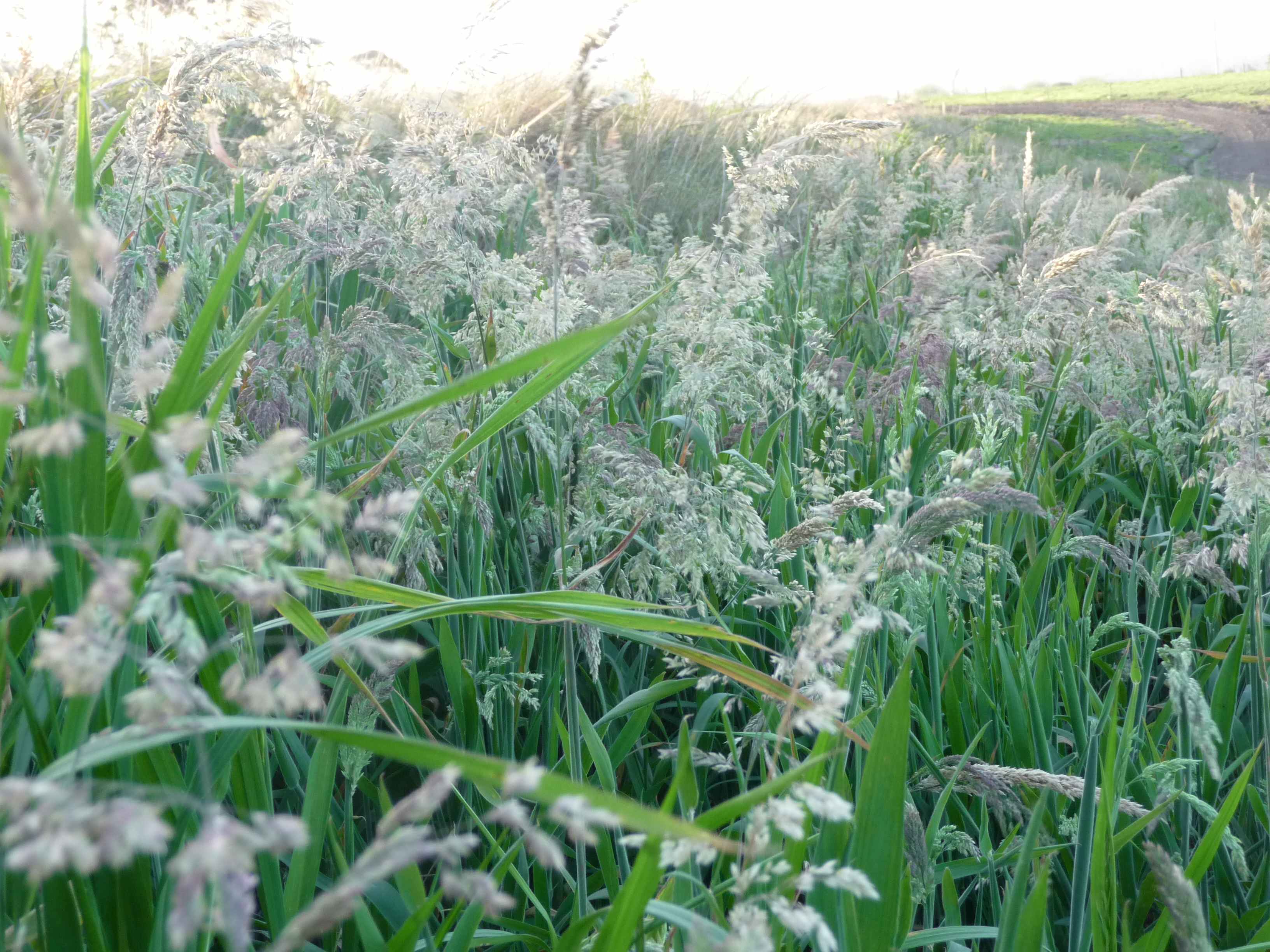
What does the perfect body look like? Not mine, that’s for sure! Yesterday, I was reminded just how bad my genes are for farming. Allergies run on both sides of my family and the worst irritant of all looks like this:

Yorkshire fog grass

Yorkshire fog grass: one UK expat we could do without!

I’m told it’s called “fog” grass because the pollen is released in such huge quantities, it makes everything go misty. Dynamite! Yesterday, I had to wander through thigh-high forests of it to get the dam siphon running again. My scalp, eyes, nose, mouth and arms are all still desperately itchy 15 hours later.

The cows don’t like it either. Fog grass is covered in thick velvety “fur” that understandably is most unpalatable.

Thankfully, we have a lot less of this hideous grass nowdays. It was everywhere when I was a girl but much better grazing management has seen it restricted to untouched pockets of dampness (like the dam wall).

Grass management is a big deal for Australian dairy farmers because it is the greatest predictor of profitability. We count leaves, we estimate the tonnes of pasture in paddocks and aim for the magic nexus of quality and quantity. Somehow, it’s reassuring to know that nothing beats the simplicity of grazing grass for high performance dairy farming, even in 2012.

Robotic milking: the gentle touch of machine on moo?

FutureDairy project leader Dr Kendra Kerrisk is something of an icon in her field of milking automation and so it’s very exciting to have her write this guest post for Milk Maid Marian. There are already a handful of robotic dairies in Australia and this looks to be the way of the future. Ironically, Kendra explains, it may allow dairy farmers to spend even more “quality time” with their cows.

Robotic milking is a relatively new concept for Australian dairy farmers even though our European counterparts are well accustomed to the idea. It is a technology that I have had the honour of working with for 10 years now and there a lot to be send for this new way of milking cows.

To the less informed, the concept may conjure up images of metal on flesh that are less appealing than the tender human touch. In fact the contact with the cow is every bit at gentle as the conventional approach and one of my fondest observations is that robotic milking farmers have an increased ability to enjoy the time that they spend with their cows when they no longer have to attach milking cups to every teat of every cow twice every day. It seems that the saying “quality not quantity” has a place when it comes to farmer/cow interactions.

Robotic milking farmers are unanimous in their opinion that the technology creates a farm system that results in very relaxed and laid back cows. The idea of robotic milking is that milking occurs 24 hours per day and that the process is voluntary (i.e. the cow completes the process without human intervention). Whenever I spend time with visitors at a robotic dairy (either our research facility or on commercial farms) the visitors are always deeply influenced by how quite and calm the milking process is with robots.

With robotic milking the cow chooses when to be milked and moves around the farm system at ‘cow pace’.

Cows in paddock with robotic milker in background

The cows are moving one by one hoorah hoorah…

Whilst I have been involved in researching the application of robotic milking I have also had the pleasure of being involved with many commercial farmers as they adopt this new way of farming. The farmer must learn a new management style whereby the farm is managed in such a way that the cows makes choices that suit the farmer and the farm targets. Cows move around the farm to gain access to incentives and by default can find themselves at the dairy for milking when their time is due.

Cow walks through robotic gates

With robotic milking the cows bring themselves to the dairy (they even operate specially designed one-way gates themselves) and take themselves back to the paddock.

The concept of robotic milking is creating a work environment that allows farmers and their employees to focus on higher level management tasks. In this manner they have the opportunity to manage their herd through an increase in the level of real time data that becomes available to them allowing them to focus on individual cows that require attention. The real attraction is the more flexible working hours that reduce the need for the early morning starts and commitment to milking cows twice a day. And the bonus for the cows is that they can now manage themselves in a manner that best suits them as individuals or as social groups.

Robotic dairy

These ladies know exactly how to manage the system to ensure they don’t miss out on the “treats” and “rewards” that are available to them.

Cows are creatures of habit and they truly appreciate a predictable environment. Robotic milking is exactly that and the outcome is a herd of cows that are very easy to work with since they become extremely calm and ‘chilled out’. With all of my experience in the area of robotic milking I have absolutely no doubt that this is a way of farming that is going to be increasingly adopted on commercial dairy farms in Australia and around the world.

Possibly one of the greatest bonuses is that I reckon dairy farming is going to increase in appeal with the younger generation which is exactly what our industry needs if we are to remain sustainable far into the future. If we achieve that they we are all winners because it goes a long way to securing our ability to continue to provide Australians with fresh, safe and nutritious dairy products that are produced in our own backyard!

There’s always time for a good scratch!!

There’s always time for a good scratch!!

Have Australian dairy farmers given up?

I know things have gotten tough for Australian dairy farmers but I’d hate to think of us as quitters. Still, as the Dairy Levy Poll roadshow tours the country, it seems a real possibility that in just a few weeks we will try to vote ourselves out of existence.

In just a few weeks, Australia’s dairy farmers will vote whether to increase the amount we pay in levies to research and development body, Dairy Australia, or have it abolished. I hate seeing any deduction from my milk cheque as much as the next farmer (believe me!) but I also know that I would not be farming here today without that Dairy Australia levy.

Twenty years ago, our farm looked greener but not all that different from the beef farm next door. Dad was more interested in his role as local councillor and, later, dancer and bushwalking pursuits than in making every blade of grass count. And he could afford to. Farming was more profitable then and his debt level was low.

One divorce and a drought later, things changed. Faced with a suddenly massive monthly interest repayment, it’s fair to say Dad’s initial response was to panic. He lost two stone off his already very slender frame, considered selling the farm and then sought help. His decision to enrol in a Dairy Australia levy funded Target 10 course and to seek the advice of farm consultant, John Mulvany, saved the farm.

Productivity soared as a rotational grazing system offered cows fresh, high quality grass every day. Dad also confessed a new enthusiasm for farming. After 50 years on the job, he was learning again. He then embarked on just about every DA funded course he could find: Feeding Dairy Cows, Fertilising Dairy Pastures, Feeding Pastures For Profit, Countdown Down Under and Cow Time are just some of the handbooks he left behind.

Today, my interest repayments are even higher than Dad’s and farm margins are even tighter but with the latest know-how, I will make it.

Australian dairy farmers have become some of the lowest paid in the world. That stinks but it’s the reality. If we are going to survive, we need to be smarter than the rest. And if we don’t vote for investment in the very research that keeps us going, can we really expect the Australian taxpayer to help? I think not.

If you want to send a message to the bureaucrats, ring them up and tell them you’re not happy. I do. But I’ll never tell them I’ve given up and that’s why I will vote yes.

Putting ourselves in the best position

In the lead up to the Australian Dairy Conference later this month, I’ve invited a few fellow speakers to do guest posts on Milk Maid Marian. One of them, Steve Spencer of the Freshlogic consultancy, issued this challenge to dairy farmers.

Steve Spencer

Steve Spencer


The world has changed in the last 5 years and with that so have the prospects for dairy producers. If you read the views of the global food gurus, we’re riding on the cusp of an ever-tightening world food shortage that puts the dairy industry in a great position. We’ll have plenty of competitors going after that future prize, and in the last decade dominated by the effects of drought, other exporters have emerged. But at the same time, decades of protectionism by major economies is steady evaporating, as governments admit they can’t afford to fund the high walls built around agriculture.

As we’ve seen in the past couple of years, the variables affecting our farmgate milk prices in Australia have become more complex, and the volatility in the future world that affects those prices, grain costs and weather will only increase.

As we step into the future, it has never been more important to make sure our industry is structured in the best possible way to make sure we optimise the flows from the market back onto farms. It isn’t something that we should steadily work on for a few years – this pressure now urgent!

I will be presenting a paper at the Australian Dairy Conference at Warragul, Vic (which is being held on 22-23 February) that will aim to stir up the debate on the agenda for getting that going. It will look at precisely what can be done to improve returns, and it should be no surprise to anyone to recognise that most of the things that can be done are within our own control.

So my paper will tour:
• How farmers do or can engage with the dairy market
• The value of the co-operative as a channel to that market
• How they perform in different industries
• What changes others are making and why
• What changes are most important in the Australian market
• How those can happen

We’ll discuss the elephant in the room. Murray Goulburn is the largest farmer-owned processor of milk in southern Australia, accountable to their shareholder-suppliers for performance through farmgate milk prices and dividends. In a highly competitive farmgate environment, prices paid by foreign-owned, privately owned or listed competitors will be set at or above MG’s price – others will only pay what they have to in order to get a secure milk flow. They are accountable to shareholders who may not be dairy farmers purely on their performance as a business.

It will be up to the co-op’s farmer shareholders to determine if the company is properly structured and managed to maximise performance, and the opportunities and risks of change.
Whether dairy farmers supply and own shares in MG or not and no matter where they farm, the performance of that largest co-op is an issue relevant to all Australian dairy farmers, as milk values are set by MG’s payment performance.

Like Australia’s competitors in the US and Europe will find as they embrace deregulation in the years to come, clinging to tradition is probably the worst thing farmers can do for the future of the industry.

I urge dairy farmers, their advisers and investors to attend the conference and get involved.

Why not have a whinge when we deserve it, after all?

On Tuesday, I was given the opportunity to have a really good cathartic whinge on Melbourne radio and I almost took it. The announcement of an increase in public transport fares prompted 774ABC radio host Mark Holden to ask for examples of what’s gotten cheaper.

The obvious answer is milk, of course! So I rang in and said consumers were getting a great deal on milk, which is at 1992 prices. He wanted to know whether farmers are doing it tough as a result. Now the answer to that question is complex and I wasn’t going to try to explain it all in five seconds so I said that, yes, one in three dairy farmers had left the land since deregulation but that Australians are among the world’s most efficient dairy farmers and that allowed us to deliver low prices. Now that’s a strange message, isn’t it?

It means that instead of whingeing about low prices, we can be incredibly proud of being able to deliver them. Most importantly, we can be incredibly proud of the shape we’re in: we haven’t succumbed to a factory farming model.

  • 98 per cent of Australian dairy farms are family farms rather than corporations
  • The average herd size is 220 (small enough to know every cow)
  • Our cows enjoy “cowness”, as Tammi Jonas would put it, free to roam the paddocks

In other words, our farming practices have become more and more professional without compromising the ethics that guide all the farming families I know: love of animals, love of land. We have a great story to tell and we should shout it from the rooftops!