When the lights go out on farm

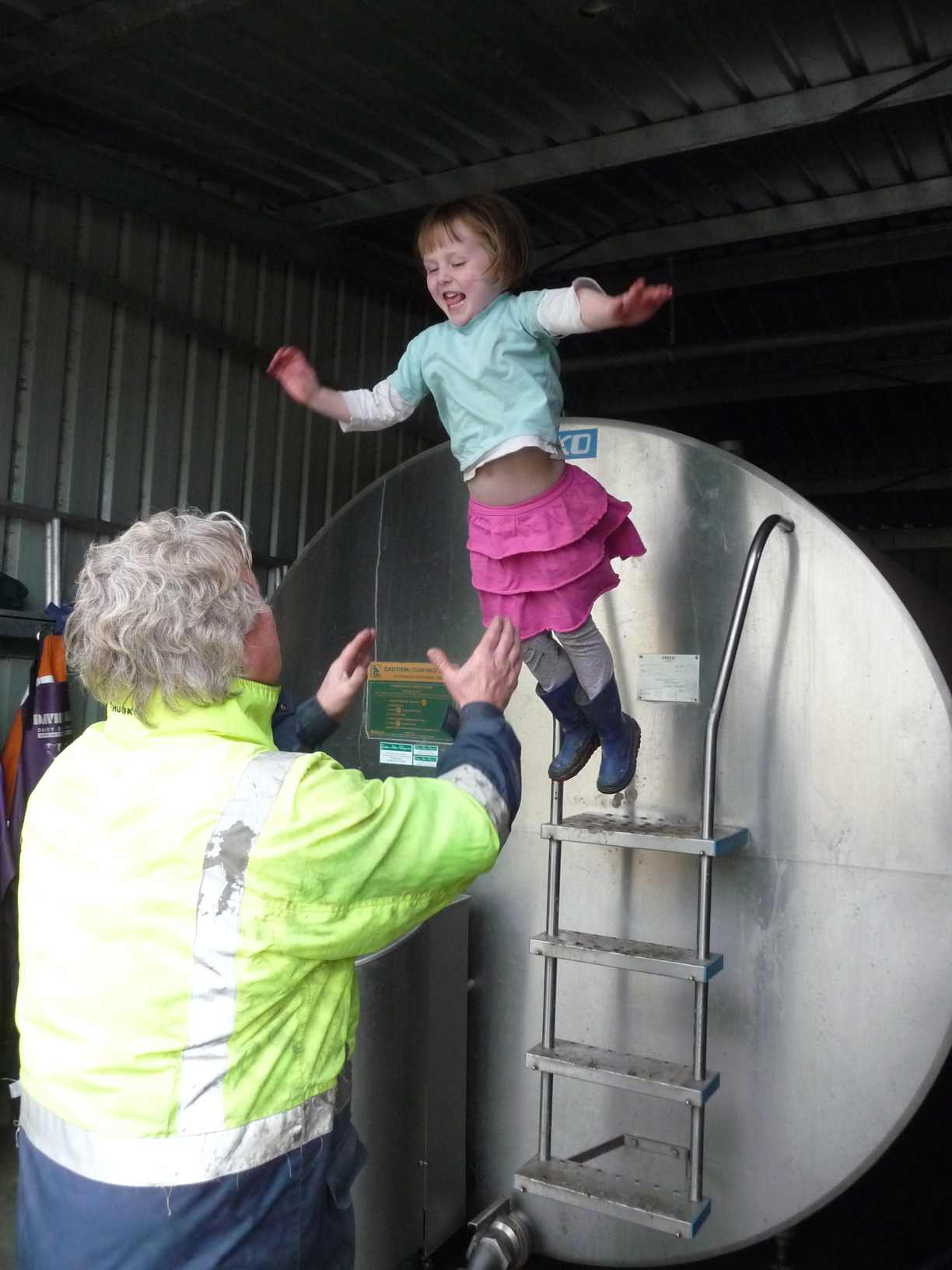
Jumping off the milk vat

Zoe leaps off the vat ladder to her Papa

Our power has become so unreliable I’ve given up resetting the microwave clock but this is far from the most serious consequence for our dairy farm. Unfortunately, we use a lot of power. There are water pumps, milking machines and, most critically, refrigeration. Our milk is stored in a stainless-steel 17,500-litre vat before it is collected by the tanker.

The vat keeps the milk at a steady 4 degrees Celsius to keep it fresh. As part of the co-op’s quality assurance program, the tanker driver records the temperature upon collection. If the refrigeration fails, we need to organise immediate collection to prevent a quality failure.

The most common cause of problems with the vat are power outages or spikes that mean we have to manually reset the compressors. That’s what happened yesterday and the milk was not kept cool enough. The co-op’s lab will test the milk to make sure it remained fresh. Fingers crossed.

Power outages also affect milking of course. There’s nothing worse than being halfway through milking when the power goes off and looks like staying off for a while. The dilemma is whether to let the cows out and know they won’t be comfortable overnight or keep them waiting in the yard and hope it comes back on quickly.

A little while ago, the electricity infrastructure company rang to do a customer satisfaction survey. I don’t think they were expecting quite the ear-bashing they got!

Dogs and ducks, genomics and designer bulls

Training working dogs with ducks

Paul McPhail training working dogs with ducks

Outside the pavilion, hundreds watched working dog trainer Paul McPhail show how young dogs are schooled herding ducks. Inside the pavilion, a small crowd lunched with researchers investigating genomic testing of bulls.

This scene from the Dairy Expo at Korumburra yesterday struck me as a really interesting statement about modern farming. It’s the meshing of age-old skills and cutting-edge science.

Zoe and I couldn’t resist watching the pups – one just four months old – rounding up the ducks. The warmth of Paul McPhail’s training and the dedication of his dogs were mesmerising. Nor could I resist the chance to find out what science will bring to our dairy farm in the next few years. One of the most interesting was the genomic testing – as distinct from genetic modification – of bulls.

Normally, bull calves are selected for breeding based on pedigree and their conformation or “type score”. Their semen is then collected and used to breed daughters, who must then get in calf so we know how fertile they are, and then be milked at age three before we know the real value of the bull as a sire.

It’s all based on observed and measured performance. On the other hand, genomic testing compares the DNA of new sires with the DNA of historically well-performing sires as a benchmark. More work needs to be done to increase the reliability of this testing but it promises a shortening of that four-year timeframe.

There is also hope that the testing will soon be affordable for mass screening of our cows. We will be able to verify the parentage of our animals and gauge their genetic merit very early on. This should “speed up” improvements in our herd with powerful animal welfare outcomes. By better selecting cows for breeding, we should be able to reduce the number that become lame, have bad udders and need to be treated for mastitis.

The scientists, who were from the DairyFutures CRC and are also working on designer forages, will help Australia’s dairy farmers remain competitive on the world stage.

Exciting stuff!

Weaned calves acclimatise to new surroundings with maremma guardians

Weaned calves take in their new surroundings

Weaned calves take in their new surroundings

We’ve weaned a bunch of calves and they love their new surroundings by the forest. When I took this picture, they were still a little overwhelmed, walking quietly around the paddock.

At our farm, calves are weaned relatively late. The calf rearing experts say you can wean a calf as soon as she’s eating at least 1.5kg of grain or pellets per day but, in my view, it doesn’t hurt to offer them milk for a bit longer. Calves are the future of our dairy farm and we don’t skimp on their wellbeing.

We’ve chosen a paddock far from the dairy that offers shelter from cold weather and shade from the sun. Cows are kept off this pasture to minimise the risk of transmitting disease like Bovine Johnes Disease from one generation to another. Aside from buying in bulls to preserve genetic diversity, we have a closed herd and no history of the muscle-wasting BJD but it’s good practice to keep stock under 12 months old off pasture that’s been grazed by mature cows.

While the pic doesn’t show them, maremmas Charlie and Lola have been staying close to their charges and I’m hopeful the transition will extend their range.

Farming and the carbon tax

Cow wearing a monitor to detect methane gas production

Cow wearing a monitor to detect methane gas production - pic by DPI Victoria

Donald Rumsfeld could have been talking about the impact of the carbon tax on farming and agriculture when he infamously said:

“Reports that say that something hasn’t happened are always interesting to me, because as we know, there are known knowns; there are things we know we know. We also know there are known unknowns; that is to say we know there are some things we do not know. But there are also unknown unknowns — the ones we don’t know we don’t know.”

The politics of carbon are still in full swing and it’s too early to say for sure how we will be affected but there are some things we do know:

1. Agriculture is the second biggest source of Australia’s greenhouse gas emissions – just ahead of transport

2. Much of current best-practice farming minimises emissions

In a recent study (see link at point 2 above), Department of Primary Industry researchers say:

“We calculate, therefore, that in 1980 an Australian dairy cow emitted approximately 33 gm of methane for each litre of milk produced. But, in 2010, because of better feeding practices, genetic improvements, higher per cow milk production, and efficiency improvements adopted by the Australian dairy industry, this number has fallen to approximately 24 gm of methane per litre of milk produced.”

Great news! We are doing well, you say? The only problem is that until science provides us with some more tools, we cannot achieve a lot more. As the researchers go on to say:

“As a greenhouse gas, methane is about 25 times more powerful than carbon dioxide and methane emissions from cows constitute about 65 per cent of the total dairy farm greenhouse gas emissions.”

Meanwhile, as Neil Lane of the Carbon Ready Dairy Demonstration Project notes:

“Highly digestible feed and cereal supplements, along with products like Rumensin, are the best way to minimise emissions at the moment. Many dairy farmers are already doing this.”

This may be why agriculture has been excluded from the carbon tax, although our inputs, like fertiliser and fuel will not be exempt. On the other hand, the much-touted Carbon Farming Inititiative seems equally as impotent to this dairy farmer.

Reforestation and revegetation isn’t really an option because each planting needs to be at least 2ha and 10 metres wide. Soil sequestration sounds wonderful but the fact is that the rich fertile soils of dairy farms are generally already high in carbon content. The other options of reduced fertiliser emissions and effluent management are already being practised on our farm and, as I understand it, would therefore be ineligible under the CFI.

Will be interesting to see how it all pans out and I would love to hear from anyone who sees lots of emerging opportunities for dairy farmers to actively participate in the carbon economy.

Gasp: the cows love fescue (and I do too)

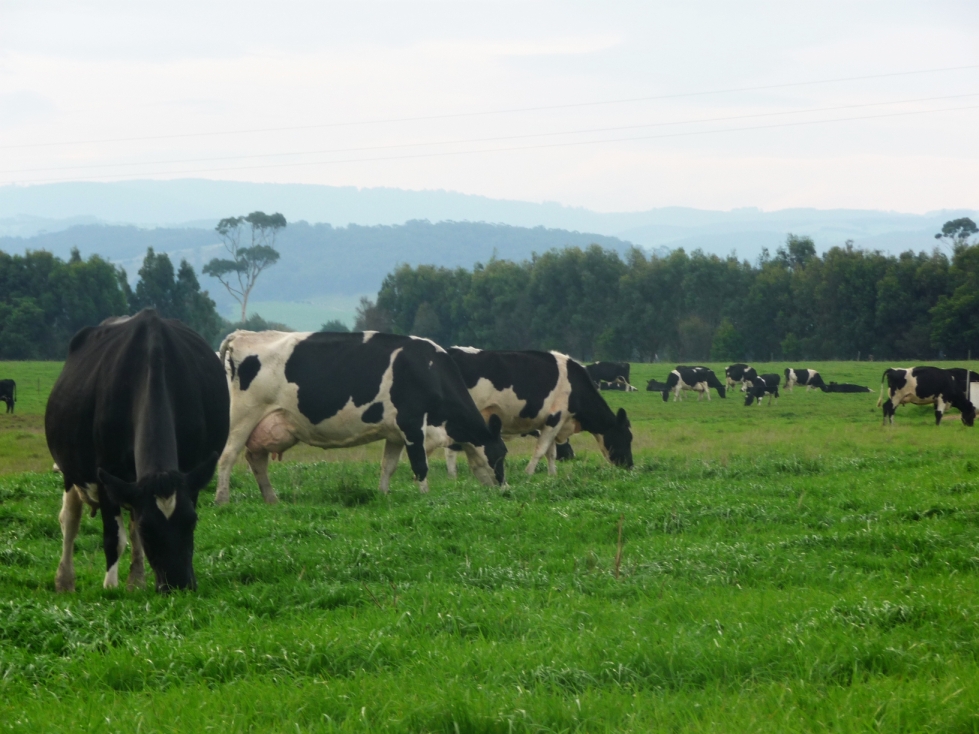
Cows grazing Advance Tall Fescue

The cows really seem to prefer the Advance tall fescue over ryegrass

I’m beginning a clandestine (well maybe I’m coming out of the closet with this blog) love affair with fescue and cocksfoot. Our Gippsland dairy farm has always relied on a combination of ryegrass and clover, although prairie grass loves to volunteer. Because the weather patterns have changed so much, I’ve started to experiment with other pasture types.

We sowed the aptly-named swamp paddock with Advance tall fescue last year. It doesn’t mind waterlogging and produces massive volumes of feed in summer – just when the swamp paddock can withstand grazing without getting pugged. I’d had the paddock sown to an annual ryegrass which reshot and seemed to overwhelm it, so had the whole lot sprayed out with glyphosate. To my delight, the ryegrass was knocked out and the fescue has come back in force.

The cows seem to love Advance. I had them in the adjacent paddock of gorgeous perennial ryegrass but when I lifted the fence to let them into the rear of the still partially inundated swamp paddock, they rushed in and stayed there to eat the fescue.