What The Project didn’t have time for me to say

TheProject

The Project delivered a powerful story last night about the turmoil we face that included footage of Wayne recounting my unvarnished reaction to the price drop.

I’m upset and I’m anxious about the future but I’m okay.

The price drop felt like the last straw. We’ve been battling a horrid drought that has already drained much of my emotional reserves over the last year. To hear that we would now have to face this on top of what’s pretty much guaranteed to be a rotten milk price next financial year was just overwhelming. The light at the end of the tunnel suddenly became very dim.

But Wayne and I are a strong unit and we’re not giving up on anything.

We will get through this. We are luckier than many others and I am inexpressibly grateful to the people around me, especially Wayne.

I’m grateful to the generous dear people who have rung out of the blue just to ask “how’re you going?” over the last few weeks. I’m grateful to the strangers who have been moved to write notes of encouragement for farmers on Facebook forums. I’m grateful to the journalists who have helped share our stories.

What you didn’t hear me tell The Project was that we are resilient and we do this because we love it. That hasn’t changed.

What I do hope is that from this seismic shock will come seismic change. There has to be a better way both for our little family and the thousands of other farming families across the country. We cannot let the opportunity to reshape the future slip through our fingers now.


Why don’t dairy farmers just…?

Comment

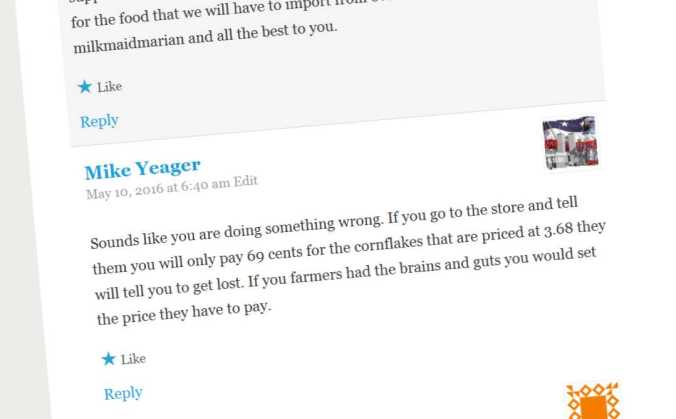
Of course, Mike is right. You can’t walk into a shop and demand a box of cornflakes at a fraction of the cost.

You can’t cut someone’s wage because your business is losing money. Nor can farmers choose to pay less for stockfeed, electricity or shire rates just because the price of milk has fallen.

We dairy farmers are in a uniquely vulnerable position. We shoulder almost the entire risk in the dairy supply chain. It stinks. It’s grossly unfair. And when you read stories like Appreciating Australian Agriculture‘s below, it’s harrowing, too.


AppreciatingAusAg

So, if we have both guts and brains, why do we let others set the price for our milk? The reality is that dairy farmers have little choice in the matter.

Why not stop sending milk? You cannot switch cows on and off. You have to milk them every day, no matter what, and their milk needs to be sold within two days. It can’t be stockpiled until buyers offer a reasonable price. Of course, you could sell all your cows but then how would you pay your mortgage?

Why not find a buyer who will pay more? Because there are only a handful of buyers and they all offer about the same deal. They tell you the price of your milk. If their sales strategy goes sour, you get paid less. Anyhow, right now, few milk processors around here are willing to take on new farmers. You’re stuck right where you are.

Why not sell the milk direct? Yes, a few farmers do. It costs a six-figure sum to set up a processing plant and takes about a year to get it approved by the regulators. Running that plant and marketing your dairy products is another full-time job on top of dairy farming. It’s also another completely new skill set. In any case, not many farmers have deep enough pockets to establish the plant and endure the inevitable losses during the time it takes to become commercially successful.

Why not just sell the farm and do something else? Well, that’s a question plenty of farmers are asking, too, but it can take years to sell a farm and we do it because we are good at it and we love being farmers.

The reality is that when a few thousand small family businesses sell a highly perishable commodity to a handful of very large corporations, the playing field is anything but even.


Straight-talking UDV president Adam Jenkins on milk price cuts

In the confusion that’s followed the cuts to milk prices, I asked the president of the United Dairyfarmers of Victoria, Adam Jenkins, how the UDV was responding.

Adam had some very clear messages for milk processors, politicians and bankers. A big thank-you to Catherine Jenkins for filming Adam’s answers to my questions in their calf shed on a very windy day.

This video is the first in a short series addressing the milk price crisis.


Despair, anger, disbelief.

3wisecowspsycho

Lots of dairy farmers are naturally cynical and, let’s face it, we’re never entirely happy with the weather forecast. But we are optimists at heart because things will always be better next season.

Not this season.

I have never seen my fellow dairy farmers so subdued as they were at a meeting last night. Dinner at the local pub was laid on – a rarity that normally guarantees a festive mood – but somehow it felt like more like a last supper. Nor have I seen such anger online.

Partly, I think, it comes down to being battle-weary. Around here, it’s been a disastrous season. Dry-land farmers have not been able to grow grass and the La Nina we were hoping for still hasn’t arrived. By now, we should be building a wedge of grass to get the cows through winter. Instead, paddocks are eaten to the boards while farmers wait for resown paddocks to fire up.

The conventional wisdom is to apply nitrogen now while the soil’s still warm enough to grow grass. Many farmers at last night’s meeting had not applied any urea yet despite its unusually attractive cost this year because the soil is still too dry.

We can buy in more fodder or sell more cows. Fodder is getting hard to find and expensive, too. Many of us have already culled hard. The options are narrowing. We need something to go right.

It isn’t. Farmers seem sure that the milk price for 16/17 won’t be good. Will it be devastating? We’re all wondering and worrying.

On top of all this came the Murray Goulburn announcement that it had overspent this year and will have to claw money back from farmers for the next three years. None of it makes sense. Many farmers had hailed the MG plan as visionary, something that would transform our industry to create sustainable prosperity. But the loss of so much money in so little time is incomprehensible.

It’s a blow from left field that will leave barely a Victorian dairy farmer untouched. MG is the pacemaker for the entire industry. Processing half our state’s milk and 38% of Australia’s, it sets the benchmark for the southern farmgate milk price. When it falters, we all do.

In the face of all this, the message from last night’s speaker was simple: seek help, watch out for your neighbours and don’t lose sight of the vision for your farm. Good advice.

What MG’s announcement means in plain English

This is a post written purely for my fellow dairy farmers in light of the MG announcement today. After speaking with the people at MG, this is what I have learnt:

Why the price must fall
MG opened at $5.60/kgMS. Its lower than expected sales, the rising Australian dollar and the fall in the value of its larger than normal (which are routinely high anyway) inventories mean it has a shortfall of between $170 and $200 million. This means the price paid to farmers must fall.

How far the price must fall
Depending on how the last two months of this financial year pan out in terms of sales and exchange rates, Murray Goulburn will finish the season between $4.75 and $5.00.

But the price can’t fall that far in two months…
To do that, it would need to pay farmers virtually nothing for milk supplied in May and June. Some rough numbers sent to me by an industry analyst puts those figures at about 4.75 cents per litre. Clearly, that would be disastrous for many suppliers. It would also cripple MG because farmers would have little choice but to leave MG and supply any other processor that would take their milk.

…so, here’s what will happen
MG will pay farmers for milk supplied in May and June as if the price was $5.47 all along. In other words, the price for May milk will be $3.38 for fat and $7.42 for protein. For June’s milk, it will be $3.45 for fat and $7.59 for protein.

If MG’s sales and the currency fall in line with the worst case scenario and MG really should have paid farmers just $4.75 for the year, it will mean there is a shortfall of 47 cents for every kilogram of fat and $1.03 for every kilogram of protein.

This money will be deducted from the price paid to farmers evenly over the next three years. It means the milk price will be lower for each of the next three years than it otherwise would have been by about 15 cents for fat and 34 cents for protein.

But it’s NOT a debt carried by individual farmers
The money to be deducted over the next three years will simply come out of the milk price. If a farmer leaves MG and moves to a different supplier during the next three years, no debt will follow that farmer. If a farmer joins MG in the next three years, that farmer will have a lower milk price than they would have received in a normal year.

MG will not apply a loan against an individual supplier and will not respectively apply terms and conditions to suppliers.

About this post and me:
I am a former MG supplier who still holds some MG shares and currently supply Fonterra Australia. This post is not designed to do anything other than clarify confusion surrounding the situation because I am fearful for the mental health of my fellow farmers. This post has been checked by MG for accuracy.


MG responds to questions about Devondale

Devondale logo

After the publication of yesterday’s post, Murray Goulburn’s Robert Poole has this afternoon responded to Milk Maid Marian’s questions following the Financial Review’s commentary on Devondale’s sales performance. They are included here in full.

Q1: Are the figures quoted in the Financial Review a fair representation of Devondale’s sales performance?
A: MG considers that the data represented in the Rear Window opinion piece in the Australian Financial Review is selective and as a result has the potential to be misleading to readers. MG does not consider that it is a fair representation of Devondale.

Q2: To quote from the Fin Review: “According to Murray Goulburn, a big upside of the Coles deal was that it would ‘drive significant growth in sales for [its] core Devondale milk and cheese brands in the years ahead’”
A: MG has consistently stated that the underlying basis for the Coles contract was to enter the private label daily pasteurised milk market. This statement was made on 10 April 2013 when MG announced its entry into the landmark 10 year contract and again on 3 July 2014 when announcing the commencement of supply to Coles under that agreement. MG launching the Devondale branded daily pasteurised milk and Devondale Cheese into Coles (after a nine year absence) was separate to the underlying business case of supplying private label daily pasteurised milk to Coles. The supply of Devondale daily pasteurised milk and supply of Cheese was not the basis for entering into the Coles contract.

Q3 How do actual Devondale sales figures compare to the budgets set when the plants were planned?
A: Sales are in line with business plans.

Q4: Does Murray Goulburn continue to enjoy “preferred supplier status” with Woolworths?
MG does not comment on its relationship with customers.

Q5: How have the Devondale sales at Woolworths compare with those at Coles?
A: This information is commercially confidential. MG is proud to be a supplier to total Grocery and Foodservice trade, and works with all customers to grow the business and maximise returns to farmers

Q6: Does MG plan to review its product mix or marketing strategy in light of Devondale’s sales performance?
A: MG has a balanced portfolio across international and domestic markets, ingredients, Private label and branded products. Like any strong business, MG is managing this portfolio to maximise the returns to Farmers, as evidenced by the current farmgate price.

Q7: How does Devondale’s sales performance compare with other areas of MG’s business?
A: In 2014/15 Devondale is one of the leading growth and profit divisions for MG

The trouble with the MG and “Gary the Great” sideshow

Murray Goulburn’s colourful managing director, Gary Helou, is not universally loved and he’s become a bit of a target over the last year or so.

Some dairy farmers are nervous about his proposed transformation of the much-loved 100% farmer-owned co-operative into a “farmer-controlled” hybrid or are alienated by his brash, bullish style.

Some of his competitors hate him for driving up the price of raw milk (which is, of course, his mandate) and they also deeply resent this Devondale ad:

Given that Gary himself is a suit-wearing Sydney-sider who flies in weekly to MG’s Melbourne headquarters where a large corporate Mercedes Benz awaits him in the basement, he could be accused of a little hypocrisy.

So the acerbic commentary from the Financial Review directed at the so-called “Gary the Great” generates plenty of sniggers, including yesterday’s piece, which was republished outside the pay wall in The Land.

The article reveals a series of sales figures that suggest sales of MG’s Devondale branded products have tanked disastrously, followed by an observation that:

“When Helou locked Murray Goulburn into a decade of skinny margins supplying Coles with its $1 milk, his rationale was that it would lead to growth in his branded products and thus higher margins for his farmers.”

“But the growth has not transpired, which means the margins are on borrowed time – especially as Helou juggles significant debt covenants, tries to raise $500 million in new capital and wears major cost blowouts getting his new processing facilities online.”

Are the figures fair? I asked dairy industry analyst, Steve Spencer of Freshagenda, about the data quoted in the story.

“The figures are sourced from retail scan sales data reports, which are expensive and normally only purchased by some of the larger supermarket suppliers,” Steve explained.

“The figures supplied to the Financial Review are current and specific and certainly not publicly available, so the data was most likely leaked by a competitor. It’s unlikely that any of the figures were inaccurate but could have been used selectively to paint a certain picture or the columnist’s agenda.”

But if the article is fair, it’s worrying news for MG farmer shareholders. I invited MG’s Robert Poole to answer a series of questions to set the record straight:

  • Are the figures quoted in the Financial Review a fair representation of Devondale’s sales performance?
  • To quote from the Fin Review: “According to Murray Goulburn, a big upside of the Coles deal was that it would ‘drive significant growth in sales for [its] core Devondale milk and cheese brands in the years ahead’”. To what degree does the profitability of the Melbourne and Sydney plants rely on the sale of Devondale products?
  • How do actual Devondale sales figures compare to the budgets set when the plants were planned?
  • Does Murray Goulburn continue to enjoy “preferred supplier status” with Woolworths?
  • How have the Devondale sales at Woolworths compare with those at Coles?
  • Does MG plan to review its product mix or marketing strategy in light of Devondale’s sales performance?
  • How does Devondale’s sales performance compare with other areas of MG’s business?

Robert pointed me to a media release on MG’s website released later in the day. Unfortunately, it does not answer the questions. Instead, it plays the man rather than the ball, providing any genuinely concerned farmer shareholder little comfort.

Are the criticisms of Gary Helou and MG simply sour grapes or dirty competitive tactics? I hope so but it seems only time will tell. This is the tragedy of the “Gary the Great” sideshow: it all descends into an ugly bun-fight in which, ultimately, the farmer is the loser.

EDIT: I HAVE WOKEN TO AN EMAIL FROM ROBERT POOLE INDICATING THAT HE WILL BE PLEASED TO ANSWER THE QUESTIONS TODAY (20/02/2015).

How processors decide the opening price for our milk

Piggy Bank

With the anticipation of shoppers pressed against the doors of a Boxing Day sale, farmers look forward to the “opening price” for our milk every season. This year, the hype was bigger than ever.

Last season’s prices were high enough that many farmers have recovered from the year before, commentators continue to gush about the future of dairy and processors are on the hustings looking to poach supply. On the other hand, global dairy commodity prices are tumbling and the Australian dollar remains stubbornly high. Uncertain times.

The first of the major processors to announce its (edit: this post applies to the south eastern Australian states only) opening price was Fonterra, the giant NZ co-operative, at $5.80 per kilogram of milk solids, only to be trumped hours later by Australian co-op Murray Goulburn at $6.00. The two forecast closing prices were in the range of $6.10 or $6.15 to $6.30, making this year’s buffer between the start of season price and the forecast close one of the narrowest ever, suggesting an increased risk of a historically rare and confidence-busting mid-season price “step down”.

Opening prices are a little contentious, with United Dairyfarmers of Victoria president Tyran Jones, labelling them “misleading“. I invited the two big processors to answer some questions about how the opening prices are set. Thank you to Matthew Watt of Fonterra and Robert Poole of Murray Goulburn for their explanations.


Q1. How do you arrive at an opening price?

A: Matthew Watt, Fonterra:

We look at multiple information sources. The most important one of these is the market intelligence we get from the Fonterra Global insights team. I expect that others in the market take a lead from our and Fonterra NZ pricing to leverage this information as well. Other information sources include GDT futures, Fonterra Treasury (FX), Rabo Bank.

  • We extrapolate these information sources into a number of different commodity and currency scenarios (this season we ran in excess of 15 pricing futures through our model)
  • Model looks at weighted returns based on forecast milk flows.
  • Sensitivities are completed at different commodity prices and currency
  • Following this, we establish the most likely estimate of closing price – this becomes the forecast close range.
  • We then compare the forecast close to our lower price scenarios & calculate an opening price that is paying what we can to farmers but also ensure there is a level of protection from any market/forecast downside.

A: Robert Poole, MG:
At a high level:

Milk Price = Total Revenue less Total Non-milk Costs less Profit. As stated below the 2014/14 milk pool grew to $1.7 billion up from approximately $1.2billion in 2012/13.

An extensive budgeting process occurs across the business. We estimate milk intake volumes and composition, determine product mix, budget sales revenue (sales and other), budget company-wide costs, determine profit requirements (to manage balance sheet and funding needs, and dividends) which provides for a milk price. Throughout this process we make certain assumptions such as pricing, volumes, product mix, foreign exchange and sales channels for revenues and savings initiatives, efficiencies, wages and working capital for company costs.

Improvements in the budget position as the year progresses are usually passed through as step-ups.


Q2. How have the margins between opening price and forecast close changed since 2008?

A: Matthew Watt, Fonterra:
The traditional rule of thumb was that opening price was 85% of forecast closing although published forecast closing prices are a relatively recent addition. This year our forecast opening is 94% of midpoint of forecast close range. To actually track this is difficult because published forecast closing prices are a relatively recent introduction.

A: Robert Poole, MG:
Yes, these are slightly different each year. In determining the amount of buffer required, allowance is made for those areas where the co-operative is exposed to volatility; upwards, downward  and other adverse conditions or potential risks.  Generally MG has an opening price between 90 and 95% of its initial forecast.


Q3. Given the uncertainty of the exchange rate and falling commodity prices, is there an increased risk of a step down this year?

A: Matthew Watt, Fonterra:
As the variance between opening and forecast close narrows, there are an increased number of potential scenarios that provide a number that is on or lower than opening price.

  • Our current forecasts suggest that commodities will improve which is factored into our forecast close price. However, these are subject to global economic conditions and global production – both can move quickly and can impact commodity prices either way
  • The exchange rate has been anticipated to fall for some time but it remains high and a number of forecasts suggest that this could increase. As a rule of thumb, every 1 cent move in the exchange rate (across a full year) will have a 5 c/kg MS impact on milk price
  • At this stage of the season, we have limited volumed that is priced and sold. This means that, any moves in the commodities or exchange rate have a large impact on the actual, final milk price. As we move through the season, we get more priced and sold, meaning that movements that happen later in the season have a lower impact on the farmgate milk price.

A: Robert Poole, MG:
The difference between the opening milk price and the budgeted milk price allows for adverse variances to budget and a step down in price is historically very unlikely.


 Q4. What percentage of your Australian suppliers receive a price that is equal to or above the published opening price?
A: Matthew Watt, Fonterra:
All of our published pricing is based on best quality milk. The greater the level of penalty/incentive built into the pricing construct and the relative achievability of the premium quality standard will impact the difference between average quality and premium quality.

On our new, simpler pricing construct, between 25 & 50% of our farms will be at or above average quoted price, (assuming premium quality). Given we also have a transition payment in place from old pricing system to new, the number that will actually receive more than the published number will be over 50%.

60% of our suppliers are within +/- 0.15 cents per kg MS of average price, based on premium quality. Naturally, the poorer the individual farms actual quality that is delivered, the further they get from average price due to penalties incurred.

A: Robert Poole, MG:
Approximately 50% of milk supply is above the average and 50% below – hence the weighted average.  The majority of suppliers are within 2 cents per litre of the average.

[NOTE from MMM: I did follow up with Robert to clarify his answer in terms of the percentage of farms but the information was not available for the blog.]


Q5. Aside from the opening price, what do you think are the top three reasons farmers are attracted to supply your business?

A: Matthew Watt, Fonterra:

  • As a broader comment on price, I would like to think that farmers look past opening price as a reason for choosing a processer, particularly on opening average quoted numbers. On the price aspect, whilst opening is an important indicative number, what is really important is how that pricing construct suits an individual farm and, what the actual as opposed to projected or opening price performance is.
  • However, the three key reasons that we think farmers value are
    1. Leveraging our Global Leadership for Local Benefit – this means giving the best market information to our farmers to help better decision making on farm and, as a key extension to this, introducing fixed base milk price to enable farmers to better manage price risk. The other aspect of this is the multiple product streams, brands, domestic and global markets that we are active in. This provides access to the best and emerging opportunities in the market as well as a balanced group of customers and products which serves to reduce risk.
    2. Supporting Profitable Farmers – Profitability in farming is fundamental to industry success and our success if we are going to have long term, secure milk supply. We clearly don’t control all of the profitability factors. However, there are some that we do and some we can influence. These include simplifying our pricing structure. A critical aspect of this was ensuring we were aligning the value that we could extract from the value chain into  a clear construct, enabling suppliers to farm profitably to their set of circumstances and available resources. We be believe it is now better understood, reduces risk to farm business profitability and enables better decisions around optimising margin to be made by our farmers. It also includes our support crew work, where we assist where we can with specific opportunities within business to increase bottom lines – this year we have identified well over $1M of profit that has been generated by specific farmers through this program.
    3. Partners in Asset creation – this means getting to a stage of sustainable profitability and then leveraging that for future growth. Again, our fixed base milk price program plays an important role in helping to provide the certainty and confidence required for a farmer to make an investment decision to growth. We are also leveraging our support crew team to identify opportunities to support the growth of our farmers, where it makes sense for them. The support can come in many ways – technical, helping prepare information for banks, direct finance assistance and the like.

A: Robert Poole, MG:

Our suppliers are attracted to MG for a number of reasons. If I had to limit these to the top three they would be:

  • The strong understanding that whilst opening price is very important that having a Co-op that has the objective of growing the pool of money available to farmers. For example in 2013/14 we have grown the pool paid to farmers from $1.2 billion to approximately $1.7 billion.
  • A desire to supply the last Australian farm owned dairy Co-op, controlling the milk supply process from end to end and passing benefits to farmers.
  • Stability – MG has a proven performance, reliability and track record of successfully running a large and complex dairy company for 64 years and we have a clear strategy to improve business performance
  • Service and support


Bittersweet as Devondale milk reaches Coles shelves

Photo: The Weekly Times


Three men in suits – a prime minister, supermarket supremo and the MD of a dairy processor – stood drinking glasses of frothy cold milk on the steps of the first MG Co-op factory dedicated to supplying fresh Devondale-branded and private label milk to Coles. Beneath the froth, however, doubt among the very dairy farmers sponsoring the opening celebrations continues to simmer and bubble.

Ever since the Coles deal was announced, there have been skeptics. Plenty question whether it is possible to make money supplying milk that retails at a dollar a litre and the concept alone that milk could be priced cheaper than water offends many dairy farmers.

The speculation and anger reached new heights this week, however, after a scathing opinion piece in the Australian Financial Review that says MG managing director, “Helou ‘in a hurry’ has a reputation at MG, as he did at SunRice, for being hell bent on revenue over margins.”

The AFR also writes, “MG’s margins are non-existent and its deal has locked the whole industry into $1 milk for a whole, punishing decade, structurally squeezing the profit pool.”

All that gloom follows the journalist’s derisory comments about the Sydney factory being at least one month late, $30 million over budget and the trigger for contractual penalties that can only be imagined. And, yes, when the deal was announced, MG’s farmer shareholders were promised the factories would cost “just” $120 million. MG now puts that figure at $160 million, hinting at a cost blow-out of staggering proportions.

To top it all off, Coles ads pimping our cherished, premium Devondale-branded milk at just 75 cents per litre sent shockwaves through the Australian dairy community on Twitter yesterday.

This ad went viral on Twitter for all the wrong reasons

This ad went viral on Twitter for all the wrong reasons

So, I sent a list of questions off to MG’s executive general manager shareholder relations, Robert Poole, who to his great credit offered these explanations:

Q. What are the actual costs of the two factories?
A. Following our initial cost estimates for the two factories we decided to invest in additional capability and capacity to maximise efficiencies through automation and layout. This brought the total investment in our Melbourne and Sydney facilities to approximately $160 million. This provided for future operational cost savings.

Q. Has MG been unable to supply milk to Coles on time?
A. We have had some shortfalls, however contingency plans were promptly enacted . Laverton is ramping up towards its full capacity and at the moment is servicing Coles requirements in Victoria plus the Devondale Brand both in Victoria and NSW. Our NSW plant remains scheduled to commence production in early August, at which time MG expects to be able to be supplying all of Coles requirements in Victoria and NSW

Q. If so, what are the penalties?
A. This is a contractual matter between MG and Coles.

Q. Does MG have adequate raw milk supply for the Sydney factory now?
A. In New South Wales, we have already sourced more than 180 million litres of milk. This is more than enough to cover our initial requirements of approximately 100 million litres per annum in this market and allows for future growth.

Q. When do you expect the Sydney facility to be supplying milk Coles with its full requirement of milk?
A. The site is being commissioned through July with production scheduled to commence early August, reaching full capacity by the end of August.

Q. When will the investment break even?
A. Both sites are forecast to add positively to MG’s farmgate price from year 1.

If the Murray Goulburn deal with Coles can withstand a 33% cost-overrun and Coles’ penalties while adding to the milk price from year one, this must be an extraordinarily lucrative contract indeed. Who would have thought the Down, Down, Down folks could be so generous?

While you’re chewing that over, take a minute to look at the new Devondale ads via my fellow dairy blogger Lynne Strong, who tells me her post discussing the commercials has gone viral attracting around 1500 views in 24 hours. MG cannot be accused of being boring!