Why Australians become vegans and why it matters to this farmer

According to 2010 Newspoll research sponsored by Voiceless, only 1% of Australians call themselves vegans, with vegetarians accounting for another 5%, but the reasons why people consider veganism reveal some very interesting things about our attitudes towards food.

Overall, 56% of Australians say there are one or more things that would encourage them to become vegan. These are:
• evidence that many farming practices cause stress and pain for millions of animals every year (36%)
• evidence they can be healthy on a vegan diet (35%)
• evidence that being vegan is better for the environment (31%)
• more vegan menu items in cafes or restaurants (25%)
• being vegan costing less than their current lifestyle (23%)
• family or friends that are vegan (20%)
• more vegans in general (17%)

The research also found that “47% of Australians think making cows pregnant every year and taking their calves from them to obtain milk is unacceptable”.

Veganism is the canary of the disconnect between farmers and other Australians. Those who choose to avoid eating the food we produce on the grounds of morality are telling us we are falling short. Some will have made their minds up but most Australians are quite receptive to the true story.

The good news is I don’t think there is a large gap between mainstream dairying practices and what most Australians perceive as “ethical” farming. I do think we can bridge it if we find a way to work with others who share our passion for animals. We must also learn to talk about it with confidence and pride.

Charlie Arnot of the US Center for Food Integrity wrote an excellent post on just this topic today, which includes this comment:

For far too long, many in this discussion have resorted to attacking those who don’t share their beliefs – an “us vs. them” mentality that limits the opportunity for meaningful discussion about complex food issues. This polarizing debate is unfortunate and unproductive. What would be far more beneficial is an informed discussion of food system issues that will allow us to meet the growing global demand for food, while decreasing our impact on the environment and assuring responsible farming.

Just as a balanced diet that includes a variety of foods is a sound strategy for good nutrition, a balanced discussion of the complex issues related to food is a sound strategy for making good decisions on food policy.

I learned a great deal from agricultural leaders in Australia and I look forward to learning more. The open exchange of ideas makes everyone better. I pledge to use that same approach to other issues in the coming year. The next time someone raises a concern about today’s food system I’m going to welcome the question, encourage a discussion and learn more about the issue. I’m going to reject the appeal of culinary colonialism and work to assure we all have the opportunity to make informed choices about our food.

Hear, hear, Charlie!

Should farmers be embarrassed to talk about money?

A very thought-provoking piece by Terry Etherton deserves some discussion in dairy circles, I think.

Is it considered a little shabby for dairy farmers to be concerned with profit? Certainly, animal activists are quick to label farmers as greedy at the expense of their animals and the environment. Their web sites and advertisements paint “profit” and “money” as very dirty words indeed.

In contrast, Terry Etherton makes the point very well that:

“My perspective is that sustainable should first be viewed through the ‘lens’ of economic sustainability. Farms are businesses. If they don’t make money they close…pretty simple.”

“However, sustainable gets used in a myriad of confusing ways. For example, some in society talk about sustainable in the context of this being the ‘best’ food production practice to embrace. I am sure many readers have seen the marketing message: organic food production is more sustainable than other agricultural production practices and, therefore, better.”

Mr Etherton is right and Australian dairy farms are even more precariously balanced than their US counterparts, receiving no taxpayer-funded subsidies at all. We do have to be keenly focussed on the almighty dollar to survive. On the other hand, that doesn’t mean we cut corners when it comes to animal wellbeing.

A dairy farmer with a dislike of animals would soon quit. We work with them all day, 365 days of the year. They’d also quite likely get “sacked by the bank” because being mean is not profitable. Our livestock, our land and our people are our greatest assets – generations of farmers and cows know that.

So, how do we respond when we are labelled as “greedy farmers who exploit animals”? The US experience is that it’s best to say little about the link between profitability and animal welfare, preferring instead to focus on the values that we as farmers hold.

I agree because it’s true that values are much more powerful than profit. When the chips are down during drought, fire or pestilence (so to speak), it is the farm family that goes without, not the cows.

Where city collides with country

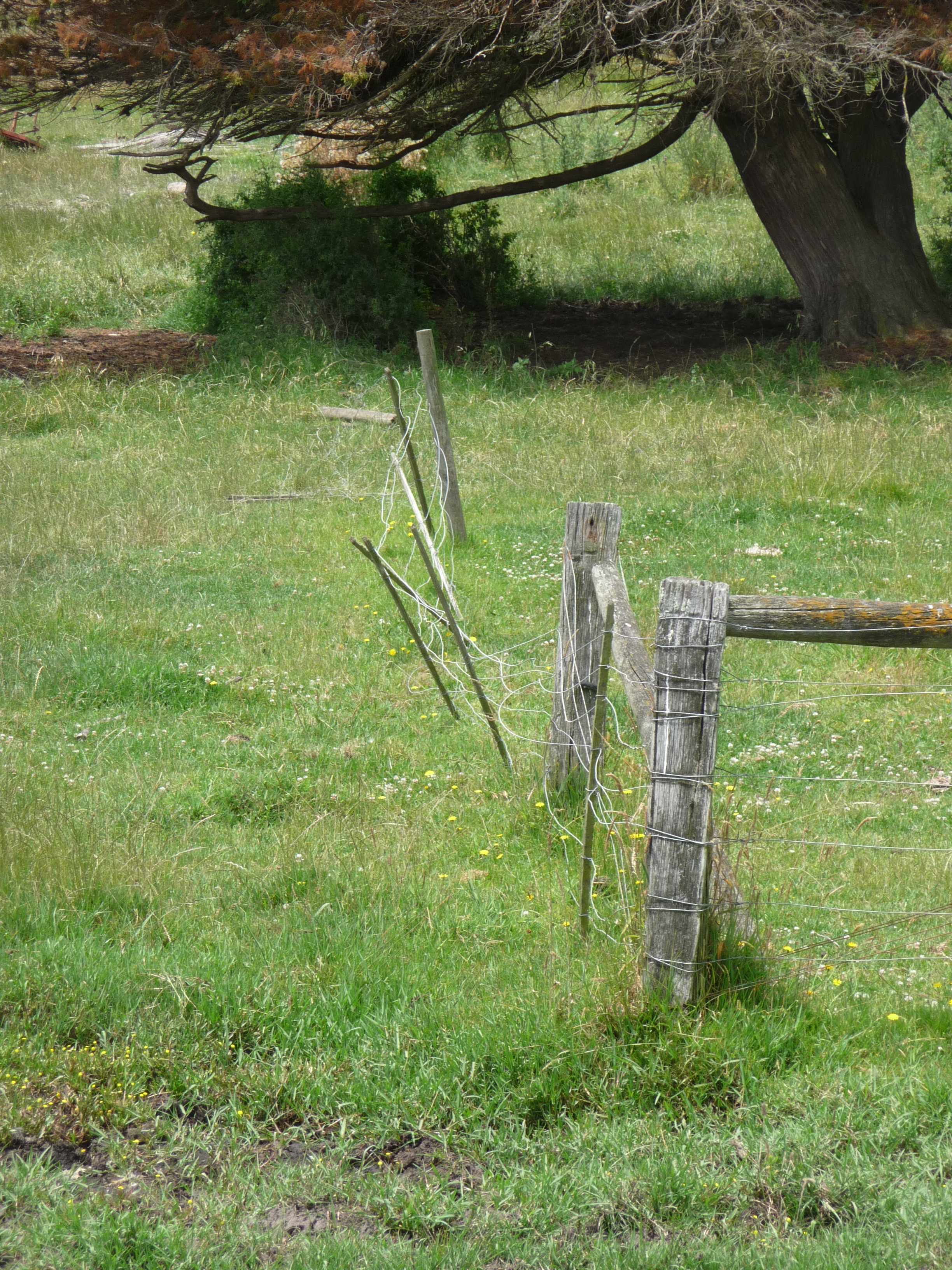
Collapsed fence

"But I don't have any stock..."

I don’t know when this fence was built but it was there in the 1970s when I was a child and, as you can see, it does little more than serve as a marker these days.

The significance of the fence is that it marks our boundary with an abandoned house site held by an absentee owner. He doesn’t maintain his land and was shocked to receive a call from me asking him to share the cost of rebuilding the fence. “Whose stock trampled it? I don’t have any stock,” was his response. And that was before I gave him the estimate.

I had to very gently explain that fences slowly deteriorate over decades and eventually are beyond repair. The reality is that we have been maintaining his internal fences for some years and using those as a boundary fence but they too are now past it.

It’s the responsibility of both neighbours to build and maintain boundary fences – whether you have stock or not is completely irrelevant. After all, if he decided to sell, I reckon the fencing would suddenly become an asset (or not).

This incident touches on one of the reasons I decided to create the Milk Maid Marian blog. Unless farmers and other Australians “talk”, what hope is there of mutual respect?

Christmas in a country hall

Last night, the meaning of Christmas was there in all its glory. The hills bathed in the golden light of early evening, our little family drove through the valley to sing carols at the local hall.

Fifty or so members of our extended neighbourhood had brought plates of home-made delicacies to share and some enthusiastic young women had decorated the tiny wooden hall with tinsel, fairy lights and balloons. One of the district’s matriarchs led the singing, complete with readings and a nativity scene reconstructed by the children.

I haven’t been a member of a congregation since I left school but this felt like a homecoming, not to my faith but to my community.

As the adults renewed friendships over cupcakes, Zoe ran around the oval with a dozen other kids ranging in age from three to 13 and when the treats were handed out at 9.30, she was running purely on adrenaline. Walking back through the chilly air to the car, we wondered at the stars, admiring Venus and Mars among the glittering planets.

How lucky are we?

Why not have a whinge when we deserve it, after all?

On Tuesday, I was given the opportunity to have a really good cathartic whinge on Melbourne radio and I almost took it. The announcement of an increase in public transport fares prompted 774ABC radio host Mark Holden to ask for examples of what’s gotten cheaper.

The obvious answer is milk, of course! So I rang in and said consumers were getting a great deal on milk, which is at 1992 prices. He wanted to know whether farmers are doing it tough as a result. Now the answer to that question is complex and I wasn’t going to try to explain it all in five seconds so I said that, yes, one in three dairy farmers had left the land since deregulation but that Australians are among the world’s most efficient dairy farmers and that allowed us to deliver low prices. Now that’s a strange message, isn’t it?

It means that instead of whingeing about low prices, we can be incredibly proud of being able to deliver them. Most importantly, we can be incredibly proud of the shape we’re in: we haven’t succumbed to a factory farming model.

  • 98 per cent of Australian dairy farms are family farms rather than corporations
  • The average herd size is 220 (small enough to know every cow)
  • Our cows enjoy “cowness”, as Tammi Jonas would put it, free to roam the paddocks

In other words, our farming practices have become more and more professional without compromising the ethics that guide all the farming families I know: love of animals, love of land. We have a great story to tell and we should shout it from the rooftops!

Who should a farmer look to when it comes to animal welfare?

As a dairy farmer, I’m more focused on giving our cows optimal wellbeing rather than thinking about their slaughter but Tammi Jonas’ thought-provoking post brought home that everyone has a different view of ethical farming. Here are just a few:

    • vegans prefer not to “exploit” animals at all
    • others say it’s okay to farm so long as the animals are never killed
    • others that the animals are killed in the paddock
    • others that animals can be sent to abattoir, so long as they are stunned
    • and many Australians simply do not care to know and just want good quality food at an affordable price

None of these positions is without potentially horrible consequences worthy of a secretly-filmed expose. I’ve never understood the vegan one, which must leave the animals to the tender care of mother nature: drought, floods, fires, parasites and all. I’m yet to see an animal on a wildlife documentary have what I’d call a humane death.

If, on the other hand, the ideal is to keep all the animals until they die of old age in the care of vets administering palliative doses of morphine, I can’t see how the planet has the capacity to support all these retiring animals.

Killing animals in the paddock could theoretically be done if there was sufficient demand to spawn a whole new industry. The consequences would be huge but would certainly involve extra costs currently not acceptable to mainstream Australia, necessitate a lot of small mobile and therefore more difficult to monitor operators, and leave a very large environmental footprint – the refrigeration and marketing costs would be substantial.

The last two positions are where we’re currently at.

So, where do I stand? Well, I think we should “humanise” Mother Nature wherever possible. In nature, animals eat other animals and they pick off the weak first. This means the animals remaining make the greatest contribution to the planet and it also relieves some suffering. The way that’s done is pretty horrid though. I would not want to be eaten alive by a lion or die the slow, dreadful death brought about by lameness, starvation or parasites. I would rather be stunned and euthanased in a millisecond.

For these reasons, I am happy as a farmer that, so long as our animals are strong enough to make the journey without undue stress and so long as they are treated with care and respect along the way, I am making the right choice sending them to market. And this is why I was appalled by the abuse meted out in an abattoir and relieved that it has now been closed. It’s not just about farm ethics – as Tammi says, “Ethics requires all of us.”.

Jonas on what ethical farming means to consumers

Tammi Jonas, who is writing her PhD on the role of food in a cosmopolitan, sustainable society, always has some wonderful insights into the expectations of farmers and consumers, so I was thrilled when she agreed to write this guest post for Milk Maid Marian.

In a number of recent discussions amongst farmers and with non-farmers, there has seemed to be an impasse. It goes something like this:

Non-farmer: ‘how can you treat animals that way?’

Farmer: ‘we love our animals, you’re just being misled by activists showing you worst practice’

Non-farmer: ‘I just want you to be kind to the animals while you raise them, and to kill them with as little stress as possible’ [many vegans snort at this point, though not all]

Farmer: ‘we treat our cows/sheep/etc better than our children! They’re pampered! We love them!’

Non-farmer: ‘but you handle them roughly and slaughter bobby calves young after starving them!’

Farmer: ‘what do you want us to do with all the bobby calves? We can’t afford to raise them all? But we send them to a nearby abattoir to minimise stress and time off feed…’

Non-farmer: ‘but the poor calves!’

Non-farmer then in most cases goes and purchases milk from Coles or Woolworths at $1 per litre for private label, or slightly more for ‘branded’ milk. They also consume meat and dairy daily, yet don’t want their meat to come from intensively-raised animals.

Who’s right here? And what’s at stake?

To get to the heart of the matter, I asked a very simple question on the twitterz yesterday:

Non-farmy (meat-eating) types – what do you want from farmers in the raising of the animals you want to eat? Be specific!

Here were the replies:

@trib: animals get more open space than legislated, only necessary drugs, healthy, natural food, capacity to behave naturally, eg herding

@FreeHugsTommy: I want the animals to be living a life as close as possible to the one they would live if they weren’t being farmed.

@hadrian33: Happy animals (allowed to roam and eat what they like best) As stress-less a death as possible

@andrewfaith: Organic, free range, humanely treated. Treat them the way we would like to be treated – with care and respect.

@katgallow: For animals 2 have chance of self-expression. Eg pigs root around, wallow etc as expressn of ‘pighood’

@drnaomi: I would like food animals to have good living conditions, good natural food and to not be traumatized by transport and slaughter.

@th3littleredhen: the best possible quality of life (& death) before it becomes food.

@graceonline: Truly pasture-raised, pasture-fed; no feed or plants with GMO or animal parts or slurry; respectful butchering; clean;

@abbystorey: to know where & how animals are raised. Sounds obvious but pics of happy farmyards & slippery terms like freerange are misleading.

@stillmansays: want cows raised in deep pasture w cow/calf herds & slaughter in pasture to allow cows opp to grieve & re-form herd dynamics

@EmpiricalBaker: reasonable prices, animals raised outdoors in nature, open communication with farmers

Now, my communities of interest on the twitterz are overrepresented with food-focused folks, and many of them are much more conscious of ethical consumption than average. But by and large, what they said they want is roughly what I believe most people would actually say they want in the treatment of farm animals. As @kirsty_l pointed out, it would make one appear and feel ‘not good’ to suggest one doesn’t care about the treatment of animals.

And yet in the supermarket, where the average consumers’ interactions with food take place, people are confronted with the constant appeal of ‘lower prices’. ‘Consumers win!’ ColeWorths and their mates at the Institute of Public Affairs tell us. But do we? Actually, the only winners here are the shareholders and highly paid execs of the duopoly.

The rest of us consumers lose – we lose choice as they label everything with their own brands, further obscuring an already impenetrable barricade of marketing spin – where are the farmers behind these products? The traceability of our food in supermarkets is now so clouded is it any wonder consumers have forgotten that there are real people out on the land working hard so they can purchase their daily bread in bright, shiny packages?

So back to the farmers – the majority of Australian farmers I believe do care for their animals, but they are very aware that they are raising these animals for slaughter. There is an inescapable level of pragmatism when handling animals destined for dinner plates, but that doesn’t mean most farmers are treating their animals in ways consumers wouldn’t like.

For example, the average dairy cow in Australia grazes happily in the paddock, coming in for milking twice a day (some dairies have gone to three, I understand, due to intense financial pressures in this deregulated market). Yes, on most dairies the calves will be taken off the mother between 12 hours and three days after birth, and some 700,000 calves will go to slaughter between 5 and 30 days old. There are concerns about how long these animals are left without feed in their final day of transport and while waiting at the abattoir, just as there are concerns about their handling throughout. We farmers would do well to listen to those concerns and always aim for best, humane practice, as I believe the majority do. And if we know or hear of farmers, drivers or abattoirs who are treating the animals poorly, rather than responding like the Catholic church and remaining silent or being defensive, we should be the loudest voices denouncing their behaviour.

Australia is lucky – this isn’t America – our beef and dairy cattle and sheep are still living out their lives in the full glory of cowness and sheepness (except in the case of ‘grain fed’ cattle, who are kept in feedlots for long periods even in Australia) – I only wish I could say the same for pigs and poultry, the vast majority of whom are raised intensively.

But I’ll finish by returning to consumers. We vote for humane treatment of animals with our dollar. So long as we over-consume meat and dairy while seeking the cheapest prices, we’ll get what we pay for – intensively farmed animals. If everyone decreased their meat and dairy consumption and paid more for it, farmers could afford to give the animals the space we say we want them to have. Next time you’re not sure you can afford that free-range pork, eat a couple of vegetarian dinners and then splash out and eat the tastiest shoulder you’ve ever had. Everyone will be happier, from your taste buds to the farm critters to your grandchildren. Ethics requires all of us.
Live conference post: Why so few farmers blog, straight from the horse’s mouth

Animal activists accuse farmers of being secretive and I’ve just asked attendees at the Future Focused AgOz conference why they aren’t blogging their personal farm stories. Here were their responses:

  • Scary
  • Just want to get on with the business of farming – maybe it’s someone else’s job
  • Lots of farmers don’t realise that what they do is amazing, that it’s newsworthy. There’s a perception that the daily grind is not interesting and that we may not be capable of presenting the bigger picture
  • Is it worth it? Will anybody read the blog?
  • The confidence they have the skills
  • Don’t feel they need or want to do it
  • Need to find the farmers who are interested in blogging and who will present farming positively
  • A desire to maintain privacy. You’re letting them into your private place
  • Uncertainty about who you are writing to
  • Uncertainty of how to handle attacks.

As Lynne Strong says, there is a need for a circle of support people behind farmer bloggers. Maybe the agvocacy community needs to spread its wings beyond the net and reassure aspiring bloggers that they are not alone.

Why are farmers so secretive? I’ll ask them at 9.30

There is a dark side of dairying that is hidden from the average milk drinker.” – RSPCA

“Do you want to know a secret?…next week Animals Australia is going to do some advertising of their own, only this time, they’re letting people in on a little secret — the dark side to dairy that they *won’t* tell you about in their ads. Click here to download the new ad, or sit back and watch this video to discover the truth” – Animals Australia

Actually, we don’t talk much about ourselves unless there’s a drought or a flood and I’ve got a golden opportunity to find out why. From 9.30 this morning (Sydney Australia time) I’ll present a webinar to the Future Focused AgOz conference and ask the farmers there about the hurdles they see to farm blogs and will report back to you.

In the meantime, if you write, or read Australian farm blogs, please do share them with us on Twitter at @milkmaidmarian.

One farm blogger, Fiona Lake, reckons there are few Aussie blogs written by full-time farmers and has an explanation:

“It’s much harder to locate well-explained rural blogs written by people running fulltime agribusinesses, long-term – with information on the nitty-gritty facts of large scale farming and livestock raising, environmental and agribusiness issue discussions. (Full time) farmers work long hours most or all days of the week and are generally exhausted when they knock off. So naturally it’s hard to find any hands-on fulltime farmers dedicated enough to voluntarily spend some of their scant spare time, writing about what they do, for no other reason than to help people unfamiliar with the industry, understand how their food and fibre is grown and encourage thought on topical issues.”

Fiona’s certainly right but is that it? Are we all simply too pooped to tell our stories? I suspect there are other factors too and would love your thoughts.