What do farmers hide from you?

Faces in the herd

Some of the girls on our team

The other day, my friend Julie emailed me a link to a story about a Kiwi farmer called Tim. Here’s the gist of it:

So convinced is he that farmers have nothing to hide that he urges people to knock on a dairy farmer’s door and ask them about their farm. “They’re welcome to call on me anytime,” he says, then adds: “As long as they come with an open mind, not with any particular axe to grind.”

Animal activists will tell you there is a dark side to dairying and then mostly follow that up with stories about calves being removed from their mothers and forced annual inseminations. It’s true. We do remove calves from their mothers and it’s also true that we hope to get cows in calf every year (although that’s not realistic – we keep dozens every year who don’t fall pregnant). But it’s not cruel.

The point of this blog is to provide a window to another Australian way of living as well as showing you what we do and why. You have a right to know your milk is ethical and safe.

Our top priorities are to look after people, animals and the land while producing the best milk possible and staying afloat. They have to be or we wouldn’t be doing it: we don’t earn nearly as much as Tim does, unfortunately. The farmgate price of milk fluctuates like crazy and in the past three years, it’s varied from 28 cents per litre to 48 cents, so Wayne and I are both working second jobs while we “renovate” the farm (which is, by the way, valued at a fraction of Tim’s).

So, if there are dairy practices you’re wondering about, please hit me with them.

Even the farmer’s wife has a say

Farming may be dominated by the male of the species but a rural lending ad is so overtly patronising to women on the land, it deserves special mention.

A sepia-toned picture of a woman’s hand on a kitchen table with a tea cup is the graphic. Here’s the introductory text (or “copy” in advertising parlance):

It’s not just a kitchen table. It’s where the big discussions take place. Where generations of farmers have sat and pondered the future. Where generations of farmer’s wives have sat and had a say. Cuppas have been poured. Financial statements have been pored over.

Lucky wives being allowed a say!

A seed rep clearly of the same mindset knocked on the back door a couple of years ago, telling me he’d already seen “hubby” at the dairy and he was “just dropping the brochure off at the house to keep it clean”. Despite me asking a series of questions about the grass, he simply refused to discuss it, telling me I didn’t “need to worry” because he’d be back again to chat with my hubby.

Fortunately, these types are the exception rather than the rule but it’s very disappointing to find a major bank with such a backward attitude.

Video shows what happens if you tangle with ag on the road

When you see a tractor on a straight stretch of road, you get ready to overtake the slow coach while you can, right? Well, this driver was preparing to do just that as he approached a tractor towing a silage trailer and mustn’t have noticed the right turning indicator was on until it was too late.

Apparently changing his mind and trying to go left around the outside instead, his ute ended up going under the cart and out the other side. Looking at the damage on this video, it’s amazing he survived.

Our silage and sowing contractor, Wayne Bowden, asked me to upload this video and plead with drivers to watch out for slow-moving ag equipment as the silage season begins. This is the second big road crash his team has experienced and he tells me they have near misses every year. One car even clipped the front tyre of a tractor and kept on going.

The same applies for cows on the road, so watch this space for a story about cows who are bad drivers!

Why farmers are so conservative


Oats too wet to graze

Feed everywhere and barely a blade to eat

What lovely forage oats at the perfect stage to graze! But we can’t. The paddock is too mushy.

Since I took over management of the family farm in 2008, we’ve had a drought, a record price, an unprecedented milk price collapse, unheard-of grub infestation and now, a record-breaking wet season. Volatility in the extreme. Such an unpredictable environment weeds out rash risk-takers in the long term.

We’re seeing urban parallels while the world’s economies reel from one shock after another and the gold price soars as investors scurry for safety. Conservatism is suddenly universally in vogue.

Animal welfare is not just about dairy farmers doing the right thing

“If not appropriately handled, animal welfare concerns could threaten the long-term viability of several livestock industries. Even though the industries operate within their legislated requirements, there is a real risk they could lose public acceptance.”

This excerpt reportedly from a brief by the Agriculture, Fisheries and Forestry Department for the incoming Minister Ludwig makes sense. Farmers don’t have a monopoly on caring about animals and everyone has a right to feel comfortable that the food they’re eating is ethical. At the moment, much of that is based on trust that we farmers will do the right thing but when that trust is sufficiently shaken, Aussies will understandably demand that we are made to do the right thing.

In the wake of the Indonesian cruelty revelations, who could blame urban Australians for asking more questions about animal welfare, whether at the abattoir on the farm? Rather than being defensive about farming practices, I think it’s time to open the “farm gates” and show everyone what really goes on so they can judge how we are doing for themselves.

Rural isolation: what isolation?

A friend suggested I write about how I deal with “rural isolation” but the irony is that I feel less isolated living on 500 acres, 15 minutes out of a small town, than I did when I lived in Melbourne, a city of millions.

The farm is a busy place. As well as Clarkie, who works four days per week with us, we employ relief milkers and deal with a long list of contractors – vets, those who cultivate the soil and harvest silage, fencers, fertiliser spreaders, dairy service technicians, agronomists, farm consultants and earthworks contractors spring to mind. There are our suppliers too – stockfeed merchants, rural supplies, even waste collection.

It also seems there’s not a day goes by when I don’t get an invitation to an industry seminar or forum. Around Yarram, we have quite a group of progressive farmers who regularly attend field days and sessions to learn from the experts and our local Landcare network keeps a busy calendar. Slowly, too, farmers are getting together online as well as at field days. From the warmth of my office, I can connect with dairy farmers on the other side of the state or the world, whether that’s New York, Japan or even Africa.

Still, just as in the city, children draw the community together in a way that nothing else can. Kindergarten, swimming lessons and dancing classes offer a chance to relax, enjoy the moment and catch up with friends. With around 2000 residents, Yarram is the sort of place where you can’t walk down the street without bumping into somebody you know. That sense of community balances perfectly with the space of the farm.

I can’t imagine living in central Australia on a remote cattle station. That might be real rural isolation but this certainly is not.

The farming community celebrates

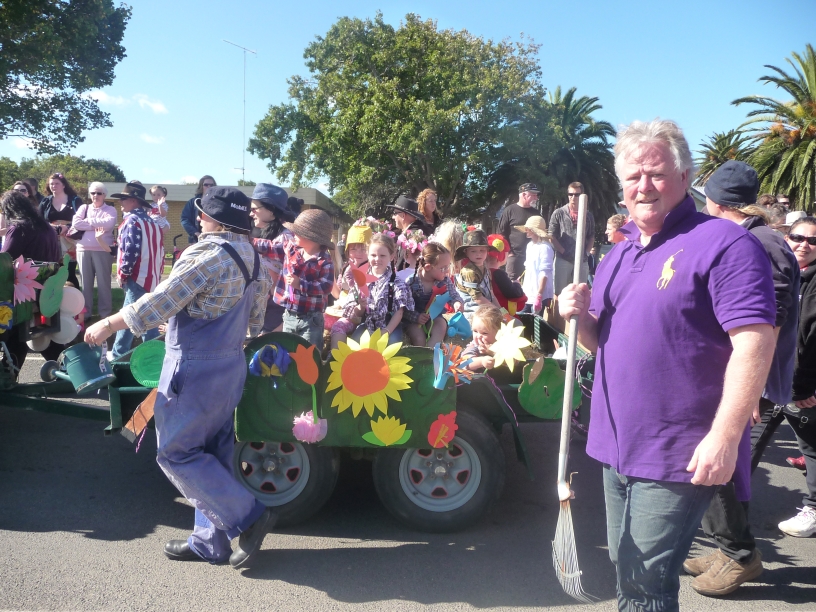
Zoe's first Tarra Festival parade

Today was huge. Every Easter our local town, Yarram, celebrates the Tarra Festival and at its heart is the parade. Colourful floats representing just about every facet of community life pass by thousands gathered on the footpaths and the centre plots. This morning, Zoe sat proudly among her friends on the kindergarten float, resplendent in yellow gardening hat and apron while waving a paper sunflower regally at the crowds. It was something of a rite of passage – I still remember clumsily twirling a Calesthenics baton decades ago along the same route – and she was in awe.

At the tail of the parade came three trucks: two B-Double milk co-op trucks and one belonging to the parade sponsor. The milk trucks are part of the community too and were warmly applauded.

The co-op's milk trucks are part of Yarram

The co-op's milk trucks part of the festival parade

After face-painting, slides, marvelling at the magicians, laughing at the clowns, catching up with friends and gobbling way too much fairy floss, we headed home to round up the cows. I was very proud of my tired little girl. She walked the cows in to the yard over 1.7 kilometres while making up lots of silly songs and giving me important directions.

Madame Butterfly stops traffic at the trough

We have a rule to let the cows drink for as long as they like on their way into the yard and in the picture you’ll see Madame Butterfly giving orders to stay clear of the drinking cows. After that, we checked two groups of cows, got in two mums and their newborns, fed grain to the yearlings and the springers, shifted the rising two-year-olds into a fresh paddock and checked in on a very sleepy and well-fed Laura.

Zoe will sleep well tonight!