How Gallipoli put Grandpa on the land

Grandpa is the little boy in the gateway

Grandpa is the little boy in the gateway

My grandfather, Harry, first saw Melbourne on his way to Gallipoli. I imagine it felt like a ticket to a new life after a childhood framed by tragedy.

When his mother died giving birth to his brother, little Harry was left in the care of his Irish grandmother. He worked her hillside farm hard and, at one stage, never left the property for the good part of a year. The stories my own father passed down to me spoke of a Harry abandoned by his father and shown little pity.

When war came, Harry became an ANZAC light horseman and carried water to the front line. My aunt Heather says dysentery “saved him” from the Western front and nearly a year later, he was home and regarded as a man.

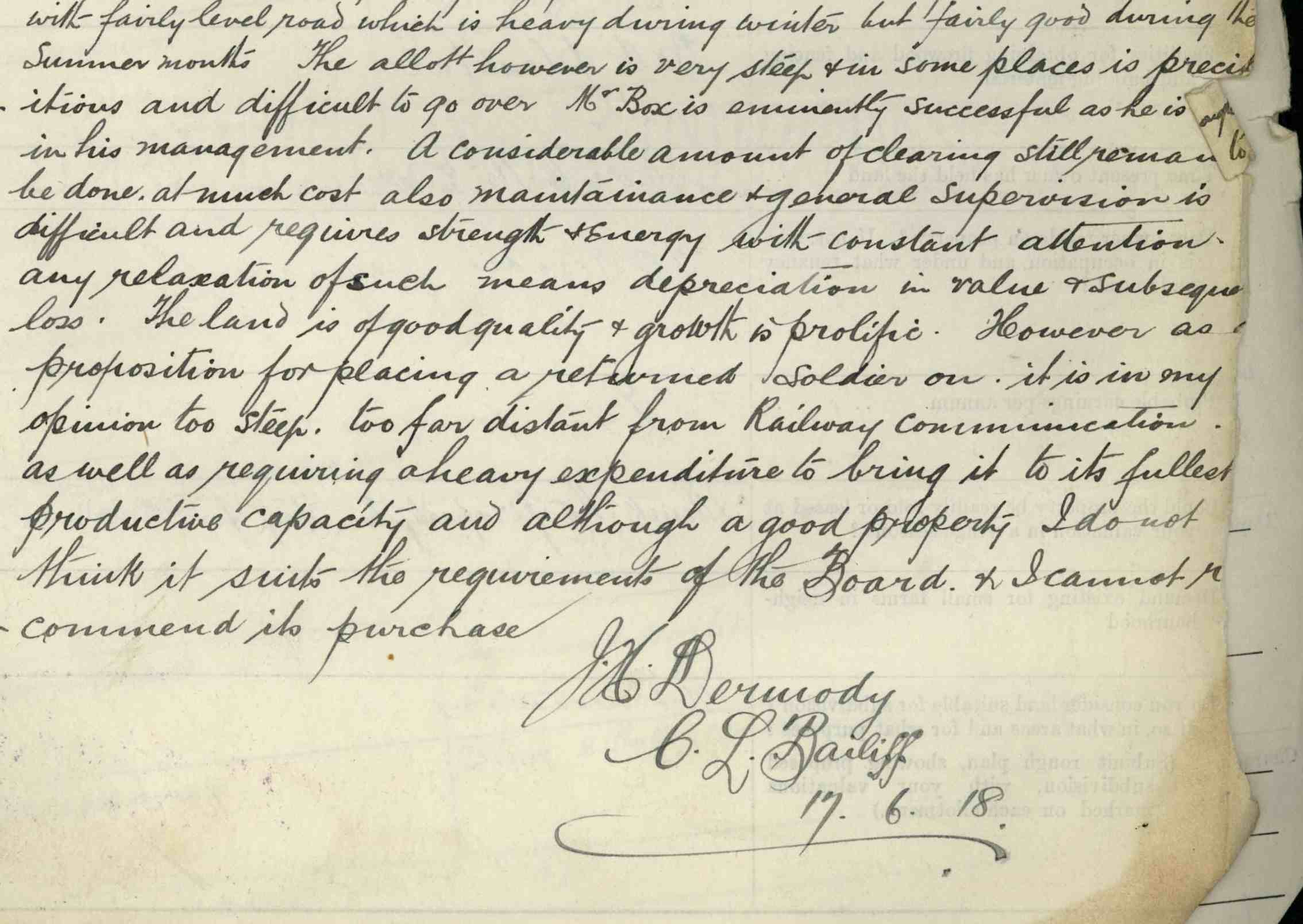
In 1917, Harry applied to secure a parcel of land under the soldier settlement scheme. The inspector recommended against it and his report forewarns of a battle too great for a returned soldier.

GrandpaSoldierSettler4cropLoRes

Mr Dermody’s advice made sense. I’ve been there many times and tried to imagine how it must have been 100 years ago. The valley is sweet but the property, known as Yosemite, does indeed reach up “precipitous” faces lined with cattle track terraces. Impossible country to farm with a tractor, nigh-on impossible with a fern hook and crosscut saw.

Although still recovering from dysentery and the psychological damage of war that he called “neurasthenia“, Harry’s ambition is palpable in his own submission.

GrandpaSoldierSettler6crop

Against the odds, Harry made it. And after his first two children were born around 15 years later, he built a new house with his bride, Pearlie, in the foothills down the valley.That is the place I remember when I think of Grandpa. Heather recalls her father wanting to sign up again in 1939 only to be told farmers were to remain on the land. So, she says, he resolved to buy the land we farm now in order to “do his duty and grow more food”. A notion almost incomprehensible in this era of plenty.

It’s to that lonely boy’s courage in the face of battle – both on the shores of Gallipoli and later in the hills of Gippsland – that I owe this farm. I will not forget.

Mastitis, antibiotics and milk

Why do we use antibiotics on our farm? Very simply, because despite everything we do to look after their well being, cows, just like people, sometimes fall ill and need antibiotics to get better.

It’s very rare that any of our 260 milking cows become lame with an infection while digestive problems are almost unheard of here and, in any case, do not require antibiotics.

The number one illness we treat on our farm is mastitis. If you’ve breastfed a baby yourself, there’s a fair chance you’ve experienced mastitis. In both cows and women, the symptoms include swelling, warmth and redness for light cases. Nasty cases bring flu-like symptoms that, in cows, can progress to become extremely serious.

How we prevent mastitis
So, how do we reduce the incidence of mastitis on the farm? We begin even before the calf is conceived by selecting sires whose daughters show a naturally lower susceptibility to mastitis.

At the same time, we minimise the risk of infection by keeping the cows and their environment as clean as possible. Tracks are maintained so there’s less mud around to flick onto teats and cows are happy to walk straight to their grassy paddocks rather than spending their rest times on mucky surfaces.
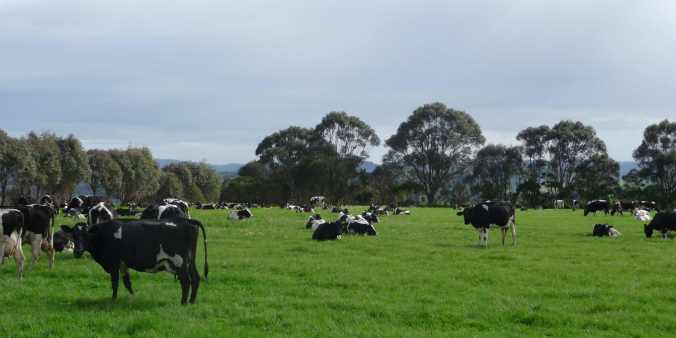
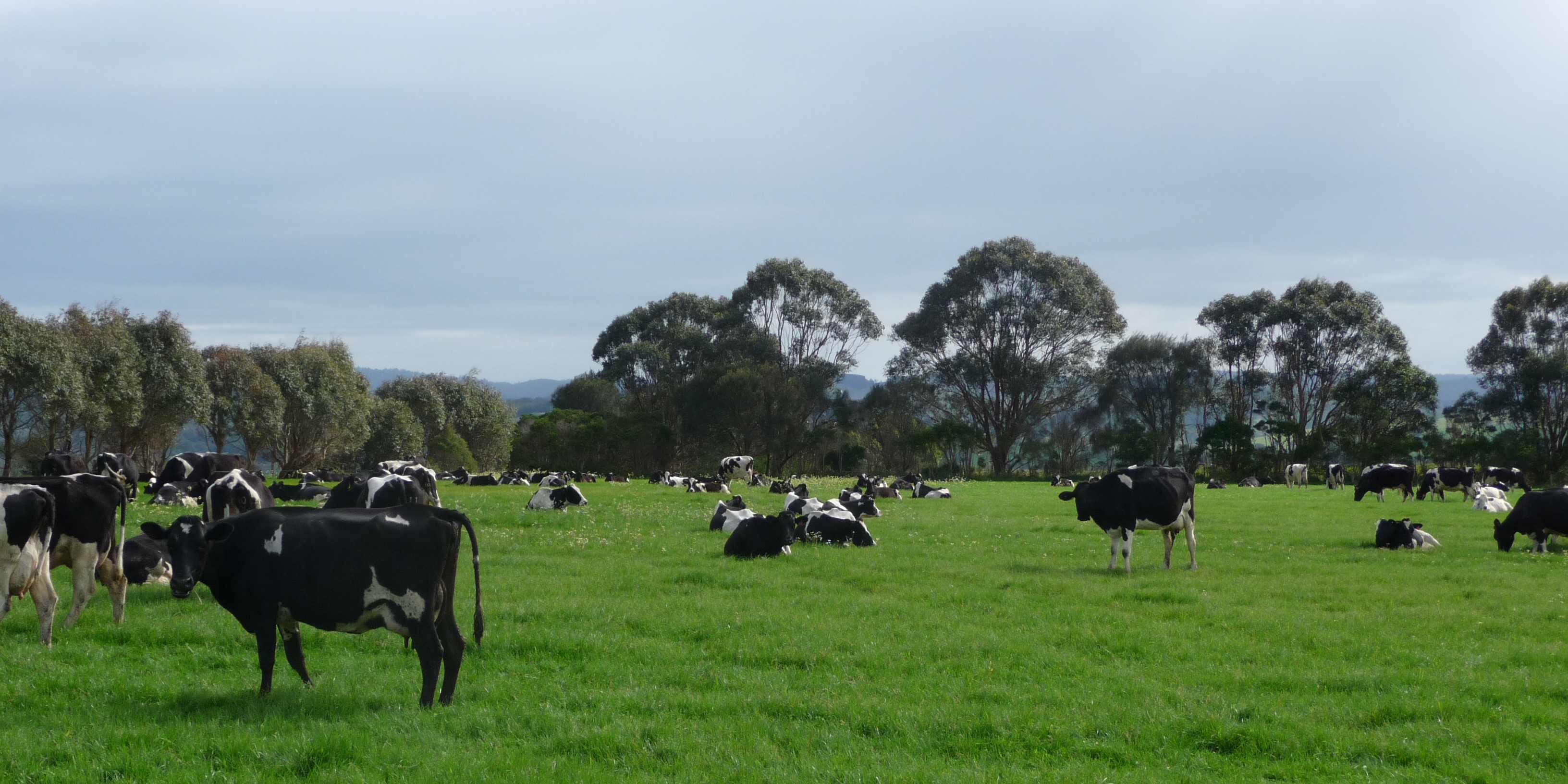
Cows resting in the paddock

Cows resting in the paddock after milking

The cows are well fed with a carefully balanced diet that is mostly grass and we treat the cows with care to minimise stress. It’s a slow, gentle walk to the milking shed, there’s no shouting and if I see one of our cows run, there’d better be a good explanation!

The hygiene of the dairy is important, too. We clean any dirty teats before the milking machine cups go on and spray them afterwards with a mix of iodine and glycerine to disinfect and protect them. We also routinely test the milking machines to make sure they are gentle and effective.

And we’re vigilant. Not surprisingly, when you spend hours every day with the cows’ udders at face level, you notice a sore cow quite quickly. A sore cow is an unhappy cow and an unhappy cow is an unhappy milker, too. Everyone who milks in the dairy has been specially trained at a “Cups On, Cups Off” course to look for mastitis and put top priority on the comfort of our cows.

Sometimes, cows have sub-clinical infections that don’t show any symptoms, so every few weeks, we collect samples of milk from every cow and have them analysed at the local herd test centre lab.

It’s a lot of work but it’s important work. The comfort of the cows is our number one priority and there are implications for the quality of the milk, too. If there is too much mastitis in the herd, our milk has a shorter shelf life.

One thing we don’t do, however, is include antibiotics in the cows’ feed. Routine antibiotic use is not legal and would mean that none of our milk would be useable.

Treating mastitis
When we find a cow with mastitis, we don’t wait to see whether she goes downhill, we treat her immediately with the medicine prescribed by (and only available from) our vets to help her recover fast. Antibiotics help the cow feel better in a day and we keep on milking her so that her udder is well drained and kept as soft as possible.

Making sure milk is free from antibiotic residues
The milk we collect from a treated cow is tipped out until there is no risk of antibiotic residues in the milk. The antibiotics come with quite precise details of how long they remain in meat and milk. It’s critical information because nobody wants food laced with antibiotics, especially those with life-threatening allergies.

As precautionary measures, we:

  • paint the cow’s udder red as a warning to everyone in the dairy that she either needs more treatment or to have her milk disposed of,
  • write her treatment needs and the time her milk needs to be withheld from the vat on a whiteboard in the dairy for all to see, and
  • record all her treatment details in a quality and treatment register.

After she has finished a course of treatment, we check the cow again to be sure the infection has cleared up.

Testing for antibiotic residues
Even with all these protocols, it’s good to know that if milk contaminated with antibiotics somehow got into the vat, there are more safeguards in place. In the next post, a guest from milk processor, Fonterra, will explain how they test our milk for antibiotics.

The bottom line
Our cows live good, healthy lives and rarely fall ill but when they do get sick, we give them the best treatment available straight away. For people and animals alike, antibiotics are our last line of defence against misery and death, so we use them only when really needed and then with great care. And I don’t want to go back to a world without them.

50 shades of green in an electrifying Easter

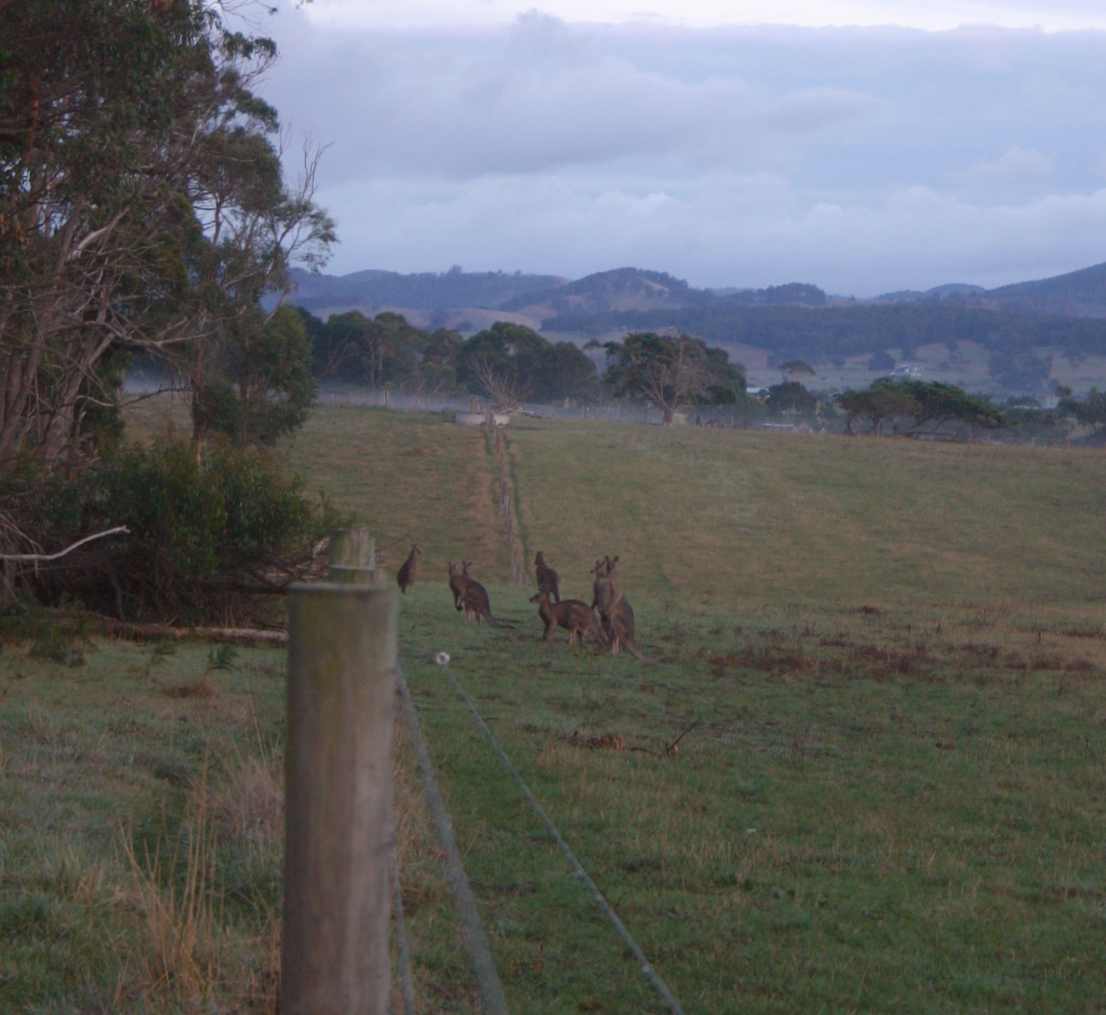
The big ones who weren't scared of me this morning

The big ones who weren’t scared of me this morning

There’s nothing black and white about being a farmer like me; there are about 50 shades of green. For this greenie farmer has a big problem that is not widely appreciated outside farming circles and, in fact, denied altogether by greenies of a different shade. It’s a kangaroo problem.

The side of the farm that adjoins state forest hosts about 300 kangaroos and wallabies every day and they’re quite literally eating us out of house and home. Last year, we and the cows harvested around 10 tonnes of dry matter per hectare (DM/ha) on the non-forest side compared to just 5 tonnes DM/ha on the half of the farm that sits next to the forest. The bottom line: it’s not even paying its share of the mortgage.

How could a few hundred macropods make such a dent in the farm when researchers say they don’t compete with cattle? First of all, the research was done in semi-arid land, which is not comparable to dairy farm pasture.

Rye grass, the dominant dairy farm pasture species, is sweet, much lower in fibre and easy to snip off at ground level if you have upper and lower teeth. Cows don’t – they only have one set of teeth and wrap their tongues around the grass to eat it – which limits how short they can eat the grass.

Kangaroos and wallabies have wonderful teeth for eating really tough native grass that also make it possible to raze less fibrous grass to ground level, which is exactly what happens on our farm.

Macropod teeth are brilliant for snipping off every last blade of grass. Source: howstuffworks.com

You could host a lawn bowls championship on our pastures closest to the bush, year round. Rye grass just doesn’t cope with that kind of pressure. It needs rest time between grazings so it can replenish its energy stores enough to push out new leaves and grow healthy roots.

Just a couple of years ago, we discovered that not even a vigorous fast-growing crop like oats can outrun our kangaroo population.

Oats eaten by kangaroos

Oats eaten by kangaroos

Oats guarded by dogs unaffected by kangaroos

Oats guarded by dogs unaffected by kangaroos

So, what are our options? We got a licence to cull 40 kangaroos a year but never fired a shot. It would be like trying to push back the tide and I have no appetite for creeping around in the chilly dawn air with a gun every week. I find it gut-wrenching enough to euthanase a suffering creature, let alone stalking Skippy.

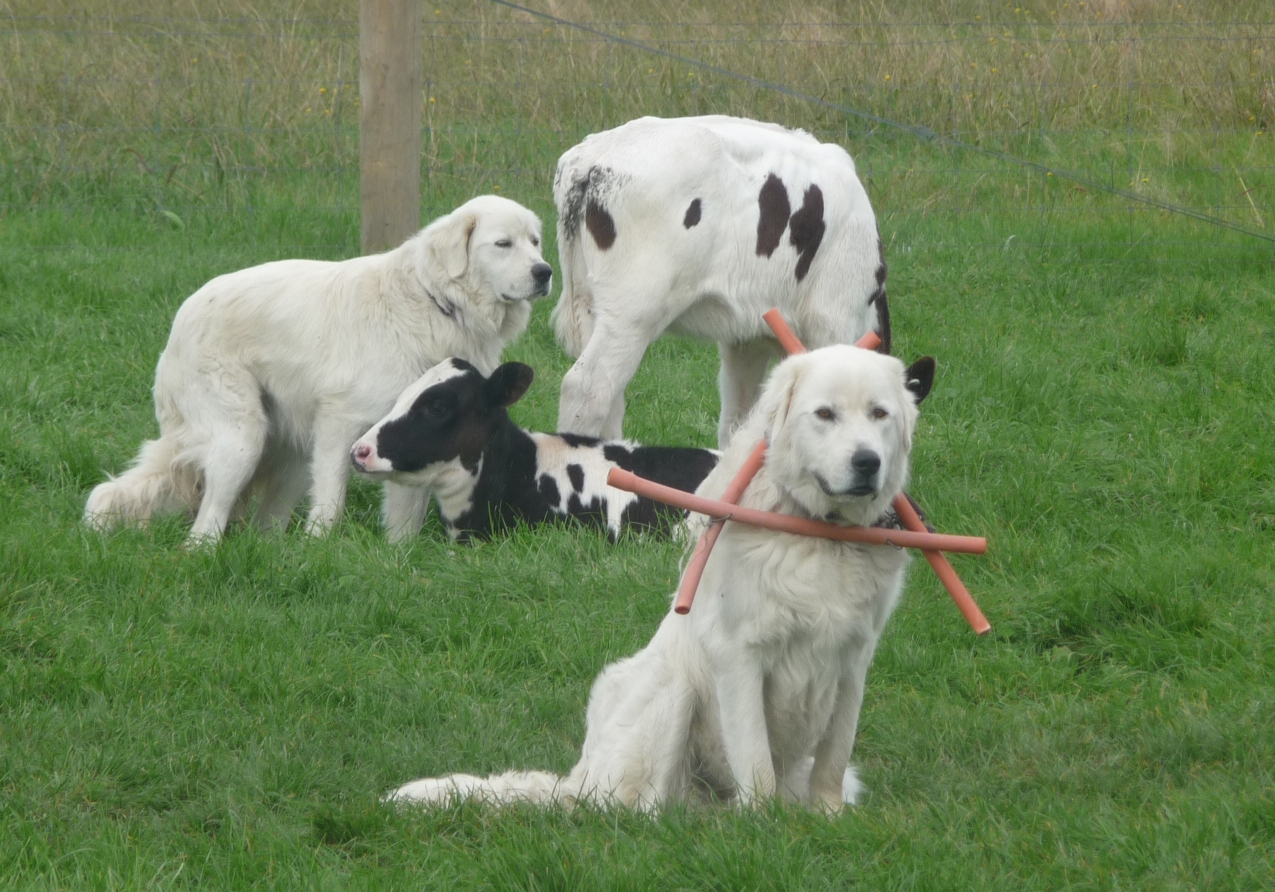
Next, I tried the great Maremma experiment. Charlie and Lola have turned out to be fantastic livestock guardians but they’re almost too good. When a threat approaches their calves, Lola stays with the poddies while Charlie ventures out to see whatever it is off the premises. They are effective for about a 50 metre radius of the calves but not hundreds of acres.

Charlie and Lola love their bovine friends

Charlie and Lola love their bovine friends

I even investigated spraying dingo urine around the boundary and all manner of sonic deterrents but found them either ineffective or impractical.

It’s come down to a cracking great electric fence. I’ve taken out a new mortgage to install it with real regret because we’ve had to remove trees to put it in and I know we’re committing ourselves to a lifetime of intensive maintenance.

The roo fence

The roo fence

The fence is only halfway around the boundary so far but I’ve already got a taste of what it takes to make it work. It will take more than one nasty shock to convince our visitors to dine elsewhere and kangaroos prefer to go under rather than over fences, so I have to keep the fence fired up all the way down to the wire that almost scrapes the ground. Longish green grass is enough to sap power from the system and have the roos squeezing under again.

I’ve spent a lot of time with my fence fault finder this Easter and I have a suspicion the fun is just beginning.

Good excuse for a walk

Good excuse for a walk

So, being an ethical farmer is not as clear-cut as you might think. If I carried on as we have been, we would be providing a great breeding ground for hundreds more roos than the bush can sustain and saved the felling of what I’m guessing was a thousand trees.

Building the fence means a more resilient farm that no longer relies on fodder bought in from across the state. It also means that I might finally be able to extend our program of planting 1000 trees a year to add to our 27 hectares of native forest on that side of the farm without the seedlings being wiped out.

Most importantly, if I am being honest, it secures the farm for our children. What would you do?

From the forest into light

From the forest into light

The politics of Easter eggs

kids_spring06_egg_cow.jpg

Easter eggs are now a political football with Animals Australia is using them as an opportunity to spread the word – and the guilt – about eating food laced with dairy cruelty.

At the same time, the Australian Raw Milk Movement is preaching the gospel of Vicki Jones, the woman behind the recalled milk associated with the death of a toddler. Apparently cows being treated with antibiotics when they fall ill are “paying the price” for the milk we conventional farmers provide. Better to assume no animal on an organic farm ever falls ill (or can simply “disappear” if she doesn’t respond to a massage with magic cream).

It disheartens me tremendously that treating a sick animal with the best medicine available can be dressed up as some form of cruelty but I think I’d better get used to it fast. Why? Because there are two movements gathering pace in Australia: “food fear farming” and “orthorexia nervosa”.

Food fear farming for product differentiation
You can make money from frightening mums and dads in the supermarket.

Milk that contains added permeate (which is an ugly name for milk’s natural sugars and vitamins), is pasteurised, comes from cows fed some grain or is not organic can be made scary. And non-scary milk gets a lift!

This is a basic marketing principle called “product differentiation” and is used by marketers in every consumer goods category from toilet paper to life insurance to gain market share or justify a higher price.

“When we were conventional dairy farmers I felt so frustrated at being powerless in the industry but now we are price setters and have security. It actually feels like we are running a business.”
– Vicki Jones, raw milk farmer, The Weekly Times, 17 September 2014

The reality is that as the margins around milk become tighter and tighter, we can expect to see increasingly desperate attempts to differentiate milk brands from the mainstream.

Orthorexia nervosa
Nutrition lecturer at UNSW Australia, Rebecca Charlotte Reynolds, wrote in The Conversation recently, that:

Orthorexia nervosa, the “health food eating disorder”, gets its name from the Greek word ortho, meaning straight, proper or correct. This exaggerated focus on food can be seen today in some people who follow lifestyle movements such as “raw”, “clean” and “paleo”.

Of course, food-centric righteousness comes in many forms and I’m watching as animal activists and food activists come together.

That quest for purity teamed with the need to differentiate what is otherwise a commodity product is perfect for farmers and food marketers desperate to make a dollar. Sadly, it’s often at the expense of everyday farmers and shoppers like you and me. And, if they could have their way preventing the use of basic medicines like antibiotics, the wellbeing of innocent cows.

MG responds to questions about Devondale

Devondale logo

After the publication of yesterday’s post, Murray Goulburn’s Robert Poole has this afternoon responded to Milk Maid Marian’s questions following the Financial Review’s commentary on Devondale’s sales performance. They are included here in full.

Q1: Are the figures quoted in the Financial Review a fair representation of Devondale’s sales performance?
A: MG considers that the data represented in the Rear Window opinion piece in the Australian Financial Review is selective and as a result has the potential to be misleading to readers. MG does not consider that it is a fair representation of Devondale.

Q2: To quote from the Fin Review: “According to Murray Goulburn, a big upside of the Coles deal was that it would ‘drive significant growth in sales for [its] core Devondale milk and cheese brands in the years ahead’”
A: MG has consistently stated that the underlying basis for the Coles contract was to enter the private label daily pasteurised milk market. This statement was made on 10 April 2013 when MG announced its entry into the landmark 10 year contract and again on 3 July 2014 when announcing the commencement of supply to Coles under that agreement. MG launching the Devondale branded daily pasteurised milk and Devondale Cheese into Coles (after a nine year absence) was separate to the underlying business case of supplying private label daily pasteurised milk to Coles. The supply of Devondale daily pasteurised milk and supply of Cheese was not the basis for entering into the Coles contract.

Q3 How do actual Devondale sales figures compare to the budgets set when the plants were planned?
A: Sales are in line with business plans.

Q4: Does Murray Goulburn continue to enjoy “preferred supplier status” with Woolworths?
MG does not comment on its relationship with customers.

Q5: How have the Devondale sales at Woolworths compare with those at Coles?
A: This information is commercially confidential. MG is proud to be a supplier to total Grocery and Foodservice trade, and works with all customers to grow the business and maximise returns to farmers

Q6: Does MG plan to review its product mix or marketing strategy in light of Devondale’s sales performance?
A: MG has a balanced portfolio across international and domestic markets, ingredients, Private label and branded products. Like any strong business, MG is managing this portfolio to maximise the returns to Farmers, as evidenced by the current farmgate price.

Q7: How does Devondale’s sales performance compare with other areas of MG’s business?
A: In 2014/15 Devondale is one of the leading growth and profit divisions for MG

The trouble with the MG and “Gary the Great” sideshow

Murray Goulburn’s colourful managing director, Gary Helou, is not universally loved and he’s become a bit of a target over the last year or so.

Some dairy farmers are nervous about his proposed transformation of the much-loved 100% farmer-owned co-operative into a “farmer-controlled” hybrid or are alienated by his brash, bullish style.

Some of his competitors hate him for driving up the price of raw milk (which is, of course, his mandate) and they also deeply resent this Devondale ad:

Given that Gary himself is a suit-wearing Sydney-sider who flies in weekly to MG’s Melbourne headquarters where a large corporate Mercedes Benz awaits him in the basement, he could be accused of a little hypocrisy.

So the acerbic commentary from the Financial Review directed at the so-called “Gary the Great” generates plenty of sniggers, including yesterday’s piece, which was republished outside the pay wall in The Land.

The article reveals a series of sales figures that suggest sales of MG’s Devondale branded products have tanked disastrously, followed by an observation that:

“When Helou locked Murray Goulburn into a decade of skinny margins supplying Coles with its $1 milk, his rationale was that it would lead to growth in his branded products and thus higher margins for his farmers.”

“But the growth has not transpired, which means the margins are on borrowed time – especially as Helou juggles significant debt covenants, tries to raise $500 million in new capital and wears major cost blowouts getting his new processing facilities online.”

Are the figures fair? I asked dairy industry analyst, Steve Spencer of Freshagenda, about the data quoted in the story.

“The figures are sourced from retail scan sales data reports, which are expensive and normally only purchased by some of the larger supermarket suppliers,” Steve explained.

“The figures supplied to the Financial Review are current and specific and certainly not publicly available, so the data was most likely leaked by a competitor. It’s unlikely that any of the figures were inaccurate but could have been used selectively to paint a certain picture or the columnist’s agenda.”

But if the article is fair, it’s worrying news for MG farmer shareholders. I invited MG’s Robert Poole to answer a series of questions to set the record straight:

  • Are the figures quoted in the Financial Review a fair representation of Devondale’s sales performance?
  • To quote from the Fin Review: “According to Murray Goulburn, a big upside of the Coles deal was that it would ‘drive significant growth in sales for [its] core Devondale milk and cheese brands in the years ahead’”. To what degree does the profitability of the Melbourne and Sydney plants rely on the sale of Devondale products?
  • How do actual Devondale sales figures compare to the budgets set when the plants were planned?
  • Does Murray Goulburn continue to enjoy “preferred supplier status” with Woolworths?
  • How have the Devondale sales at Woolworths compare with those at Coles?
  • Does MG plan to review its product mix or marketing strategy in light of Devondale’s sales performance?
  • How does Devondale’s sales performance compare with other areas of MG’s business?

Robert pointed me to a media release on MG’s website released later in the day. Unfortunately, it does not answer the questions. Instead, it plays the man rather than the ball, providing any genuinely concerned farmer shareholder little comfort.

Are the criticisms of Gary Helou and MG simply sour grapes or dirty competitive tactics? I hope so but it seems only time will tell. This is the tragedy of the “Gary the Great” sideshow: it all descends into an ugly bun-fight in which, ultimately, the farmer is the loser.

EDIT: I HAVE WOKEN TO AN EMAIL FROM ROBERT POOLE INDICATING THAT HE WILL BE PLEASED TO ANSWER THE QUESTIONS TODAY (20/02/2015).

The freedom to be a cow

It’s not just Cheeky Girl who magically appears out of nowhere. I had to go down to the paddock after milking to check on the cows and found myself being stalked by a tall, dark stranger.

It’s a lot of fun just sitting, watching the cows. Real individuals, some are curious, some are timid, some haughty but, without exception, dignified.

There’s a fine balance in our interactions. Yes, we milk the cows but it is they who dictate the flow of our days, months and lives. Everything from wedding dates to annual holidays are chosen to avoid calving season, a time when all hands are focused on the safe arrival of the next generation.

Continue reading

The Life of the Dairy Cow

1441 aka "Cheeky Girl" on the left

1444 aka “Cheeky Girl” on the left with the pink nose

Meet 1444, known to us as “Cheeky Girl”. If you were in the paddock alongside me, she would certainly want to meet you. As a calf, a yearling and now, a mature cow, Cheeky Girl’s always been one of the first in the herd to wander up to you in the paddock. You’re busy working on the fence, you turn around to see who’s sniffing you and there she is, every time!

Vegan group, Voiceless, today launched an “expose” of cruelty to Australian dairy cows called The Life of the Dairy Cow: A Report on the Australian Dairy Industry. Continue reading

How much listening to farmers is okay?

"Fonterra on Twitter" by Digital Jungle

Excerpt from “Fonterra on Twitter” by Digital Jungle

I don’t need to tell you how much of a stir a report tracing Twitter conversations surrounding Fonterra made when it was tweeted by farmer Shelby Anderson (@cupslinga) yesterday. The extensive 54-page document monitored just one week of Twitter conversations and looked to be a sample of what the social monitoring service could provide rather than a commissioned routine report. Still, as Shelby tweeted, it was a veeeerrry interesting report all the same. Continue reading

Secrets of a happy life revealed and it was here on the farm all along

“If your New Year resolution is to be happier, make your priorities fruit, nature, sun and sleep.”

This simple prescription for a happy life stems from Otago University research reported in the NZ Herald this morning.  Sounds a lot like farm life, doesn’t it?

From all of us here on the farm, have a wonderful 2015!

Before we say goodbye to 2014 though, I’d like to pay tribute to our wonderful fellow Landcarer, Margaret Ferguson, who helped us plant trees this summer and tragically lost her life in a farm accident this month. I still can’t believe this magnificent lady is gone but she would be delighted to see how well our trees have already grown.

The trees arrived in September

The trees arrived in September


The grass was sprayed to give the plants a head start

The grass was sprayed to give the plants a head start


We finished planting in the first week of October

We finished planting in the first week of October


Giving the trees a helping hand when it got dry was noisy work

Giving the trees a helping hand when it got dry was noisy work


Look how much they've already grown: the same trees on Boxing Day 2014

Look how much they’ve already grown: the same trees on Boxing Day 2014


RIP Margaret. We miss you.

RIP Margaret Ferguson: a passionate fellow Landcarer (Photo courtesy of Kaye Proudley)

RIP Margaret Ferguson: a passionate fellow Landcarer (Photo courtesy of Kaye Proudley)