So what should farmers be saying to other Aussies?

We’ve all been there: trapped by a bore who talks incessantly about him or herself without drawing breath. It starts off confusing, grows to be annoying until, finally, the desperation to get away and have a real conversation becomes overwhelming.

I think we farmers may be guilty of this social sin. Too often, we are presented as whingers who fail to appreciate that urban Aussies with equally as noble callings (from educating our children through to curing our cancers) can also do it tough.

In our defense, the media generally isn’t so interested in good news stories and the only time we have traditionally appeared on the 12-inch (no, make that 60-inch) screen is during a drought, flood, fire or pest-induced famine. Times when a cheery countenance would be both unlikely and ridiculous!

The face of farming throughout all the challenges was presented in a glorious Dodge Super Bowl ad the other day. In response to my post about it, farmer John Alexander, described it as, “…one of the best Ag ads out there (possibly ever), and I wish we could replicate it in Australia as soon as possible.”.

He’s not concerned that it might alienate city dwellers and neither are people like former career politician, @HenryPalaszczuk, who says, “Aussies have a quiet respect for our people on the land. This ad wold send a shiver down their backs.”.

I know that’s true of many Australians. But I want more. I want to see Australian farmers talk with non-farmers rather than at them and I hope we will learn to do it in a way that resonates for all.

The Dutch have had a go at exactly that. This ad for milk is not perfect (who wants farmers cast as peasants?) but it extends the hand of friendship to our city cousins in a way that “God made a farmer” cannot.

Love of animals, love of land, courage, humility, honesty, purity. These, the essence of Australian farming are values cherished by Australians everywhere. Isn’t it time we celebrated what unites us?

Who or what makes a farmer?

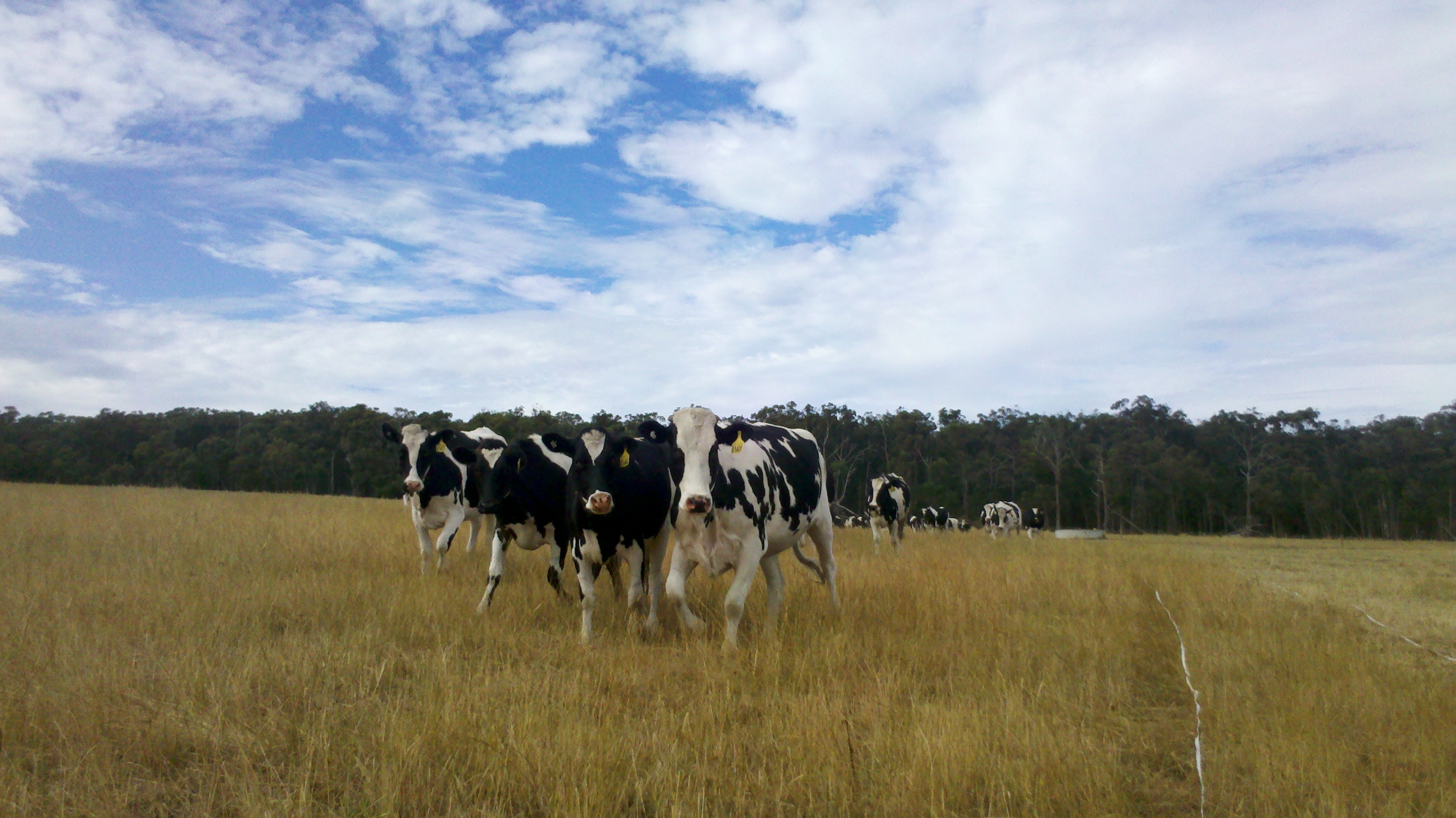
Yesterday, while rounding up the cows, Zoe announced: “When I grow up, I want to be a farmer and have two children.”.

“True? How come?”

“So I can be like you, Mama.”

It gets into the blood of farm kids early. Much earlier, I suspect, than the children of, say, accountants or writers. At six, our little girl knows when a paddock is ready to graze and has that sixth sense for when a cow seems not her normal self. Because she’s already a farmer.

Since I don’t have religious faith, I don’t believe any of this is God’s doing. Take a look at this ad, which just made its debut during the Superbowl.

This evangelical message has got farmers around the world twittering with delight. It’s nice to get a pat on the back once in a while. But I have a confession: it simultaneously makes me proud and embarrassed.

Why must we farmers talk so much about how hard we work? Yes, it is a farming fact of life but, no, it does not make us saints or martyrs. We do it because we want to.

And when I asked Zoe what she thought would be great about being just like me, it came down to this: “I can have fun with the cows every day!”. Perfect!

The tractor, the toddler and the ejector seat

The neighbours will think I have gone mad or won Tattslotto. The Macdonald farm is not known for gleaming machinery but, in the last few days, an updated tractor has arrived, followed by a new feedout cart.

The reality is that our ancient tractor was getting so tired I just had to trade it for a 6-year-old replacement. Then, in spectacular fashion, the geriatric feedout cart snapped a structural member and twisted itself into an irredeemable mangle. We’re currently feeding the cows 4 tonnes of hay and silage per day and, without it, the feeding regime would take at least an extra two hours that Wayne just doesn’t have.

The tractor may not be brand new but it’s seen barely any work in its former life as a parks and gardens curator and has gleaming paintwork teamed with dark tinted windows that instantly captures a milkmaid’s heart. Fortunately, there was urgent and important work to be done, so with toddler strapped to chest and dog in hot pursuit, I set off to christen the Green Machine and its pristine bucket.

And, oh, the experience was indeed rapturous! The new tractor was clearly designed by another child-wearing tractor driver. Alex cannot reach the forward-neutral-reverse lever on this model and a single, aptly-named joystick controls the front end loader’s up-down and tilt all at once, eliminating even more hazardous handholds!

Christening the Green Machine

Christening the Green Machine

The only thing that got me out of the tractor seat was the little man’s demands for food.

The next day, Wayne got his turn. Had to do some customisation. There was a cumbersome box to remove, the little spray tank that obscured the view, the radio key to re-enter, the steering wheel positioning and the ejector seat to adjust.

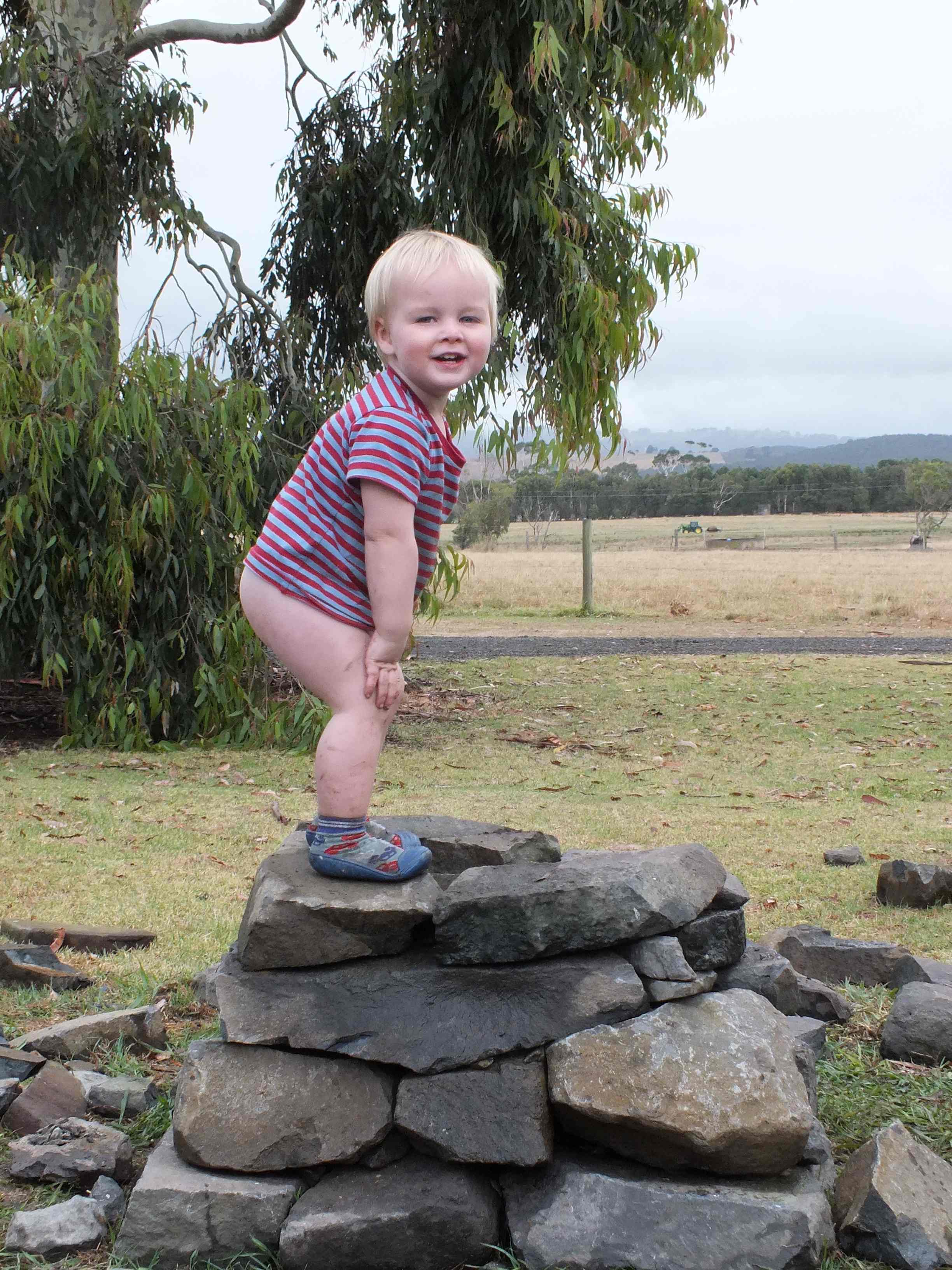
Me: (Distracted by toddler attempting to wear potty as a hat) “Hang on – what did you say?”

Him: “It was nearly impossible to squeeze in behind the steering wheel, so I had to get it up out of the way. You can see where the council blokes have been wearing the upholstery away trying to push their big…”

Me: (Hastily) “No swearing in front of Alex! What was that about the seat?”

Him: “Oh that…Yeah, well, I’d put the steering wheel up nice and high but that meant the seat was too low so I had to get it up too.”

“There’s a button between your legs to push and – can you believe it? – a little compressor starts up ‘brrrrrr’ and I’m being lifted up towards the roof! Problem is, the seat carries you away from the button and, pretty soon, you’ve got your head between your knees trying to keep your finger on the thing.”

“As you’ll no doubt remind me, my perfectly proportioned arms don’t reach all that far, so once I couldn’t touch the button any more, I let go and sat up to have a look. All I could see – right before my eyes – were the air-conditioning controls.”

Me: (Laughing) “Those ceiling-mounted knobs? Did you hit your head?”

Him: “Yep, it’s the world’s slowest ejector seat. Put that in your OHS manual.”

And the rollercoaster goes up!

This was the farm 48 hours ago. Shrouded in smoke from the bushfires, the place was tinder dry.

January 25

January 25

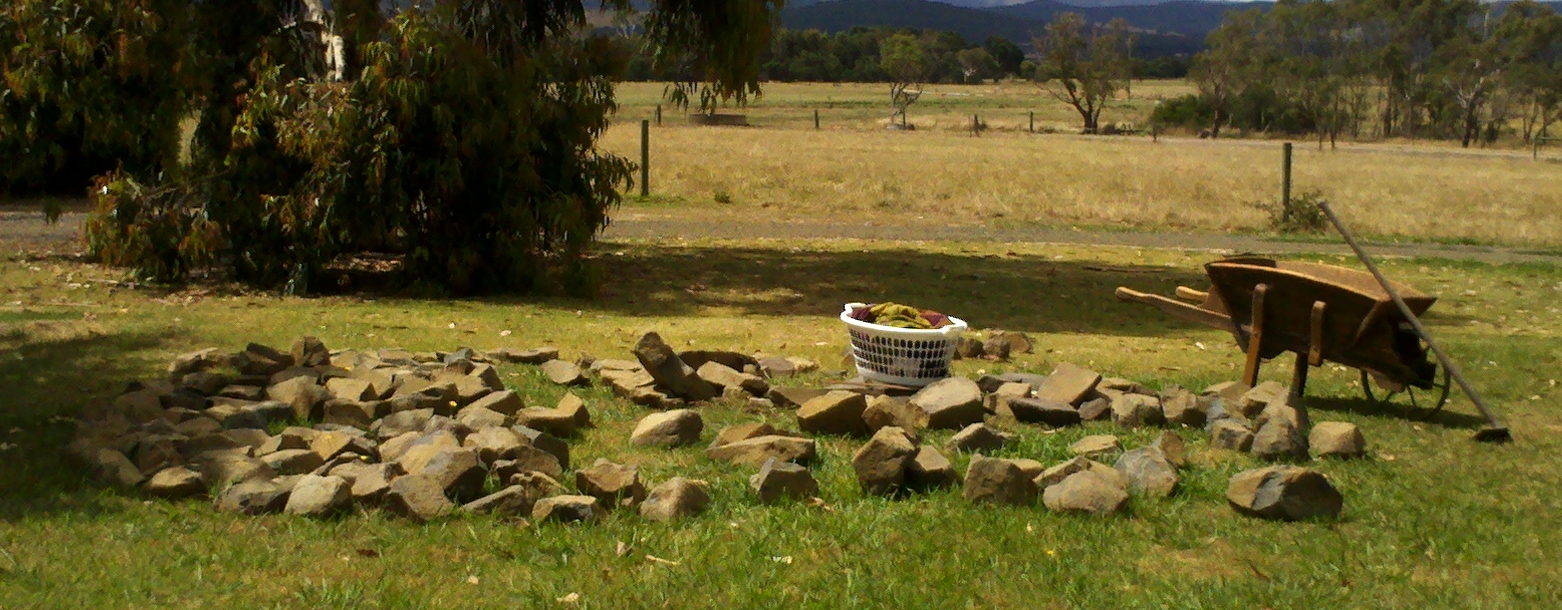
I went to bed last night with 4 inches of water in the house tank and hoped like hell that the easterly over Bairnsdale would grace us with its presence. We had gone all out, after all. The cairn dedicated to Thor is almost complete, the washing line was full of dry clothes and, to top it off, Wayne left the quad bike in the centre of the lawn with his helmet upturned like a giant goblet, ready to receive the sacrament.

Thor delivered.

Almost 18mm of gentle rain!

Almost 18mm of gentle rain!

There is not a puddle to be seen but the place smells wonderful and the plants are already responding.

What a difference 12 hours makes

What a difference 12 hours makes

We had to celebrate!

The Thor Cairn was the perfect place to celebrate and pay homage

The Thor Cairn was the perfect place to celebrate and pay homage

What makes this rain even more special is that there is more rain forecast over the next week and not a day over 30 degrees. The cows will love it! Can’t wait to snap another panorama at the end of the week to see new life breathed into the farm.

The totem of $1 milk

Two years ago today, Coles offered up milk as a sacrifice in the name of market share. It’s now become totemic in Victoria.

The reality is that about two-thirds of Australia’s milk comes from Victoria’s cows but not a lot of my farm’s milk ends up in the supermarket fridge.

We supply the Murray Goulburn Co-op, which processes about one-third of Australia’s milk and has the technology to make a huge variety of dairy foods and ingredients. It sells to the highest bidder, so the percentage that gets exported depends on how well global commodity prices compare with local dairy markets. In 2011/12, 49 per cent was exported, which is pretty typical.

But Victorian farmers are demoralised. Many are in desperate financial positions. The effects of the collapse in global commodity prices, skyrocketing energy prices, high feed costs and the high Australian dollar are clear but shrouded in secrecy is the impact of the supermarket war.

While $1 milk gets all the attention, other dairy products like butter and cheese have also been hit by the supermarket price war. Murray Goulburn has invested heavily in relaunching its supermarket brands and CEO Gary Helou infamously got all hot under the collar last month about Coles’ refusal to stock MG’s Devondale cheese. But nobody can talk about how Coles and MG negotiate our livelihoods behind the tinted windows of “Darth Vader’s Castle” as the Coles HQ is fondly nicknamed by its suppliers.

We’ll probably never know just what the damage has been – only that our situation is very different from that in states like NSW and Queensland where there is pretty much total reliance on fresh milk sales.

But what those claiming to be “the voice of reason” dismiss is the effect ‘milk that’s cheaper than water’ has on the psyche. It signals to farmers that a fair go no longer matters. And that’s what hurts the most on Australia Day.

Because diesel is the new asbestos

Diesel Bobcat without windscreen

Breezy is beautiful

Diesel fumes have always left me feeling sick and it turns out my queasiness is justified. A report in the West Australian explains:

“Researchers from the WA Institute for Medical Research and the Telethon Institute for Child Health Research found that children with fathers who were exposed to diesel exhaust fumes at work about the time of conception were 62 per cent more likely to have brain tumours.”

“The results, published in the International Journal of Cancer, also showed that children of women exposed to diesel fumes at work before the birth had twice the risk of brain tumours.”

Scary stuff? Yes. According to the WHO, diesel is the new asbestos.

“Experts at the World Health Organisation (WHO) say diesel engine exhaust fumes can cause cancer in humans. They say they belong in the same potentially deadly category as asbestos, arsenic and mustard gas.”

We are lucky to live far from city pollution but we do have a diesel car, diesel tractor and diesel UTV that gets me and the kids around the farm. That new UTV came with a roof and windscreen – a combination that, ironically, may have threatened our children’s health. Unfortunately, it seems the windscreen created negative pressure and built up a vacuum that sucks air from behind and around the UTV back over the cabin. With it came a lot of dust and a strong smell of diesel fumes.

The windscreen is now stacked neatly against a garage wall and we are breathing easy once more.

Could you be suffering from cow envy?

CuriousHeifersRun

The ethics of food is so complex. Vegans following a conscientious diet are told they are inadvertently starving Peruvians, causing deforestation and even eating with blood on their vegetarian hands. It’s not easy being green and I don’t blame vegans for being so passionate about their choice.

Life on farm is a microcosm of those ethical dilemmas. Every day, we must make decisions that impact on the well-being of an animal. Often, there is no easy answer. Should we euthanase that cow now or wait although she’s in discomfort in the hope she recovers? Should we raise that calf away from her mother or risk deadly disease transmission? And the big one: should I send heifers to China if milking just won’t pay the bills?

If nothing else, it forces you to stare hard in the mirror and here’s what I see: yes, I am a commercial dairy farmer and, hell yes, I care about our animals and our land.

Although this is something vegans on Twitter seem to find inconceivable, in my experience, this mindset is not only possible but typical of dairy farmers. It’s what keeps us on the land for generations and I am incredibly grateful to be here. My farm may not be a “cow sanctuary” as one vegan put it but I’m doing my best to make sure the cows never realise.

(Special note to my vegan friends: I realise what a privilege this is and wouldn’t blame you for some serious cow envy!)

Well hello, Luscious Legs, how pregnant are we?

luscious legs

Ooh la la!

These shapely legs belong to the beleaguered wearer of “The Shirt”. Apparently, it was too hot to wear long pants or anything waterproof today doing a Big Job.

Anyhow, the Big Job was a special occasion: we got to find out how pregnant we are (or more correctly, how pregnant the cows are). Preg testing qualifies for the title of Big Job because it entails lining up 125 cows a day for an internal examination by the vet. Not painful for the cows but a big change in routine like this always means added excitement.

The good news is that almost all of our 250 milkers have indeed conceived to our irresistible team of bulls. All expectant cows will take a two-month holiday before calving and we will greet the next generation from late April onwards.

A sizeable group of cows will not calve at all in 2013 – I pulled the plug on mating early – and will instead enjoy our company twice a day, seven days a week for the next 18 months.

How to rescue dairy – from the nutty to the tricky

Dairy farmers gathered in their hundreds in south-west Victoria last night for a crisis meeting. What makes it a crisis? Very simply, dairy farmers are working seven days a week for free and petrified of losing our shirts.

Local agribusiness bankers tell me they are busy refinancing and arranging extra debt but land sales are at a standstill around here. Reporting on last night’s dairy crisis meeting, Simone Smith of The Weekly Times, described a “dire picture”:

“Warrnambool-based Coffey Hunt farm accounting specialist Garry Smith said across his client-base, farmers milking mostly between 450-500 cows, average feed costs were up 15 per cent – a $150,000 rise – with the cost of power for the first quarter of the year up 50 per cent.”

“He estimated across his client-base earnings would be 10 per cent down on last year with a combination of cash-flow and income down $260,000.

“Charles Stewart real estate agent Nick Adamson said better quality farms had dropped in value between 8-15 per cent, while others were up to 45 per cent down on peaks of several years ago.”

None of this is pretty and astonishingly, Peter Reith decided to appear on ABC’s The Drum website with a six-point plan that, at first, I thought was a spoof. Take a look and make up your own mind.

It’s not as simple as cutting petrol taxes and municipal rates. It’s tricky because of this conundrum: milk and dairy foods are considered so important that nobody wants to pay what they are worth to produce.

Every day I read comments on Twitter that go something like this: “My kids drink three litres of milk every two days, so I can only afford to buy $1 milk”. I know first-hand how tough it is to feed a family when you’re on struggle street, so I have a lot of sympathy for people in this predicament and it’s impossible to respond with anything other than compassion.

It’s hardly surprising, then, that there is no political appetite for an increased milk price. But the truth is this: dairy farmers should not and cannot fund an ersatz Australian welfare system by subsidising the cost of food. Welfare is the role of government.

So, while my dander is up, here’s a simple list of five tricky things that would make a big difference to this dairy farmer:

1. Deal with the supermarket duopoly
Down, Down, Down is not about you, dear milk drinker. The real reasons for the supermarket war are expressed in corporate ROIs rather than family budgets. At the end of the day, it will be the little people with the least market power – you, the shopper, and me, the farmer – who will pay.

2. Level the global playing field
Julia Gillard announced that Australia would be Asia’s food bowl but guess what? Unlike the world’s most powerful dairy exporters, the Kiwis, we do not have a free trade agreement with China, putting Australian dairy at an immediate 15% disadvantage. Nor do we receive the government subsidies that support our European and North American competitors.

3. Assist with the impact of the carbon tax
Australian dairy farmers are suffering a double whammy under the carbon tax. First, processors are passing the extra cost onto us in the form of lower farm gate prices (because the consumer won’t pay extra and nor will global commodity markets), reducing our incomes by around $5,000 each per year. At the same time, our costs – especially electricity and refrigerants – are rising in quantum leaps each quarter.

4. Support smart farming
Long exposed to the blow-torch of global export markets without subsidisation, Australia’s dairy farmers are among the most efficient in the world, according to research body, Dairy Australia. We can produce very high quality milk at a very low cost because we have invested in research and development. No longer. We are spending less and less on R&D and the Victorian government has just made massive staff cuts to our brains trust, the Department of Primary Industries.

5. Remember, I am the goose that lays the golden egg
I will not be able to continue to deliver high quality milk at such a low price while enhancing the environment and caring for our cows without sacrificing the basic wellbeing of my family and that, I refuse to do.

Project “Thor”

After a record wet winter followed by a fleeting Spring, it hasn’t rained here in a long time.

In fact, despite several attempts at emulating the Sioux rain dance ritual shown in the remarkable footage (bear with it, not all stills) below, we have had little success – other than the 2.5mm of rain we got after our fourth performance a week ago, there’s been nothing in the gauge for a few weeks now.

Perhaps the problem lies in our execution. Since the materials used by the Sioux are not all readily available here in Australia, we have been forced to improvise with picnic blankets, turquoise hayband, the feathers of wedge-tail eagles, dyed hessian sacks and rubber boots adorned with eucalyptus leaves and shells.

We are getting desperate and it shows.

Under construction: will Thor be impressed?

Rain Dance Ampitheatre under construction

Drawing upon my husband’s Scandinavian heritage, I am building a stone amphitheatre to honour Thor with a special sacrifice: a washing basket full of damp linen. With a toddler in the midst of toilet training and the truly spectacular laundry that makes our dairy-farming family infamous, you’ll understand the meaning of such an offering.

I know I must show total faith in Thor’s generosity but any tips would be gratefully received.