Heifers, bulls and fear

Today, we drenched and vaccinated the most dangerous animals on the farm: heifers and bulls.

At two years old and weighing about 500kg each, the heifers are as skittish as teenagers and have no concept of their own might. They’re not used to being yarded and react quickly and unpredictably in the unfamiliar environment.

Bulls, on the other hand, are well aware of their power and are quite prepared to use it. As we rounded them up, one neatly threw a competitor over (or through) a five-foot fence with a toss of his head. A timely reminder to treat them with respect.

We used an oral rather than a pour-on drench because it’s been so much more effective for our animals this year. The warm, wet season has been ideal for worms. The 7 in 1 vaccine we used protects us from a debilitating disease called leptospirosis and the animals from a suite of nasties.

Drenching and vaccinating the lot of them in one day was really the only way to do it, even though it amounted to a rather daunting task that quite literally took two hours of blood, sweat and tears to accomplish. Still, it was worth it. They might be the most dangerous animals on the farm but they are its future.
The farmer is dead, long live the farmer: succession is rarely so easy

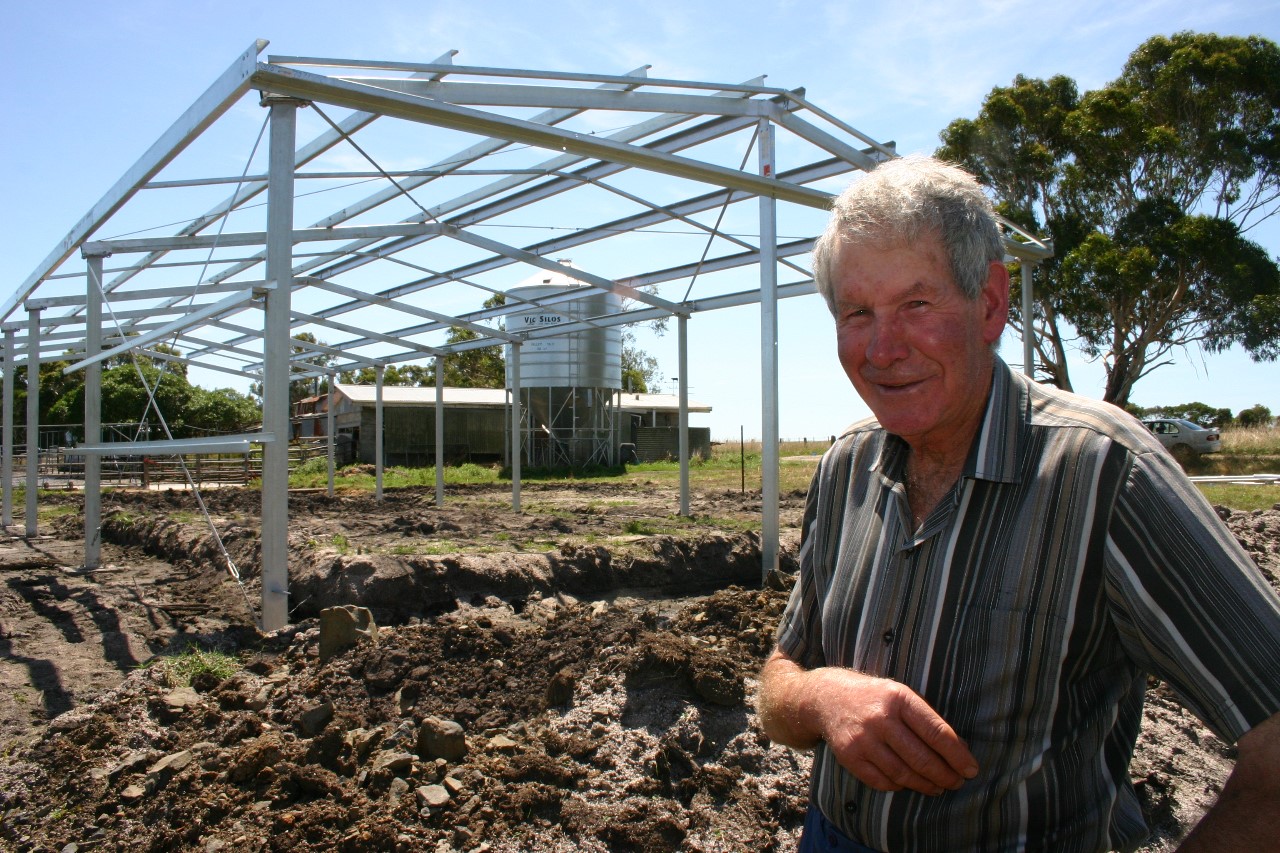
Dad with the dairy under construction

Dad missed out on his dairy

The royal wedding got me thinking about succession. Nobody maps it out more clearly than the Windsors. From the moment they are born, everyone knows exactly where they stand. Not so for many Australian farming families, including ours.

Dad and I loved each other but there just wasn’t enough room for both of us on the farm: financially, emotionally or in terms of management style. Although immensely proud of his university-trained daughter, I think he felt the farm was no place for a “girl” and, besides, this was his domain.

As Dad aged and grew more tired, it was great to have his daughter on hand to milk, feed calves, fix fences, drive tractors and so on but the subject of succession planning was taboo. He would tell anyone who cared to listen that he wanted to be “found dead in the dairy at 97”.

The dairy itself ended up being a rather poignant reminder of Dad’s determination and, ultimately, frustration. The dairy farmer who prided himself on always milking alone built a new 16-aside double-up herringbone in 2005/06. Sadly, he only milked in it a few times. Prostate cancer claimed Dad, aged “just” 77, in December 2006.

His last year was difficult. Dad did not want to admit defeat, so struggled on farming for many months despite being incredibly weak. Finally, the tipping point came when he fell off a tractor and had to be rushed into hospital unconscious.

In the weeks leading up to Dad’s death, the will was able to be discussed. He had remarried only five years earlier and the assumption was made that his wife would sell the farm. I was desperate to keep the farm and it became a bitter battle. In the last two or three weeks before his death, Dad decided that if he did die, I should be given the chance to pay her out and try my hand at farming.

It was almost too late and the indescribable stress was unfair on everyone. Tragically, this scenario is not unique and gets even more complicated when siblings are involved. Don’t let it happen to your family. Get everyone involved early and take advantage of all the resources and expert advice you can find.

Would love to hear how your family has approached this sometimes tricky topic.

The pregnant farmer, her 4-year-old and the breech delivery

At 5pm, Zoe and I checked the springers (cows soon to calve). Cow 535, a very strong cow in the prime of her life looked agitated. Off by herself in a corner of the paddock, 535 had her tail up and could barely decide whether to pace around or sit down. All of this is normal behaviour for a cow about to calve but I wasn’t sure. Nothing I could really put my finger on, just a sixth sense something was wrong.

Having been poked and prodded at my own 35-week exam today, perhaps I was a little paranoid?

After dinner, Zoe and I ventured out in the ute with the heater roaring. Where was 535? Still off in the far corner of the paddock, still pacing nervously, still no membranes. I’d expected some progress after two hours but I didn’t think it was a smart move to try assisting the labour myself and Wayne was in the city so we called Pete the vet.

Mother guilt kicked in. My cheerful little assistant was very keen to be involved but even as we yarded 535 it was already past Zoe’s bedtime. She’ll be tired tomorrow. On the other hand, I told myself, this type of experience helps to build resilience and she was learning lessons about taking responsibility for animals that you just can’t get in books.

It turned out that 535’s calf was trying to come out backwards but had not made it to the birth canal and her mum’s body was not getting a clear signal to push. If we hadn’t called Pete, both cow and calf might have been dead by the morning. Pete delivered the long and lanky heifer calf alive, then massaged her abdomen to help clear her lungs. We moved the pair to a dry, sheltered spot where 535 could do the all-important job of licking her calf dry and encouraging her to stand and drink. Can’t wait to see them in the morning.

Zoe was delighted and rang her Papa to relay the whole experience before falling asleep almost the moment her head touched the pillow.

Too tired to post (almost)

Premmie calves Ella and Bella graduate

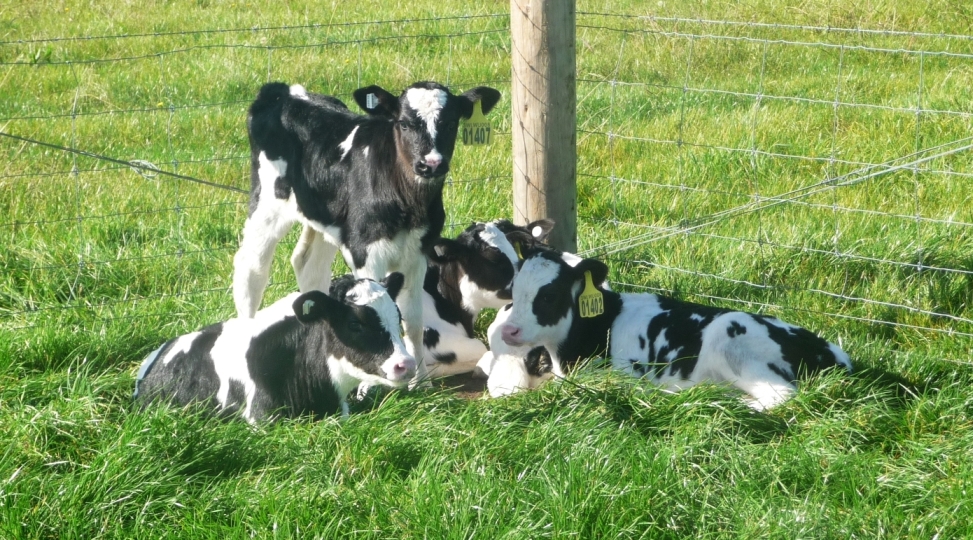
Ella and Bella, our premmie calves, soaking up the sun with friends

It’s been a normal day for a calving season but I’m just too tired to put a proper post together. Instead, here’s an update with some good news:

  • Ella and Bella are doing so well, they’ve graduated from the calf shed out into a sheltered paddock
  • Laura, the premmie twin, is always the first to hop up and say “hello” when we arrive with milk
  • The excavator finished work on the effluent pond today and we installed a new storm water pipe
  • Our maremmas, Charlie and Lola, are out and about doing their job of looking after the calves well (but have not yet roamed to scare off the kangaroos)
  • Wayne and vet Amy managed to deliver one of the largest bull calves we’ve ever seen and both mum and calf are doing well. I was sure he’d be dead and was very worried for her.
  • Milk production is up!

After feeding all the calves, mucking out stalls, sorting out cows to go in the “springer’s” (cows that are less than 3 weeks away from calving) paddock, fixing fences and a vital calf transport trailer, pouncing on sprightly newborns and doing all the normal farm stuff, the three of us are jiggered.

The farming community celebrates

Zoe's first Tarra Festival parade

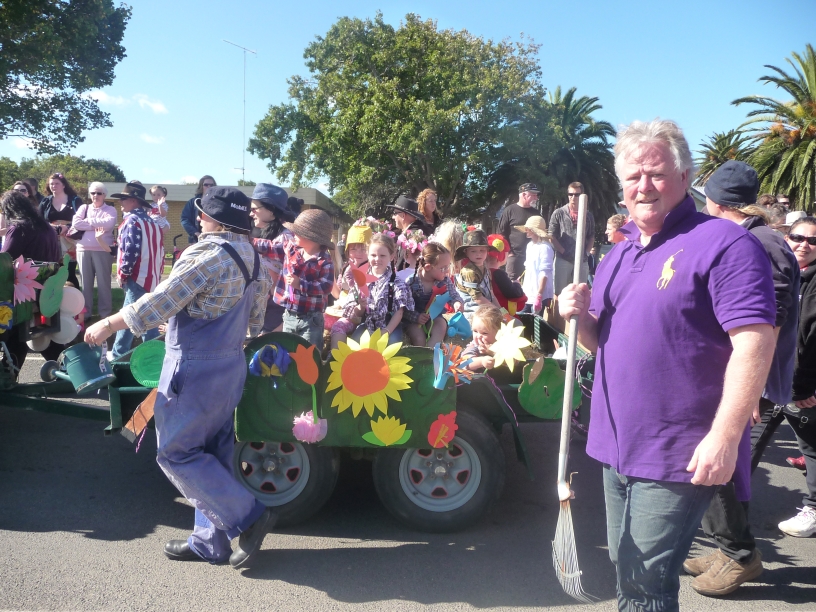
Today was huge. Every Easter our local town, Yarram, celebrates the Tarra Festival and at its heart is the parade. Colourful floats representing just about every facet of community life pass by thousands gathered on the footpaths and the centre plots. This morning, Zoe sat proudly among her friends on the kindergarten float, resplendent in yellow gardening hat and apron while waving a paper sunflower regally at the crowds. It was something of a rite of passage – I still remember clumsily twirling a Calesthenics baton decades ago along the same route – and she was in awe.

At the tail of the parade came three trucks: two B-Double milk co-op trucks and one belonging to the parade sponsor. The milk trucks are part of the community too and were warmly applauded.

The co-op's milk trucks are part of Yarram

The co-op's milk trucks part of the festival parade

After face-painting, slides, marvelling at the magicians, laughing at the clowns, catching up with friends and gobbling way too much fairy floss, we headed home to round up the cows. I was very proud of my tired little girl. She walked the cows in to the yard over 1.7 kilometres while making up lots of silly songs and giving me important directions.

Madame Butterfly stops traffic at the trough

We have a rule to let the cows drink for as long as they like on their way into the yard and in the picture you’ll see Madame Butterfly giving orders to stay clear of the drinking cows. After that, we checked two groups of cows, got in two mums and their newborns, fed grain to the yearlings and the springers, shifted the rising two-year-olds into a fresh paddock and checked in on a very sleepy and well-fed Laura.

Zoe will sleep well tonight!

Dairy farming a glamorous job?

At a social get-together today, someone said dairy farming was glamorous. Rewarding, challenging, interesting, in touch with nature, a great way to raise a family, yes. Glamorous? I’d never thought of it that way. My friend (not a farmer) pointed out that many urban professionals might envy the freedom and sense of purpose enjoyed by dairy farmers.

It’s all about perspective, I guess. My husband saw me engrossed in reading a farmer’s newsletter last night and said: “You really love your farming, don’t you?”. “Yes,” I said, “Look at this! Turns out the nitrogen in the first effluent pond is much less volatile and…”. Well, there’s nothing sexy about a primary effluent pond. Realising how ridiculous I sounded, all I could do was laugh at myself. I do love it – especially learning how all the natural systems that come together in a farm work – even though there are days when it’s a really hard, dirty and uncomfortable grind that’s anything but glamorous.

But how do other Australians see us? According to one 2010 poll, as trustworthy. I wonder how the milk wars have affected public perceptions.

My lucky girl

Farm life can be fun and safe for children but tragedy strikes too often

Farms are extremely dangerous places for children. FarmSafe warns farming families of the horrible record of child deaths on Australian farms and makes some very sensible recommendations.

Some more conservative organisations recommend children are confined to safe play areas. That’s not reality for many farming families, including ours. We all work together because we need to and because it’s fun. On our farm, we are really careful Zoe understands there are some no-go zones and to observe some critical rules (not to get too close to the cows is one example).

One of Zoe’s favourite jobs around the farm is rounding up the cows for milking. It’s a great chance to run around, be an important helper and show how responsible she is. Zoe’s very proud and very lucky. So am I.