How to rescue dairy – from the nutty to the tricky

Dairy farmers gathered in their hundreds in south-west Victoria last night for a crisis meeting. What makes it a crisis? Very simply, dairy farmers are working seven days a week for free and petrified of losing our shirts.

Local agribusiness bankers tell me they are busy refinancing and arranging extra debt but land sales are at a standstill around here. Reporting on last night’s dairy crisis meeting, Simone Smith of The Weekly Times, described a “dire picture”:

“Warrnambool-based Coffey Hunt farm accounting specialist Garry Smith said across his client-base, farmers milking mostly between 450-500 cows, average feed costs were up 15 per cent – a $150,000 rise – with the cost of power for the first quarter of the year up 50 per cent.”

“He estimated across his client-base earnings would be 10 per cent down on last year with a combination of cash-flow and income down $260,000.

“Charles Stewart real estate agent Nick Adamson said better quality farms had dropped in value between 8-15 per cent, while others were up to 45 per cent down on peaks of several years ago.”

None of this is pretty and astonishingly, Peter Reith decided to appear on ABC’s The Drum website with a six-point plan that, at first, I thought was a spoof. Take a look and make up your own mind.

It’s not as simple as cutting petrol taxes and municipal rates. It’s tricky because of this conundrum: milk and dairy foods are considered so important that nobody wants to pay what they are worth to produce.

Every day I read comments on Twitter that go something like this: “My kids drink three litres of milk every two days, so I can only afford to buy $1 milk”. I know first-hand how tough it is to feed a family when you’re on struggle street, so I have a lot of sympathy for people in this predicament and it’s impossible to respond with anything other than compassion.

It’s hardly surprising, then, that there is no political appetite for an increased milk price. But the truth is this: dairy farmers should not and cannot fund an ersatz Australian welfare system by subsidising the cost of food. Welfare is the role of government.

So, while my dander is up, here’s a simple list of five tricky things that would make a big difference to this dairy farmer:

1. Deal with the supermarket duopoly
Down, Down, Down is not about you, dear milk drinker. The real reasons for the supermarket war are expressed in corporate ROIs rather than family budgets. At the end of the day, it will be the little people with the least market power – you, the shopper, and me, the farmer – who will pay.

2. Level the global playing field
Julia Gillard announced that Australia would be Asia’s food bowl but guess what? Unlike the world’s most powerful dairy exporters, the Kiwis, we do not have a free trade agreement with China, putting Australian dairy at an immediate 15% disadvantage. Nor do we receive the government subsidies that support our European and North American competitors.

3. Assist with the impact of the carbon tax
Australian dairy farmers are suffering a double whammy under the carbon tax. First, processors are passing the extra cost onto us in the form of lower farm gate prices (because the consumer won’t pay extra and nor will global commodity markets), reducing our incomes by around $5,000 each per year. At the same time, our costs – especially electricity and refrigerants – are rising in quantum leaps each quarter.

4. Support smart farming
Long exposed to the blow-torch of global export markets without subsidisation, Australia’s dairy farmers are among the most efficient in the world, according to research body, Dairy Australia. We can produce very high quality milk at a very low cost because we have invested in research and development. No longer. We are spending less and less on R&D and the Victorian government has just made massive staff cuts to our brains trust, the Department of Primary Industries.

5. Remember, I am the goose that lays the golden egg
I will not be able to continue to deliver high quality milk at such a low price while enhancing the environment and caring for our cows without sacrificing the basic wellbeing of my family and that, I refuse to do.
How to get farmers wearing helmets on quad bikes

With my hair plastered to my head with sweat and feeling woozy, I conceded defeat. I’d been rounding up in 30 degree heat on a quad bike with a road bike helmet on and just couldn’t do it. At 2 km/hr behind 250 cows, each literally giving off the same amount of heat as a 1500 watt hair dryer, sitting astride a hot engine, the heat got to me and I was not far from passing out.

Road bike helmets are designed for use on bitumen at high speed and have no effective ventilation at speeds of one to three kilometres per hour. Having one strapped on in this type of environment could be lethal.

Why had I been so stupid, you ask? Because I was trying to do what the regulators would have me do and, as an employer, insist everyone else does it too. And yet I’m in The Weekly Times today saying we all wear helmets here; I won’t let our kids on quads; and that we have Quadbars on our bikes.

What the story doesn’t explain is that I won’t wear a road bike helmet. This seems to be something of a taboo and sadly, this means many farmers ride quad bikes without a helmet at all and simply hope nobody gets hurt.

This situation has arisen because:

–     Quad bike manuals stipulate the wearing of a road bike helmet that meets Australian Standard AS1618

-`    An Australian Standards committee dominated by helmet manufacturers refused to ratify a New Zealand off-road quad bike helmet standard.

I would never argue that riding quad bikes on farm – even at slow speed – without a helmet should be permitted but far lighter helmets are legal in much more hazardous circumstances.

Thousands ride pushbikes down Melbourne’s busiest thoroughfares at 40 kilometres an hour alongside semi-trailers wearing very light, yet legal, helmets. Thousands more ride horses equally as fast wearing cool helmets strong enough to withstand a collision with horse hoofs and a fall onto a hard surface at speeds of up to 55km/hr.

And that’s been our solution: we’ve chosen a light, really well ventilated equestrian helmet. Everyone here wears them without complaint whatever the weather, all of the time.

While many WorkSafe inspectors appreciate the hazards created by wearing road bike helmets for low-speed agricultural use, they are hamstrung by the absence of a specific standard. A new Australian Standard seems destined to be stymied by cost and disregard of the realities by those who work in air-conditioned offices rather than hot paddocks.


What does the missing dairy farmer look like?

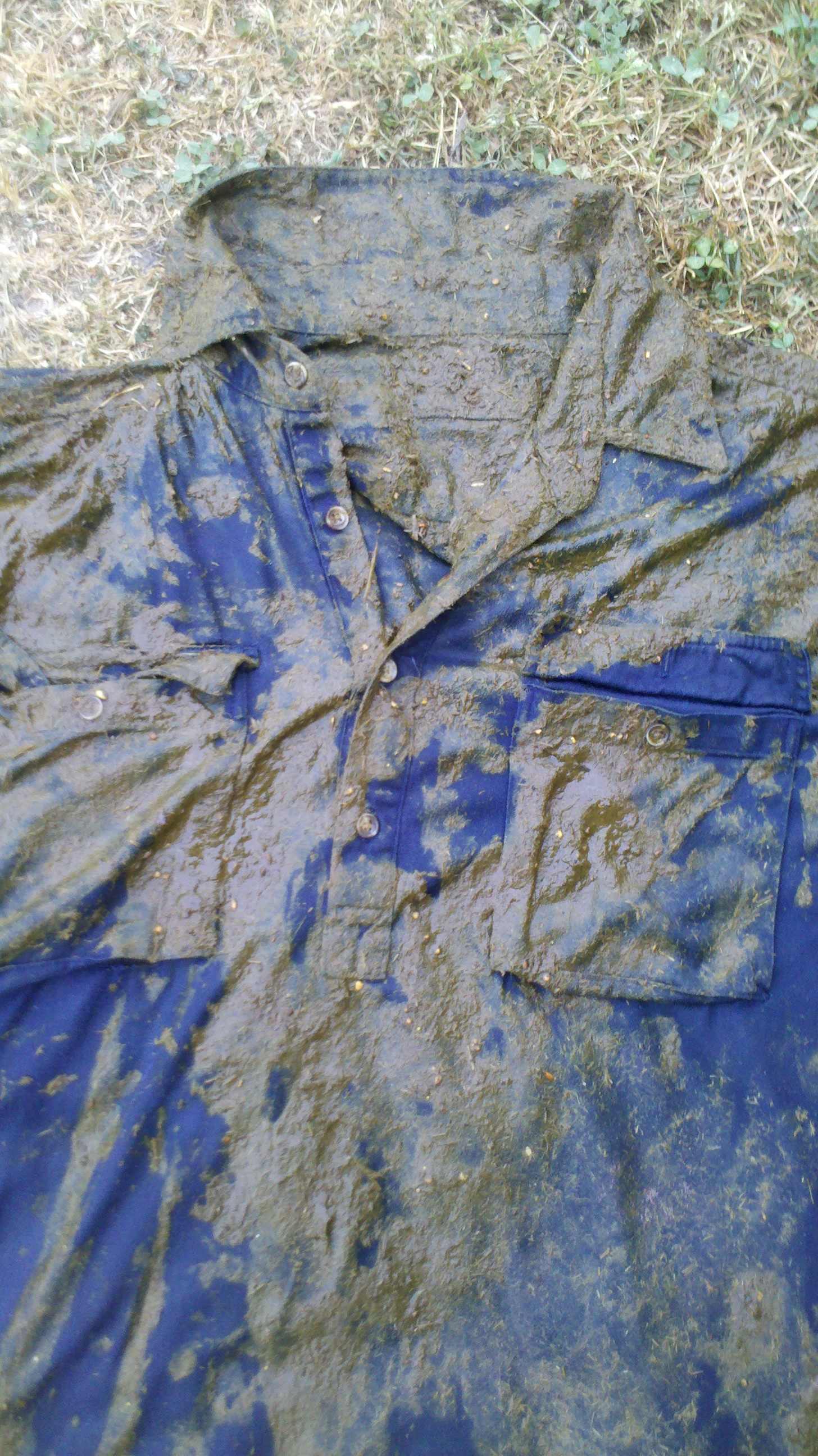
Shi#t

Shi#t

This is the shirt that had to be left on the lawn because it was too dirty for the laundry. Check out the collar. He was wearing it when it became…soiled. Imagine the man.

Me: “So, who got you? Was it 1257 or 800?”

Him: “I don’t know – it was too quick, I was blinded and they were firing at me from all directions – in front and behind.”

Me: (Trying desperately not to laugh) “What did you do?”

Him: “I groped about and found something really thick and thought, ‘Great, that’s a hose’ and just blasted myself with the fire hose for a few minutes. And a few minutes later, another one got me from behind and it flowed down over my eyes before I could stop it, so I don’t know who that was either.”

Me: “Oh, you poor thing. But you seem in good spirits…”

Him: “Yeah. I decided that s#$t happens, so I might as well just take a break and have a drink. I peeled off my shirt, hosed myself down again, had that drink, and milked like this.”

Me: “What – in the nude?”

Him: (Indignantly) “With my shorts and gumboots on! I added an apron when the tanker arrived in case I scared the driver.”

Me: Raucous laughter.

Him: “Feel my hair”

Me: “Ah, no thanks.”

Him: “Go on, feel it…Don’t look at me like that…Okay, smell it then.”

Me: “It smells like Ovaltine – go and have a shower, for goodness’ sake.”

Milking cows certainly has its moments and there were quite a few of those “moments” for Wayne because now that the grass has pretty much shrivelled up, the cows have been dining on a divine, juicy crop of rape and tender young millet. Never mind, it’ll settle in a day or two…

Cows grazing millet

They can barely walk because their pants are suddenly too tight

Painful fall as Ball Face ousted as king of the bulls

The farm’s most aggressive bull has reigned for about two years as no other bull, even those who stood several inches taller, were as mean as Ball Face.

Wayne put him in the bull paddock last night. This morning Ball Face was missing. We discovered snapped wires along the laneway and figured the grader had clipped the fence, shorting out the power, so after the afternoon rounding up, it fell to me and the kids to restore the circuit and find the errant king while Wayne milked.

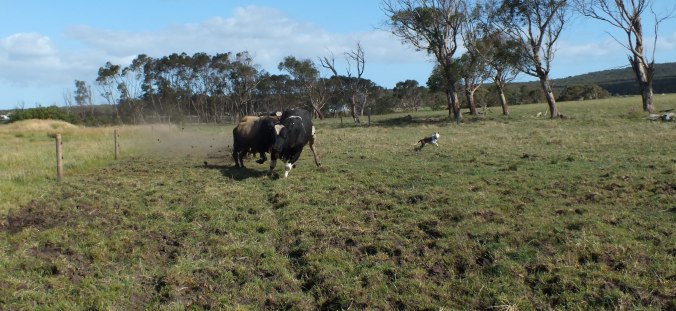
I fixed the laneway and found Ball Face and Fernando in the newly planted-out wetland. Aargh! Not my precious revegetation!!! The pair of them had left a trail of sagging wires and were busily roughing up some melaleucas. Can you spot them?

BullsInWetland

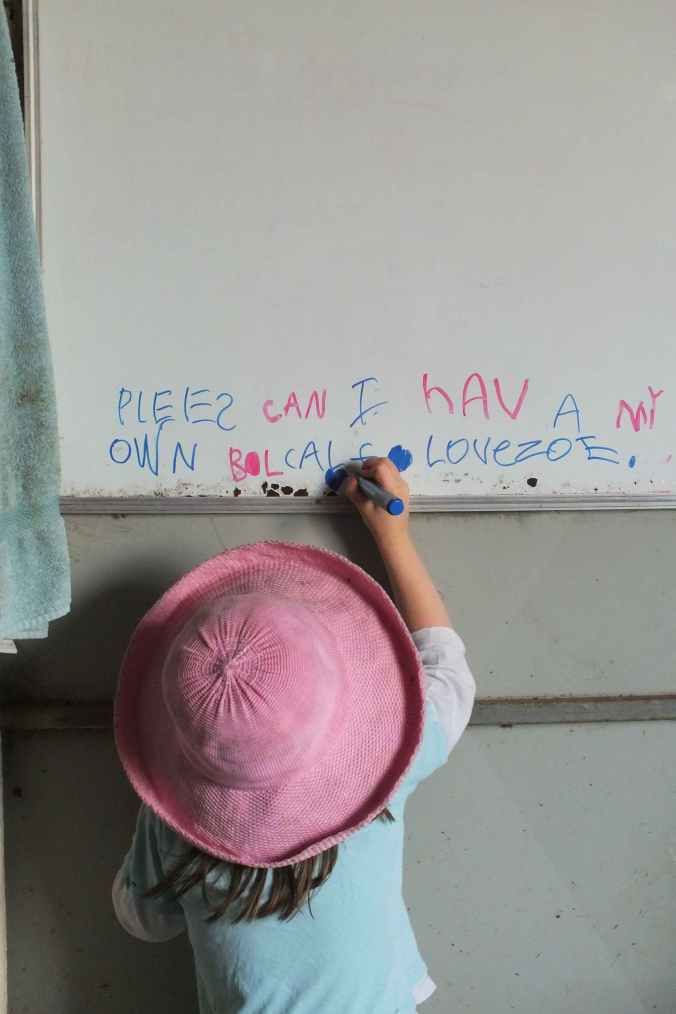
I sallied forth armed with a pigtail post and a long piece of poly pipe, leaving strict instructions for Zoe to stay on top of the Bobcat. I tried to look big and summoned my growliest voice. Magically, the two of them hopped out quite obediently. All that was left was to strain the three wires and turn the fence back on. Until this.

BallFaceChase

No one bull may have been game to take Ball Face on but a pack of them wanted him dead. Shrieking but quick, Zoe snapped this pic as the group charged towards us and I scrambled back onto the Bobcat. They thundered right around us and pursued Ball Face, literally pushing him through the fence (again) a hundred metres further up the paddock.

The fence strainer got a workout and then it was off, again, with pigtail post and poly pipe to remove Ball Face from his refuge. The gang stayed close to the fence and it was painfully obvious they would give him the medicine all over again, so I put him on the far side of the wetland, nine strands of hotwire away.

I don’t think I’ve ever seen a king deposed by a gang. Normally, it happens when an upstart matures, challenging the patriarch to a one-on-one duel with the rest watching. But then, Ball Face is something extraordinary. Maybe it really is time for him to go.

The hard lessons of life on farm

Message for Papa

Every farmer is by nature a philosopher. You must live for the big picture, cherish the little things and remember that, no matter what, the wheel continues to turn.

This week, a cow died in labour and two more gave birth to bulls. We felt sad about the death of a favourite but welcomed two of her sisters back into the herd. Farmers know that death is an inescapable fact of life.

Even so, it was different when a friend’s dog was killed in a freak tree-felling accident. It’s much harder to be philosophical about a the passing of a man’s best mate and I felt sick just hearing about it.

It’s times like these that throw the delineation between farm animal and pet into stark relief. Animal activists often ask farmers and meat eaters whether they would eat their own pets. Of course not. Does that make a compelling case for veganism?

Not in my view. All our animals will die one day, irrespective of the cause. What makes us ethical custodians is the quality of life we provide.

What does a real farmer look like? Something exciting!

Exciting news item number 1: The lame and denigrating Dev and Dale ads seem to have vanished. I await the Co-op’s next breathless announcement regarding its marketing with great anticipation!

Exciting news item number 2: The perfect antidote to Dev and Dale has been created by the Brits. Reality show, Farmers Apprentice, follows 10 people (selected from 600 applicants) as they slug through a five-day bootcamp in a quest to win 10,000 Pounds.

Something like this can be done here in Australia. It’s a wonderful way to show people from all walks of life that farming is neither “McLeod’s Daughters”, “4 Corners” or “Dev and Dale”. It’ll build bridges, inspire new careers and provide an enormous morale boost to crusty types like me.

PS: This is me bathed in glory just the other day.

I declare this trough...open!

I declare this trough…open!

It only took five minutes to install the valve and float but this was the final step in opening up a new paddock that took 18 months to complete. For me, this is what real farming excitement is all about – the thrill of pulling off a big project.

The farmer’s wife

A really disturbing media story about a male-only farm succession plan set Twitter alight today. It’s so incredible I’ve been wondering if it’s a hoax but, then, maybe not. There are some pretty strange characters in any corner of society, so I guess it is possible there is a deluded beef farmer out there who thinks he’s a sheik.

Most of the comment on Twitter has been expressions of disbelief, which is reassuring, but quite a few people have drawn parallels with their own upbringings and perhaps I should not be surprised at all. In fact, Australian family farms are generally passed on from father to son.

While there’s a dearth of research on the topic, a 1996 University of New England study on farm inheritance found:

“Farmers approach succession within a distinct rural ideology where farming is seen as man’s vocation, with great value placed on self-reliance, independence and hard work. Central to this ideology is the concept of patriarchy whereby women are inherently viewed as dependents, being either the wife or daughter of a farmer (Poiner 1990, 33-52). Marriage has been the usual point of entry into farming for women. Although daughters are often required to participate in the work routine on farms, they are not often encouraged to think beyond the possibility of marrying a farmer, and to consider farming as a career (Nalson and Craig 1987). Patriarchy also entails the exclusion of daughters from inheritance of land (Voyce 1994).”

“The majority of respondents entered farming with some form of assistance from their parents (or the parents of their spouse). This usually involved parents bringing the respondent into the existing farm business or parents leaving land to respondents, or helping them to purchase land. We found that daughters are not, as a rule, involved in farm businesses. The proportion of families where daughters are working on the farm, are partners in the farm business or share in the ownership of land is less than ten per cent. We also found that sons are more likely to inherit land from their parents, and be helped by their parents to enter farming, than are daughters. This has the potential to cause ill feeling. As one respondent wrote:

“‘My parents are giving their farm to my oldest brother to maintain it as a viable business. This effectively disinherits me and my sister and other brother. This is not fair, but my father wants to keep the farm intact and in the family. There is very little by way of compensation. This is a common scenario in the rural community.’

“Of course, interest and commitment to farming varies among women. Some embrace the opportunity to farm with great enthusiasm and play an active role in the family enterprise. Others reject the notion of farming as a career. These women may continue with a career outside farming or confine their activities as far as possible to those equivalent to an urban woman in unpaid domestic work (Nalson and Craig 1987). Whether women are free to exercise their choice between these alternatives is debatable.”

I’d like to think that we have come a long way in the 16 years since this research was conducted but I’m certain we still have a long way to go. The local dairy expo still advertises a “Women’s Pavilion” full of crafts and preserves (well away from the machinery displays). Our own milk co-op thinks it’s funny to portray women on farms as fluffy accessories. Major banks publish ads trumpeting that even the farmer’s wife has a say in the business.

Perhaps these are examples of out-of-touch advertisers playing on dated stereotypes. Perhaps it reflects current reality. Either way, isn’t it time we told them we’ve had enough?

OHS inductions for the city cousins?

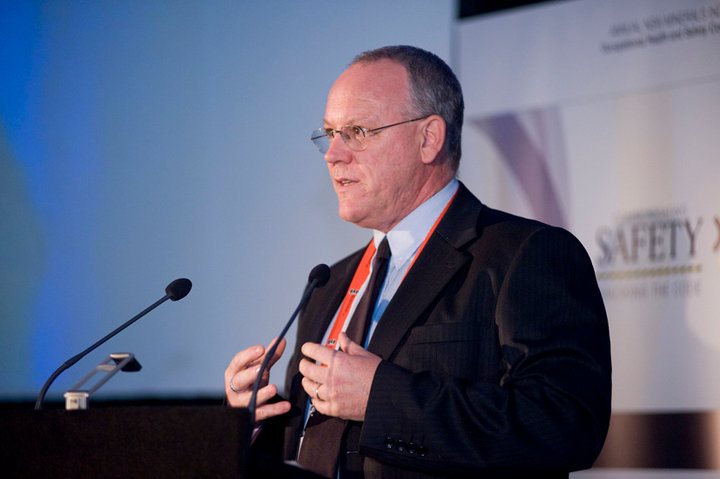
“City cousin season” is fast approaching for many farmers. It’s a time we look forward to here but we do have to be extra careful. With new safety laws emphasising the need to include volunteers and visitors to the farm in safety systems, I asked Kevin Jones, OHS consultant, freelance writer and editor of the award-winning SafetyAtWorkBlog.com what it all means.

Kevin Jones

Kevin Jones

Some media has been reporting anger and outrage about the Government imposing new work health and safety duties on small business, volunteers, farmers and many others. There are new safety laws in many States but largely these reflect the moral and safety responsibilities that have always existed. If farms have been doing the right thing in the past, they are likely to be doing the right thing in the future.

OHS laws are always going to be seen as an imposition from the city when things were pretty good the way they were. Things may have seemed to be pretty good but plenty of families lost relatives in farm accidents, many lost limbs or struggle to cope with economic stress. There is plenty of statistical evidence to show that things in the country weren’t as good as many thought and the Government felt obliged to act. Perhaps the original work health and safety laws, developed in the cities in the 1980s, were not suited to the country or the application of these laws needed a different approach from that in the city. But the intention of these laws is always to reduce harm, injury, death and the related impacts on farming families.

These occupational health and safety (OHS) laws may also require paperwork but so does public liability insurance, Business Activity Statements, and a range of other paperwork all businesses are obliged to provide. Paperwork has always felt to be a major distraction to why we set up our businesses in the first place.

Over the last twenty years OHS laws have broadened from the physically-defined workplace to include the impact of work on others such as visitors, neighbours and customers. But the workplace has also changed to an extent where it is hard to know where a workplace starts and a workplace ends. Many in the city struggle with these laws but farming communities have always worked with an almost invisible delineation between a workplace and a home. Where others went outside for a smoke, farmers often went for a smoke and checked on the animals. Farmers are hardly ever not working, and this means that farms are almost always workplaces, so when visitors come to the farm for a weekend break, they are visiting a workplace and so OHS laws will apply.

This unreal demarcation is a major reason why the new laws focus on Work and not the workplace. Dealing primarily with the work activity focuses on the reduction of harm to the worker rather than making a workplace safe. Often the best, most tidy, most organised workplaces still had unsafe work being done.

Do the new laws mean that all visitors require a safety induction before entering the farm and to sign a document saying they understand the rules? Usually, no, but if they come to undertake farming activities (ie. work), maybe there should be an introduction to the farm – where to go, where not to go, what to touch, what not, what to drive, what to keep away from. Maybe the signs in the milking shed need to be written for visitors instead of in family shorthand. Maybe pits should be covered instead of assuming the pit will be in the same state next morning.

If WorkSafe is called to a farm, for whatever reason, showing the inspectors that you know about your OHS obligations and apply basic safety procedures to equipment, tractors, quad bikes, and industrial and agricultural chemicals is going to reassure them that you know what you’re on about and that you are active about managing the safety of your workers, visitors and family. Will you be found to be in compliance with the OHS laws? Probably not, but neither are most of the small businesses in the cities either.

OHS is often dismissed as only common sense. But OHS is almost always common sense, after an incident. Why didn’t we cover that pit? Why did I leave the keys in the quad bike? Why didn’t I chain up the dog when I knew kids were coming over? These and many other daily questions are all made safer through the common sense of covering or fencing the pit, hanging up the keys, chaining the dog. If safety is only common sense why then don’t we apply it?

The new Work Health and Safety laws are not yet active in all States and Safe Work Australia, or your local OHS regulators, are a good place to watch and see if and when these laws apply to specific circumstances and industries.

How a girl becomes a cow-girl

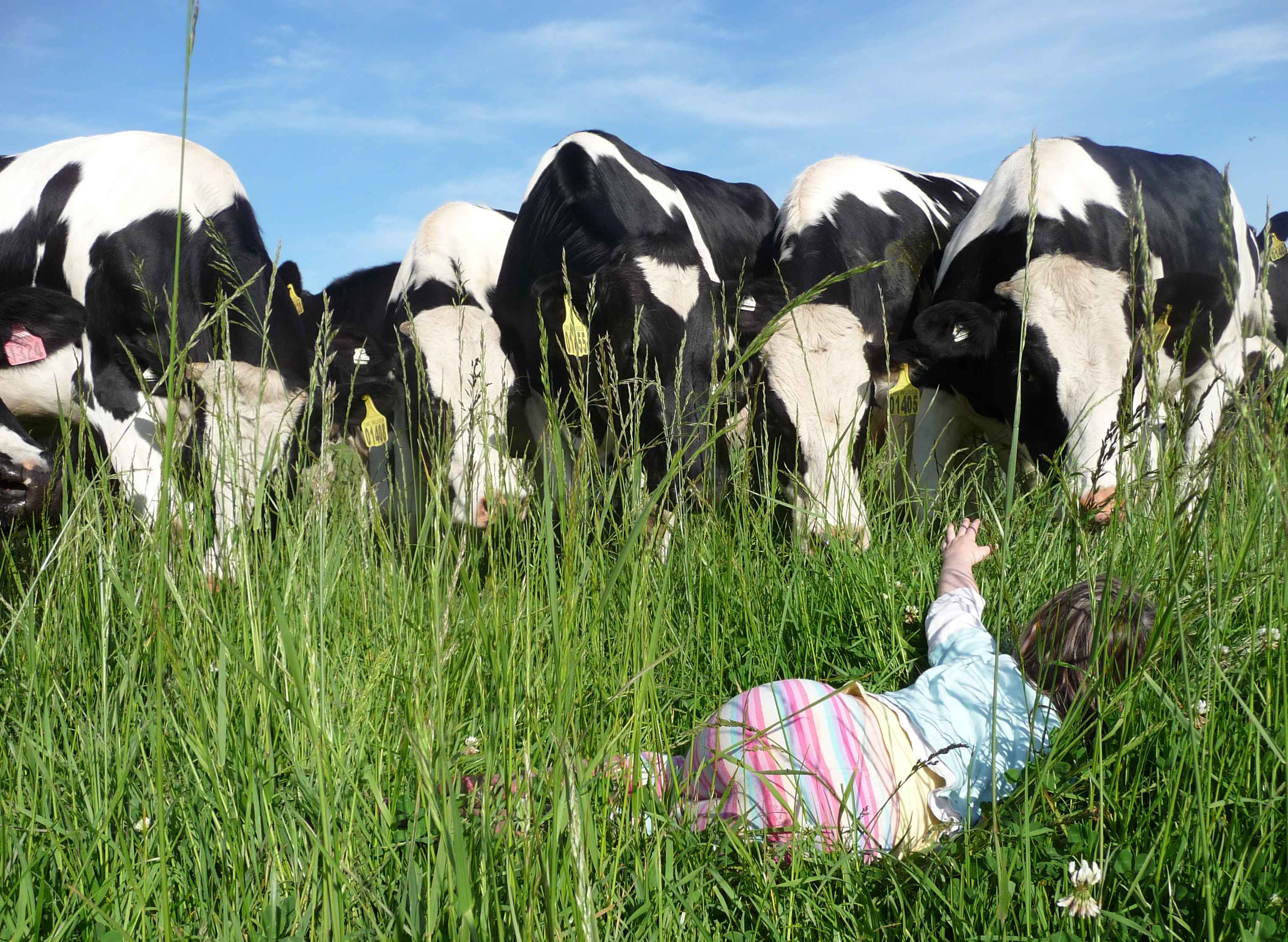
Zoe gets cows. She really undersands them but there’s still lots to learn and, early this morning, we had a fun little lesson with the “teenagers” on the farm.

Step one is to lie down nice and still in the grass. Step two is to stay still (and quiet). Step three is to wait a little bit longer.

Heifers and Zoe reach out

“You can trust me”

If you’re patient enough, they’ll come. Snuffling, chewing their cud and nudging forward little by little with unbridled curiosity. It’s not exactly “Gorillas in the Mist” but it is an awesome, humbling experience and everybody should try it.

Tragic irony

I cannot imagine finding a child killed on the farm yet this is perhaps Australia’s most dangerous backyard. One of the things we do to keep Zoe and Alex safe is to keep them off quad bikes.

According to Safety Around Farms:

“ATVs are the most common cause of death for children 5-14 yrs on farms. Between 2001-2004, 12 children died on ATV’s in Australia and many more were hospitalised with serious injuries, 50% of these children were visitors to farms. (National Farm Injury Data Centre, 2007)”

That’s why I have a Bobcat UTV. Problem is, it’s only a two-seater and Alex is getting to the stage where he likes to stand in his child carrier and give me loving kisses on the face while I am driving. Hardly ideal.

I’m in the process of upgrading to a three-seater so little man can be strapped in more safely beside me rather than on me. Among the options is the Polaris Ranger Diesel and here’s the promo for it:

Buy this big machine to keep your kids safe and we’ll give you a small machine to keep your kids #%@

Do you see the irony of it? I rang Polaris HQ to see if I could get more family-friendly Ranger accessories – like a roof and windscreen – instead of the dangerous machine for little children. No, certainly not.

I asked the marketing manager a raft of quite pointed questions about the safety of the little machine. He couldn’t answer them. It seems certain he hadn’t read this from the Canadian Paediatric Society:

“While industry guidelines suggest that children under 16 years of age should only operate youthsized models, these vehicles are still heavy and can travel at significant speeds. Also, a higher centre of gravity contributes to instability, making ATVs prone to flips or rollovers.”

“Currently,there is little evidence to suggest that smaller youth models are safer when used by children. US CPSC injury data from 2001 showed that the risk of injury per number of driving hours for an operator under the age of 16 is reduced by only 18% when driving a youth-model ATV with an engine size of 200 cc.

“In addition, the level of risk for a child or adolescent operating a youth-model ATV is still almost twice as high as for an adult on a larger machine; the risk of injury to a youth using a smaller machine is also five times higher than the risk to an adult on a machine of the same size.”

In other words, don’t think your child is safe on a quad bike of any size.

The Polaris kids’ quad may be free but it could be Aussie kids who pay the ultimate price for this corporation’s cynical grab for market share.