Milk Maid in WCB wonderland as Saputo offers $8

Well, I wonder what MG will do now? And where will it end? Judging by the email I just got from MG, the co-op’s going to sit on its hands and hope the FIRB undermines Saputo’s bid.

“Murray Goulburn (MG) notes the revised conditional offer by Saputo for Warrnambool Cheese and Butter (WCB) announced today.”

“MG notes that Saputo’s offer continues to be subject to substantial conditionality. MG believes that resolution of the future ownership of WCB will be a long process and that WCB shareholders should not act prematurely in relation to giving up control of their shareholdings.

“MG remains committed to acquiring WCB and to satisfying all conditions associated with its offer as quickly as possible. MG presently owns 17.7% of WCB.

“MG believes it to be reasonable and in the national interest that Saputo’s Foreign Investment Review Board (FIRB) application to acquire WCB is not resolved until the public benefits of MG’s proposed acquisition of WCB have been given full consideration – pursuant to MG’s application for authorisation to the Australian Competition Tribunal to acquire WCB.

“MG considers its offer will bring many benefits for WCB shareholders, WCB suppliers, the Warrnambool community and the Australian dairy industry.”

But if push comes to shove, will MG go higher than $8?

I do understand the reasoning behind the co-op’s drive to acquire WCB for all the reasons outlined by Gary Helou when interviewed by the Australian Financial Review the other day (the video is very, very interesting). The WCB bid is important because it allows MG to grow quickly and achieve efficiencies similar to that of its giant Kiwi rival, Fonterra. Those efficiencies should mean better margins, which the coop would pass back to farmers.

On the other hand, it does make me feel like Alice in Wonderland just a little. When MG last launched a takeover bid for WCB in 2010, the price was $4.35 and WCB hasn’t suddenly hit the jackpot – its profits have fallen.

On the farm, we are in recovery mode from a year when the average Gippsland dairy farmer lost a lot of money. As the Dairy Industry Farm Monitor results 2012-13 showed:

“In what was a difficult year for many Gippsland farmers, average return on assets fell to -0.2% with average whole farm earnings before interest and tax down 82% to $37,609.  The average return on equity for Gippsland farms was -6.2% with average net farm income across the region reported at -$58,784. This performance impacts on the decision making ability of farmers in 2013-14.” 

The difference, says Helou, is that demand for milk is growing by 6 per cent while supply is growing at 2 per cent. If this is more than just a blip and a long-term trend, why wasn’t this foreseen three years ago? Curiouser and curiouser. Please forgive me for being a little confused.

Proof that cleaning can kill

My Mum passed a love of gardening on to me and with it came a fascination with the small birds who love to hop about in the bottle brush hedges and sip at the emu bush blossoms.

My Little People meet a young honeyeater

My Little People meet a young honeyeater

This dear little New Holland Honeyeater was a casualty of our big spring cleaning effort this week, twice crashing into our sparkling windows. Lifted up ever so gently beyond Patch’s reach, the youngster recovered in a couple of minutes, only to fly along the verandah a few metres before crashing all over again! He or she took another breather under the watchful gaze of two Little People for a few moments before zipping off into the shrubs.

Whoever said housework never killed anybody clearly was misinformed. Next time the cleaning urge comes, I’ll try harder to resist.

MG makes its move

I used to think of our co-op as a bit like the ABC: your favourite aunty. Comfortable, dowdy, trustworthy and a little quirky.

But Aunty MG has undergone a transformation.

Since it acquired a new CEO, Gary Helou, in October 2011, Murray Goulburn has embarked on lancing $100 million of costs, opened up in Dubai, restructured the way farmers are paid for milk, revamped its retail trading store network, developed assistance packages for the next generation of farmers and forged the spectacular Coles fresh milk deal. At least, these are the “headline acts” that come to mind.

Now, MG is making a $420 million bid for its rival, Warrnambool Cheese & Butter, gazumping Bega Cheese and Canadian dairy giant, Saputo.

According to MG, (if the bid is successful) the new Murray Goulburn Warrnambool:

“Creates a new 100% Australian farmer-controlled dairy food company with over 3,000 supplier shareholders delivering more than 4 billion litres of milk to nine processing sites annually. The business will be positioned for strong growth in both domestic and international dairy markets with forecast revenues in financial year 2014 of $3.2 billion including export sales of $1.4 billion to over 60 countries.”

This, Gary Helou wrote in a letter to MG’s farmer shareholders yesterday, would bring the coop, “…the necessary scale, market reach and competitive strength to capture the benefits of the historic growth opportunity resulting from the consumer affluence of developing Asian economies.”

MG’s triple-jump

The bid is in, it’s the most lucrative on offer and it’s Australian, yes, but there are three serious hurdles for MG:

1. A bidding war

What will Saputo and Bega do next? WCB traded higher yesterday, closing at $7.89, a sign that markets believe MG’s $7.50 isn’t enough to win the bidding war.

2. Shareholder seduction

WCB rejected a takeover offer from MG in 2010. At the time, there was quite a bit of anti-MG sentiment. It’ll be interesting to see if the reinvention of Aunty and a bigger bucket of cash will make a difference.

The Sydney Morning Herald reported Mr Helou said yesterday that farmers supplying WCB needed to consider the future of the Australian dairy industry when deciding on the take-over bid.

“For farmers generally, they are at a fork in the road today.”

“If they sell out to a private company, that they have no control over … they will be spectators.”

“What we are putting on the table is an offer for them to take a stake in every step in the value chain.”

“It’s a fundamental, philosophical different point of view.”

3. The competition watchdog

Back in 2010, the ACCC was loathe to allow MG to acquire WCB. As reported in the SMH at the time:

THE competition regulator says its preliminary view is to oppose Murray Goulburn’s proposed acquisition of Warrnambool Cheese & Butter on the grounds it would cut competition in some markets for raw milk.

The Australian Competition and Consumer Commission said yesterday it was concerned the proposed deal “would substantially lessen competition for the acquisition of raw milk from farmers in the relevant markets within South Australia and Victoria”.

“The potential effects in the relevant markets include a significant reduction in farm-gate prices paid to farmers for raw milk; and reduced competition in the offer of non-price terms such as finance, field advice services and discounted hardware and grain supplies.”

The irony of the ACCC’s 2010 statement is that Murray Goulburn’s mission, as a 100% farmer-owned co-operative, is precisely to return the maximum price to farmers — something to which the listed Bega Cheese nor the privately owned Canadian giant Saputo cannot lay claim.

I hope it takes a broader perspective this time. A serious exporter battling subsidies and tariffs around the world, MG needs scale so that its processing can be as efficient as its farmers. The Australian government does not afford our dairy farmers the protections enjoyed by most of our competitors. The least it can do is allow us to grow.

UPDATE: See this article and extended AFR interview with MG CEO Gary Helou: http://www.afr.com/p/national/the_battle_for_warrnambool_kxxm78XXLgfsAJ6y7ARaVJ

Lovers behind the shelter shed

Lovers

Lovers

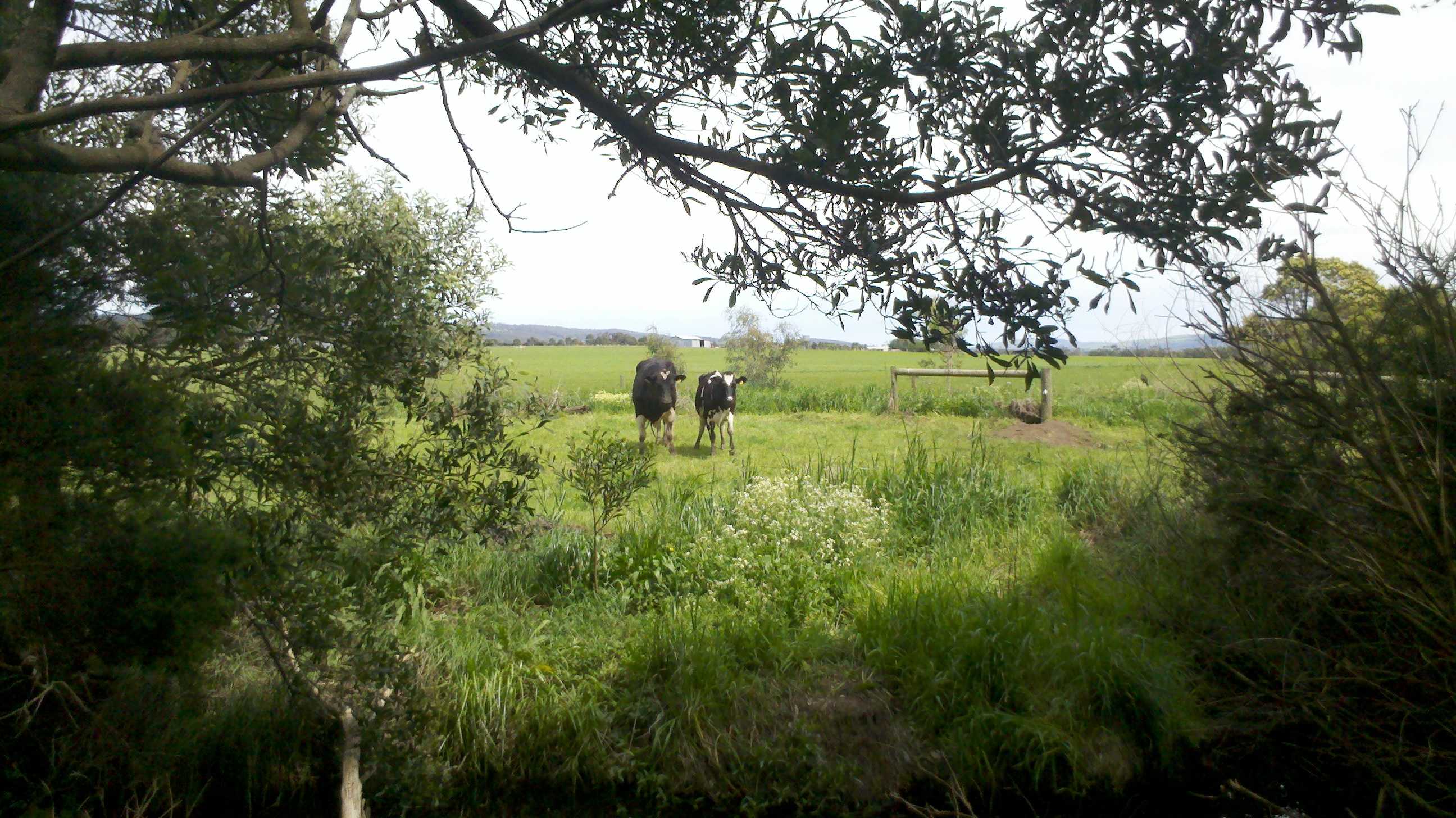
I was out shifting fences yesterday when, through the trees along the gully, I heard the tell-tale staccato of furtive lovers nearby. And there they were, in a hidden pocket of the paddock, him licking her flank, she still undecided.

I crept closer to take a snap and uh, oh, I’d been spotted. Like guilty teens behind the shelter shed, the pair straightened up, stared belligerently (if a little gawkily) and wanted to know what I was looking at.

What else should I expect? It is springtime, after all. Isn’t a cow entitled to a little privacy?

What the cold, cold heart of Coles reveals

The man who directs the face and voice of Coles must have become a little overconfident. In a breathtaking display of arrogance, Coles’ general manager of corporate affairs, Robert Hadler, addressed an audience of spin doctors with this presentation: http://www.documentcloud.org/documents/800088-reputation-coles.html#document/p5

Plenty of people have discussed why this presentation was in such bad taste. Callous, even.

But the part that really caught my attention was the role of our co-op, Murray Goulburn, in Hadler’s “case study”. The gloating Hadler describes the deal with Murray Goulburn as “The game changer”.

Hadler’s right about this but not in the way he means, I suspect. The Hadler case study goes to show just one thing: no matter how Coles tried to spin $1 milk, Australians knew it stank and none of their ads, infographics or appearances by Curtis Stone could fix it. Until, finally, Coles actually did something to address the damage caused by the milk war: an unprecedented 10-year deal that was too good for the co-op to refuse.

Now that’s not a case study in spin, Mr Hadler, that’s a case study in people power.

PS: If you would like to keep up the pressure for Coles to do the right thing, add your voice to this petition by Queensland ag teacher, Lisa Claessen, who was compelled act after her students became casualties of the ColesWorths milk war.
 

One woman’s kindness is another’s cruelty

Animal welfare is one of those things that often falls into the realm of sex, politics and religion. It’s an emotionally-charged topic at the best of times and when standards need to be set, conflict is inevitable. Consider this:

“Rear the calf in safety away from the herd so it can lead a healthy life”
vs
“Take the calf from its mother so farmers can steal the milk”

Both statements put the calf first, yes, but advocate diametrically-opposed practices. Vets say science supports the hand-rearing of calves, animal rights bodies say that’s immoral. So, what’s a farmer to do? At the moment, farmers have a lot of freedom to do whatever we think is right, so long as the calf’s healthy.

But animal welfare is increasingly becoming a political hot potato as vocal lobby groups demand more of a say in, and greater scrutiny of, farming practices. We farmers can’t stick our heads in the sand and hope this will all go away.

And, to be frank, many of the farmers I’ve discussed the issue with would like to see our representatives raise the bar to match the standards almost all of us meet every day. Few choose farming as a career just for the money (that concept never fails to raise a chuckle) – most do it because we love being outdoors with the animals. Why should we let a few rotten apples bring us all down?

But who decides what those standards should be? The dairy community? Well, no, we can’t do it by ourselves because external input is important to progress. The attitudes of the wider community have to be part of the decision-making process.

The thorny question really is: who represents the views of the wider community? Neilson research presented by Courtney Sullivan at the Australian Dairy Conference a couple of years ago showed that most Australians have little knowledge of where their food comes from, that they are aware of their ignorance and that, to put it bluntly, ignorance is bliss. Price was the main driver. Quality was taken for granted.

Ironically, this is a view that is eschewed by farmers and animal welfare bodies alike. It probably comes about because we farmers are trusted to do the right thing – a perception that some animal welfare activists would like to change.

Farmers have the opportunity to be proactive and show the good faith of the community is deserved. Why on earth not?

PS: If you want to know more about how we rear our calves and why, the answers are here on the Milk Maid Marian blog.

A shocking day

Yesterday was a shocker.

After getting Zoe off to school, it was time to do the annual “spring clean” of the fences. The event is triggered by the influx of youngsters into the herd. Every bit as adventurous and bullet-proof as your teenage son, these first-time calvers are new to the dairy side of the farm and love to explore far beyond the allocated paddock of the day.

The result: chaos. Sure, it only lasts a few weeks but, in that time, I could face divorce from a frustrated hubby sick and tired of chasing newbies around the farm. With all that in mind, I head off with the tester to gird the fences against the onslaught.

First stop is the all-important fence around the effluent pond. Nothing. “Not another #@$% battery.” Much muttering.

I’ve broken the farm’s electric fence system up into cells using a cadre of solar-powered energisers so that a single fault cannot bring the whole place to its knees and what I’ve discovered is that the batteries only last a season or two.

I wriggle the connections and ZAP! Well, at least I know it’s working. Test the blasted thing: 9 point bloody 6. No wonder I didn’t enjoy it. Pick up the clamp to attach it to the fence.

ZAP!

“AAAARGH”

“Need…new…clamp”

“What doing, Mama?” asks the little fellow in the Bobcat. “Never mind, Little Man”.

After a bit more spring cleaning, I discover a major fault down by the gully. Investigations reveal a blessed wombat has dug a perfectly good post right out of the ground, collapsing the fence and quite literally earthing it. A steel picket does the job nicely. And we’re up!

Job done, I roar the Bobcat through the gates, leap off and in a few paces find myself shrieking and dancing over a writhing red-bellied black snake.

Fellow dairy farmer, Nick Renyard (@farmer_nick_au) later described this snake as “pretty” but with ashen face, thumping heart and jellied limbs, that was not what sprang to mind a few moments later when the silence was again broken by Little Man.

“What doing, Mama?”

Back on the job and with a paddock selected, it’s time to bring the heavily pregnant youngsters across the road. We crossed that road a total of eight times (four return trips) over the course of an hour before conceding defeat. Young stock like to be driven by pedestrians rather than UTVs but I was tethered close to the machine by Little Man who understandably wanted to be part of the action.

We decided to take a breather (did I mention that low-stress stock handling techniques do not involve inter-spousal shouting sequences?) and let them settle for a couple of hours while we had a think.

In the end, it was Wayne’s brain-wave that saved the day: “Why not just let them run up the road?”.

A cunning plan indeed. Refusing to take the orthodox route along the track past the dairy, the rotters duly ran straight up the road and “escaped” through the road gate into the house paddock. Not there yet but across the road, yesssss!

There was much running, shouting and frantic arm-waving to get the mob of 50 trainees to run under the hot wire into their new home. All done wearing heavy rubber boots through deep mud. This morning, with aching hammies, I think of Cliff Young and marvel at not just the stamina but the ingenuity of the Legend.

How the political parties responded to a Milk Maid’s questions

For the first time in my life, I really don’t want to cast a vote, such is my disenchantment with the politics of our times. It seems more about point scoring and personalities than ever before. And now, perhaps more than ever before, ag needs leadership: we are on the cusp of a food boom with the promise of new golden agrarian age. An age that may never dawn for Australian farmers as we struggle with inadequate investment coupled with a tilted trading field (more on that soon).

So, waaaay back in February, when the election was but a twinkle in Julia and Tony’s eyes, I invited Joe Ludwig (the then Minister for Ag) and John Cobb (the Coalition’s Shadow Minister for Ag) to answer four fundamental questions here on Milk Maid Marian:

1. What are the three biggest challenges facing Victorian dairying?
2. How will you as a government address each of these?
3. What are our three most significant opportunities?
4. Please outline the top three policies that will help us seize those opportunities

After countless phone calls and emails to both politician’s offices, I received two recycled and general media releases from John Cobb’s office that didn’t answer my questions. Earlier this week, I did, however, get this post and pic from Joe Ludwig’s successor, Joel Fitzgibbon.

Good luck making the right choices tomorrow and over to Joel Fitzgibbon!

Joel Fitzgibbon meets a Hunter farmer

Joel Fitzgibbon meets a Hunter farmer


My deep thanks to Marian for the opportunity to speak directly with dairy farmers, families and their communities through her blog. It is a great project and as an MP from a country seat, and as Agriculture Minister, I appreciate the chance to outline Labor’s support for the dairy industry.

Labor’s strong plan for Australian agriculture will help dairy farmers become more productive, competitive and profitable. This is important for both those with a domestic focus and those looking to grab the opportunities of the Asia-led ‘Dining Boom’.

Challenges like drought, a high Australian dollar and falling prices have given the industry a tough decade and farmers are rightly looking to Government for assistance.

In response we have done a number of things. Our $420 million farm debt relief is now starting to help farmers who are viable but in need of a bit of short-term help. Our additional $20 million to help fight our war on weeds will help maintain pastures. Our ‘Fair Go For Farmers’ package seeks to redress the power imbalance between the supermarket chains and producers. Our ‘Planting the Seeds for Australian’s Farming Future’ will encourage young people into agriculture and give them the skills they will need. We have also committed more than $20 million to promote agriculture in primary and secondary schools. The Food in the Australian Curriculum initiative helps students better connect with food and appreciate the important role of producers. We must make sure there is a ‘next generation’ of Australian dairy farmers.

Each year the Government provides $18 million for dairy research and development. We have also invested $28 million into the Dairy Futures Cooperative Research Centre to invest in large-scale research projects and, more recently, $1 million through the Energy Efficiency Information Grants program for Dairy Australia to conduct on-farm energy assessments to help reduce energy costs for a number of dairy farmers nationally.

For those with an eye to export markets, our National Food Plan and our efforts to improve market access are important. Since 2005-06, Australian cheese exports to China have grown from less than $10 million to nearly $37 million in 2011-12. Cheese exports to Japan during the same period have grown from $298 million to over $422 million in 2011-12. The value of skim milk powder exported to China has grown from $14 million to $49.6 million at the same time. We can build further on this success.

Infrastructure, both soft and hard, will help everyone in regional Australia. That’s why we are building the National Broadband Network (NBN). It will transform the way dairy businesses operate, as well as the way your health services are delivered, and how students and your children (of all ages) access educational opportunities.

Road, rail and port infrastructure will be vital to help the dairy industry grow as new markets are opened, so Labor has delivered a record $60 billion towards transport infrastructure. Much of this investment occurs in regional Australia and dairy and other agricultural industries will benefit from resulting infrastructure improvements.

Australia is a great producer of milk and dairy product. Together we must ensure it stays that way.

You can find more on Labor’s strong plans for agriculture and regional Australia at http://www.alp.org.au

Hon Joel Fitzgibbon MP
Minister for Agriculture, Fisheries and Forestry

How we nearly lost “Papa” this Father’s Day

Today started well with freshly-baked ginger biscuits and special gifts wrapped with far too much sticky tape but almost ended with tragedy.

Wayne was guiding a calf out from among the herd towards the shed when time stopped, or at least slowed. As the blow under his left arm pit hurled him two metres across the cow yard, he had time to think “I’ll pull my head down, I’m going to hit the fence” and then, “oh no, this is it, my hips are exploding”. Then, bang, onto the concrete.

With the footy blaring from the dairy radio, Wayne lay very still right where he’d landed for a long, long time – five minutes, he thinks – and wondered what to do next. There was pain in his ribs, neck, back and hips. A tiny bit of blood in his mouth but, yes, his teeth were all okay.

In the end, the only thing to do was try to get up and, thankfully, he did.

Wayne had no warning of the collision and we’ll never know for sure what happened down at the dairy this Father’s Day. Doped up on painkillers, swathed in Deep Heat and wrapped up in blankets, but he’s alive.

The business of dairy farming and what that means for our “stock”

I don’t like to use the word “stock” when it comes to cows. The connotation is that they are simply economic units. Yes, we do rely on their milk for our living but, no, they are not simply the equivalent of black-and-white boxes in a grassy warehouse. We burn the midnight oil, holding down second jobs during tough times so the cows will never know a lean year.

A sick cow is more important than our own dinners.

Nor are male calves “low-value by-products” of dairying. Maybe for some but not for me. Absolutely not. Rather than shooting them (the economically rational path), our family chooses to make a loss rearing the bull calves for the first few days of their lives and then selling them to beef-farming locals.

In the same vein, I am not a “milk producer” but a farmer. Somehow, “producer” conjures up factories and production lines, while nothing could be further from the truth here. We nurture our animals and the land because we understand that nature is bigger than we are. Sounds trite and fluffy? Perhaps, but it’s the reality.

There is no financial reward for such an attitude and in the teeth of the economic crisis most dairy farmers have suffered in recent times, the pressure’s been on to make every conceivable saving but here’s how I look at it: if you’re not able to make a dollar out of farming this year, you should at least be able to feel good about the way you farm.

If farming this way is not viable, I would rather not be a farmer.