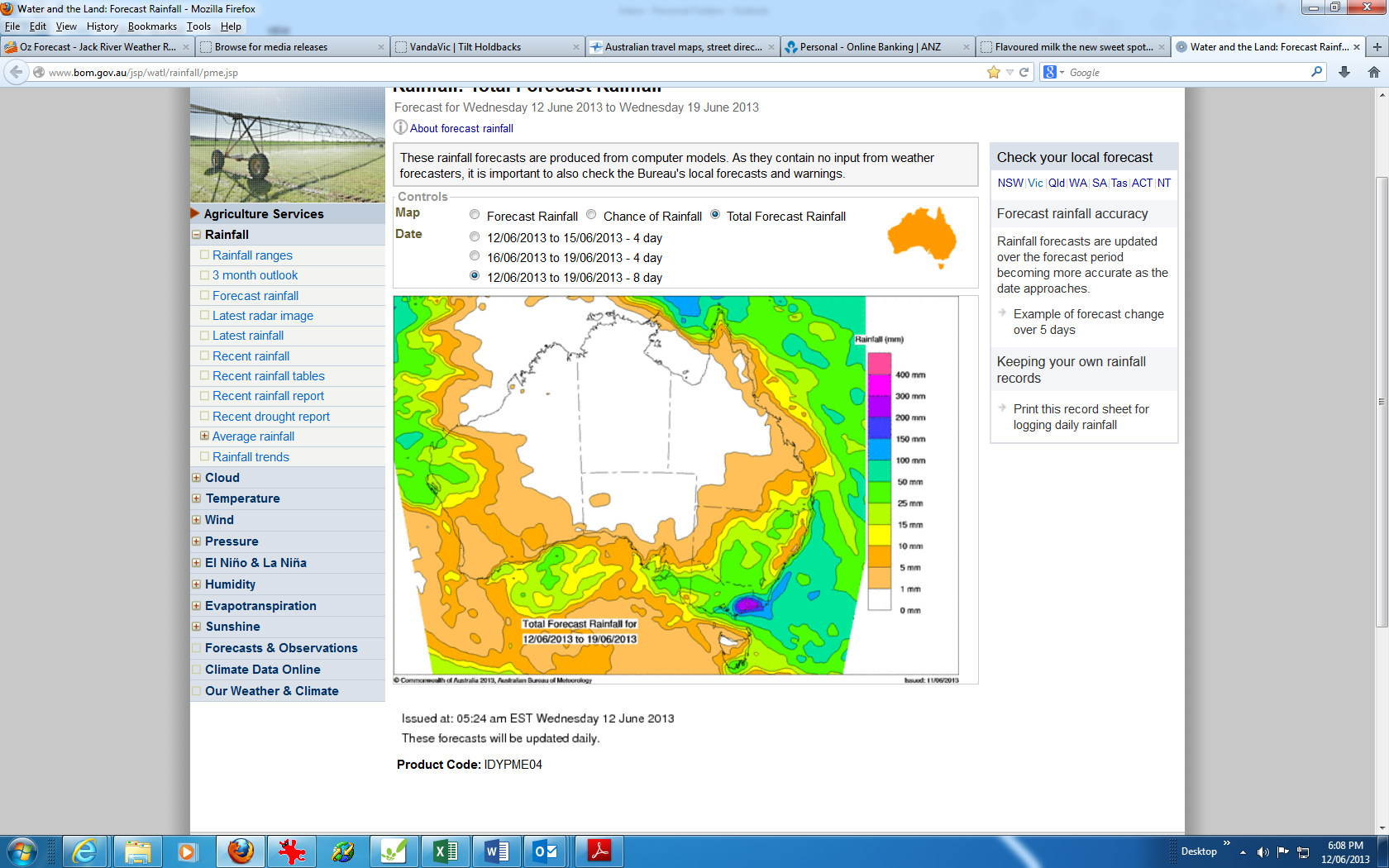
A purple blister on the weather map is coming to get us

Holy cow

Holy cow

It’s not a good sign when the local weather forecaster gets a spot on ABC Radio’s National news. Our forecast is so shocking that, yes, it made headlines today.

A massive chunk of Victoria is about to go underwater and, with it, a massive chunk of our farm. We’ve had an inch of rain in the last two hours and the prediction is for between 51 and 102mm tomorrow, followed by another 20 or 30mm over another couple of days.

I’m thankful for the undulations at the southern end of the farm. The cows will at least be safe.

I’m also thankful for the Bureau of Meteorology’s timely warnings. It gave us time to:

  • Set up safer paddocks for the cows
  • Ask Scott, the grain merchant, to deliver more feed before we get flooded in
  • Remove the power units from the electric fences on the river flats
  • Bring all the eight new calves born during the last 48 hours into the warmth of the poddy shed
  • Stock up at the supermarket
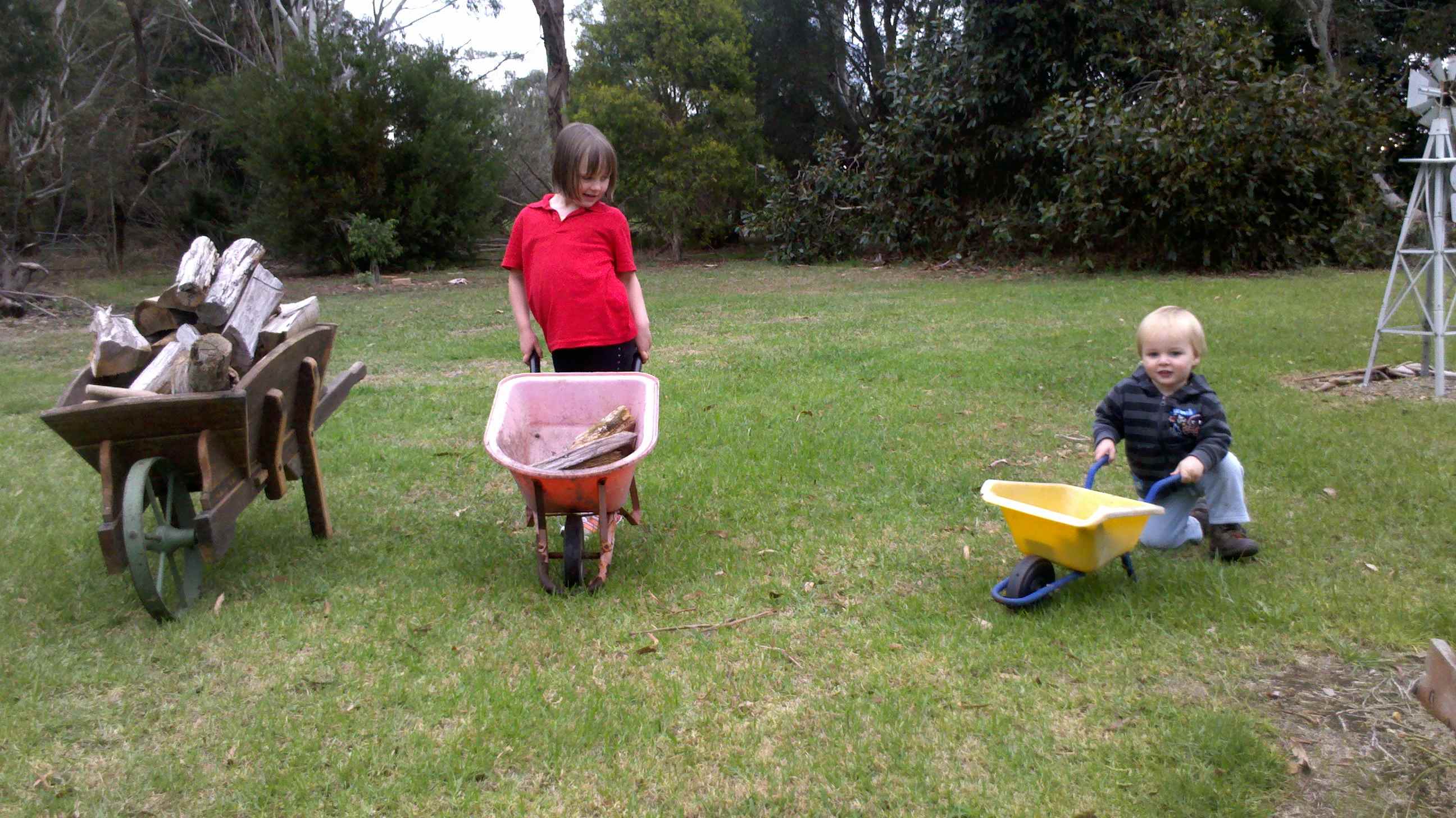
  • Pile the verandah high with dry kindling and wood to keep the kids warm

As the flood sets in, we’ll be:

  • Offering extra TLC for newborns and freshly-calved cows
  • Feeding out more of our precious and rapidly dwindling stock of hay while hitting the phones looking for more ridiculously scarce fodder
  • Keeping an even keener eye out for mastitis
  • Walking the cows extra gently to the dairy to reduce the risk of lameness
  • Hoping like hell that the damage to the fences and tracks isn’t too bad
  • Monitoring the condition of paddocks to minimise pugging (mud, mud, mud)
  • Stocking the dairy snack bar with a bottomless supply of soup and raisin bread

It’s often said that good farmers only worry about what they can control. I’ll do my best!

Never say die

When analysts talk about softening milk supply, there’s a whole other layer that’s anything but soft. It’s uncomfortable chats in the dairy about next week’s roster, sleepless nights worrying about where the next load of hay is going to come from, and long, long hours.

He spends more time in the tractor, she spends more time off-farm to pay the bills. The office is a mess, the kids watch a little more TV than usual and the mummy guilt rises with it. They all get snappy.

He comes in from the chilly night air long after the children have gone to bed. She’s in the office doing the books. Farms are not selling. There is no light at the end of the tunnel and there’s no way out, either.

Then one afternoon, the farm consultant brings a welcome dose of encouragement: the place is in great shape, poised to take advantage of any recovery, and the gossip around the traps is that an upbeat announcement from the co-op is imminent.

That night, as she takes her little boy out to check on the maternity paddock, the farmer is drawn by a ruckus at the dam. A moorhen hangs about a metre above the water, caught by one leg in a twist of wire and flapping its glossy blue-black wings desperately even though there’s clearly no hope of escape.

The farmer cannot stand and watch any more than she can walk away. With toddler on her shoulders and Blundstones squelching through the shallows, she wades towards the struggling bird. There is blood on the wire but with a deft spinning wrench, the fence springs back to shape, releasing the bird which, to the farmer’s astonishment, paddles away seemingly unhurt.

In the morning, the most anticipated email of the year arrives. To the farmer’s astonishment, the milk price will open 24 per cent higher than last year and the co-op has a little rescue package in the shape of a pre-payment for those prepared to pledge their loyalty. She reads the email twice more, just to be sure.

Never say die.

A milk maid’s Mother’s Day

Zoe is sound asleep still gripping a book propped upright on her chest with the rollicking Fantastic Mr Fox in full swing on her CD player. Alex is prostrate with both arms up around his ears.

Today was tough for my little people. Alex got himself soaked and in trouble with Mama for tossing stones into a trough while Zoe learnt the hard way not to swing on a gal gate beside a hot wire.

We were desperate to get a whole list of farm jobs done before the rain came and it was action stations all day. Now, as the first shower of a forecast two or three inch deluge tip-toes across the farm house’s iron roof, it seems all very satisfactory.

Zoe, Alex and I fed two batches of cows, treated a sick calf, repaired two fences and a gate (what is it with the bulls?), brought in a load of wood, planted a tree, sorted 24 cows from a mob of 60, shifted the teenagers and got out two new mums with their calves.

A real team effort

A real team effort

And, in amongst all that, I was treated to the most marvellous Mother’s Day. Wayne cooked a Moroccan chicken lunch and I was presented with all sorts of very meaningful mementos. I am very, very lucky indeed.

AutumnGardenAlexCowsLoRes

Poll: How much would you donate from your pay packet to promote your industry?

As we speak, Dairy Australia is touring the country rolling out the farmer side of the Legendairy campaign. Consumers will see it from late winter, when it hits magazines, radio, TV, supermarkets and bus stops around August.

The campaign is designed to build bridges between farmers and consumers, encouraging trust and an increase in claimed dairy consumption.

My question is this: how much would you personally spend on an industry branding exercise? And if you’re not a farmer, how much would you pay for a campaign aimed at portraying your trade or profession as “good guys”? Be honest, since there’s no way I (or anyone else) can see which way you vote.

Work life balance on farm and a good dose of mother guilt

The slow burn of mother guilt catches me unawares sometimes but on other occasions, it’s as sharp as a knife. Or more accurately, as shrill as a tired toddler’s screech.

Just In Time (JIT) fencing

Just In Time (JIT) fencing

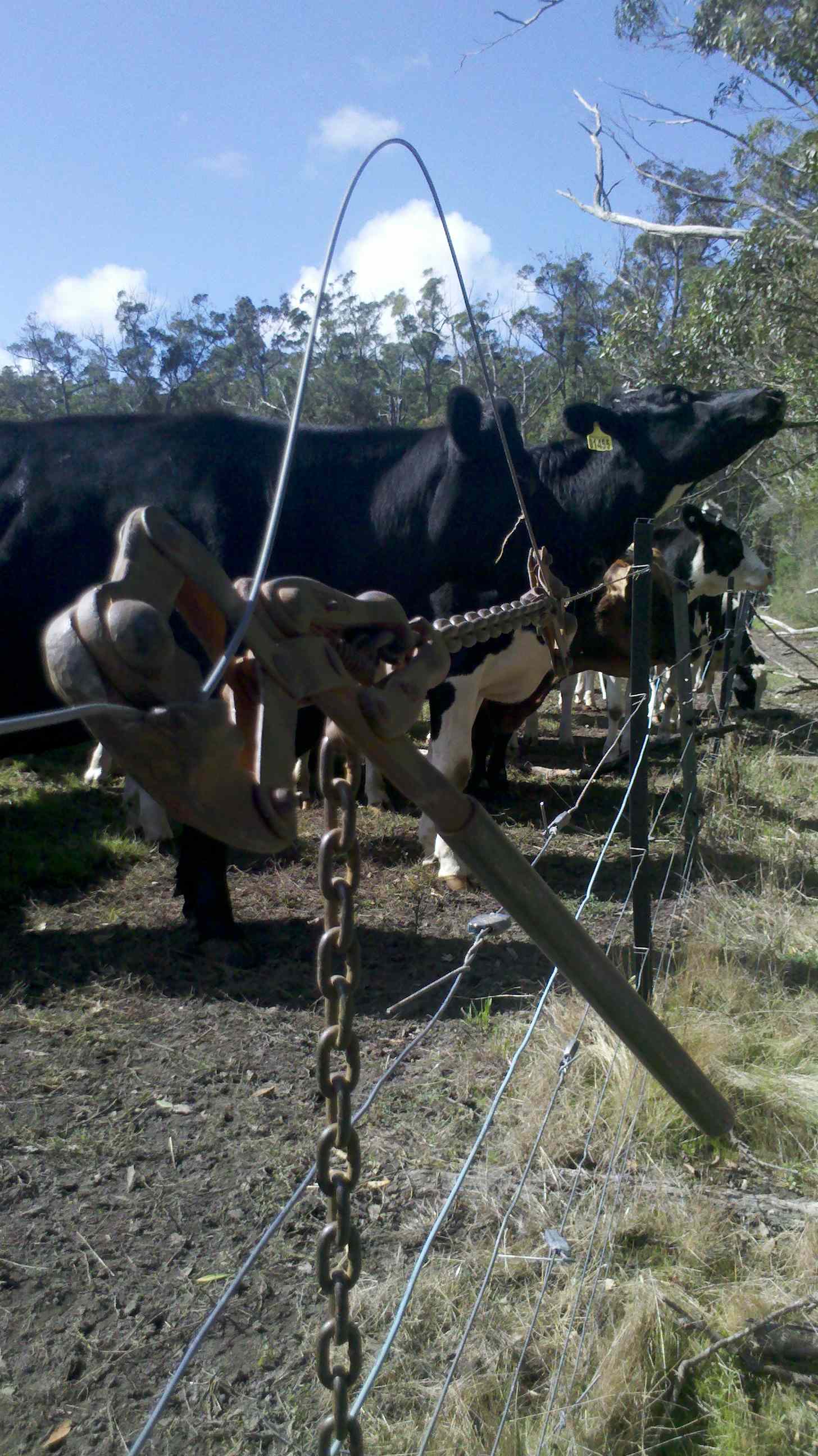
When a knock on the door from a concerned motorist signals a heifer and bull trotting down the road, which in turn reveals that a mob of skittish kangaroos have rendered your fence as floppy as a spoonful of fettuccine, a farmer has little choice but to report to the scene, sirens wailing. If the farmer is also the mother of a toddler, the ramifications can be far more serious: Nap Time Deferral (NTD).

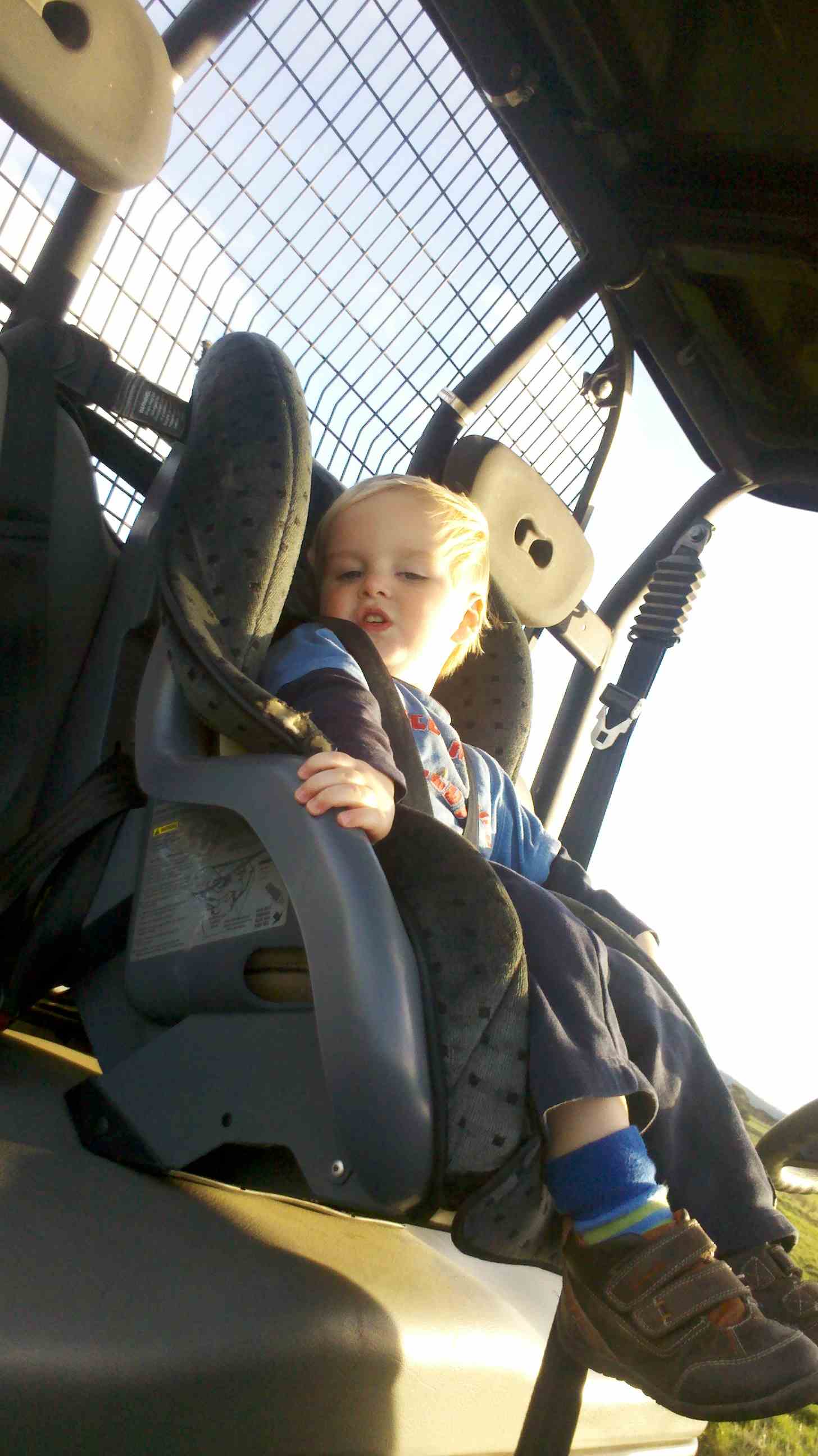
Strapped to the Bobcat seat, my Little Man finds it hard to understand why Mama is singing lullabies as she fumbles with the fence strainer when she should be singing them at the bedside.

"Home, peese"

“Home, peese”

“Sorry, Little Man, I promise I’ll be as quick as I can, I just have to get this done…”

I know Mother Guilt is not limited to farming or, indeed, mothers. On Twitter’s AgChatOz forum the other day, fellow dairy farmers told of their dismay.

MotherGuilt

And, then, Shelby posted a link to this:

Cat’s in the Cradle always “gets me”, too. It’s times like these that I wonder if I am doing the right thing. My children see more of me going about daily life than they would if I was an office worker but, with farm returns so low, it seems we spend most of our time working and less of their time playing.

With the heifer paddock hastily patched up, Zoe, Alex and I returned last weekend to do the major works. As I wrestled with wire and strainers, they gambolled about the picturesque hidden paddock. Flanked by forest, they were out of the chilly wind, away from roads and so carelessly happy. I smiled as their little heads bobbed across the pastures and my spirits soared as their laughter echoed around the trees.

A gambol cures a dose of mother guilt

A gambol cures a dose of mother guilt

I was cured. Well, almost. What mother would stand back and film this?

The question engage or educate and why it matters?

What an interesting post from Lynne Strong, founder of the Archibull Prize for schools.

Lynne Strong's avatarWe are Champions for Change

If we want our children to know where their food comes from; if we want them to be motivated to care about the lives and livelihoods of farmers; if we want them to take seriously the environmental impacts of their food choices; and if we want them to know more about how their health is affected by the way food is made, perhaps we need to rethink the place of food production

This knowledge has been lost since we all became so reliant on the industrial agriculture system; we should talk to the experts – the farmers – so we can get it back. We don’t just need more urban agricultural initiatives, including food-producing back, front and median-strip gardens, school kitchen gardens, community gardens and city farms. We also need a transfer of knowledge from rural farmers. We need Australia’s farmers to be intimately involved in the development of innovative…

View original post 1,584 more words

The sun is up and so is the sparky (or, the day began pear-shaped)

Dairy cows are rounded up before dawn but, today, they slept in. We had a bit of a disaster in the dairy last night that would have meant the girls missed breakfast. That certainly would not do, so while they waited for the sparky to weave his magic in the grain auger control box, this is how the cows enjoyed watching the sunrise.

Sleeping in

Sleeping in

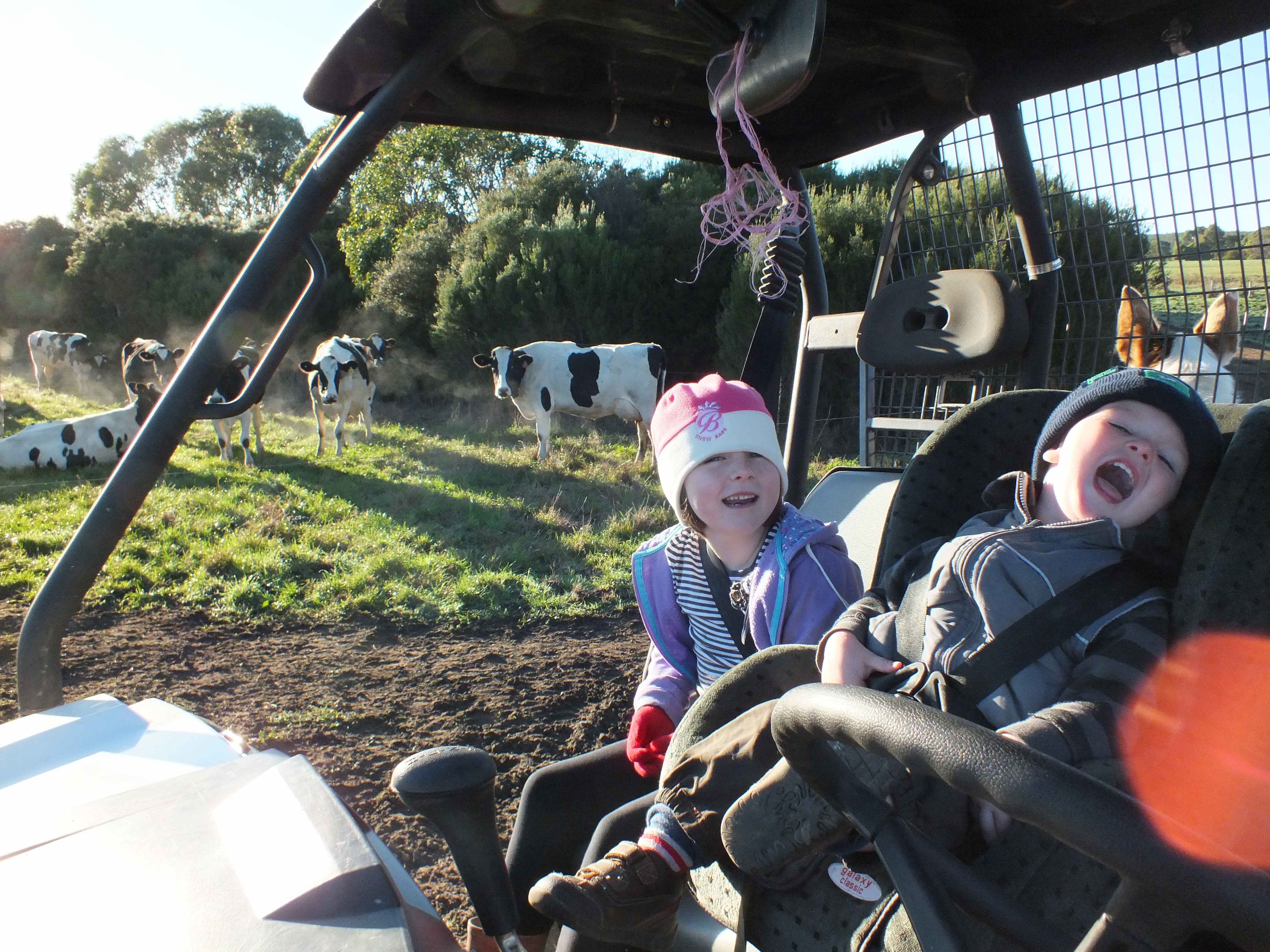
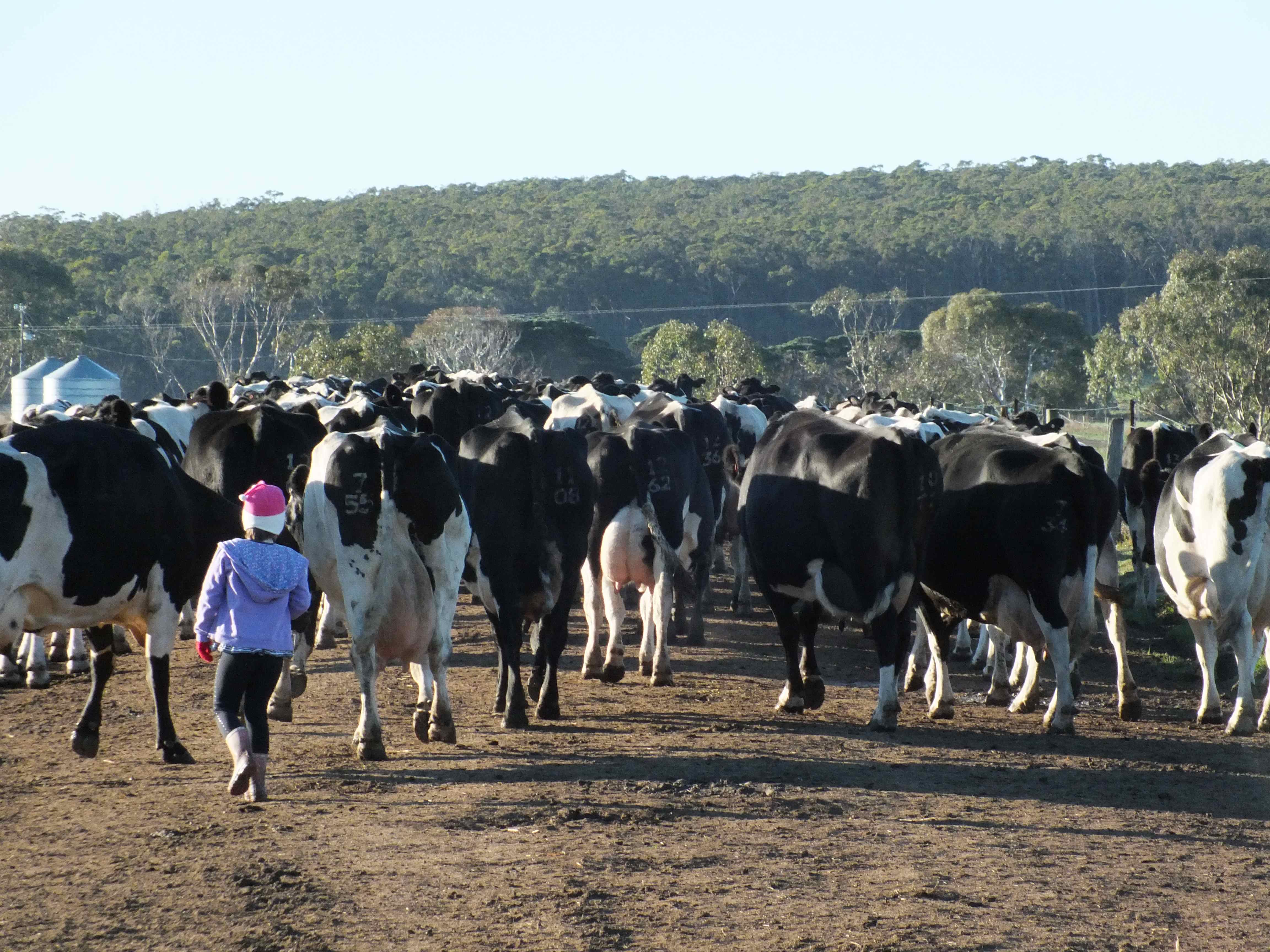
Two hours later than normal, with steaming breath and swaddled in layers of clothes to ward off the still chilly air, the kids and I had the rare treat of a family morning round up.

Rounding up was noisier than usual, too!

Rounding up was noisier than usual, too!

The cows seemed to take it all in their stride but we are lucky this has happened late in the season when milk production is falling away. Farmers are so fastidious about rising early because a late morning milking means painfully-full udders and the risk of mastitis. Wayne took the opportunity to do a heap of other farm chores while the feed system was repaired and will milk the cows late tonight to help even things out for the cows again.

A big thank you to Dutchy the sparky for getting out of bed so early on a frosty Sunday morning. It turns out that, in dairy country, the cows rule the lives of farmers, their families and even the local electricians.

Cows having a sleep in

Has the MG co-op fed Aussie dairy farmers to the wolves?

If $1 milk is unsustainable, how is the Coles deal locking in pricing with Murray Goulburn a good thing? Good question. Has MG made a giant mistake? Will it mean a mass exodus by NSW dairy farmers and will the big co-op do its socks on the deal, taking the hopes of dairy farmers down, down, down with it? Blair Speedy of The Australian certainly seems to think so.

I decided to ask some rather blunt questions of two men in the know: independent dairy analyst, Jon Hauser of Xcheque and Murray Goulburn big-wig and general manager shareholder relations, Robert Poole.

1. How can MG make a profit supplying fresh milk to Coles if Lion could not?
Robert Poole refused to comment on Lion’s circumstances but said the co-op’s new factories would be “purpose-built, state of the art and the most efficient milk processing plants in Australia”.

“We will make a good return supplying Coles and will have the capacity to supply other customers in time, too, making even higher returns.”

Jon Hauser goes further. “I can see how 10 cents per litre in costs can readily be taken out of the chain,” he says. “There is a view in the dairy community that milk should be sold for more than a dollar per litre when it’s being sold cheaper than that right now in the USA and the United Kingdom. The local processors have been retaining much more of the milk dollar than international processors.”

2. What risk is there to the $120 million of farmers’ funds that will be spent on the new factories?
Poole says quite flatly that the cost of the factories is well and truly covered by the 10-year Coles contract: “We have total security. There will be no cross-subsidisation of this investment – it will be fully funded by the agreement with Coles.”.

3. Why hasn’t MG sold fresh milk into supermarkets before?
“Historically, we would have had to submit a tender for milk supply. And what, build factories in the hope that we won?,” says Poole. “This was a golden opportunity. Nobody gets a 10-year contract like this but Coles came to Murray Goulburn because it wanted to work with farmers.”

4. How does it work for MG?
According to Poole: “Under the supply agreement, the price to Coles is based on a farm-gate price and the cost of processing plus a comfortable profit margin. There’s a rise and fall clause that means the price reflects the changing value of the milk on international markets.”

Hauser explains that the New Zealand and Australian dairy industries are “price takers”, unlike the Europeans and Americans, who have greater control over pricing.

“Australia can’t control the export price but, reading between the lines, Murray Goulburn is using the Coles deal to increase its control over the price it gets for its milk and will position itself for a much greater role in the 2 billion-litre fresh milk market. Because MG will slash the cost of delivering fresh milk to supermarkets, I predict the co-op will be selling supermarkets a billion litres of fresh milk a year by 2023.”

“Aside from milk, the deal also allows MG to range its cheese, butter and spreads in Coles, which makes it even more attractive.”

5. Has the Coles and Murray Goulburn deal devalued milk?
Poole was ever the diplomat on this one, saying the retail price of milk was “up to the supermarkets”. Hauser is a tad more direct. “For people to say milk will be devalued is absolute rubbish,” he says. “This is a great deal for MG’s farmer members. Is it MG’s responsibility to stay out of the market and let nonsense economics run the show?”

6. How will this affect NSW dairy farmers?
Hauser says many NSW dairy farmers will need to reassess their businesses. Milk price in both NSW and Victoria will be based on a mixture of domestic and export value with the export market being a major driver of that value.

The man himself, Robert Poole, says the NSW price will reflect “supply and demand, international prices and a premium that takes into account the added costs associated with supplying exact volumes of milk every month of the year”.

Will it shake up the NSW dairy sector, with its large number of very small farms? Undoubtedly, says Hauser. “NSW’s dairy farmers sold themselves into trouble when they handed over the responsibility for, and the value of, their products to private processors, who have no interest in their viability. Ironically, it is a Victorian farmer cooperative that is now reclaiming control in NSW.”

7. Why should Australians buy Devondale fresh milk rather than Coles homebrand milk?
“That you’ll have to wait and see,” teases Poole. “Seriously, it’s up to us to place Devondale in the market carefully, with the right price, packaging and provenance and other benefits that will appeal to shoppers.”
Changing down to go up a notch

It seemed Mother Nature had played a classic nasty trick on us: the false break.

Each autumn, we take a punt on when the first downpour that heralds regular rains has arrived. Too early and some seed just won’t germinate costing us thousands in fresh seed and fertiliser, too late and we could miss out on autumn growth altogether, costing us thousands in replacement feed.

We get it right most of the time but when the early rains aren’t followed up with more, we end up with the worst of all worlds: seedlings shrivelling in the sun. That’s the way it was shaping up this season until we got 26mm of rain just the other day. Wow, what a relief and what a difference it makes.

The rains have come and the farmer and her cows are ecstatic!

The rains have come and the farmer and her cows are ecstatic!

Oddly enough, this means the cows will get less rather than more grass in the short term. This follow up rain was our signal to pile on the fertiliser across a huge slab of the farm to ensure the grass gets ahead before falling temperatures and longer nights slow growth once more. While the fertiliser does its job, we have to keep the cows away, limiting them to a smaller than normal area for grazing.

Just another couple of weeks to go, moos – until then, it’s a smorgasbord of grain, hay and silage.

Legendairy stuff or just fluff?

There’s little doubt Australian dairy farmers are feeling a little demoralised and that’s not good for business. The first symptom displayed by farmers lacking confidence is a stubborn refusal to open their cheque books.

And here we are, hunkered down in survival mode, deaf to our leaders’ calls to invest and grow so that Australia can realise its dream of becoming a vital piece of the Asian food bowl.

With all this in mind, then, take a look at the “farmer-side” launch of the new Dairy Australia campaign, Legendairy.

Ad agency, CumminsRoss is to be congratulated for the stirring execution.

In a media release, DA project leader Isabel MacNeill, says Legendairy is “not just a branding exercise” but a singular rallying point that will help develop pride among dairy people, and increase community appreciation for the industry and demand for its products.

The Legendairy platform will be translated into an initial three-year integrated marketing and communication plan focusing on three core audiences:
• Farmers and farm communities
• Consumers, especially parents of young children
• Societal shapers such as policy makers, authorities and health professionals.

According to MacNeill, it’s all about the dairy community telling its own stories about what makes us legendary.

After sleeping on it, I’m guessing Legendairy will polarise farmers. One camp will say, “Yeah, it’s great to get a pat on the back” and the other camp will say “Don’t spend my levy on expensive ads telling me how great I should feel while I’m struggling to pay the bills”.

I must admit I have a foot in each camp. When you’re going through a rough patch, the last thing you want is a pat on the head and this strays dangerously close to that. I’m really looking forward to seeing what comes next.

EDIT: As I walked away from the computer after writing this post, one BIG thing occurred to me: What does DA want out of the farmer-side campaign and how will it be measured? Fewer exits from the industry, greater farmer investment? Lower depression rates among farmers? Sadly, no, I suspect not because no mere communications strategy could realistically hold such worthy objectives. Not now, in any case. Perhaps it would be better timed to build confidence when the tide has truly begun to turn.