Because diesel is the new asbestos

Diesel Bobcat without windscreen

Breezy is beautiful

Diesel fumes have always left me feeling sick and it turns out my queasiness is justified. A report in the West Australian explains:

“Researchers from the WA Institute for Medical Research and the Telethon Institute for Child Health Research found that children with fathers who were exposed to diesel exhaust fumes at work about the time of conception were 62 per cent more likely to have brain tumours.”

“The results, published in the International Journal of Cancer, also showed that children of women exposed to diesel fumes at work before the birth had twice the risk of brain tumours.”

Scary stuff? Yes. According to the WHO, diesel is the new asbestos.

“Experts at the World Health Organisation (WHO) say diesel engine exhaust fumes can cause cancer in humans. They say they belong in the same potentially deadly category as asbestos, arsenic and mustard gas.”

We are lucky to live far from city pollution but we do have a diesel car, diesel tractor and diesel UTV that gets me and the kids around the farm. That new UTV came with a roof and windscreen – a combination that, ironically, may have threatened our children’s health. Unfortunately, it seems the windscreen created negative pressure and built up a vacuum that sucks air from behind and around the UTV back over the cabin. With it came a lot of dust and a strong smell of diesel fumes.

The windscreen is now stacked neatly against a garage wall and we are breathing easy once more.

Could you be suffering from cow envy?

CuriousHeifersRun

The ethics of food is so complex. Vegans following a conscientious diet are told they are inadvertently starving Peruvians, causing deforestation and even eating with blood on their vegetarian hands. It’s not easy being green and I don’t blame vegans for being so passionate about their choice.

Life on farm is a microcosm of those ethical dilemmas. Every day, we must make decisions that impact on the well-being of an animal. Often, there is no easy answer. Should we euthanase that cow now or wait although she’s in discomfort in the hope she recovers? Should we raise that calf away from her mother or risk deadly disease transmission? And the big one: should I send heifers to China if milking just won’t pay the bills?

If nothing else, it forces you to stare hard in the mirror and here’s what I see: yes, I am a commercial dairy farmer and, hell yes, I care about our animals and our land.

Although this is something vegans on Twitter seem to find inconceivable, in my experience, this mindset is not only possible but typical of dairy farmers. It’s what keeps us on the land for generations and I am incredibly grateful to be here. My farm may not be a “cow sanctuary” as one vegan put it but I’m doing my best to make sure the cows never realise.

(Special note to my vegan friends: I realise what a privilege this is and wouldn’t blame you for some serious cow envy!)

Why it’s great to work with kids and animals

I’m so grateful for the support of people around Australia and as far afield as Canada in response to my post about how to save Australian dairy. It’s been so heartening.

But then, a rather nasty person appeared out of the blue on Twitter today and cast a cloud over my morning – for 10 minutes anyhow. Because, after that, I got to do some work in the paddock and enjoyed the company of my two little farmers and some other members of our team. Kids and animals are the perfect antidote for trolls.

Well hello, Luscious Legs, how pregnant are we?

luscious legs

Ooh la la!

These shapely legs belong to the beleaguered wearer of “The Shirt”. Apparently, it was too hot to wear long pants or anything waterproof today doing a Big Job.

Anyhow, the Big Job was a special occasion: we got to find out how pregnant we are (or more correctly, how pregnant the cows are). Preg testing qualifies for the title of Big Job because it entails lining up 125 cows a day for an internal examination by the vet. Not painful for the cows but a big change in routine like this always means added excitement.

The good news is that almost all of our 250 milkers have indeed conceived to our irresistible team of bulls. All expectant cows will take a two-month holiday before calving and we will greet the next generation from late April onwards.

A sizeable group of cows will not calve at all in 2013 – I pulled the plug on mating early – and will instead enjoy our company twice a day, seven days a week for the next 18 months.

How to rescue dairy – from the nutty to the tricky

Dairy farmers gathered in their hundreds in south-west Victoria last night for a crisis meeting. What makes it a crisis? Very simply, dairy farmers are working seven days a week for free and petrified of losing our shirts.

Local agribusiness bankers tell me they are busy refinancing and arranging extra debt but land sales are at a standstill around here. Reporting on last night’s dairy crisis meeting, Simone Smith of The Weekly Times, described a “dire picture”:

“Warrnambool-based Coffey Hunt farm accounting specialist Garry Smith said across his client-base, farmers milking mostly between 450-500 cows, average feed costs were up 15 per cent – a $150,000 rise – with the cost of power for the first quarter of the year up 50 per cent.”

“He estimated across his client-base earnings would be 10 per cent down on last year with a combination of cash-flow and income down $260,000.

“Charles Stewart real estate agent Nick Adamson said better quality farms had dropped in value between 8-15 per cent, while others were up to 45 per cent down on peaks of several years ago.”

None of this is pretty and astonishingly, Peter Reith decided to appear on ABC’s The Drum website with a six-point plan that, at first, I thought was a spoof. Take a look and make up your own mind.

It’s not as simple as cutting petrol taxes and municipal rates. It’s tricky because of this conundrum: milk and dairy foods are considered so important that nobody wants to pay what they are worth to produce.

Every day I read comments on Twitter that go something like this: “My kids drink three litres of milk every two days, so I can only afford to buy $1 milk”. I know first-hand how tough it is to feed a family when you’re on struggle street, so I have a lot of sympathy for people in this predicament and it’s impossible to respond with anything other than compassion.

It’s hardly surprising, then, that there is no political appetite for an increased milk price. But the truth is this: dairy farmers should not and cannot fund an ersatz Australian welfare system by subsidising the cost of food. Welfare is the role of government.

So, while my dander is up, here’s a simple list of five tricky things that would make a big difference to this dairy farmer:

1. Deal with the supermarket duopoly
Down, Down, Down is not about you, dear milk drinker. The real reasons for the supermarket war are expressed in corporate ROIs rather than family budgets. At the end of the day, it will be the little people with the least market power – you, the shopper, and me, the farmer – who will pay.

2. Level the global playing field
Julia Gillard announced that Australia would be Asia’s food bowl but guess what? Unlike the world’s most powerful dairy exporters, the Kiwis, we do not have a free trade agreement with China, putting Australian dairy at an immediate 15% disadvantage. Nor do we receive the government subsidies that support our European and North American competitors.

3. Assist with the impact of the carbon tax
Australian dairy farmers are suffering a double whammy under the carbon tax. First, processors are passing the extra cost onto us in the form of lower farm gate prices (because the consumer won’t pay extra and nor will global commodity markets), reducing our incomes by around $5,000 each per year. At the same time, our costs – especially electricity and refrigerants – are rising in quantum leaps each quarter.

4. Support smart farming
Long exposed to the blow-torch of global export markets without subsidisation, Australia’s dairy farmers are among the most efficient in the world, according to research body, Dairy Australia. We can produce very high quality milk at a very low cost because we have invested in research and development. No longer. We are spending less and less on R&D and the Victorian government has just made massive staff cuts to our brains trust, the Department of Primary Industries.

5. Remember, I am the goose that lays the golden egg
I will not be able to continue to deliver high quality milk at such a low price while enhancing the environment and caring for our cows without sacrificing the basic wellbeing of my family and that, I refuse to do.

Project “Thor”

After a record wet winter followed by a fleeting Spring, it hasn’t rained here in a long time.

In fact, despite several attempts at emulating the Sioux rain dance ritual shown in the remarkable footage (bear with it, not all stills) below, we have had little success – other than the 2.5mm of rain we got after our fourth performance a week ago, there’s been nothing in the gauge for a few weeks now.

Perhaps the problem lies in our execution. Since the materials used by the Sioux are not all readily available here in Australia, we have been forced to improvise with picnic blankets, turquoise hayband, the feathers of wedge-tail eagles, dyed hessian sacks and rubber boots adorned with eucalyptus leaves and shells.

We are getting desperate and it shows.

Under construction: will Thor be impressed?

Rain Dance Ampitheatre under construction

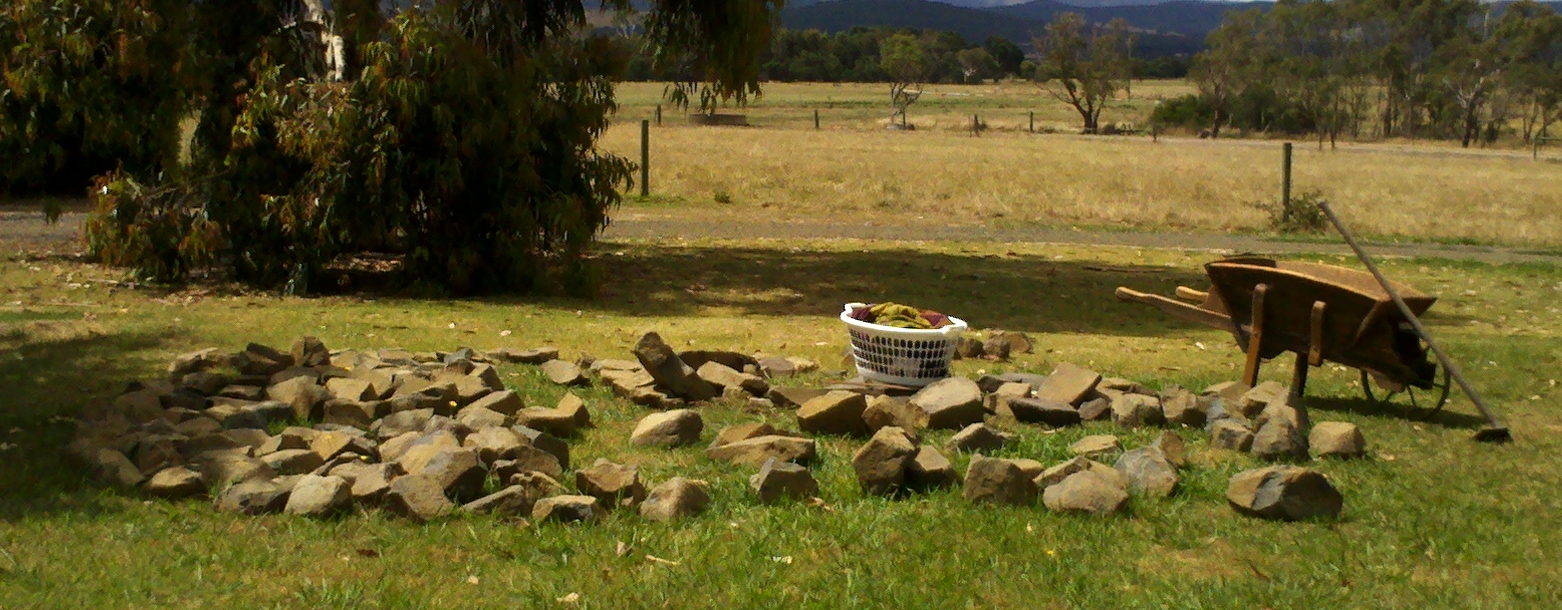
Drawing upon my husband’s Scandinavian heritage, I am building a stone amphitheatre to honour Thor with a special sacrifice: a washing basket full of damp linen. With a toddler in the midst of toilet training and the truly spectacular laundry that makes our dairy-farming family infamous, you’ll understand the meaning of such an offering.

I know I must show total faith in Thor’s generosity but any tips would be gratefully received.

Grand plans

Dream big

Dream big


Dad loved the Grand Plan. So do I.

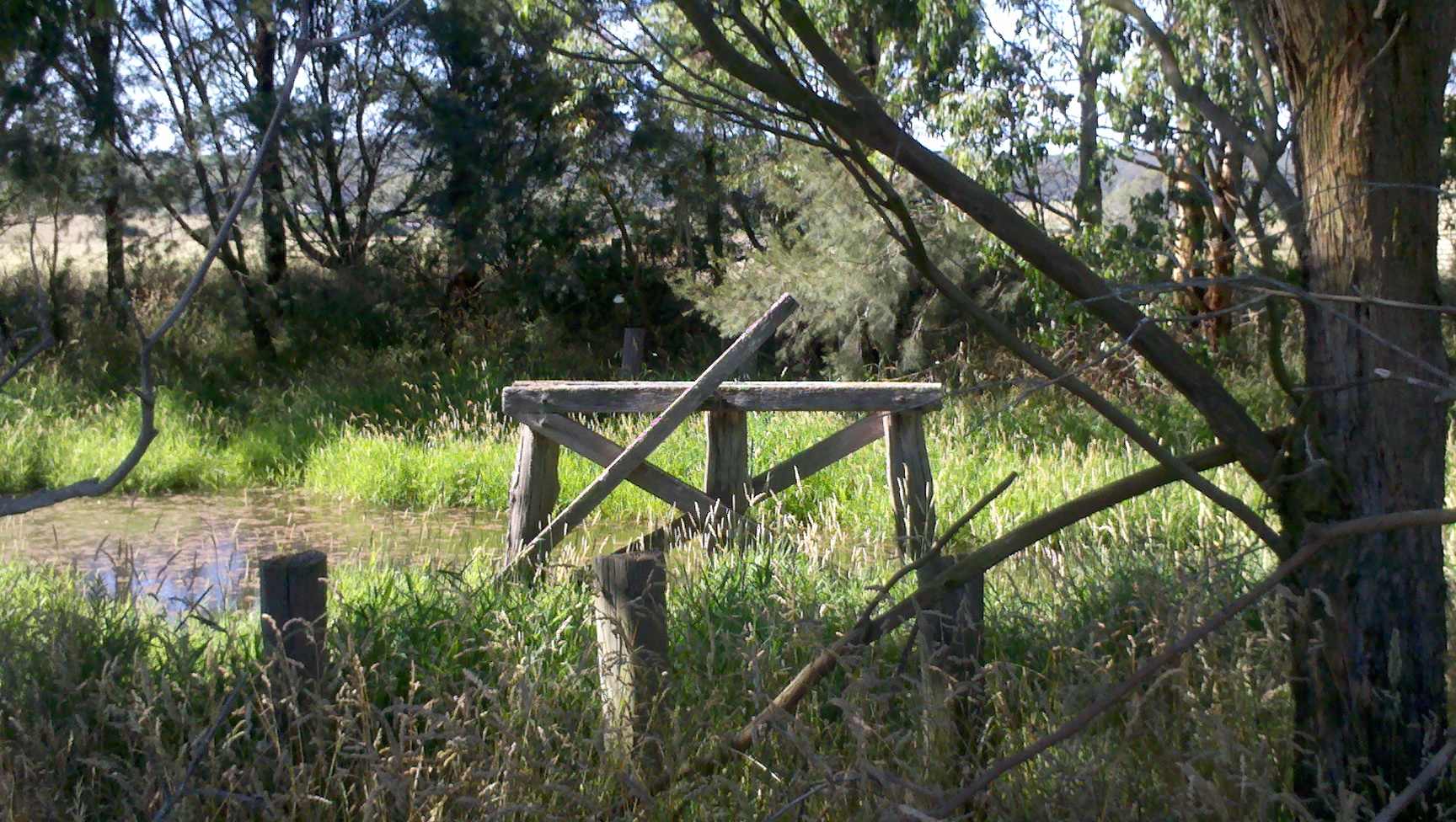
I don’t know why he decided not to finish the building of this bridge but there’s a feeling of romance about it. There would have been hours of planning, sourcing of materials, chattering about the project and, then, the wondrous day the pylons were driven. Perhaps it all got too hard or funds dried up with a scorching season.

It doesn’t matter really. The incomplete bridge is a symbol of progress because, for every white elephant, there were three glittering successes.

On one hand, farmers these days are often cast as peasants and, in some ways, we are – living at the whim of nature, commodity markets and the duopoly. On the other, few Australians are more empowered to bring their Grand Plans to life.

How to get farmers wearing helmets on quad bikes

With my hair plastered to my head with sweat and feeling woozy, I conceded defeat. I’d been rounding up in 30 degree heat on a quad bike with a road bike helmet on and just couldn’t do it. At 2 km/hr behind 250 cows, each literally giving off the same amount of heat as a 1500 watt hair dryer, sitting astride a hot engine, the heat got to me and I was not far from passing out.

Road bike helmets are designed for use on bitumen at high speed and have no effective ventilation at speeds of one to three kilometres per hour. Having one strapped on in this type of environment could be lethal.

Why had I been so stupid, you ask? Because I was trying to do what the regulators would have me do and, as an employer, insist everyone else does it too. And yet I’m in The Weekly Times today saying we all wear helmets here; I won’t let our kids on quads; and that we have Quadbars on our bikes.

What the story doesn’t explain is that I won’t wear a road bike helmet. This seems to be something of a taboo and sadly, this means many farmers ride quad bikes without a helmet at all and simply hope nobody gets hurt.

This situation has arisen because:

–     Quad bike manuals stipulate the wearing of a road bike helmet that meets Australian Standard AS1618

-`    An Australian Standards committee dominated by helmet manufacturers refused to ratify a New Zealand off-road quad bike helmet standard.

I would never argue that riding quad bikes on farm – even at slow speed – without a helmet should be permitted but far lighter helmets are legal in much more hazardous circumstances.

Thousands ride pushbikes down Melbourne’s busiest thoroughfares at 40 kilometres an hour alongside semi-trailers wearing very light, yet legal, helmets. Thousands more ride horses equally as fast wearing cool helmets strong enough to withstand a collision with horse hoofs and a fall onto a hard surface at speeds of up to 55km/hr.

And that’s been our solution: we’ve chosen a light, really well ventilated equestrian helmet. Everyone here wears them without complaint whatever the weather, all of the time.

While many WorkSafe inspectors appreciate the hazards created by wearing road bike helmets for low-speed agricultural use, they are hamstrung by the absence of a specific standard. A new Australian Standard seems destined to be stymied by cost and disregard of the realities by those who work in air-conditioned offices rather than hot paddocks.


Farmers just need to…

Complete the sentence: “Farmers just need to…”

A few I’ve heard recently are:

  • “Work smarter”
  • “Be more innovative”
  • “Drive for >5% cost reductions”
  • “Scale up to meet the world’s insatiable need for protein”
  • “Don’t JUST farm. Add a few more feathers to your cap”

Most of these comments have been made quite flippantly, with little or no background knowledge of Australian dairy farming and, to be frank, they give me the irrits.

What makes me really angry, though, is when our leaders parrot the “Scale up to meet the world’s insatiable need for protein” line.

We farmers need to justify investing more money, blood, sweat and tears in growth – both to our families and our bankers. Unless farm gate prices for milk increase substantially, that’s a very difficult proposition. According to official figures, most of the state’s dairy farms have a return on investment of 1 to 3 per cent, forcing a focus on financial survival. Much higher returns can be made elsewhere with less work and far lower risk.

To those whose simplistic response is “work smarter, diversify or value-add”, let me point out some realities. Click the link to see how the average Australian dairy farmer is paid compared to dairy farmers around the world:

https://milkmaidmarian.com/wp-content/uploads/2011/10/figure-8-international-farmgate-milk-prices-us-per-100kg.pdf

What does this mean for a farming family like mine? We want to improve the farm, so Wayne and I are both holding down second jobs (in other words, we are not “just farming”). The plan is that these improvements will make the farm more profitable and sustainable. We are making progress but farm life is currently anything but sustainable from a personal point of view. You just can’t work this many hours forever.

Perhaps we are dullards and are just not efficient enough but I doubt it. The farm I run now bears almost no resemblance to the farm of my childhood 30 years ago. It’s the same 500 acres but we milk 50 per cent more cows and each produces around 55 per cent more milk than her ancestor did in the 1980s: a huge leap in productivity.

Although these numbers are impressive, we are far from exceptional. According to Dairy Australia, Victoria’s raw milk production peaked in 2001-02 at 7.4 billion litres – more than double the 3 billion litres produced in 1980-81. Yield per cow also increased from 3,012 litres in 1979-1980 to 5,864 litres in 2008/09.

Sadly, we are unlikely to continue to make such gains. Our brains trust, the Victoria’s Department of Primary Industries, is being savagely pruned, reducing our ability to innovate and work smart. We don’t enjoy the subsidies that support our US and European counterparts or the free trade agreement with China that advantages our Kiwi neighbours. And now, we face an estimated $7000 carbon tax cost that will nobble us even further.

The playing field is far from level and getting steeper all the time.

What does the missing dairy farmer look like?

Shi#t

Shi#t

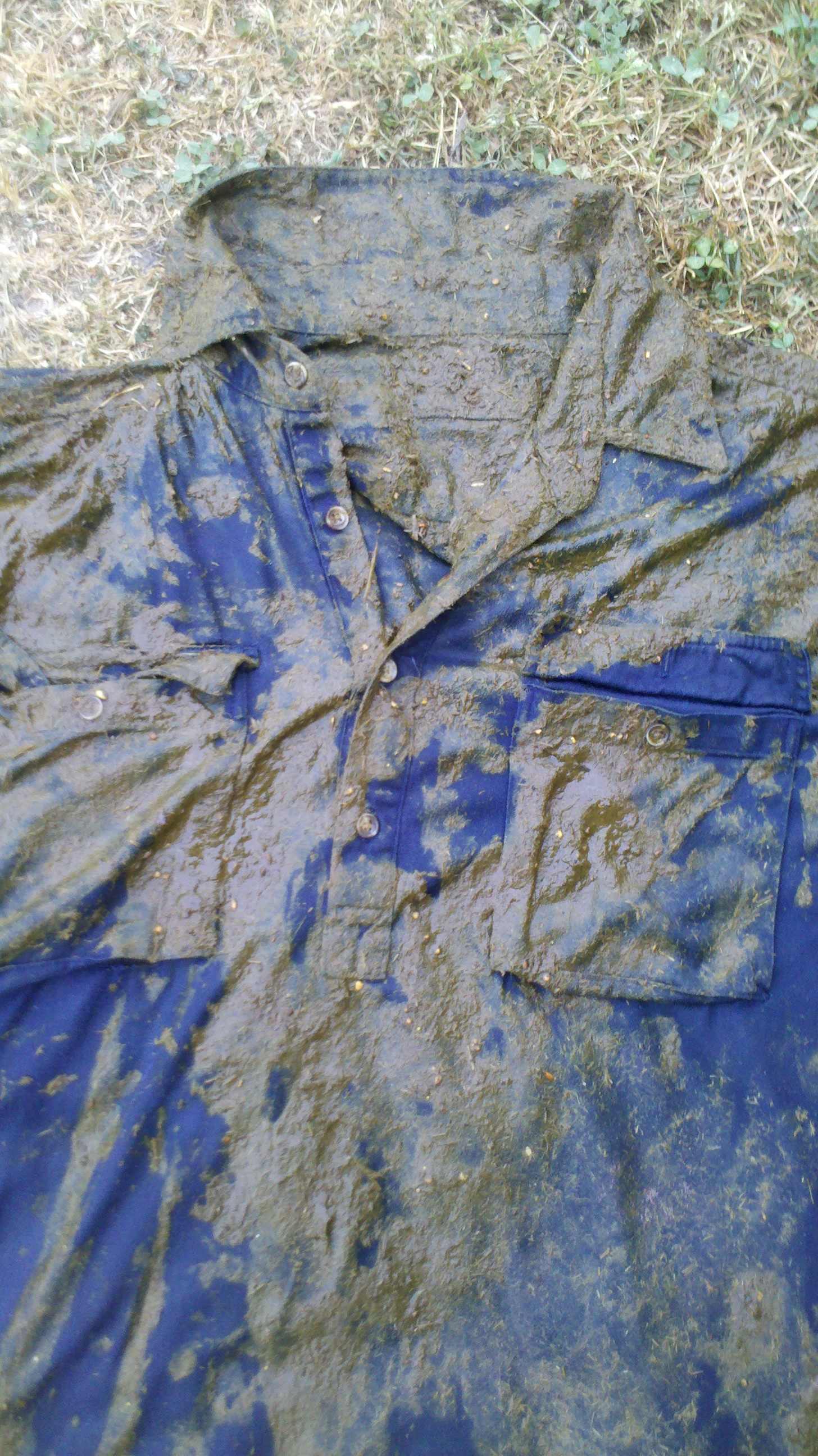
This is the shirt that had to be left on the lawn because it was too dirty for the laundry. Check out the collar. He was wearing it when it became…soiled. Imagine the man.

Me: “So, who got you? Was it 1257 or 800?”

Him: “I don’t know – it was too quick, I was blinded and they were firing at me from all directions – in front and behind.”

Me: (Trying desperately not to laugh) “What did you do?”

Him: “I groped about and found something really thick and thought, ‘Great, that’s a hose’ and just blasted myself with the fire hose for a few minutes. And a few minutes later, another one got me from behind and it flowed down over my eyes before I could stop it, so I don’t know who that was either.”

Me: “Oh, you poor thing. But you seem in good spirits…”

Him: “Yeah. I decided that s#$t happens, so I might as well just take a break and have a drink. I peeled off my shirt, hosed myself down again, had that drink, and milked like this.”

Me: “What – in the nude?”

Him: (Indignantly) “With my shorts and gumboots on! I added an apron when the tanker arrived in case I scared the driver.”

Me: Raucous laughter.

Him: “Feel my hair”

Me: “Ah, no thanks.”

Him: “Go on, feel it…Don’t look at me like that…Okay, smell it then.”

Me: “It smells like Ovaltine – go and have a shower, for goodness’ sake.”

Milking cows certainly has its moments and there were quite a few of those “moments” for Wayne because now that the grass has pretty much shrivelled up, the cows have been dining on a divine, juicy crop of rape and tender young millet. Never mind, it’ll settle in a day or two…

Cows grazing millet

They can barely walk because their pants are suddenly too tight