Tribute to a farmer who’s not a farmer

My husband was not born a farmer. While I rode my pony to primary school, Wayne caught the tram through the, err, “colourful” streets of St Kilda.

Before we took on the farm, Wayne had the idea that after milking you could have a nap on the couch – a ritual my father had adopted. But that hasn’t been our experience. I was bequeathed a terrifying mortgage along with the farm and making ends meet means running the place at fever pitch. Wayne is still driving up and down to Melbourne a few times a week and rounding it off with 14-hour days on the farm. He’s doing it so I can follow my dream. Maybe I sold him a pup.

The workload is exhausting. Things are improving – we’ve fixed most of the water, weed and wire problems that hobbled the farm just a few years ago – but it’s really hard yakka and, with a toddler literally strapped to my chest, I’m still not pulling my weight in the paddocks.

We keep reminding ourselves how much we’ve accomplished in just a few short years. I keep thanking my lucky stars for the man I married.
No fresh milk for Australians? Is UHT the next big thing?

It’s been an amazing week. First, milk processor Lion, came right out and said the unthinkable – that a milk price below the cost of production was “fair” and that there need to be fewer dairy farmers in Queensland and New South Wales.

Then, yesterday, Sue Neales (follow her @BushReporter on Twitter) of The Australian reported that “Desperate Australian dairy farmers are looking to fly fresh milk directly into Asia to deprive Coles and Woolworths of their unassailable market power.”.

In Sue Neales’ story, Dairy Connect farmers’ group president Adrian Drury said: “We are telling the supermarkets that they mightn’t always have easy access to fresh milk and that they take us for granted at their peril in their push to force milk prices down.”.

What does that mean for you, the milk drinker?

To put it bluntly, you might find yourself drinking UHT milk rather than fresh milk sooner than I expected. Rumours are rife in dairy-land that Coles is keen to shift you from the fridge to the aisles when it comes to picking up your milk. Coles has quite a contingent of European executives these days, where the move from fresh to UHT has been spectacularly successful for the supermarkets. According to Wikipedia, 7 out of 10 Europeans regularly drink UHT rather than fresh milk.

Why UHT? For supermarkets, the benefits of stocking UHT are huge. It lasts longer, it doesn’t need to be refrigerated and, best of all, it can be sourced from far away, increasing their range of supply.

What’s wrong with that, you may ask? After all, there’s evidence that UHT is greener (given it doesn’t need to be refrigerated) and it is still good for you (read more about UHT here, if you like). Question is, do you want to be able to choose?

PS: If The Australian won’t let you read Sue’s story, Google the headline Farmers’ bid to end duopoly milk run and you should be able to read the lot.

How a farmer hangs out her washing (or desperation is the mother of invention)

At 15 months, Alex loves “riding” the quad bike.

The little man is drawn to anything he can climb, toot or wobble, especially if it has buttons and the quad has all those magical qualities with the added bonus that it’s his Dad’s.

The mite’s adventurousness is only slightly hampered by his wet blanket of a Mama. When Wayne bought Zoe a hot pink mini-quad for Christmas last year, I refused to let him bring it home. Quads are seriously dangerous bits of gear and, besides, a pushie is still the best way to burn up all that excess energy.

But whether it was out of sheer exhaustion or the joie de vivre that comes with the first truly warm day of Spring, I relented just a touch today and took Alex for an illicit ride on the quad. As we’d passed the quad with the washing basket, he’d somehow become firmly attached to the Suzuki’s grimy plastic faring. A moment later, his padded posterior was straddling the gear shift.

It turns out that the trip from the laundry to the washing line with a toddler is gloriously smooth-sailing when you’re riding a quad – albeit at a snail’s pace. It also turns out that the quad makes an excellent table for the washing basket and is just the right height for pegging up everything from unmentionables to our Sunday best. Don’t tell anyone, will you?

First day of spring and the bulls are a-leaping

It’s officially the first day of Spring in Australia and it feels like it, too. This was the view from the garden this morning. I almost wanted grass on my rice cakes!

House paddock

Welcome to Spring!

The cows seem to feel it, too. They play “butter-heads” (as Zoe calls it) at almost every turn and are shedding their scruffy winter coats, revealing glossy new hair underneath. The male of the species, I must say, is also enjoying himself.

We run three bulls with the herd while resting another group of four at any one time because it’s hard work jumping on cows all day (yes, I know what you’re thinking). There was a change of shift for the bulls this morning and I thought I’d capture a little of the courting game for you.

The first bull opened with an impressive display, enrapturing the cows, well not quite…Oh dear – I have a video but YouTube is taking all afternoon – sorry. Let me put it this way, while Buster bull roared, sang and dug up dirt, the cows simply continued to eat. I told you the grass was good!

The next step is to have a good sniff of everyone.

Sniffing bull

Ooooh, you smell gooooohd!

The curled lip is called the “Flehmen Response” and shows the bull thinks she might just be “in the mood”.

Sadly, she wasn’t. He got it wrong and she quickly scurried off. Oh well, Bully Boy, better luck next time!

I asked UDV president whether dairy farmers should tip their milk down the drain

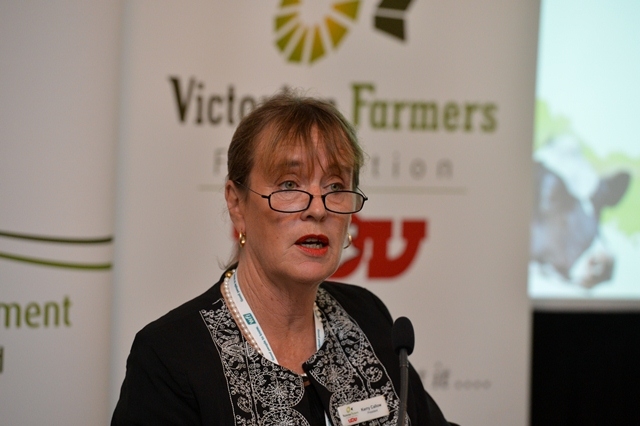
I’ve been asked a few times why dairy farmers don’t just refuse to supply supermarkets or tip our milk down the drain in protest at the unsustainable price of milk. Meanwhile, the actions of the Brits in blockading milk processors has been spectacularly successful. I thought I’d put a few “burning” milk price questions to the president of the United Dairy Farmers of Victoria, Kerry Callow, who kindly offered the following replies.

Kerry Callow

UDV president, Kerry Callow

MMM: We’ve all heard that $1 milk is a big deal for farmers but what about consumers? It sounds like a great deal, especially for families doing it tough!
KC: Milk at $1 is obviously attractive to consumers. Especially those with limited incomes and young families to feed. Dairy farming families understand limited incomes. They have had a cut in prices they receive – like having a salary cut. But this is not just about the here and now. It’s also about what’s sustainable. What will consumers have in years to come? Milk at $1 a litre retail is not sustainable for dairy farmers to produce. In Queensland it is reported that already 30 farms have left the dairy industry and more will follow. And consumers will have noticed the challenge in finding non-supermarket brand full cream milk in the dairy sections. This is a strategy for the supermarkets to dominate the supply of milk products industry. It is hard to see how consumers will keep the choices they currently enjoy. Farmers cannot afford to produce milk at the current price.

MMM: Why don’t farmers simply refuse to sell the milk at such low prices?
KC: Dairy farmers also have families to feed, children to educate and bills to pay (power has gone up 16% since the end of June, refrigerant gases required to cool milk have skyrocketed). And dairy farmers also have contracts to supply milk to processors to fulfil. The financial penalty to not supply is greater than the financial penalty to supply at a loss.

MMM: What about tipping the milk down the drain for a few days?
KC: Tipping milk out for a few days doesn’t fix the problem. (Disposing of milk that way does create added management challenges on farm). The problem is that supermarkets have decided to use milk as a ’loss leader’ and hold the price of milk down to ridiculous levels.

MMM: Is the VFF/UDV considering action like the farmers took in the UK? Would it work here?
KC: There is also discussion in New South Wales and Queensland about taking direct action. Because dairy farmers in those states rely heavily on the fresh milk market they are more exposed to the supermarkets pricing actions. Taking direct action is difficult because in this case the focus of dairy farmers angst is not a government or agency or authority, it is a commercial entity that has shown limited capacity to hear farmers concerns or acknowledge that their actions are directly and adversely impacting dairy farming families. That said, farmers are getting frustrated with the current situation.

MMM: Is there a silver lining to the $1 milk campaign?
KC: Not really. The supermarkets will point to milk consumption being higher now than before the retail milk price was slashed. But we think the consumer is heading down the road of less choice for milk products. And now we have other products like cheese and butter being marketed heavily on price. That is not a positive outcome.

O-week for a young cow

The first member of the class of 2012 has calved and she’s lovely! To help her learn the ropes, we’ve had her with the milking herd for a couple of weeks prior to calving. The noises of the dairy are already familiar and the dinner served during milking must have been divine because she only kicked at the cups once – even though it’s the first time anyone’s handled her teats, let alone milked her.

That’s a big deal for us as farmers. A quiet cow is a happy cow and that means she lets down her milk readily and is less likely to suffer mastitis. And we are less likely to get hurt. In the dairy, we have to reach between the powerful hind legs of 550 kg cows, 500 times a day. Getting kicked can mean broken fingers, hands, arms and faces.

Anyhow, this young cow is a pretty cool customer, even when being pestered by a silly pup who wants to slurp up some delicious cow poo (never let a farm dog lick your face).

A sad discovery that is good for my green farm girl

We were off setting a dinner-time paddock for the cows yesterday afternoon when Zoe spotted something that looked like a dead calf on one of the cow tracks. But it was something even more heartbreaking.

Fallen Pelican

“I will really miss that fellow” – Rob

The pelican lay below the power lines near our Land for Wildlife dam.

“What should we do with him? Can we give him to someone to look after?”

Even though she knew he was beyond hope, Zoe shared my impulse to somehow rescue the magnificent aviator from such an ignominious resting place. Perhaps someone would like to study him. We rang our next-door neighbour, Rob, whose network of environmentalists outstrips mine.

“Oh, that’s very sad. I will really miss that fellow,” he said. Rob’s place has hectares of very beautiful wetlands that he and wife Jenny have preserved and regenerated over three decades. A former engineer, Rob said there was a new power line swing arm design that should reduce bird deaths but this seemed little comfort as we stood by the gorgeous bird’s body.

A quick Google afterwards showed that our pelican is far from alone in his fate. In South Africa, for example, 12 per cent of blue cranes – the country’s national bird – are dying every year due to collisions with power lines and the UN has released guidelines in an attempt to curb the destruction.

But, not surprisingly, Rob had no contacts who’d like a dead pelican, no matter how magnificent. In the end, we decided to study him ourselves. The curved tip of his beak, his amazing expandable gullet and those outstretched wings. If nothing else, Mr Pelican offered my little farm girl an even greater appreciation of what it takes to fly.

Coles won’t rule out CCTV on Australian farms

Despite a barrage of requests on Twitter and emails to the Coles executive interviewed by ABC Radio, Coles has refused to rule out video surveillance of Australian farming families.

All it would say was that it has “no plans” for the cameras. It’s a remarkable turnaround given the enthusiasm for CCTV on farms so publicly expressed by one of its most senior executives on Wednesday. Either Jackie Healing was way out of line or Coles could do with a little more transparency of its own.

Seeing as the retail Goliath decided not to respond, here’s my best attempt at answering the questions Coles apparently found too hot to handle:

  1. What do you consider are the benefits of video cameras on farm?
    The presence of the cameras could lift the awareness of animal welfare, while reassuring the wider community that farm animals are well treated.
  2. Do you see any potential problems?
    A family farm is also a home and I will not have our little family watched by millions via spy cameras. Imagine CCTV on your backyard streaming live to the internet. Totally unacceptable.
  3. Do you have any concerns that practices in the best interests of animals (restraint for vaccinations or veterinary procedures, for example) could be misconstrued by viewers?
    The viewers would deserve an explanation for some of the practices they’d see. Veterinary treatment for an eye cancer, for example, could very well look like animal abuse on video.
  4. Do you anticipate Australian farmers will volunteer to host the cameras?
    No.
  5. Have you (Coles) discussed the possibility of cameras with farmer organisations? If so, what has been the response?
    I don’t know.
  6. If Australian farmers do not volunteer to host the cameras, how will Coles respond?
    I am guessing they would refuse to pay for the milk but Coles won’t say.
  7. Does Coles plan to offer education for consumers about animal husbandry practices?
    This would be critical but was not mentioned by Coles quality manager, Jackie Healing. It would be a gargantuan undertaking.
  8. Where would cameras be mounted on a typical 500-acre dairy farm?
    To be effective, they’d need to be in the dairy, the calf sheds, the yards, the ute, the quad bikes, the tractor and the paddocks. That’s around 50 cameras on my farm alone.
  9. How would the dairy supply chain need to be “remodelled”?
    If Coles does intend to follow the Tesco example, it will try to contract farmers directly, giving it incredible control over the food consumers get and the price farmers are paid.
  10. Will Coles install cameras in the food preparation areas of supermarkets?
    I suspect not.

I am hoping that, despite its silence, Coles has got the message. Please pass it on. The supermarket wants to become a superpower and it has to hear loud and clear that Australians from every walk of life reckon it’s gone too far this time.

Coles wants video cameras on Aussie farms

In an ABC Radio interview yesterday, Coles quality manager Jackie Healing called for video cameras on Australian farms. I asked the Twitterverse to add to my list of questions for the retail superpower and sent the following email to Ms Healing and Coles PR contact, Jon Church:

Hi Jackie,

As a dairy farmer and blogger, I was fascinated to see that you are advocating a Tesco-style approach, including video cameras on farm. Would you care to answer some questions for http://www.milkmaidmarian.com? The blog is now quite popular with both farmers and consumers who would, I am sure, be equally as interested in exploring the topic further.

  1. What do you consider are the benefits of video cameras on farm?
  2. Do you see any potential problems?
  3. Do you have any concerns that practices in the best interests of animals (restraint for vaccinations or veterinary procedures, for example) could be misconstrued by viewers?
  4. Do you anticipate Australian farmers will volunteer to host the cameras?
  5. Have you discussed the possibility of cameras with farmer organisations? If so, what has been the response?
  6. If Australian farmers do not volunteer to host the cameras, how will Coles respond?
  7. Does Coles plan to offer education for consumers about animal husbandry practices?
  8. Where would cameras be mounted on a typical 500-acre dairy farm?
  9. How would the dairy supply chain need to be “remodelled”?
  10. Will Coles install cameras in the food preparation areas of supermarkets?

I shall post the questions online tomorrow and would be delighted to add your answers, provided they are no more than 100 words each and reach me by COB tomorrow. If this doesn’t suit, please let me know and I will do my best to provide a balanced response.

It will be interesting to see whether Coles is happy to elaborate, don’t you think?
 

Milk money makes the town go round

They say our local town has a heart that beats on the 15th of every month – pay day for the milk co-op. While 98 per cent of Australian dairy farms are small family-owned businesses, they do turn over significant sums. My own books show it was almost $900,000 last year. It’s a shame we keep so little of that turnover (the average dairy farm enterprise makes 1 to 2% returns) but it’s great for the town.

Dairy Australia notes that: “Dairy is also one of Australia’s leading rural industries in terms of adding value through downstream processing. Much of this processing occurs close to farming areas, thereby generating economic activity and employment in country regions. ABARE estimates the regional economic multiplier effect to be roughly 2.5 from the dairy industry.”

Here on the farm, we employ one full-time local and two casuals directly but I think the biggest contribution our little business makes to the community is through our purchases. We spend a lot of money on grain, fertiliser and pasture renovation but there are also the vets, rural produce store, hay and silage baling, mechanics and even excavators.

This year will be a little different. I have to save almost $150,000 at a time when the price of grain is on the rise, sell silverware in the form of cows or borrow more money. Suffice to say, I will be as tight as a Yuletide Grinch.

It will be essential repairs only and the tractor will simply not be allowed to blow its gaskets like it did last year.