Fur flies as seven bulls join the herd

We did something desperately silly yesterday: we pushed not one but six fighting bulls along a one kilometre treck (including a road crossing) at once, just before milking time. Silly because I was very worried someone might get hurt. Desperate because they’d broken into the yearlings’ paddock.

Yearlings get as randy as a mature cow but until they’re 15 months old, their bodies just aren’t up to carrying a calf, let alone a one-tonne Friesian bull.

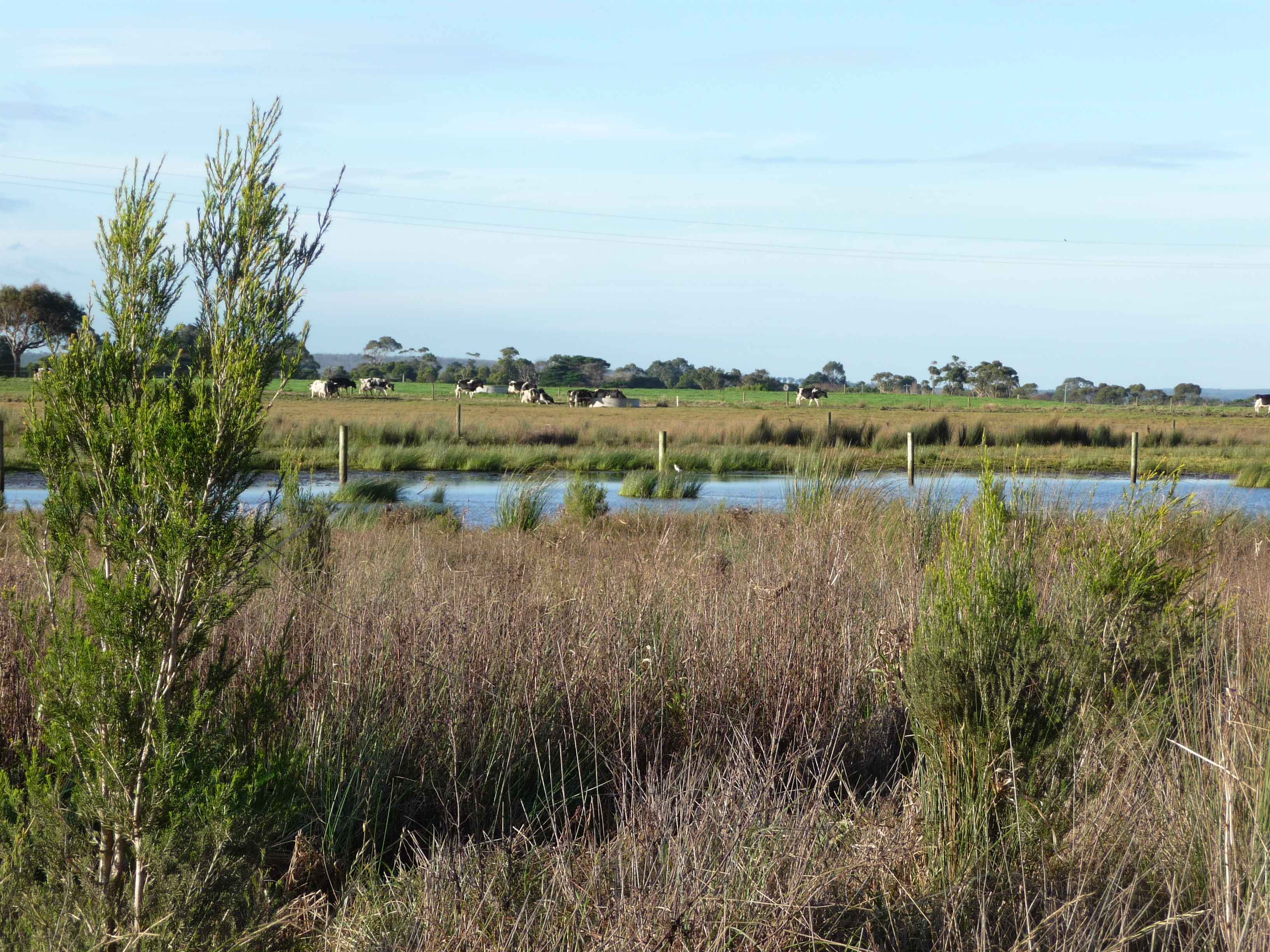
Strangely enough, the six jousting bulls went across the road okay. It was “Buster” who had my full attention. Buster the bull was in a group of seven until, suddenly, he was by himself over the fence. A seemingly impregnable, tightly strained eight-barb was no match for him and his mates. We hadn’t seem him exit the laneway but the fence was the worse for wear and a slow drip of blood from his tail showed he wasn’t completely unscathed.

As we approached – me, Zoe and Alex in the Bobcat and Wayne on a quad – Buster’s first response was to swing round at Wayne and put his head down. Now, that’s not a good start. That’s a threat.

Wayne very wisely stopped and feeling a little safer on the Bobcat, I called Buster’s bluff, who stood his ground. There we were in a bull to bull-bar standoff. I squeezed the accelerator and Buster pushed forward, then swung around again facing the Bobcat a-midships. Reverse, redirect, start again. This went on for about 15 minutes before we finally got Buster back out into the laneway.

We decided Buster was bound to make even more trouble with the “crew” in tow, so he had to be cajoled the entire way by himself. He was better with the cows but, even then, decided to pick a fight. Hope Buster just had PMT!

A challenge for the Gruen Transfer

Farmer: The salt of the earth; rich whinger; straw-chewing simpleton; or oik in the bush who only wants to joyride in a very thirsty V8, drink excessive quantities of Bundy’n’Coke, shoot guns at one another and abuse women?

I’m sure one or more of us fits into any one (or more) of those categories. Some of us won’t fit any of them. We’re just people after all.

There’s also a lot of talk about how we can attract young people into agriculture. ABC journalist, Warwick Long, asked Twitter how it can be made sexy enough and Graeme Nicoll (@Hoddlecows) responded with this:

“If you’re looking 4 a sexy job buy fish net stockings,if u want a job at the cutting edge of technology &the enviro get into ag”

I think Graeme’s hit the nail on the head. You just have to love the outdoors. It’s not glamorous but it is great.

Anubis falls

This was Patch when he joined our family during Easter.

Patch

Patch’s first morning at the farm

This is Patch now.

Anubis falls

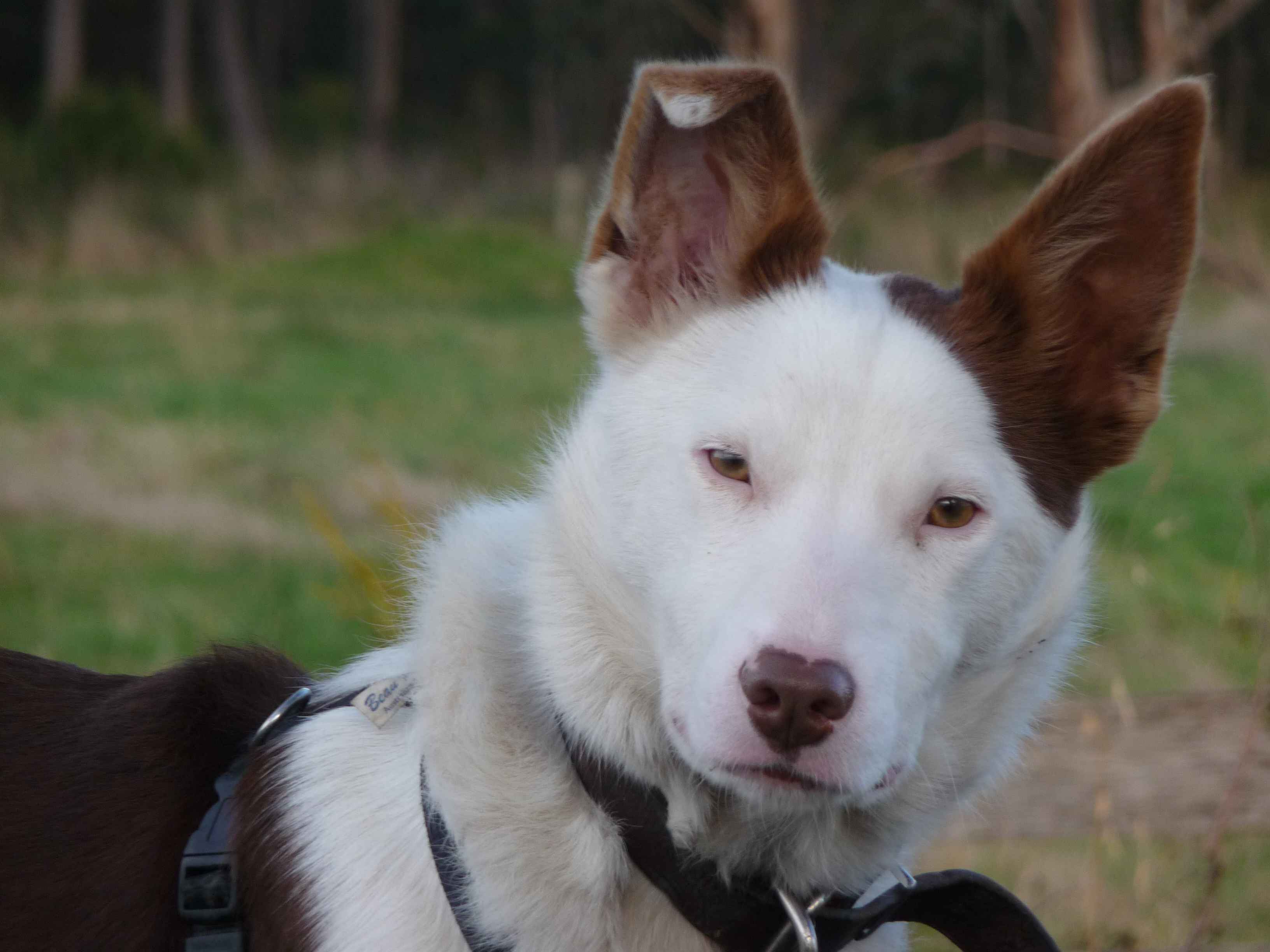
“What do you mean, my ear looks funny?”

Back when I introduced Patch on Milk Maid Marian, Kevin Jones compared him to Egyptian god, Anubis. Well, how the mighty have fallen!

According to the Kelpie Standard, “The ears are pricked and running to a fine point at the tips, the leather fine but strong at the base, set wide apart on the skull and inclining outwards, slightly curved on the outer edge and of moderate size.”.

Oh dear, Patch! Your show career is over before it started. Then again, I’m not sure whether tan and white splashed with mud and manure would be well received in the ring, either!

Why dairy farmers loathe their leaders

Okay, we don’t all loathe all our leaders but I’d argue that generally, we do. Far more often than I hear a word of praise, I hear our R&D body, our co-op managers and even our own elected representatives criticised for not being “real” farmers, for forgetting us, having their noses in the trough or being plain idiots.

Why? Perhaps it is because too many of our leaders attempt to be leaders rather than hosts as Lynne Strong experienced in Canberra last week. But then, perhaps it is because we are lazy.

Lazy is not normally a description I’d apply to any dairy farmer – it’s hard work – and that’s exactly why we leave so much up to our leaders. Most of us are too busy fighting alligators to swim the political waters. It’s generally the older, better established farmers with adult children running the farm who can take days off at a time to attend meetings in the city.

Of course, there’s nothing lazy about a farmer unable to attend meetings because she’s working too hard but it does mean we tend to stop thinking about what’s happening beyond the farm gate. That’s what my husband calls “laziness of the mind”. We say “they” ought to “(insert colourful adverbs here) do something about it” and stop there.

So, what’s the answer? I don’t know but I think the question is obvious: how do we get farmers and their representatives talking?

Finding pleasure in the small stuff

Gully reflections

Smile at the small stuff

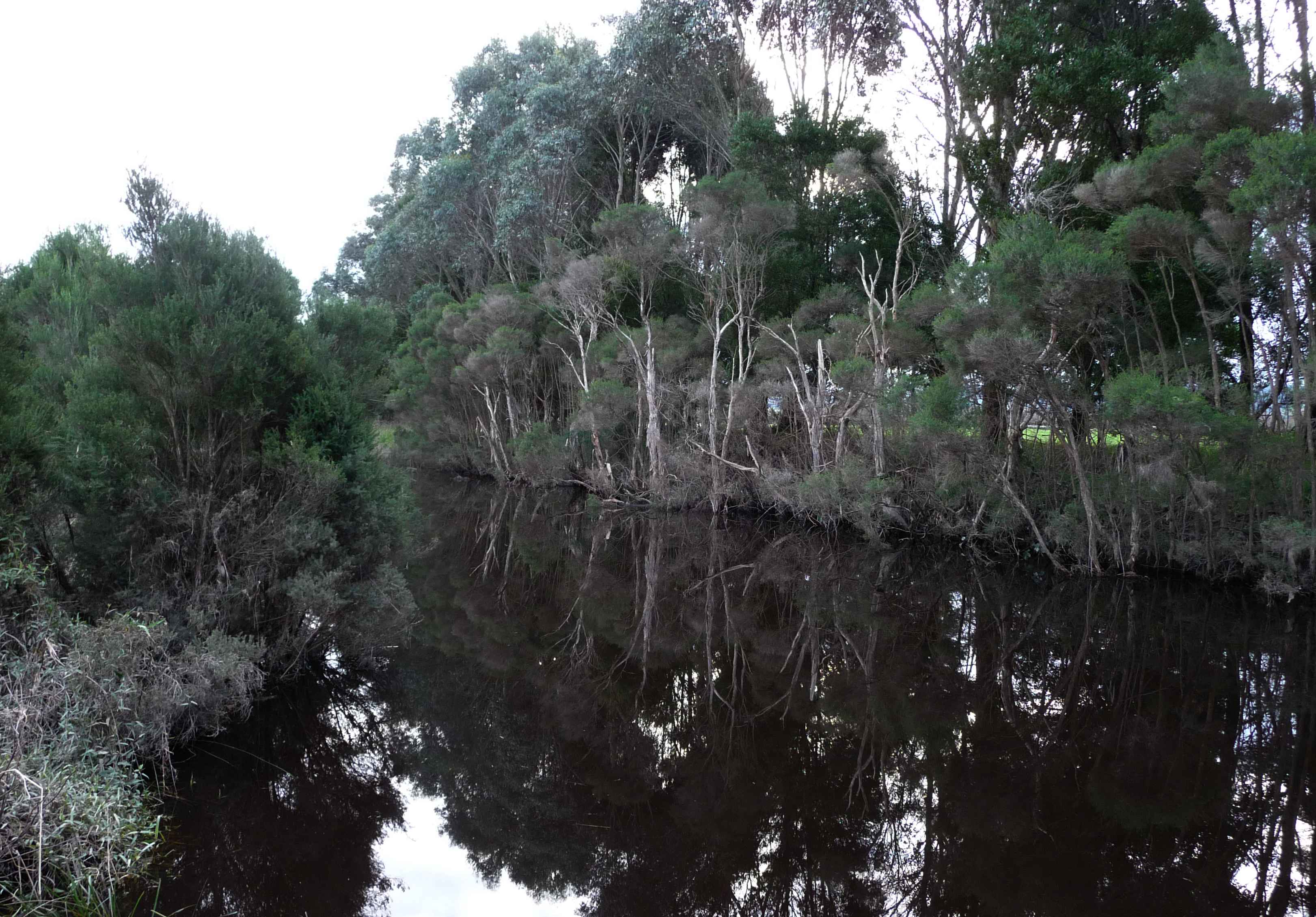
The silver lining to the devastation of the flood is that I’m enjoying some of the farm’s special secret spots. The relentless hunt for shorts in the fence bring me to lovely quiet places like this where time seems to stand still and there is no mobile reception.

I’ve been impressed to see how well the trees planted last summer with the Victorian Mobile Landcare Group fellows have not only coped but thrived in the wet conditions.

9 month old trees

Only nine months after planting, these trees are firing on all cylinders

Even trees that I gave up for dead are emerging. The wetland was planted out with 800 blackwoods, melaleucas and swamp gums two years ago. The hardy melaleucas are staging a comeback after months of at least partial submersion!

New trees in the wetland

Swamp paperbarks emerge from the morass

The favoured maxim might be “don’t sweat the small stuff” but I must admit to savouring the small stuff, especially when it’s such an important part of the big picture.

Among the most popular posts on Milk Maid Marian are those about permeate, so I thought that, for only the second time, I’d break my “never reblog” rule and highlight this post from science communicator, Heather Bray.

Heather Bray's avatarStuff & Things

Today I butted in on a twitter conversation. [View the story “So what is permeate?” on Storify] The question that caught my eye was this:

What is permeate?

I’ve been following the discussion about permeate and I knew that Lynne Strong from Clover Hill Dairies had recently posted something on the subject.

Now my friends who were having the original discussion are not your average consumers. They are scientists! They felt frustrated that they could not find the answers that they were looking for. They could find out that permeate was a natural by-product of milk processing, but could not find out what it actually was.

So I decided to do some research and find out for myself.

I should add that I find the biochemistry of lactation fascinating and I very nearly did my PhD on it. Lactation defines and unites us as mammals on a…

View original post 554 more words

I bought it but I don’t want to use it

Blitz

The circle of life in stainless steel

I paid handsomely for this German-engineered (whoops, I mean Danish) tool but I hate it. The charmingly-named Blitz Gun is used specifically for killing cattle. Importantly, it’s not a typical gun and operators don’t need a shooter’s licence. The Blitz arrived this afternoon by courier and I’ve only just opened it gingerly for a closer look.

Until now, we’d relied on professionals to euthanase our cows. Two knackery men serviced our area and the waiting time for suffering animals was brief but after one sold his business, it stretched to a single daily round. That meant the prospect of cows struggling through icy nights. That, I believe, is not good enough.

As farmers, we cannot stop the circle of life from turning but we can do our best to look after our animals the whole way through.


Do you have the stomach to adopt a heifer?

I was amazed by Mike’s comment suggesting an “adopt a heifer” program following my last post about the impact of falling milk prices on my dairy cows and even more amazed by the responses it generated.

One of my fellow dairy farmers, Jessa, has had the same thought but a few reservations have held her back. The biggie is: “What if the heifer dies?”.

To that, I’d add: “What if the heifer turns out to be infertile, bad feet that send her lame often or gets intractable mastitis?”. The reality is that, ordinarily, she’d be sent to market. There is no ‘fat’ in the price farmers are paid for their milk and, consequently, no room for infirm passengers on farm. How would you feel if your adopted heifer had to go? Especially if I posted a picture of her big brown eyes.

The scenario gets at the heart of what it is to be a farmer. We love animals. But we can only look after them properly if we are profitable farmers and that means some animals are created more equal than others (with apologies to Mr Orwell).

Farm animals are cherished but not in the same way as pets – mostly. I still remember the day 30 years ago when my father sent Queen Bessie to market. For a decade or more, Queen Bessie stood regally at the head of the dairy entrance demanding scratches until she simply became too old to thrive. Dad was shattered for weeks but, nevertheless, she was sold.

It’s only with a philosopher’s eye for the big picture that farmers manage the balancing act of love, business and the welfare of the herd. Could you stomach it or is that where the “adopt a heifer” experiment would come unstuck?


How falling milk prices affect my dairy cows

When milk prices fall, the first ones to suffer are the members of dairy farming families – Alex, Zoe, Wayne and me. The second ones are the people who make an income from supplying dairy farmers: feed merchants, vets, milking machine mechanics, fertiliser suppliers, the local newsagent and so on – our friends and neighbours. The next ones to suffer are cows.

With the price we are paid for our milk falling below the cost of production this year, I have some tough decisions to make and they come down to this: sell milkers, sell young cows, try to produce even more to meet our fixed costs (like the mortgage) or feed the cows less. Feeding the cows equates to about 40% of our income, so that’s a pretty obvious target and so is selling young stock.

It costs a lot (say $1500) to feed a young cow for two years until she’s ready to calve but, at about 12 months, I can sell her for about $1000. That’s very handy money when milk alone won’t pay the bills. Yes, it equates to selling the silverware but at least we live to fight another day.

Here’s the catch: if I sell her locally, she’ll probably be slaughtered at a value of, say, $500. If I sell her to a Chinese dairy farmer, I get the $1000. I’m assured that, as precious breeding stock, she’ll have a wonderful trip on the air-conditioned boat and she’ll join a herd of up to 30,000 other cows, with feed that arrives on a conveyor belt at their noses and whose manure is carried away by another conveyor belt at their tails. A very different life to the free range pasture based one she’d have here in Australia.

What should I do?


A taste of my own medicine

Last night, I had a shocking taste of my own medicine. The farm, you see, is almost entirely fenced with single strand electric wires.

These “hot wires” are kinder than barbs, low-cost and flexible. And while they are also less vulnerable to floods, the trio we had recently left our fences in a state of disarray. I have snipped the connections to all non-essential sections in order to keep the power up to the core and am going around fixing paddock by paddock ahead of the cows.

At the same time, Alex at 13 months is getting heavy. With 12 kgs of wriggling toddler on my chest, fencing work is becoming something of a challenge, so I decided to trial him on my back.

I ended up with an extra burden of mother guilt. Suffice to say, I am not used to crawling under electric fences with an extra load “up top”. Zap!

That horrid sensation of pulsing muscles hit me just as I crept tentatively under a fence. It must have connected with Alex on the carrier but he didn’t seem to notice at all, as he carried on with his babbling, happy as a lark while mum staggered to her feet.

Glad none of the cows were watching!