Splat!

After a nose dive

Even where it’s not wet, we manage to get nice and dirty

Today was one of those days.

Zoe fell over in the yard and got her left side covered in muck. Then she fell into a drain and got her belly muddy. Then this!

Save me

Save me, Mama!

Apparently, a good daily diet of dirt is good for you, innoculating you with beneficial bacteria. If so, Zoe is already set up for life!

It’s been another busy day. Aside from the normal milkings and feeding, this typical winter’s day on our dairy farm brought:

  • Four new calves and one assisted birth
  • The job of sorting heavily pregnant cows from those who are on “holidays”
  • Repairs to a quad bike after its electrics were savaged by hayshed rats
  • Feeding our 47 new calves
  • Moving young stock around to eat new pastures
  • Mucking out calf sheds
  • A little drama

A little drama? Yes, while we were sorting out the “springers” (cows about to calve) from the mob of dry cows, somebody decided to try out for the Bovine Olympics and crash over/through a six-strand barbed wire fence. The culprit was a cow who’d clearly had enough of Romeo the Bull. Unfortunately, she – and Romeo in turn – blundered into a paddock of yearlings, who found the whole affair incredibly exciting.

The whole scene must have looked rather comical: cow desperately zig-zagging through the paddock hotly pursued by Romeo, visibly equipped and amorous, followed by a roaring Bobcat staffed by a giggling 6 year old and white-knuckled mud-spattered farmer, plus a teen on another quad, Patch the yip-yapping pup and 60 bucking yearlings.

Thankfully, the besotted Romeo didn’t latch onto any of the yearlings and the cow seemed relieved to be out of there, so the carnival was over almost as quickly as it began.

You have to laugh!

Heifers home from boarding school

Heifers return home

“State your business!”

Youngsters of practically any species are funny, curious creatures and young cows are no different. These are our calves of 2010, back home after spending a season with Madeline, a farmer an hour up the road. Does home feel familiar? I hope so but in any case, these little cows have a bravado beyond their years and they weren’t showing any nerves as we sidled up to them.

At two years, they are about to calve for the first time and join the milking herd. It’s bound to be an exciting time for all concerned. Suffice to say, I’m rushing around the milker’s paddocks shoring up all the fencing for a good workout over the next couple of months and hoping they will be as quiet and gentle as the class of 2011!

“MG understands dairy farming profitably…will be very challenging…”

Yesterday, Murray Goulburn Co-op, which buys and processes our milk announced how much we will be paid from next week. It equates to roughly 33 cents per litre.

In the letter announcing the farm-gate milk price, Murray Goulburn CEO, Gary Helou, writes:

“MG understands that dairy farming profitably at these opening and forecast prices will be very challenging
and we will do everything possible to increase farmgate returns in the short and long term.”

I appreciate Mr Helou’s frankness but, to be honest, it sent shivers up my spine. It reminded me of 2009, when it was clear that no matter how long, hard or smart we worked, we would lose money. In fact, the average dairy farmer took on $220,000 extra debt. This year, it looks like we’ll lose about 3 cents for every litre of milk we supply. Ironically, that could mean we try to produce more milk in an attempt to offset our fixed costs or a lot less milk if we instead decide to sell cows. It will also mean I spend more time trying to earn an off-farm income to reduce the impact on our family.

This is essentially what makes dairy farming a very tricky business: we have one product that we sell to one customer at a price they set. No wonder we’re a resourceful bunch.

Warning: perfectionist in the paddocks

In a deep and meaningful conversation with our farm consultant, he told me I think too much and he’s right. Like my father before me and his before him, I was born to worry and my way of dealing with that trait is to really know my material. This can be very useful when you’re in a business like dairy farming that typically makes a 1 to 2 percent return.

It can also be a very destructive trait, however, if it boils over into a perfectionistic control-freak manifestation. There is no place for a control freak in Australian dairy farming – you are at the mercy of the weather, everything else Mother Nature can throw at you, international commodity prices and exchange rates.

You have to resign yourself to your fate to a degree and then (if you’re a worrier like I am) start researching your way out of trouble.

The great thing about dairy farming is that we are very good at sharing our ideas. I’ve walked around countless farms on field days, soaking up the freely-offered knowledge of farmers and technical experts. Farmers often are happy to tell you as much about their failures as their triumphs.

Feeling alone while under real physical and emotional pressure can be dangerous: another great reason to attend all those field days, where the unsaid but crucial take-home message could well be “thank goodness I’m not the only idiot dealing with this @#$%”.

Life goes on

Daily tasks on a dairy farm are a great reminder that, no matter what happens, life goes on.

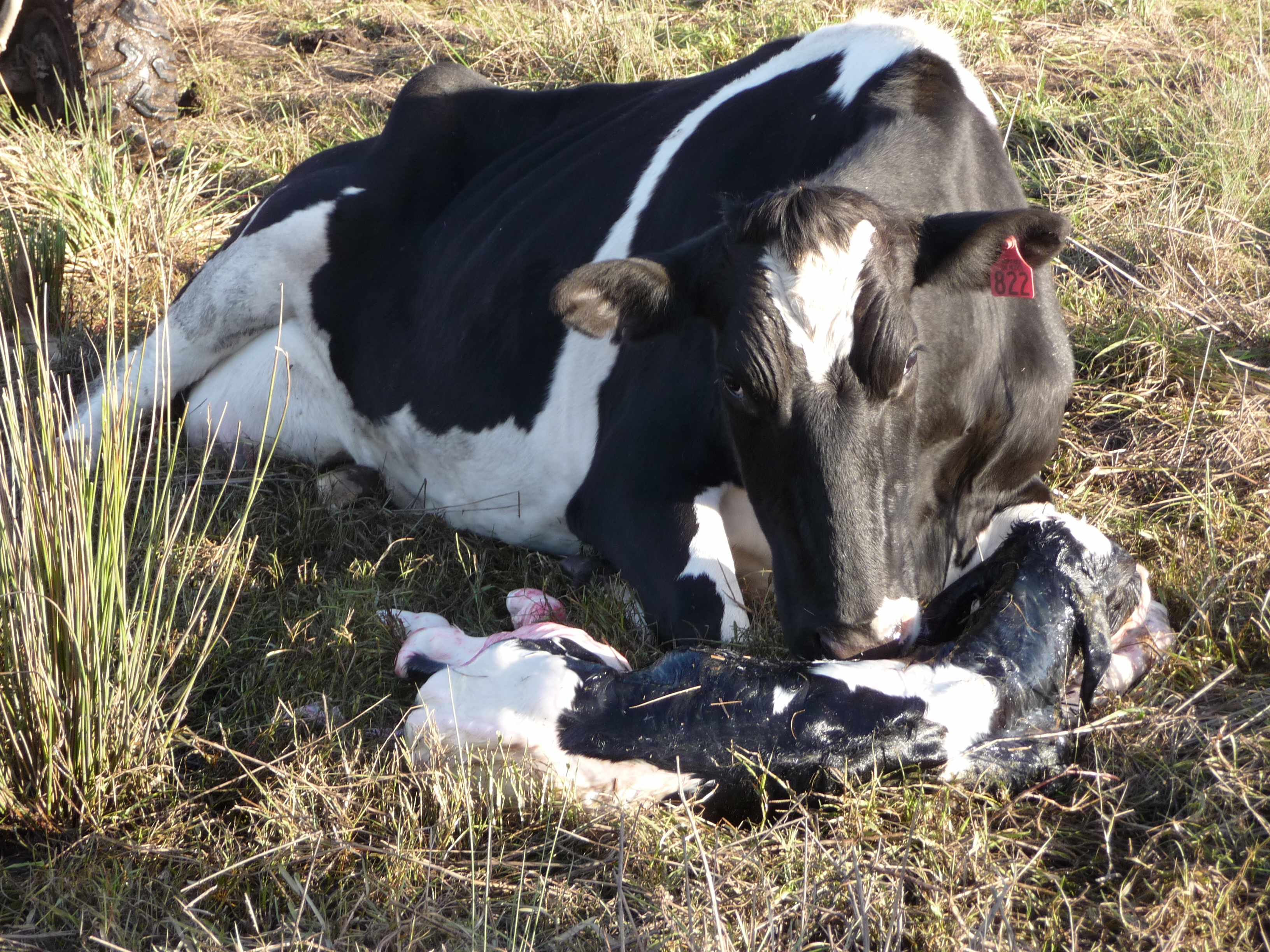
Newborn calf welcomed by the cow

New life

While the floods have given us a good shaking, the circle of life continues to turn. We lost one cow last night because her calf tried to come out with all four feet at once but were delighted to assist the delivery of this lovely little calf.

Most cows manage calving on their own with ease (at least relative ease compared to human birth) and we don’t intervene unless we must for the sake of the cow and calf.

Typically, cows tend to head off to a quiet spot on their own to calve, often pacing around and around as the contractions begin. We look for two front feet first, then a nose. The calf should seem to be diving out of the cow! The whole labour shouldn’t take more than two hours or so.

Wow! After seeing thousands of calves born over my lifetime, it still amazes me.

Three floods in 30 days

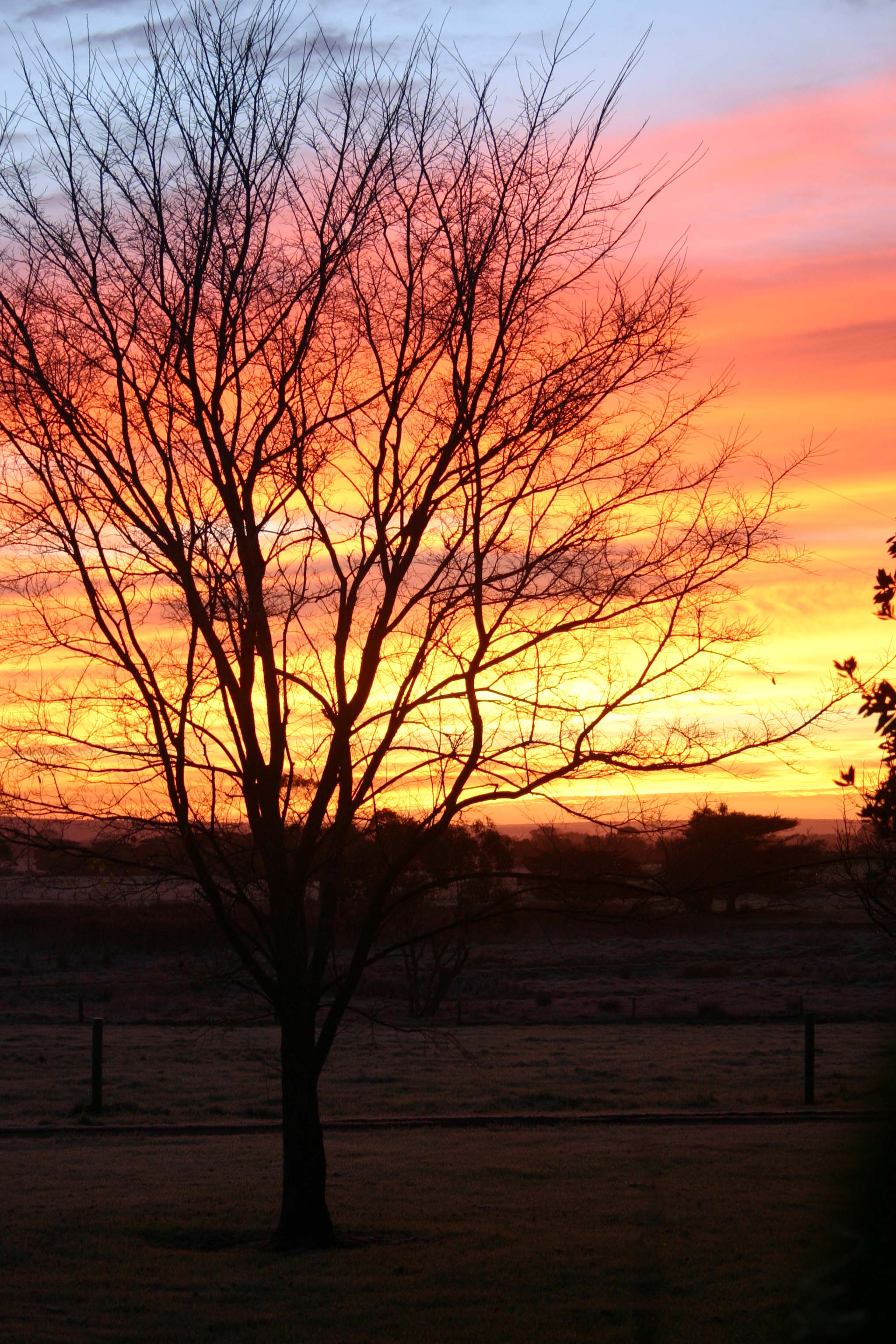
Sunrise

Red in the morning, shepherd’s warning

It all started with this glorious yet ominous sunrise over the first heavy frost of the year. But the chill of the glittering, icy landscape (and the weather forecast, for that matter) gave no hint of what was to come – three days of rain that have limited us to just two paddocks for the milking herd until the third flood in 30 days releases its grip on the farm.

Flood three

The third flood in 30 days

Normally, a minor flood like this one wouldn’t cause us any angst. We’d still have two-thirds of the farm, after all. The river flats are cut off but we also have undulating paddocks that never see a flood.

Unfortunately, we are halfway through calving and need to have six different groups of cattle in different paddocks: calves, large and small yearlings, dry cows, springing (soon to calve) cows and milkers. We also have nine “high ground” paddocks out of action due to renovation.

On top of this, we have been making up for punishing the high ground during the last two floods with remedial doses of fertiliser, including urea.

Urea is 45 per cent nitrogen, an element that is every bit as essential for plant growth as sunshine and rain. It’s even fed to animals sometimes to boost the protein level of their feed but too much of a good thing can be lethal. Nitrate poisoning brings a sudden, horrific death.

According to University of Melbourne guru Richard Eckard:

“The timing of grazing, relative to nitrogen fertiliser application, may adversely affect cows. Figure 1 shows the pattern of nitrogen uptake, as nitrate-nitrogen or crude protein in the plant, after grazing and subsequent application of nitrogen fertiliser. The following observations, from Figure 5.1, are important:

  • depending on condition, it usually takes around 4 to 5 days for the applied nitrogen fertiliser to dissolve into the root zone and to be taken up by the plant;
  • nitrate levels in the plant peak around 7 to 14 days post nitrogen application;
  • protein levels in the plant peak slightly later, usually around 16 to 18 days;
  • usually nitrate levels in the pasture drop off to acceptable levels by 18 to 21 days post nitrogen application.”

In other words, don’t let the cows into the paddock for 18 days after you spread urea. It’s 10 days right now.

Oh bother, oh dear, holy cow. I want to go home! (Hang on, this is home. Damn.)

Dairy Australia Chair Max Roberts answers a Milk Maid’s questions

One of the dairy community’s most prominent leaders is Dairy Australia chairman, Max Roberts. Thank you, Max, for answering the Milk Maid Marian’s questions and a thank you in advance to those of you reading this who can fire some more questions in via the blog!

Dairy Australia chairman, Max Roberts

Max Roberts in his own dairy

MMM: Why are you a dairy farmer?
MR: In 1982 I had what many would call a good government job that said that I had to leave Bega and go to Sydney. Sue and I didn’t like that idea so we bought a dairy farm and have never regretted that decision. It had a few interesting moments with a couple of deep and meaningful conversations with the bank manager. Over time it has worked well for our family. It has given us a lifestyle we now enjoy, educated and given a good start to both the kids and we enjoy it.

MMM: What are the hot topics discussed by dairy farmers?
MR: This depends in what part of Australia you are in and we should never generically assume that one problem fits all. For example it could be water in the Murray Darling Basin, the supermarket pressure on domestic milk prices in the northern parts of our industry, the impact of drought or wet weather in other dairying areas. Milk prices will provide some common ground as will input costs and there may be a combination of the above issues dominating farmer discussion. It’s interesting to look at the last three or four outlook reports and the variation of emphasis placed on the varies topical issues.

MMM: What is not being discussed that should be?
MR: This is an interesting question and one that exercises our minds around the board table because DA needs to be ahead of the issues and not playing catch up. It will be interesting to see what comes back via your blog. One I would suggest is farmer succession but dealing with the issue from the older or grumpier end of the industry.

MMM: How would you describe the mood of dairy farmers at present?
MR: Dairy farmers are generally cautious in terms of sentiment. Our research shows the confidence levels among dairy farmers has remained relatively stable over the past 3-4 years. Confidence levels are currently around 66%. There is still a lot of rebuilding to do after the drought years of the past decade and we should not expect an instantaneous result from the better seasons that we have had.

MMM: What is the role of dairy farmers in the management of DA?
MR: DA is the service body of the dairy industry and therefore farmer involvement in what we do is essential. Farmer access to DA’s forward planning process is available through a number of channels. In no particular order they are via one of the eight RDP’s (Gipps Dairy, Dairy Tas, Sub Tropical Dairy and the five others) the state farmer organisations, the staff and directors of DA, the dairy company’s and the many dairy research facilities.

MMM: What are the biggest challenges and opportunities for the dairy community?
MR: The dairy industry is a producer of food and has a reputation second to none on the delivery of high quality foodstuffs especially as a source of protein. Food security is a growing international issue that creates headlines outside of Australia. There will always be demand for our product which creates the opportunity but the real challenge is at what price will that demand be at. We have to have farming systems and technologies that allows us to produce milk within the demand and price parameters . We also need resource policies that allow us to be profitable farming business’s. To have the right policies we need a strong farmer lobby voice to support the work of DA. So one of the key challenges is to have farmers involved in the future of our industry.

MMM: If you had a magic wand…
MR: My magic wand would iron out the volatility of milk pricing and input costs.

More questions for Max are welcome! Simply leave a comment.

Does my bum look fat in this? Absolutely, sorry Honey

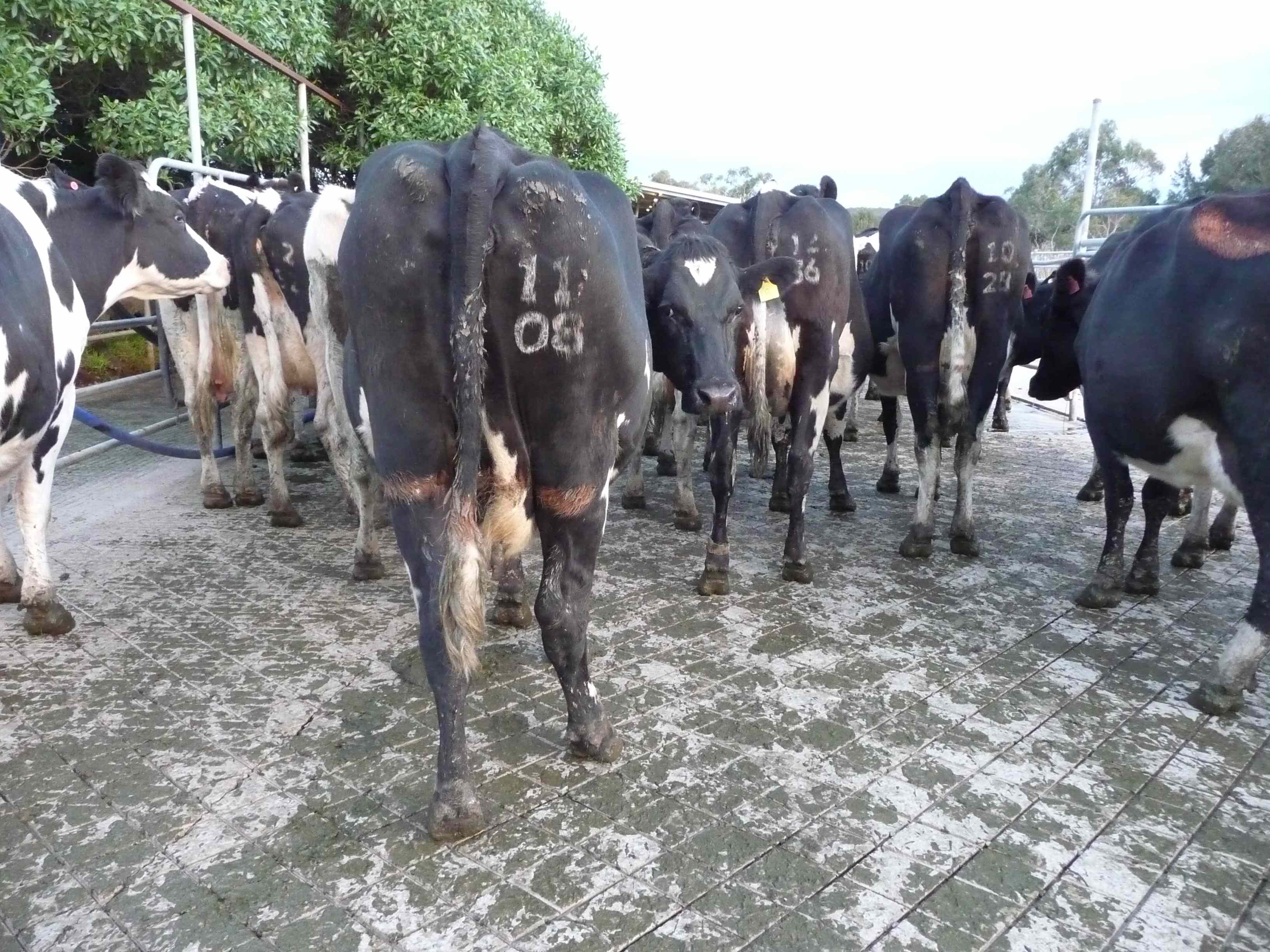
Cow rear

“Does my bum look fat in this?”

Yes, 1108, I’m afraid it does.

How do you know when a cow is fat? It’s not the size of her belly that counts – it is the hollows around her tail and 1108 barely has any. Come to that, she barely has any milk either, which is why she’s got a red stripe painted on her rear. 1108 should be in calf but my suspicion is that she’s not.

We have her and another five cows booked in for pregnancy tests on Tuesday and if she’s in calf, we’ll treat her with a mastitis preventative and send her on holiday to a paddock across the road. If there’s no calf, she will have to be sold.

While many of our cows do not fall pregnant every year, most of them milk well until they are blessed by the bull the next season. In fact, joining cows only every 18 months (“extended lactation“) is now considered a viable strategy for Victorian farmers.

It’s something that we have adopted here for cows that don’t conceive quickly and it works for almost the entire herd.

Fingers crossed, 1108.

How do I know buying branded milk will mean better prices for farmers?

“I am concerned about the welfare of Dairy farmers and the ‘$2 dollar’ milk available at supermarkets. I just want to know which milk benefits the farmers the most and not overseas owned companies who are not passing on the money to farmers. I have been paying the extra buying Dairy Farmers, only to find out that they are owned by a Japanese company!…We are happy to pay extra if we know a fair proportion of the money is going to farmers.”

A fellow called Peter sent me this message in the wee hours and raised a really good point – one that was echoed by CC & Ruby’s question the other day, so I’ve decided to address this thorny issue head-on.

Almost all dairy farmers send our milk to large processing companies because Australia’s stringent dairy food safety laws make it very expensive and difficult to supply consumers directly.

Our farm supplies the Murray Goulburn Cooperative, which is owned purely by the farmers who supply it. If you buy Murray Goulburn’s Devondale dairy foods, you know 100% of the profits are being returned to dairy farmers. The wonderful thing about MG is that because it’s owned by farmers for farmers and processes around 35% of Australia’s milk, it tends to set a farmgate price benchmark for the other processors.

On the other hand, it doesn’t pick up milk from right around Australia, concentrating on the biggest milk-producing state of Victoria. If you’re a dairy farmer in northern NSW, for example, you don’t have the option of supplying the Co-op and are more likely to supply a privately-owned processor. These privately-owned processors sell dairy foods under their own brand names or package homebrand milk under contract to the supermarkets.

When Coles and Woolies embarked on their milk war, it hit the processors hard pretty much straight away because brand name milk sales fell.

The Coles spin doctors said it wouldn’t affect farmers because they deal with the processors, not the farmers. This defies common sense. If a multinational supermarket controlling a huge chunk of retail sales decides to cut its prices below a sustainable level (Coles denies this too but Woolies has gone on record saying $1 per litre is not sustainable), putting its multinational food processor supplier to in turn lower its own costs, how do you expect that processor to respond? By sourcing the raw milk more cheaply of course! And guess what? It buys from small family businesses (98% of Australian dairy farms are family owned and operated) who have the least bargaining power of all.

No, I can’t guarantee that if Peter buys Dairy Farmer branded milk rather than private label, farmers will be better off. On the other hand, it is guaranteed that if Peter buys unsustainably priced milk, someone else will have to pay. That will almost certainly be a farmer and her family in the short term. In the medium term, it will be her cows and the environment and, over the longer term, it will be milk drinkers because there’s no such thing as a free lunch.

Robotic milking: the gentle touch of machine on moo?

FutureDairy project leader Dr Kendra Kerrisk is something of an icon in her field of milking automation and so it’s very exciting to have her write this guest post for Milk Maid Marian. There are already a handful of robotic dairies in Australia and this looks to be the way of the future. Ironically, Kendra explains, it may allow dairy farmers to spend even more “quality time” with their cows.

Robotic milking is a relatively new concept for Australian dairy farmers even though our European counterparts are well accustomed to the idea. It is a technology that I have had the honour of working with for 10 years now and there a lot to be send for this new way of milking cows.

To the less informed, the concept may conjure up images of metal on flesh that are less appealing than the tender human touch. In fact the contact with the cow is every bit at gentle as the conventional approach and one of my fondest observations is that robotic milking farmers have an increased ability to enjoy the time that they spend with their cows when they no longer have to attach milking cups to every teat of every cow twice every day. It seems that the saying “quality not quantity” has a place when it comes to farmer/cow interactions.

Robotic milking farmers are unanimous in their opinion that the technology creates a farm system that results in very relaxed and laid back cows. The idea of robotic milking is that milking occurs 24 hours per day and that the process is voluntary (i.e. the cow completes the process without human intervention). Whenever I spend time with visitors at a robotic dairy (either our research facility or on commercial farms) the visitors are always deeply influenced by how quite and calm the milking process is with robots.

With robotic milking the cow chooses when to be milked and moves around the farm system at ‘cow pace’.

Cows in paddock with robotic milker in background

The cows are moving one by one hoorah hoorah…

Whilst I have been involved in researching the application of robotic milking I have also had the pleasure of being involved with many commercial farmers as they adopt this new way of farming. The farmer must learn a new management style whereby the farm is managed in such a way that the cows makes choices that suit the farmer and the farm targets. Cows move around the farm to gain access to incentives and by default can find themselves at the dairy for milking when their time is due.

Cow walks through robotic gates

With robotic milking the cows bring themselves to the dairy (they even operate specially designed one-way gates themselves) and take themselves back to the paddock.

The concept of robotic milking is creating a work environment that allows farmers and their employees to focus on higher level management tasks. In this manner they have the opportunity to manage their herd through an increase in the level of real time data that becomes available to them allowing them to focus on individual cows that require attention. The real attraction is the more flexible working hours that reduce the need for the early morning starts and commitment to milking cows twice a day. And the bonus for the cows is that they can now manage themselves in a manner that best suits them as individuals or as social groups.

Robotic dairy

These ladies know exactly how to manage the system to ensure they don’t miss out on the “treats” and “rewards” that are available to them.

Cows are creatures of habit and they truly appreciate a predictable environment. Robotic milking is exactly that and the outcome is a herd of cows that are very easy to work with since they become extremely calm and ‘chilled out’. With all of my experience in the area of robotic milking I have absolutely no doubt that this is a way of farming that is going to be increasingly adopted on commercial dairy farms in Australia and around the world.

Possibly one of the greatest bonuses is that I reckon dairy farming is going to increase in appeal with the younger generation which is exactly what our industry needs if we are to remain sustainable far into the future. If we achieve that they we are all winners because it goes a long way to securing our ability to continue to provide Australians with fresh, safe and nutritious dairy products that are produced in our own backyard!

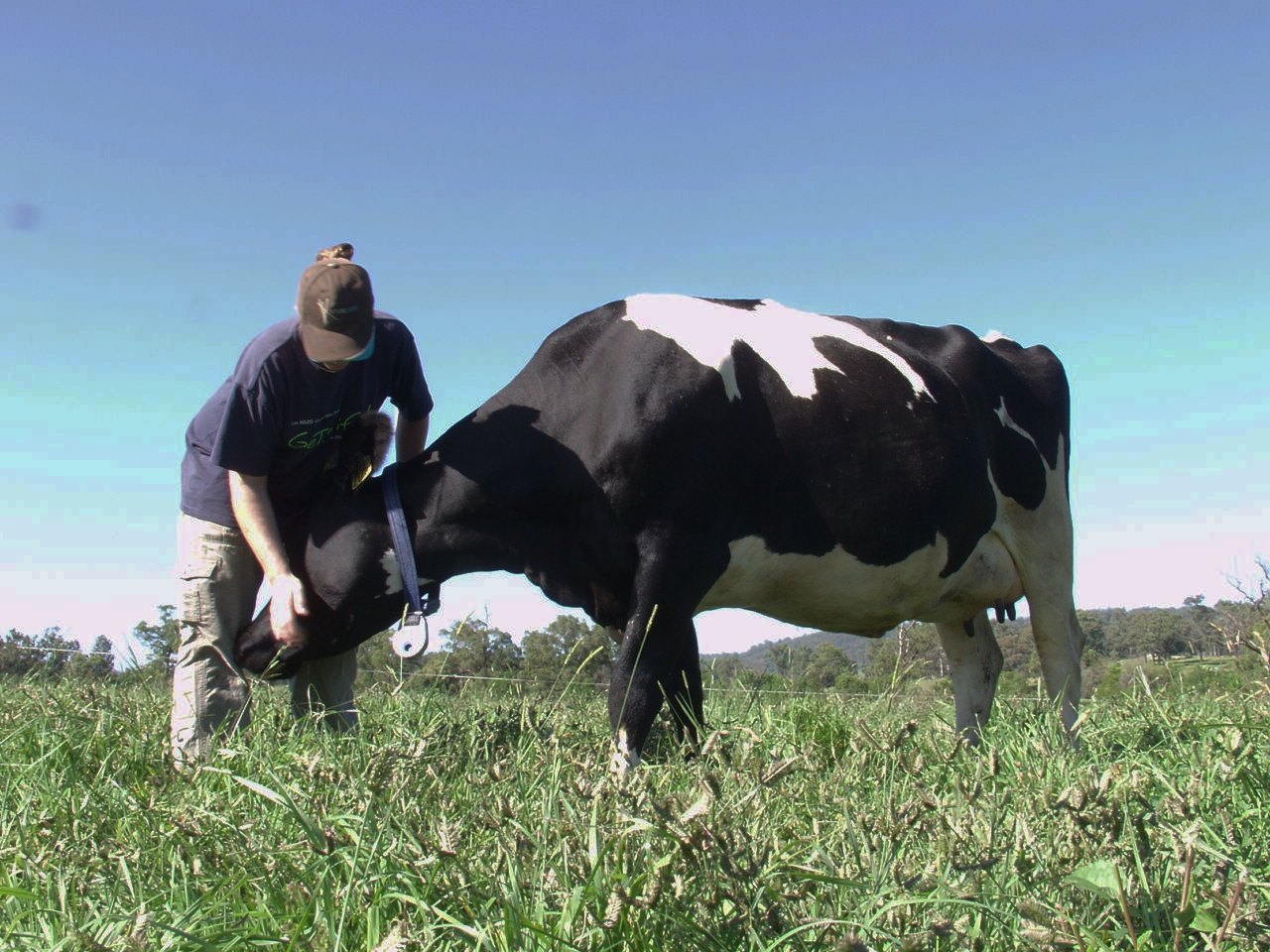
There’s always time for a good scratch!!

There’s always time for a good scratch!!