Little monsters in a crop

Cabbage moth

This picture of bridal purity is actually laying the seeds of destruction

This beautiful butterfly is no fairy. The larvae of the white cabbage moth and her wicked step-sister, the diamond backed moth,  can decimate brassica crops in days. The only way to control the diamond-backed wrigglers is to spray and spray and spray. Every five to seven days for the life of the crop! I’m no buddhist but this is a level of chemical use that scares me (and blows any hope of profitability at the same time).

For this reason, I’m falling out of love with rape. This obscenely-named brassica has long been the darling of dry-land dairy farmers. We’ve come to rely on it for high-quality lush green feed in the height of summer; when little else worthy of our cows’ refined (read “udderly spoilt”) palates will grow without irrigation.

I used to stagger plantings over a dozen hectares of brassicas to provide a constant feed source from January through to early March. Not any more. I’ve planted the oat paddock with Hunter rape and that’s it. Unlike the more hardy Winfred variety, Hunter is safe to graze at any age and when the larvae get a wriggle on, I’ll simply send in the cows and let the caterpillars have the rest. No spraying, no searching under leaves for stealthy marauders and no cow health worries.
 

Dicing with death

Our farm is split in two by a rural road that carries milk tankers, log trucks, school buses and gravel trucks from the hills down the valley to the town. And the only place to cross the road is 100 metres from a blind corner. To make matters worse, Pearlie Girlie does not know the road rules.

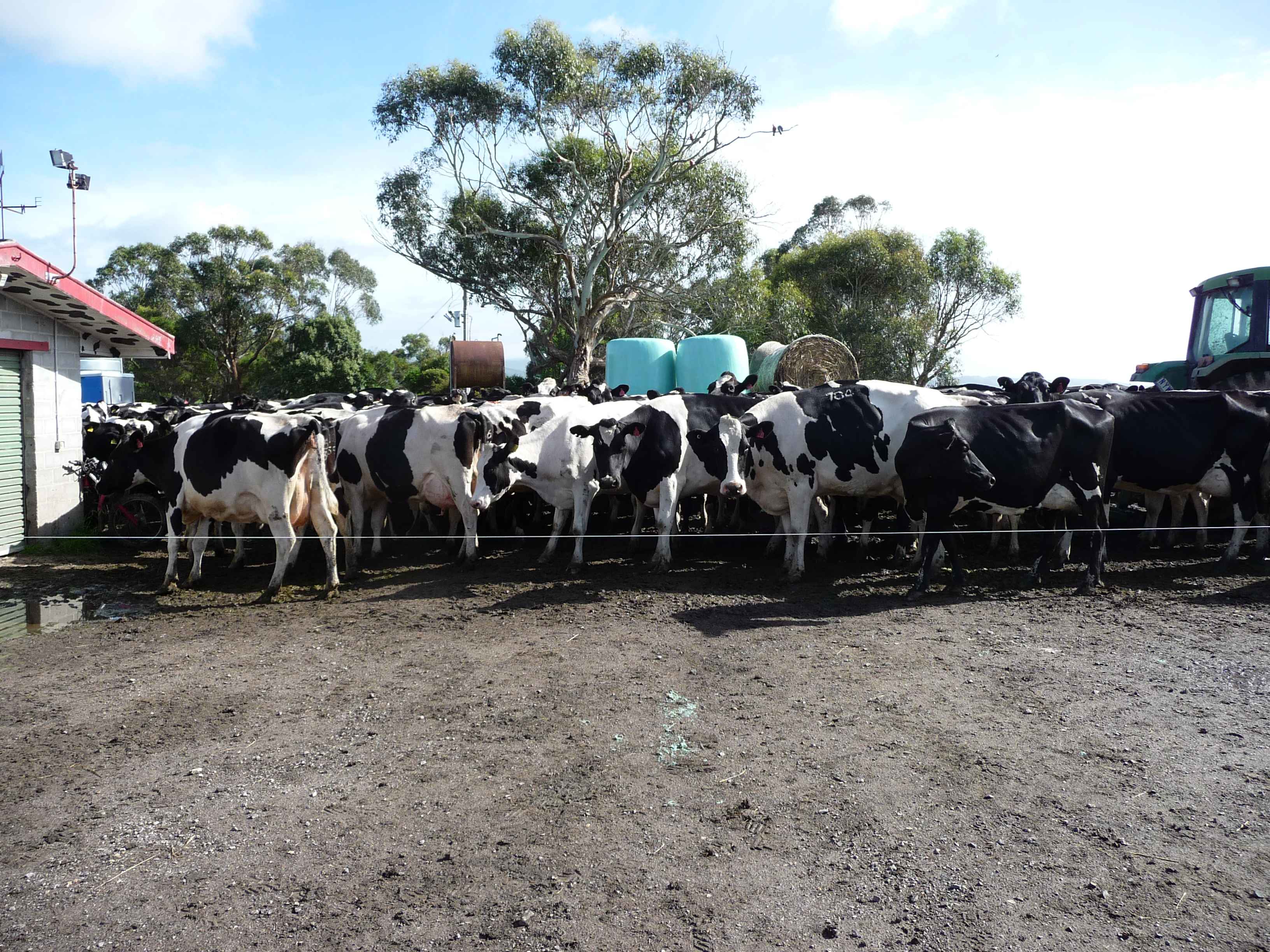
To make sure the cows are on the road for the shortest time possible, we bunch them up like a pack of marathon runners at a starting line.

Cows banked up waiting

Let us at it!

Then we stand at the road with flashing lights and signs aplenty to warn drivers and only let the cows across when the coast is clear.

Give Way to Stock

We're 100m down the slope straddling the road - watch out!

Still, we have seen smoke pour out of semi trailers desperate to stop in time, L platers “coast” right through at 60 km/hr and others roar past at 100km/hr metres away from the first or last cow. I would like to build an underpass but the cost is around $80,000 plus “extras”. One day, we will be able to afford it but please slow down on rural roads. We’re not the only ones.

By the way, Victoria’s road rules say:

  • When a Give Way To Stock sign is displayed, you must slow down to a speed which will enable you to give way or stop if necessary to avoid hitting an animal.
  • When a stop sign is displayed at a stock crossing, you must stop before reaching the crossing and must not proceed until all animals have crossed the road.


Who should a farmer look to when it comes to animal welfare?

As a dairy farmer, I’m more focused on giving our cows optimal wellbeing rather than thinking about their slaughter but Tammi Jonas’ thought-provoking post brought home that everyone has a different view of ethical farming. Here are just a few:

    • vegans prefer not to “exploit” animals at all
    • others say it’s okay to farm so long as the animals are never killed
    • others that the animals are killed in the paddock
    • others that animals can be sent to abattoir, so long as they are stunned
    • and many Australians simply do not care to know and just want good quality food at an affordable price

None of these positions is without potentially horrible consequences worthy of a secretly-filmed expose. I’ve never understood the vegan one, which must leave the animals to the tender care of mother nature: drought, floods, fires, parasites and all. I’m yet to see an animal on a wildlife documentary have what I’d call a humane death.

If, on the other hand, the ideal is to keep all the animals until they die of old age in the care of vets administering palliative doses of morphine, I can’t see how the planet has the capacity to support all these retiring animals.

Killing animals in the paddock could theoretically be done if there was sufficient demand to spawn a whole new industry. The consequences would be huge but would certainly involve extra costs currently not acceptable to mainstream Australia, necessitate a lot of small mobile and therefore more difficult to monitor operators, and leave a very large environmental footprint – the refrigeration and marketing costs would be substantial.

The last two positions are where we’re currently at.

So, where do I stand? Well, I think we should “humanise” Mother Nature wherever possible. In nature, animals eat other animals and they pick off the weak first. This means the animals remaining make the greatest contribution to the planet and it also relieves some suffering. The way that’s done is pretty horrid though. I would not want to be eaten alive by a lion or die the slow, dreadful death brought about by lameness, starvation or parasites. I would rather be stunned and euthanased in a millisecond.

For these reasons, I am happy as a farmer that, so long as our animals are strong enough to make the journey without undue stress and so long as they are treated with care and respect along the way, I am making the right choice sending them to market. And this is why I was appalled by the abuse meted out in an abattoir and relieved that it has now been closed. It’s not just about farm ethics – as Tammi says, “Ethics requires all of us.”.

Jonas on what ethical farming means to consumers

Tammi Jonas, who is writing her PhD on the role of food in a cosmopolitan, sustainable society, always has some wonderful insights into the expectations of farmers and consumers, so I was thrilled when she agreed to write this guest post for Milk Maid Marian.

In a number of recent discussions amongst farmers and with non-farmers, there has seemed to be an impasse. It goes something like this:

Non-farmer: ‘how can you treat animals that way?’

Farmer: ‘we love our animals, you’re just being misled by activists showing you worst practice’

Non-farmer: ‘I just want you to be kind to the animals while you raise them, and to kill them with as little stress as possible’ [many vegans snort at this point, though not all]

Farmer: ‘we treat our cows/sheep/etc better than our children! They’re pampered! We love them!’

Non-farmer: ‘but you handle them roughly and slaughter bobby calves young after starving them!’

Farmer: ‘what do you want us to do with all the bobby calves? We can’t afford to raise them all? But we send them to a nearby abattoir to minimise stress and time off feed…’

Non-farmer: ‘but the poor calves!’

Non-farmer then in most cases goes and purchases milk from Coles or Woolworths at $1 per litre for private label, or slightly more for ‘branded’ milk. They also consume meat and dairy daily, yet don’t want their meat to come from intensively-raised animals.

Who’s right here? And what’s at stake?

To get to the heart of the matter, I asked a very simple question on the twitterz yesterday:

Non-farmy (meat-eating) types – what do you want from farmers in the raising of the animals you want to eat? Be specific!

Here were the replies:

@trib: animals get more open space than legislated, only necessary drugs, healthy, natural food, capacity to behave naturally, eg herding

@FreeHugsTommy: I want the animals to be living a life as close as possible to the one they would live if they weren’t being farmed.

@hadrian33: Happy animals (allowed to roam and eat what they like best) As stress-less a death as possible

@andrewfaith: Organic, free range, humanely treated. Treat them the way we would like to be treated – with care and respect.

@katgallow: For animals 2 have chance of self-expression. Eg pigs root around, wallow etc as expressn of ‘pighood’

@drnaomi: I would like food animals to have good living conditions, good natural food and to not be traumatized by transport and slaughter.

@th3littleredhen: the best possible quality of life (& death) before it becomes food.

@graceonline: Truly pasture-raised, pasture-fed; no feed or plants with GMO or animal parts or slurry; respectful butchering; clean;

@abbystorey: to know where & how animals are raised. Sounds obvious but pics of happy farmyards & slippery terms like freerange are misleading.

@stillmansays: want cows raised in deep pasture w cow/calf herds & slaughter in pasture to allow cows opp to grieve & re-form herd dynamics

@EmpiricalBaker: reasonable prices, animals raised outdoors in nature, open communication with farmers

Now, my communities of interest on the twitterz are overrepresented with food-focused folks, and many of them are much more conscious of ethical consumption than average. But by and large, what they said they want is roughly what I believe most people would actually say they want in the treatment of farm animals. As @kirsty_l pointed out, it would make one appear and feel ‘not good’ to suggest one doesn’t care about the treatment of animals.

And yet in the supermarket, where the average consumers’ interactions with food take place, people are confronted with the constant appeal of ‘lower prices’. ‘Consumers win!’ ColeWorths and their mates at the Institute of Public Affairs tell us. But do we? Actually, the only winners here are the shareholders and highly paid execs of the duopoly.

The rest of us consumers lose – we lose choice as they label everything with their own brands, further obscuring an already impenetrable barricade of marketing spin – where are the farmers behind these products? The traceability of our food in supermarkets is now so clouded is it any wonder consumers have forgotten that there are real people out on the land working hard so they can purchase their daily bread in bright, shiny packages?

So back to the farmers – the majority of Australian farmers I believe do care for their animals, but they are very aware that they are raising these animals for slaughter. There is an inescapable level of pragmatism when handling animals destined for dinner plates, but that doesn’t mean most farmers are treating their animals in ways consumers wouldn’t like.

For example, the average dairy cow in Australia grazes happily in the paddock, coming in for milking twice a day (some dairies have gone to three, I understand, due to intense financial pressures in this deregulated market). Yes, on most dairies the calves will be taken off the mother between 12 hours and three days after birth, and some 700,000 calves will go to slaughter between 5 and 30 days old. There are concerns about how long these animals are left without feed in their final day of transport and while waiting at the abattoir, just as there are concerns about their handling throughout. We farmers would do well to listen to those concerns and always aim for best, humane practice, as I believe the majority do. And if we know or hear of farmers, drivers or abattoirs who are treating the animals poorly, rather than responding like the Catholic church and remaining silent or being defensive, we should be the loudest voices denouncing their behaviour.

Australia is lucky – this isn’t America – our beef and dairy cattle and sheep are still living out their lives in the full glory of cowness and sheepness (except in the case of ‘grain fed’ cattle, who are kept in feedlots for long periods even in Australia) – I only wish I could say the same for pigs and poultry, the vast majority of whom are raised intensively.

But I’ll finish by returning to consumers. We vote for humane treatment of animals with our dollar. So long as we over-consume meat and dairy while seeking the cheapest prices, we’ll get what we pay for – intensively farmed animals. If everyone decreased their meat and dairy consumption and paid more for it, farmers could afford to give the animals the space we say we want them to have. Next time you’re not sure you can afford that free-range pork, eat a couple of vegetarian dinners and then splash out and eat the tastiest shoulder you’ve ever had. Everyone will be happier, from your taste buds to the farm critters to your grandchildren. Ethics requires all of us.

Betting on a thunderstorm

Cows grazing with mower in distance

Have I made the right decision?

Imagine a game where you wager thousands of dollars on the timing of a spring thunderstorm. Too stupid? Well, that’s what I’ve just done.

Getting silage done this season has been…tricky. You need a three-day “window” of warm, dry weather to cut, dry, bale and wrap the grass. Three-day windows have been pitifully rare this season though and we have long, stemmy grass that needs harvesting.

This morning’s forecast said 25 degrees C today, followed by 30 tomorrow and a thunderstorm. We’ve decided to cut three paddocks. If the grass stays too moist, we might lose hundreds of rolls of feed. If we didn’t cut, the grass would go to head and stop growing.

Fingers crossed.

Live conference post: Why so few farmers blog, straight from the horse’s mouth

Animal activists accuse farmers of being secretive and I’ve just asked attendees at the Future Focused AgOz conference why they aren’t blogging their personal farm stories. Here were their responses:

  • Scary
  • Just want to get on with the business of farming – maybe it’s someone else’s job
  • Lots of farmers don’t realise that what they do is amazing, that it’s newsworthy. There’s a perception that the daily grind is not interesting and that we may not be capable of presenting the bigger picture
  • Is it worth it? Will anybody read the blog?
  • The confidence they have the skills
  • Don’t feel they need or want to do it
  • Need to find the farmers who are interested in blogging and who will present farming positively
  • A desire to maintain privacy. You’re letting them into your private place
  • Uncertainty about who you are writing to
  • Uncertainty of how to handle attacks.

As Lynne Strong says, there is a need for a circle of support people behind farmer bloggers. Maybe the agvocacy community needs to spread its wings beyond the net and reassure aspiring bloggers that they are not alone.

Why are farmers so secretive? I’ll ask them at 9.30

There is a dark side of dairying that is hidden from the average milk drinker.” – RSPCA

“Do you want to know a secret?…next week Animals Australia is going to do some advertising of their own, only this time, they’re letting people in on a little secret — the dark side to dairy that they *won’t* tell you about in their ads. Click here to download the new ad, or sit back and watch this video to discover the truth” – Animals Australia

Actually, we don’t talk much about ourselves unless there’s a drought or a flood and I’ve got a golden opportunity to find out why. From 9.30 this morning (Sydney Australia time) I’ll present a webinar to the Future Focused AgOz conference and ask the farmers there about the hurdles they see to farm blogs and will report back to you.

In the meantime, if you write, or read Australian farm blogs, please do share them with us on Twitter at @milkmaidmarian.

One farm blogger, Fiona Lake, reckons there are few Aussie blogs written by full-time farmers and has an explanation:

“It’s much harder to locate well-explained rural blogs written by people running fulltime agribusinesses, long-term – with information on the nitty-gritty facts of large scale farming and livestock raising, environmental and agribusiness issue discussions. (Full time) farmers work long hours most or all days of the week and are generally exhausted when they knock off. So naturally it’s hard to find any hands-on fulltime farmers dedicated enough to voluntarily spend some of their scant spare time, writing about what they do, for no other reason than to help people unfamiliar with the industry, understand how their food and fibre is grown and encourage thought on topical issues.”

Fiona’s certainly right but is that it? Are we all simply too pooped to tell our stories? I suspect there are other factors too and would love your thoughts.

A beautiful set of numbers

What does a farmer do when the kids are sick with gastro and it’s raining? Paperwork. Although I detest the oceans of sheets that flood my desk, the one batch that carries the same anticipation as a Christmas present is my annual set of soil tests.

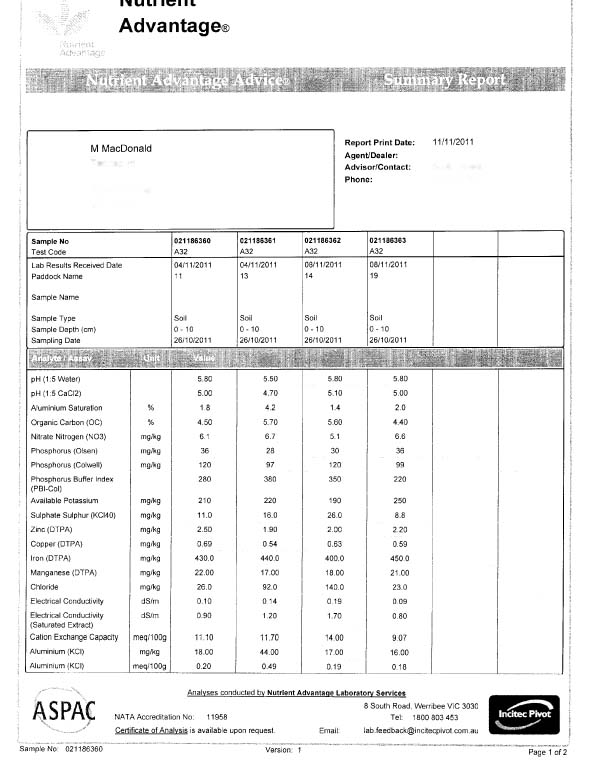
Soil test results

The beautiful set of numbers that are the river flats

 
These geeky looking sheets let me know what type of fertiliser to spread and where. Now, once upon a time, the farm’s fertiliser order was pretty basic (3 in 1 on one side of the road and 2 in 1 on the other) and it shows. Some paddocks had luxury levels of phosphorous and a shortfall of potassium, while most had miserably low pH results. Accordingly, we are now spending less on phosphorous and more on potassium and lime (both standard calcium and dolomitic).

The rotten thing about acidic soils associated with high aluminium levels, as ours have been, is that they make many of the nutrients unavailable for the plants.

Getting the nutrient levels right with the help of soil testing and observing the signs of nutrient deficiencies has led to a massive reduction in the volume of inorganic nutrients we apply to the paddocks. This has saved our family tens of thousands of dollars and boosted the growth of our pastures while lowering the risk of leaching into waterways. A big win for the sustainability of the farm.

When the wheel falls off – literally

What a day. We have our heifers (teenage cows) on agistment an hour’s drive east of the farm and it’s time for the girls to meet their beaux.

The plan was to tow two of the four Jersey bulls up in the tandem trailer and return with two immature heifers. Well, for a start, the bulls had grown since last year (wouldn’t have been surprising if I’d thought a bit about it) and there’s only room for one. “Never mind,” say I as Fernando the bull leaps aboard greedily following my trail of grain, “at least we’ll manage to draft out the two young heifers and bring them back. We can send the other bulls up in a truck another day.”.

About 60 kilometres into the trip, the jolly bull leans on the back of the stock crate and sways like a Hawaiian dancer. Not just a little but a lot. Singing stops.

“Sorry Zoe, Mama has to concentrate for a bit.”

After a few deep breaths, the frightening fishtail irons itself out and I gently up the revs. Fishtail again. Ease off again to 60km/hr and Fernando stands up straight.

“Holy cow!”

After one more repeat, I decide it best to play it cool and nurse the flaming bull into town.

“This is bull#$%t” (muttered under breath)

Get to the yards – padlocked.

“What the?”

Turn around to have a think and, wow, an apology to Fernando is certainly in order. One of the trailer wheels is hanging on by a single nut. No wonder nobody dared tailgate me, even at 60km/hr. I’d figured the cowards were wary of an Aussie (green and gold) shower over their gleaming duco.

Dig out the car’s spare (thankfully the tandem has Ford Falcon hubs), borrow one nut from each of the other three wheels, find another gate for Fernando and limp home in the rain. Feeling blonde but blessed tonight.