Ashamed to be a dairy farmer today

Yesterday, two industry representatives and a dairy farmer spoke about the treatment of bull calves on Australia’s Radio National program, Bush Telegraph.

It made Victoria’s dairy farmers appear as callous as Big Tobacco and today, I am ashamed to call myself a farmer of any description, let alone one that bludgeons premature calves to death with an axe.

The media feeds voraciously on such hideous depictions and it will be all over the internet and in the mainstream media unless something with even more news appeal happens this weekend.

This is something we can’t deal with by talking about industry standards and so on. Nobody believes that stuff. None of it resonates in the soul. We need to tell people the whole truth and how we feel about it.

And the truth is this:

I will never induce the birth of a calf unless its mother’s life depends on it. In the four years since I took over custodianship of the family farm, this hasn’t happened.

I can barely manage to hear the shot ring out as a suffering animal is euthanased humanely, even though I know it is the right thing to do.

I will always put the quality of our animals’ lives before profit.

We sell every bull calf we can to neighbours who rear them until they are big and powerful steers, even though we sacrifice income to do it this way.

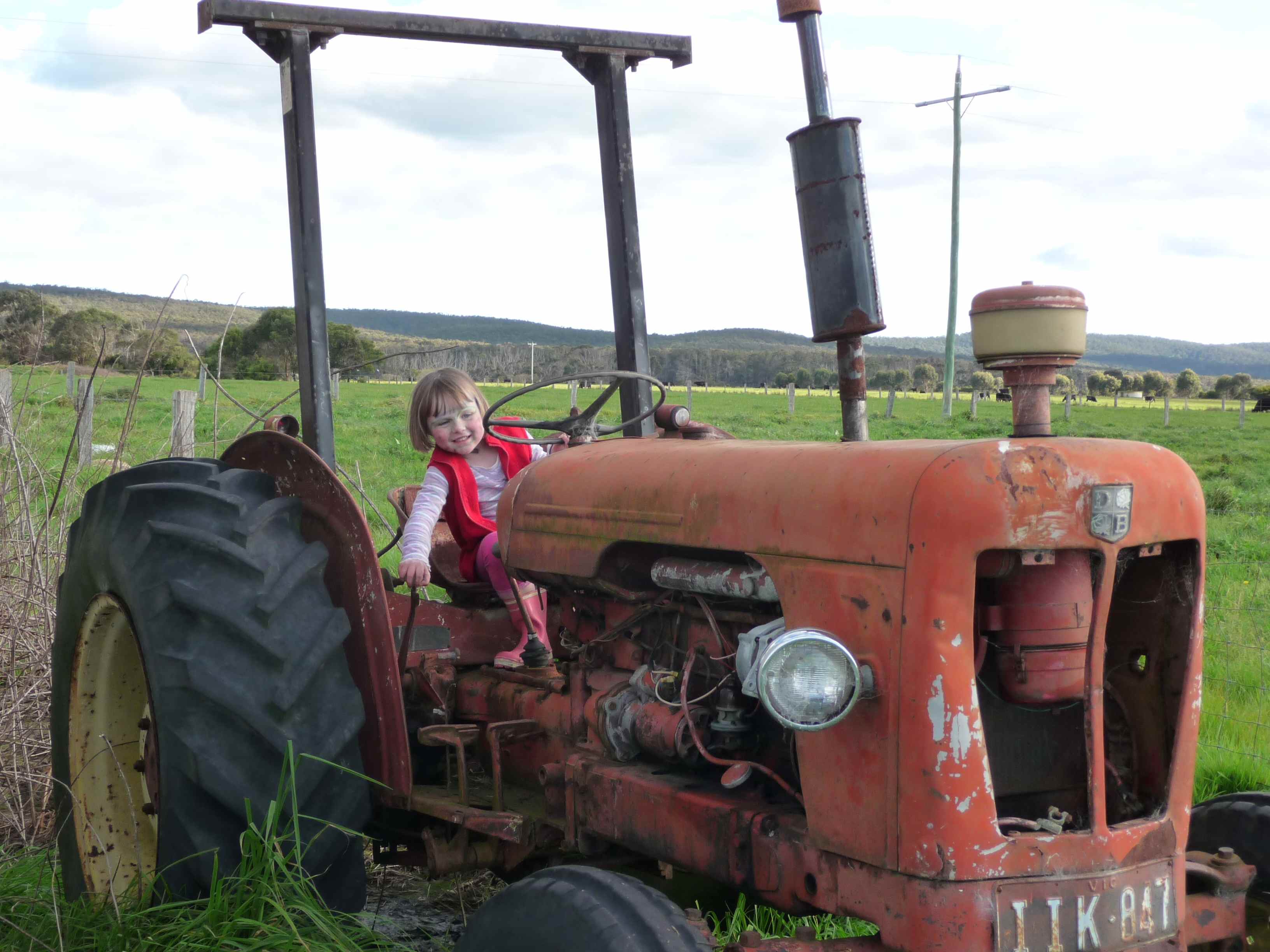
The bottom line is that I will not do anything on the farm that I could not show five-year-old Zoe without any qualms. Our farm is also our home and we could not live with cruelty.

Farmer’s forums are jammed with distressed dairy farmers this morning and I spoke long into the night about it with another yesterday. I am ashamed yet I am proud to know I am not alone in this. If you are a farmer reading this, please add your voice to the news forums and don’t be afraid to tell them how your heart guides you.

About raw milk products

Farmstead cheese

Photographer: Michael Robinson, pic courtesy of Cheese Slices

Did you know there is such a thing as “Real Milk Activism”? These activists believe the only real milk is unpasteurised milk.

Currently, it is illegal in Australia to sell unpasteurised “raw” milk but Food Standards Australia New Zealand (FSANZ) is conducting a review that could (although it is unlikely, I suspect) see it hit the shelves.

Milk has caused very little illness in Australia over the past decade. According to the FSANZ paper A Risk Profile of Dairy Products in Australia:

Microbiological survey data for pasteurised dairy products in Australia show a very low incidence of hazards of public health significance in these products. Overseas data demonstrates that pathogens are frequently isolated from raw milk and raw milk products. Pathogens were detected in raw milk in 85% of 126 surveys identified in the literature.

In surveys of raw milk cheese pathogens were rarely detected. Pathogens are found infrequently in pasteurised milk and pasteurised milk products.

In Australia, illness from dairy products is rare. Between 1995-2004, there were only eleven reported outbreaks directly attributed to dairy products, eight of which were associated with consumption of unpasteurised milk. In other Australian outbreaks, dairy products were an ingredient of the responsible food vehicle identified as the source of infection. However,
dairy products are a component of many foods and it is often difficult to attribute the cause of an outbreak to a particular food ingredient. Microbiological survey data for pasteurised dairy products in Australia show a very low incidence of hazards of public health significance in these products.

While commercial dairy products have rarely been identified as sources of food-borne illness in Australia, there have been a number of reports of outbreaks associated with consumption of dairy products internationally. Unpasteurised dairy products are the most common cause of these dairy-associated outbreaks of illness.

Among the risks that are neutralised by pasteurisation are salmonella, listeria and e coli.

Raw milk cheeses may be on their way

FSANZ recently recommended permission for non-pasteurised hard to very hard cooked curd cheeses on the provision that there are new processing requirements for cheese production that state storage time, and moisture content requirements for these cheeses to ensure product safety.

FSANZ says it will “continue to look at permissions for other raw milk cheeses through a new proposal that will use the technical work already undertaken under P1007”.

Prominent cheese officionado, Will Studd, says the changes will be insignificant.

Raw drinking milk to remain illegal in Australia
In the words of the FSANZ:

The assessment work for P1007 concluded that raw drinking milk presents too high a risk to consider any permission in the Code. In the new proposal, FSANZ will be reviewing the current exemption that allows raw goat milk.

For raw drinking milk, even extremely good hygiene procedures won’t ensure dangerous pathogens aren’t present. Complications from bacteria that can contaminate these products can be extremely severe, such as haemolytic uraemic syndrome (HUS) which can result in renal failure and death in otherwise healthy people.

People with increased vulnerability to diseases caused by these bacteria include young children, elderly people, people with compromised immune systems and pregnant women and their foetuses.

What if a farmer sells you raw milk?

I wouldn’t ever sell it to you. I would lose my dairy farmer’s licence and face five-figure fines, as one man did for selling raw milk for “cosmetic purposes” earlier this year. Worse still,  I couldn’t live with myself if, despite our best efforts to deliver clean milk, one of your children fell ill. Sure, we drank it as kids with no ill-effects and the risks are low but they are there and it is illegal.

Even after pasteurisation, milk is one of nature’s superfoods. Drink it, enjoy it and let your children thrive on it.

By the way, for a good discussion of the raw milk cheese debate, check out the Food Sage blog.

Easy to forget what makes farm life unforgettable

MyFarm screenshot

The incredible MyFarm experiment

Both bold and bizarre, the National Trust’s MyFarm online experiment in farming and food production gives 10,000 members of the public a say in the running of a real working farm. I had a look at the MyFarm website for the first time today and was astonished by the account of a farmer assisting a calving. I count myself as someone who appreciates (actually, loves) farm life but reading about it from an observer’s standpoint is something else. People were moved.

MyFarm is a ground-breaking project bridging the gap between farmers and other members of the community.  While we don’t have anything like that here in Australia, there are lots of opportunities to connect people and farmers.  Farm Day does an amazing job of getting people out to farms and meeting real farmers, while the Archibull Prize and Picasso Cows help students learn about agriculture. Farming is even on Facebook with Farming is the New Black and quite a few farmers have begun blogs like mine to offer a window into life on the land.

Isn’t it odd that something as abstract as the internet is having such a role in bringing the very earthy lives of farmers closer to those of townfolk?

Ravenous kangaroos don’t eat wattles

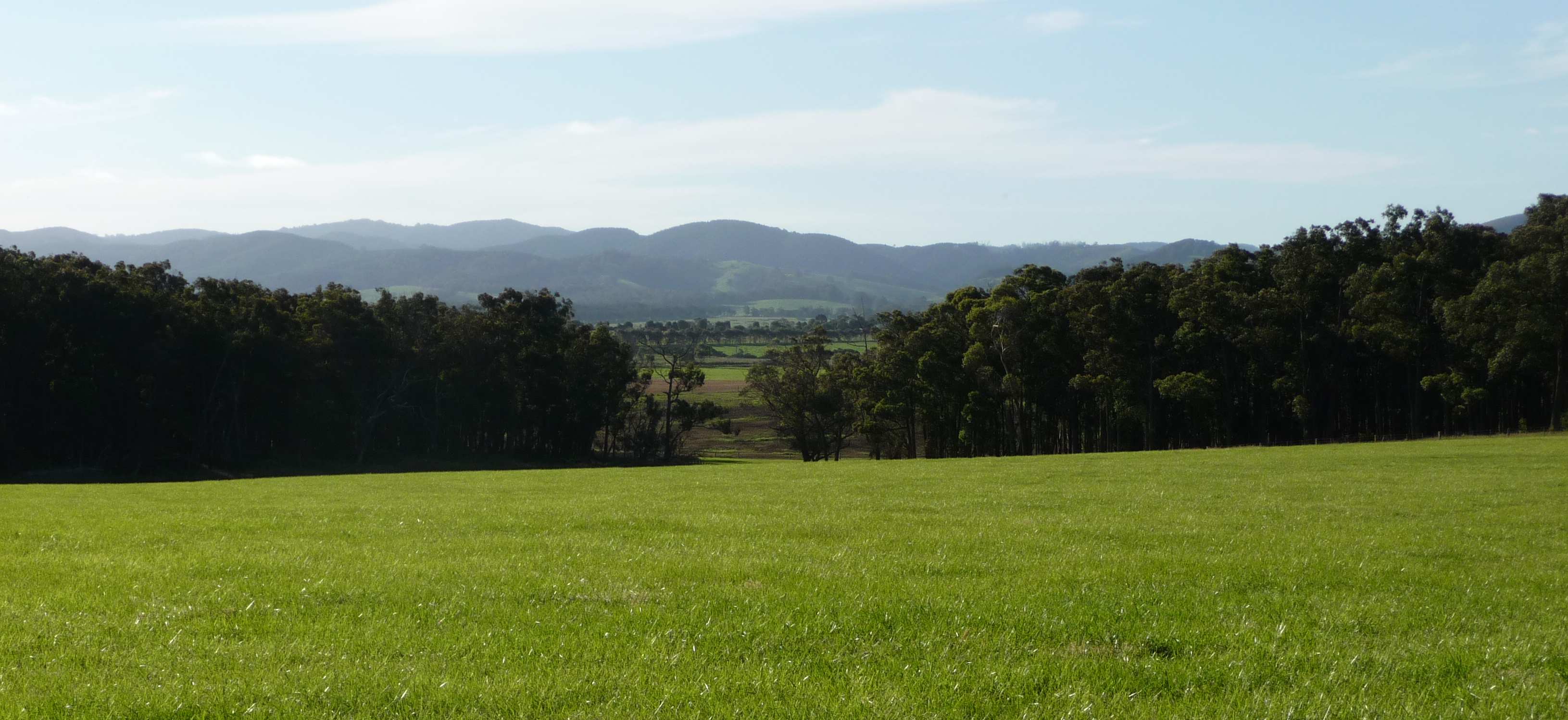
A couple of years ago, we renewed the fencing around 11 hectares of remnant forest on the farm with the help of Greening Australia so we could exclude the stock from this high-value goanna habitat.

Paddock flanked by forest

Two blocks of native forest are protected on the farm

Unfortunately, the western sides of the two bush blocks have been impacted by the wind so we moved the fence westwards and friends helped us plant about 800 trees to reinvigorate this section. The kangaroos and wallabies ate almost every tree. Almost. It seems they have a distaste for wattles, which are the only specimens that survived the onslaught.

Wattles survived grazing by kangaroos

Wattles must taste yukky to kangaroos

If you’ve had any experience protecting seedlings from macropods, please share!

Better care for bobby calves

There’s some good news about the welfare of our most vulnerable charges: young calves.

I hate selling any of our animals but we simply can’t keep all the bull calves. Our solution is to sell them to a neighbour over the river who grows them out until they are big, powerful two-year-olds. Not all dairy farmers have this option though and send them to market as young “bobby” calves.

For a long time now, there have been standards to ensure they are strong enough and fully fed before they leave the farm but once we hand over their custodianship, we could only rely on the decency of their buyers. The good news is that while governments have not been able to reach a consensus, the people involved with bobby calves have taken the lead and announced new national standards concerning their care.

The electronic scanning technology is already in place to make sure the standards are kept and I really hope that monitoring reveals the people who take calves from farms are already doing better than we expect.

Day in the life of a South African Jersey dairy cow

A little while ago, clever teenage farmer Firn Hyde made a guest post on the Milk Maid Marian blog and it was so popular I begged her for more! So here is your next instalment – a day in the life of a South African Jersey dairy cow written by Firn.

Hi everyone!
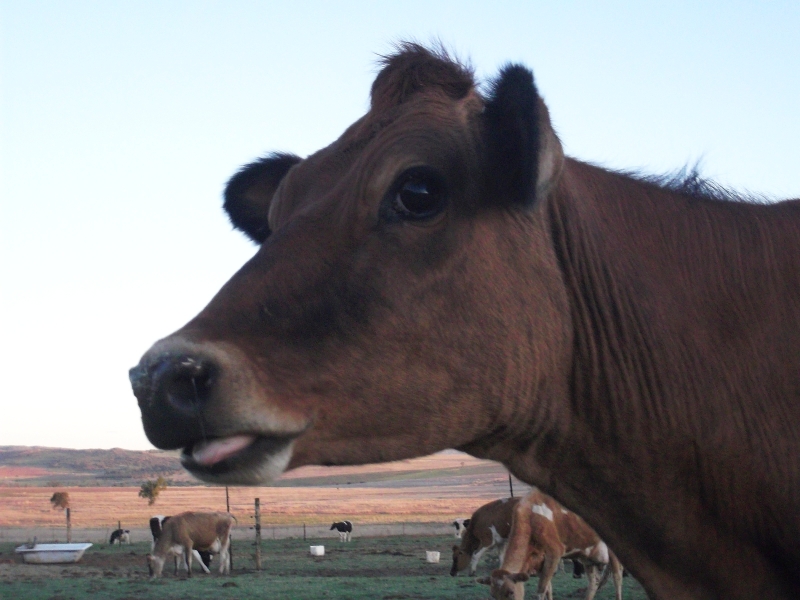
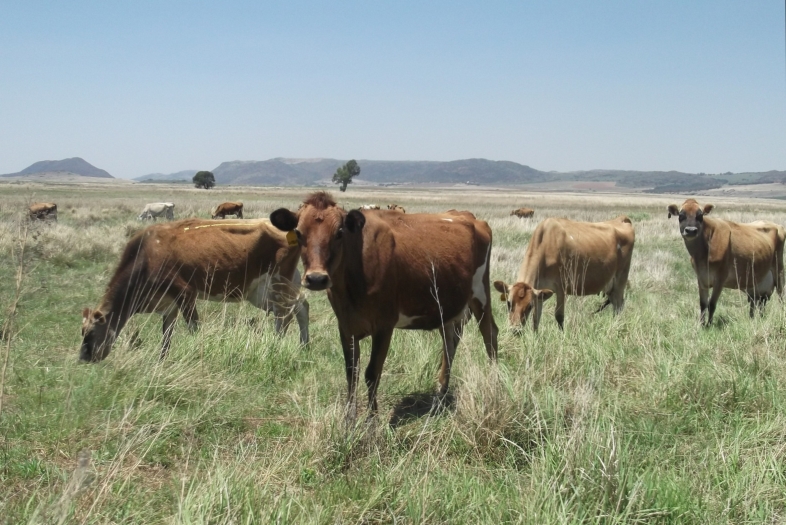
My name is Hydeaway Kalos Barbara, but most people just call me Barbara. I’m a young Jersey cow living on Hydeaway Farm in South Africa. I’ve only just had my first calf, and my friends know me as goofy but loveable.

Barbara the Jersey cow

Introducing Barbara

Early every morning, we walk up to the top of our paddock to get milked. Some of our humans come to fetch us, but we know to come as soon as we hear the milking machine bellow. We have lots of humans who for some reason walk on their hindlegs and are very noisy and not like cows at all, but they feed us and milk us so we’re quite fond of them.
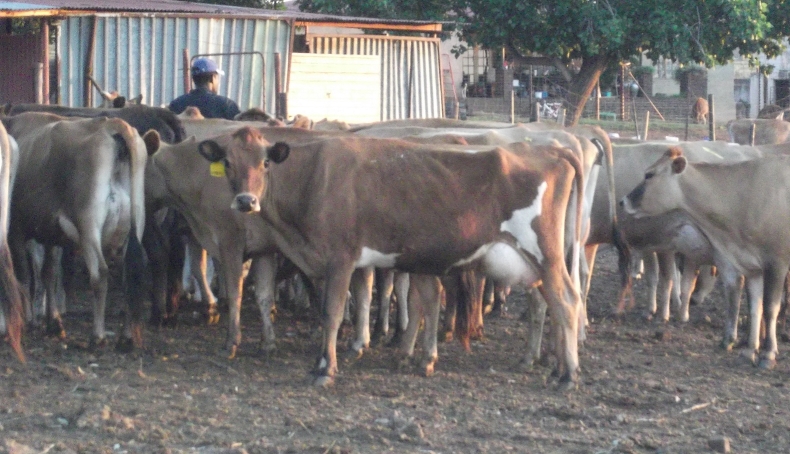
Here I am waiting to go into the parlour to be milked.

Waiting to be milked

Waiting to be milked

The parlour is really noisy. At first I was scared of going inside it with all the noise, and I used to kick at the human putting the machine on my udder to suck my milk out, but now I’m used to it. We get to eat some nice food while we’re being milked, and when I’ve been milked I feel a lot more comfortable.

Milking

Milking time

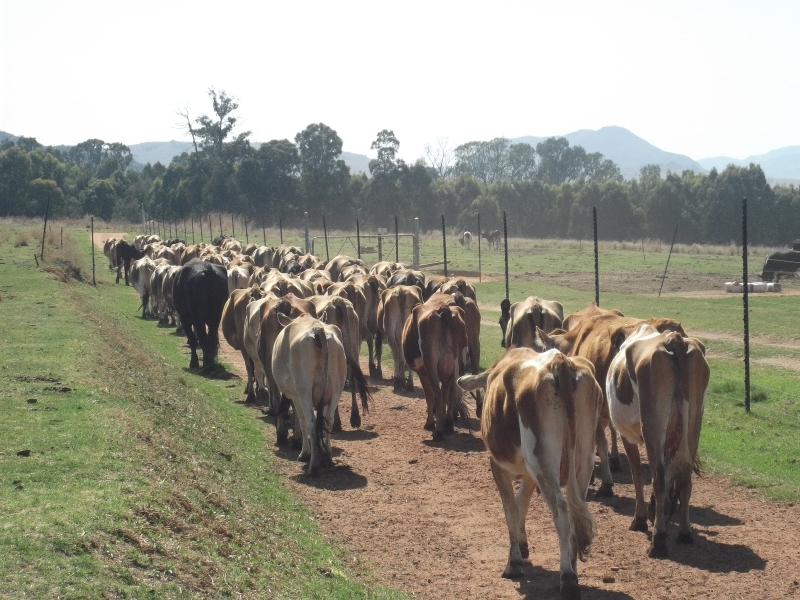
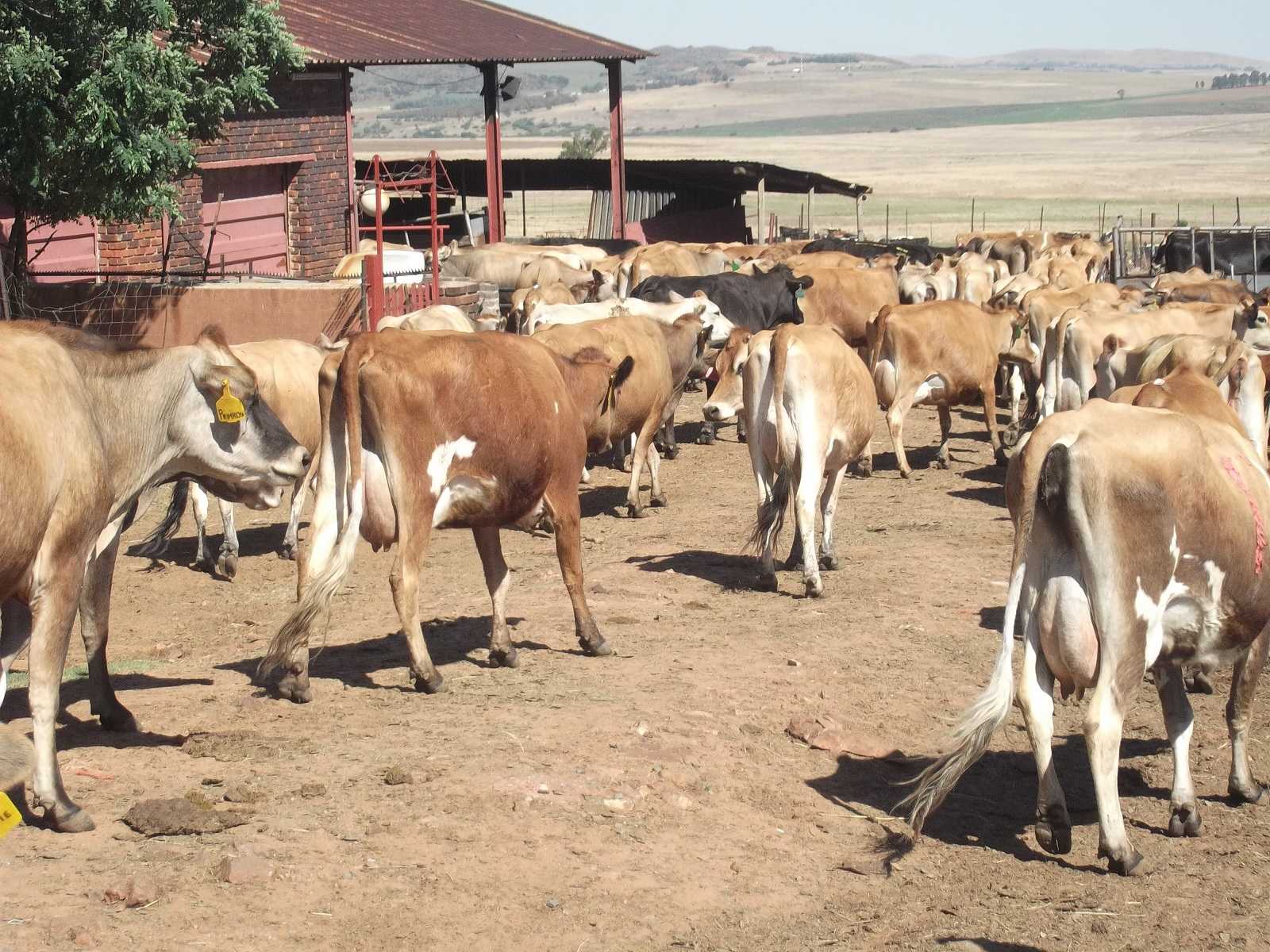
After being milked, we wait in a paddock until milking is finished. I’m usually one of the last cows to be milked because I’m smaller and younger than the others, so they push me out of the way and I’ve learned to wait my turn. Once the milking machine has stopped bellowing, our humans open the gates for us so that we can go outside for the day. I love going outside, there’s so much food and space!

Off to the Paddock

Off to the Paddock

Do you see the big black cow on the left? Well, we’re all supposed to be Jersey cows, but he’s not a cow at all; he’s half Holstein and half Jersey, and he’s an ox. He has a little heifer human who keeps him as a pet. She likes to lie on his back and scratch his ears.

Now we spend the whole day grazing in the veld. Our humans think the grass isn’t good enough for us, but I like it. Here I am with some of my friends.

Barbara with her bovine friends

With friends

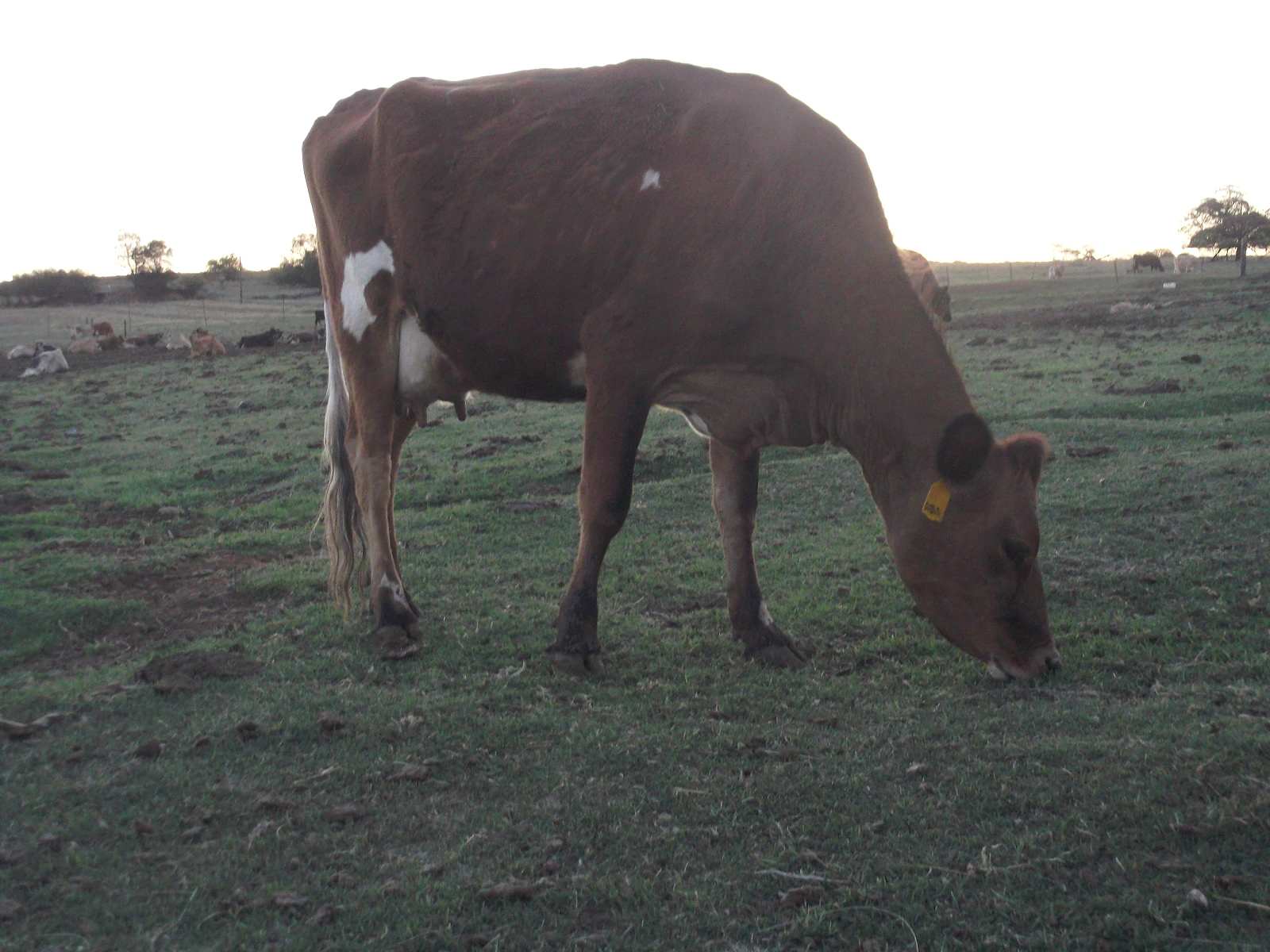
The grass tastes really good!

Barbara grazing

Delicious!

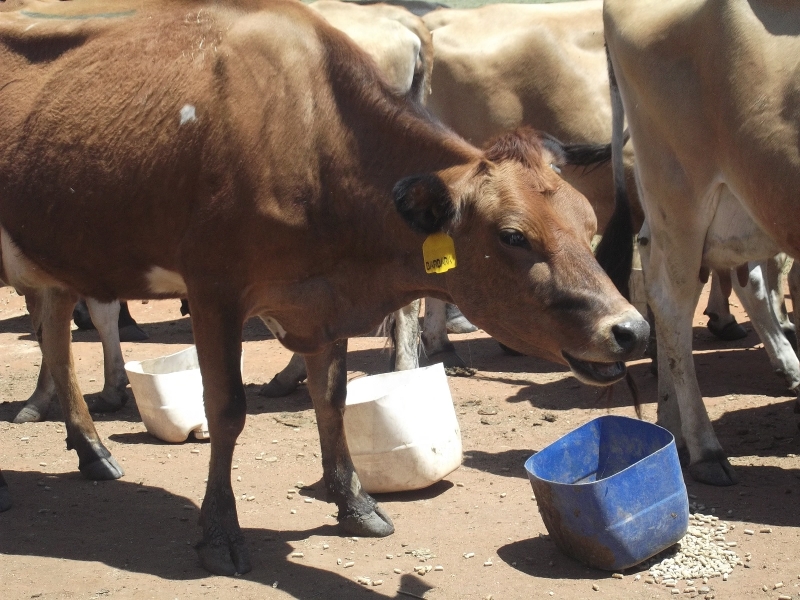
It’s not long before our humans come in a tractor to bring us our lunch. We each get our own bowl full of food. There is a bit of squabbling at the start, and sometimes us young cows get pushed out of the way, but there’s enough for everyone.

Lunch

Lunch

We spend a few more hours grazing away before our humans come to fetch us again and escort us back to the milking parlour. By then my udder is all tight and I’m ready for my supper.

Supper time

Supper time

After getting milked again, we go into our paddock for the night. We have two big round bales of hay, but I also like to nibble on the green kikuyu grass that grows there. The milking machine goes quiet and the whole world settles down for the night. As the sun retreats below the horizon and the silence of Africa spreads its wings around us, everything is very peaceful, and I graze among my friends knowing that tomorrow is going to be just as happy as today was for a young Jersey cow on Hydeaway Farm.

Day's end

Day's end

Why female elephants are called cows

“The problem with farmers is that they use all their vehicles as observation platforms,” someone told me recently and it’s true. We are always on the lookout for our animals, often without even realising it.

If the Bobcat is an observation platform, the house must be command central, so when I gazed out the kitchen window last night and saw this, I had to investigate.

Spying on the cows from the garden

Spying on the cows from the garden

The cows were gathering around a water trough rather than going into a truly delectable paddock of long yet succulent cocksfoot right nearby. This meant trouble. Either it was an empty water trough or the gate wasn’t open.

When Alex and I arrived, we found the trough brim-full and the gate wide open but the cows were angry. Angry cows mill about, urinate all over the place and sound very disgruntled. Could they have missed the open gate? I drove the Bobcat into the paddock and the mooing just got louder.

Cows outside the gate

Were the cows holding a stop work meeting?

I came back out for a “chat” and a delegate presented herself.

cow delegation

"We have an OHS issue"

It appeared there was an OHS issue to resolve. Now I know why elephants are called cows: because, like their bovine counterparts, they never forget.

During the big wet, the gateway had turned to porridge – a gooey mud that cows hate – and it was cow 33’s duty to inform me that she and her colleagues were having none of it this time. So I walked on it and she followed. As you can see, cow 33 is a young Friesian Jersey crossbred and these little cows have chutzpah beyond their years.

Once 33 had okayed the worksite, everyone else followed.

Cows entering paddock

It's good to go, girls!

The casualties of the milk war still to be counted and breaking news says they will grow

Media coverage of the senate inquiry’s report on the milk war by Coles suggests there have been only victors but this only tells half the story, for every war must have casualties. Instead, my reading of the report is that the government feels there is not much it can do about the fallout.

Gobbledegook like this:

…the ability for processors to ‘walk away’ from negotiations with collective bargaining groups (as highlighted during the committee’s 2010 inquiry), market realities such as the number of drinking milk processors in some areas and the fact that the processors must deal with the two major supermarket chains that dominate the grocery sector, can mitigate the benefits of collective bargaining arrangements.

and this:

Much of this information, however, concentrated on concerns about shifts in sales away from the processors’ branded milk products to the discounted supermarket private label milk. As a matter of overall principle, these types of free market outcomes should not be a matter for government. Many private label grocery products have grown in share in recent years…It should not be a matter for public policy to protect brands that consumers no longer value. It also does appear that the steadily increasing sales of private label milk—which have more than doubled their share of sales in supermarkets over the past decade—is a trend that is unlikely to be reversed.

…actually means that dairy farmers are standing right in the path of the cross-fire as Coles and Woolies spray litres (or should I say “rounds”?) of discounted homebrand milk at each other.

On top of all this, there are news reports that private labels will soon occupy far more supermarket shelf space. It won’t be just dairy farmers in the firing line. All of Australia’s food manufacturers and producers should see this milk war as simply an opening salvo.

How ironic then, that the most articulate description of the milk war’s impact comes from Woolworths:

…this price move has effectively re-based the price of white of milk across Australia overnight, and for an unknown period into the future, which also potentially devalues the whole milk category in the eyes of the consumer. In effect, the consumer baseline for price is now at 1990s levels, but with 2011 input costs for all parts of the supply chain.

The year turns the corner

Today’s very belated celebration with around 20 members of Wayne’s extended family of Alex’s birth in May and Zoe’s birthday in June signalled something else: the turning of the year in our family’s favour.

Back in June, we were beside ourselves. We were halfway through a marathon six-month calving period, welcoming a colicky new baby and coping with the wettest season in a very long time. Absolutely stretched to the limit.

We’ve finally turned the corner. Calving is finished and almost all the suckies are weaned, silage is well underway and Alex is a jovial, thriving five-month-old (mind you, no cake for his Mama thanks to his plethora of food intolerances).

Every dairy-farming family knows the annual cycle of crazy winter/spring workloads followed by the hiatus of December through to March. The heat slows pretty much everything on farm and is the perfect time to catch up – with everything from maintenance chores to entertaining friends. Summer is already in the air!

Lucky to be alive

Zoe drives the David Brown

Zoe drives the David Brown

I used to mow and rake the hay with this tractor and the brakes were so hard to operate, I had to stand up to put all my teenage weight on them to get the David Brown to stop. Those were the days before Roll Over Protection Systems (ROPS), let alone cabins, on tractors.

Today’s tractors must have ROPS by law and most have cabs as standard. Thank God. My husband, Wayne, was unloading a B-Double truck of hay recently, when one of the huge rectangles (8x4x3) weighing just over 500kg fell off the front end loader tynes, bounced off the tractor where the windscreen meets the roof and came to rest perfectly balanced on the bonnet. Without the ROPS built into the cabin, he would almost certainly have been killed.

Even though we are much better protected these days, tractors and quad bikes cause almost all the deaths on Australian farms. The introduction of ROPS on tractors was really contentious back in the 1990s (was it that long ago?) and now, the introduction of Crush Protection Devices on quads is causing the same controversy today. The sooner we just put them on and get on with it, the more lives we’ll save.