What heaven looks like for a dairy cow

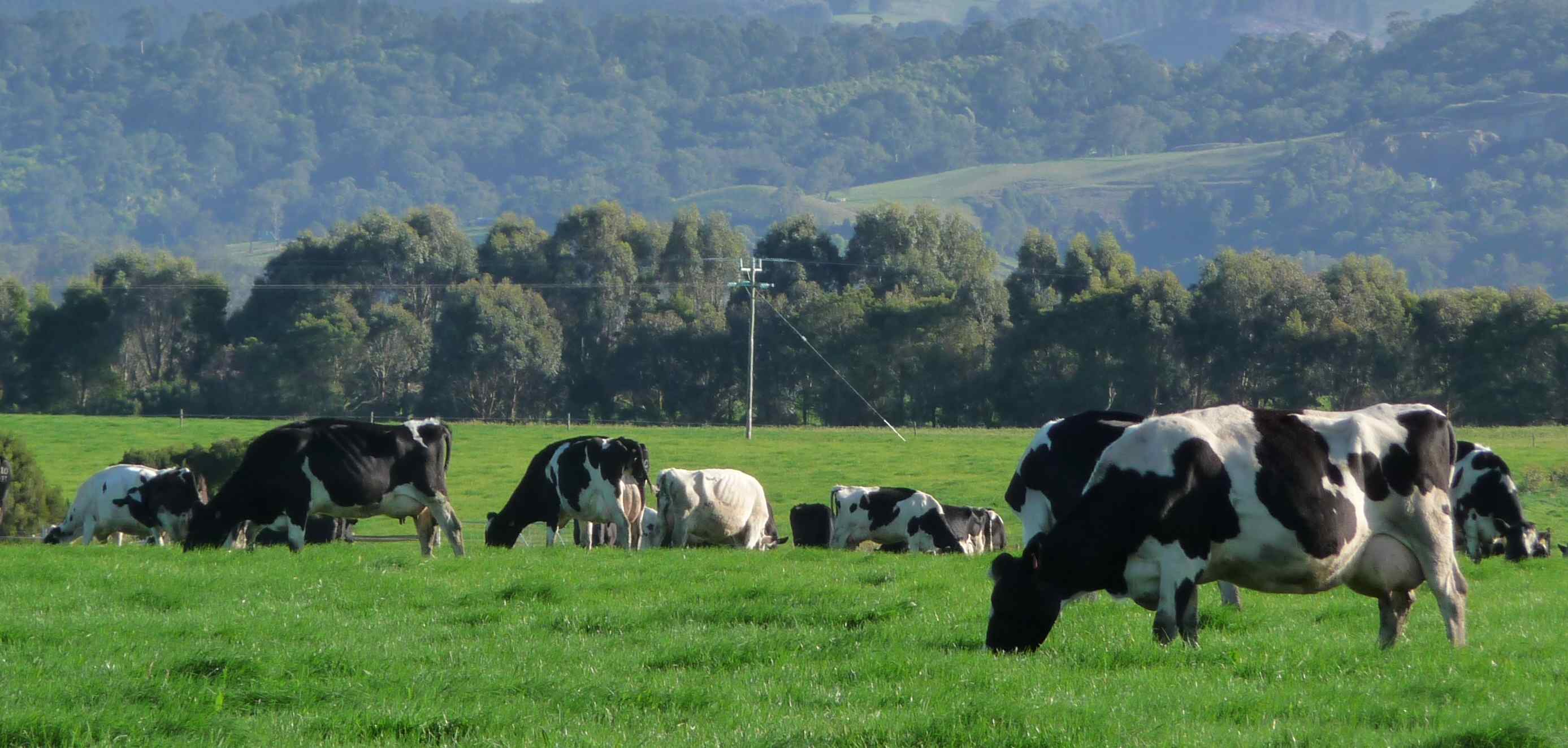
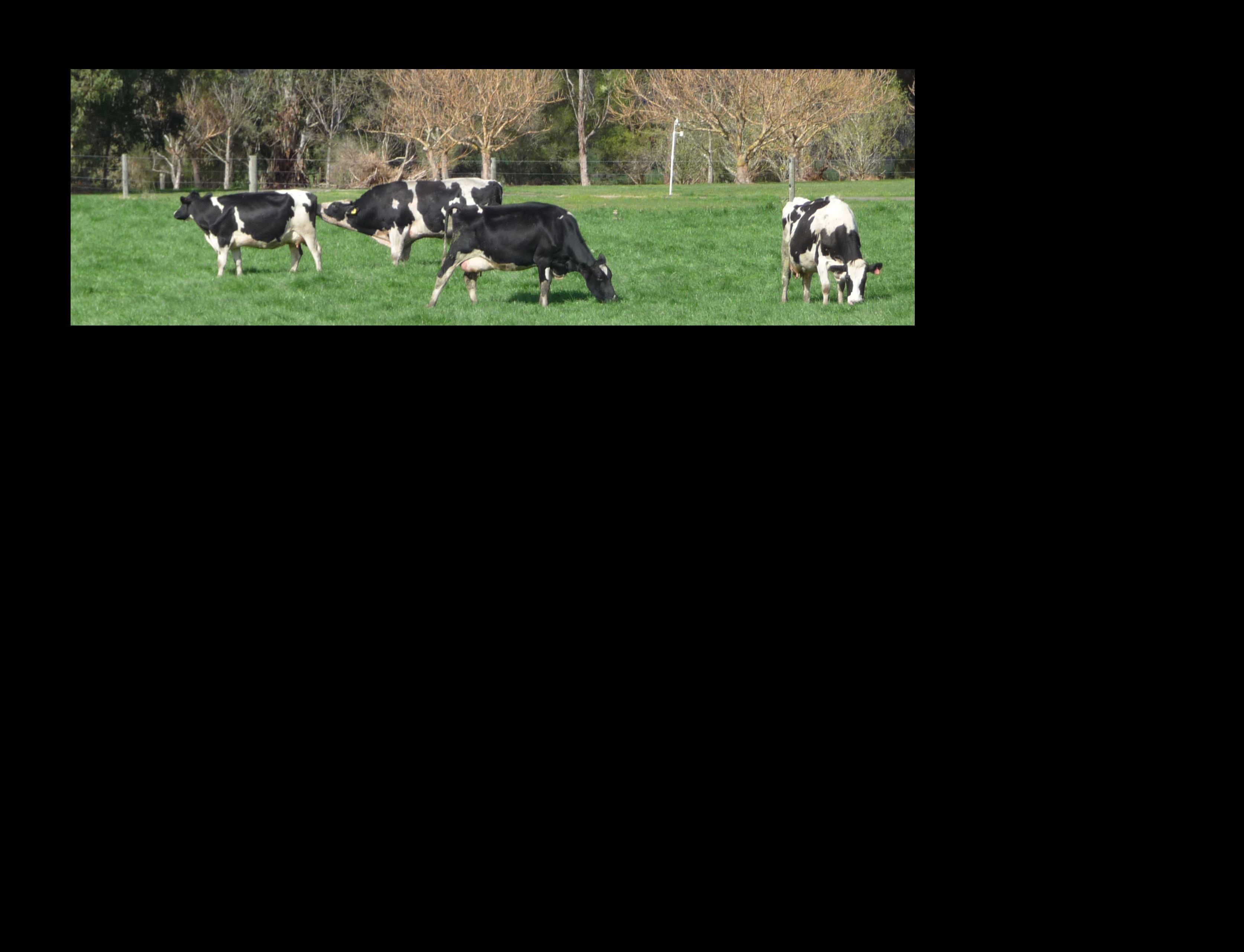
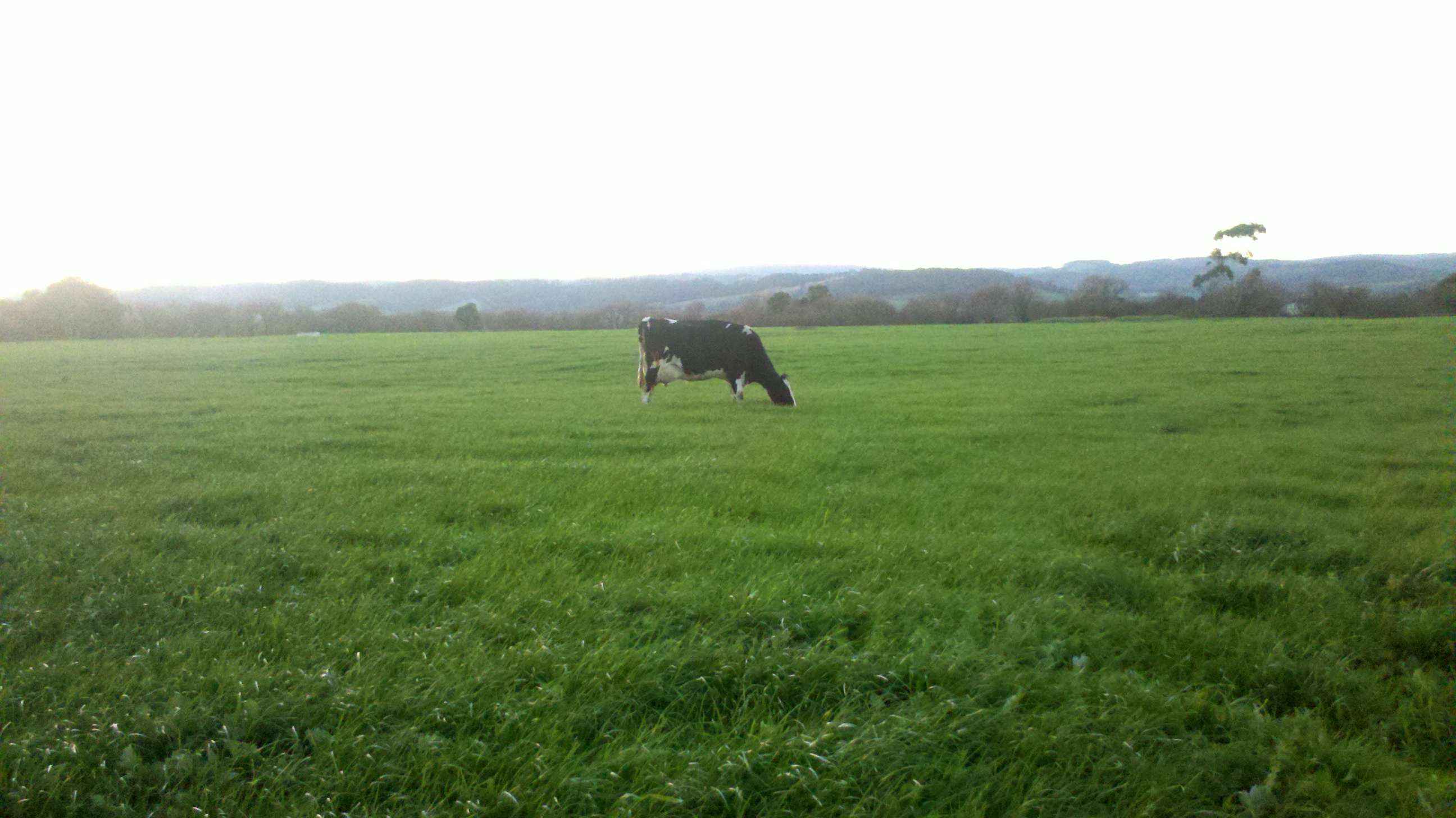
Last night I’d just finished setting up a fresh paddock for the cows when the first of our ladies to leave the dairy strolled in.

Black and white bliss

Black and white bliss

I reckon I could have sat on this cow’s back stark-naked playing the banjo for all she cared. She was in a heaven all her own. Her herd mates weren’t far away though and when they saw what was waiting for them…

It’s only the second time they’ve grazed this newly-renovated pasture and they love it. The grass comes with a special type of fungus called the AR37 endophyte, which makes the grass naturally more resistant to pests (with huge environmental gains). Endophytes are nothing new but, traditionally, they come at a cost: the taste test. Cows seem not to like the old endophytes as much and they can even cause health issues for the cows.

AR37, on the other hand, is meant not to have any impact on palatability or cow health and, judging by the cows’ reactions, I’d say they’d give it three Moochelin stars!

Suck it up, princess and a farmer’s election year wishlist

There’s been a bit of biffo on Twitter and on dairy farming forums of late. Some people are clearly very angry with our leaders. Others are polite but rather bluntly say “suck it up, princess”.

I’m in between.

I want to be among the top 10 per cent of Australia’s dairy farmers. Not because I am a nutty type A personality but because only the top 10 per cent make a good living. So, tonight I’m up late wrangling spreadsheets, casting a sharp eye over our budgets and trying to benchmark our performance.

That doesn’t stop me from wanting better from our politicians so that Victorian dairy farmers get a fair go. We’re not subsidised like our US or European competitors and we don’t have a free trade agreement with China like the world’s best dairy farmers across the Tasman, so we need to be lean, efficient and smart to survive.

To do that, we need:

  • relief from the carbon tax that puts us at an instant disadvantage
  • a more level playing field. Forget subsidising cars and get on with the China FTA.
  • to deal with the duopoly
  • most of all, to invest in ag R&D.

Being smart has historically been our strength, but no longer. Sue Neales of The Australian reports that:

“Australia’s spending on agricultural R&D has also dropped internationally from 9th to 16th place, according to a global study presented at the same conference.”

“Treasury last year predicted the value of agriculture to the nation could grow from its current size equivalent to 2.5 per cent of national gross domestic product, to 5 per cent by 2050, surpassing the manufacturing sector.”

If we are destined to become agricultural dunces, dairy farmers battling to survive on a tilted playing field will never manage the growth needed to make Australia Asia’s food bowl.

Monsters in the farm dam

There’s a creature on the farm that I find simply repulsive – eeeeeeels! Their hideous faces are teamed with swishing slippery bodies so readily mistaken for snakes. And we have them by the tonne.

It seems almost every time I set the dam siphon running, I get a hair-raising encounter with these ugly things.

Eels

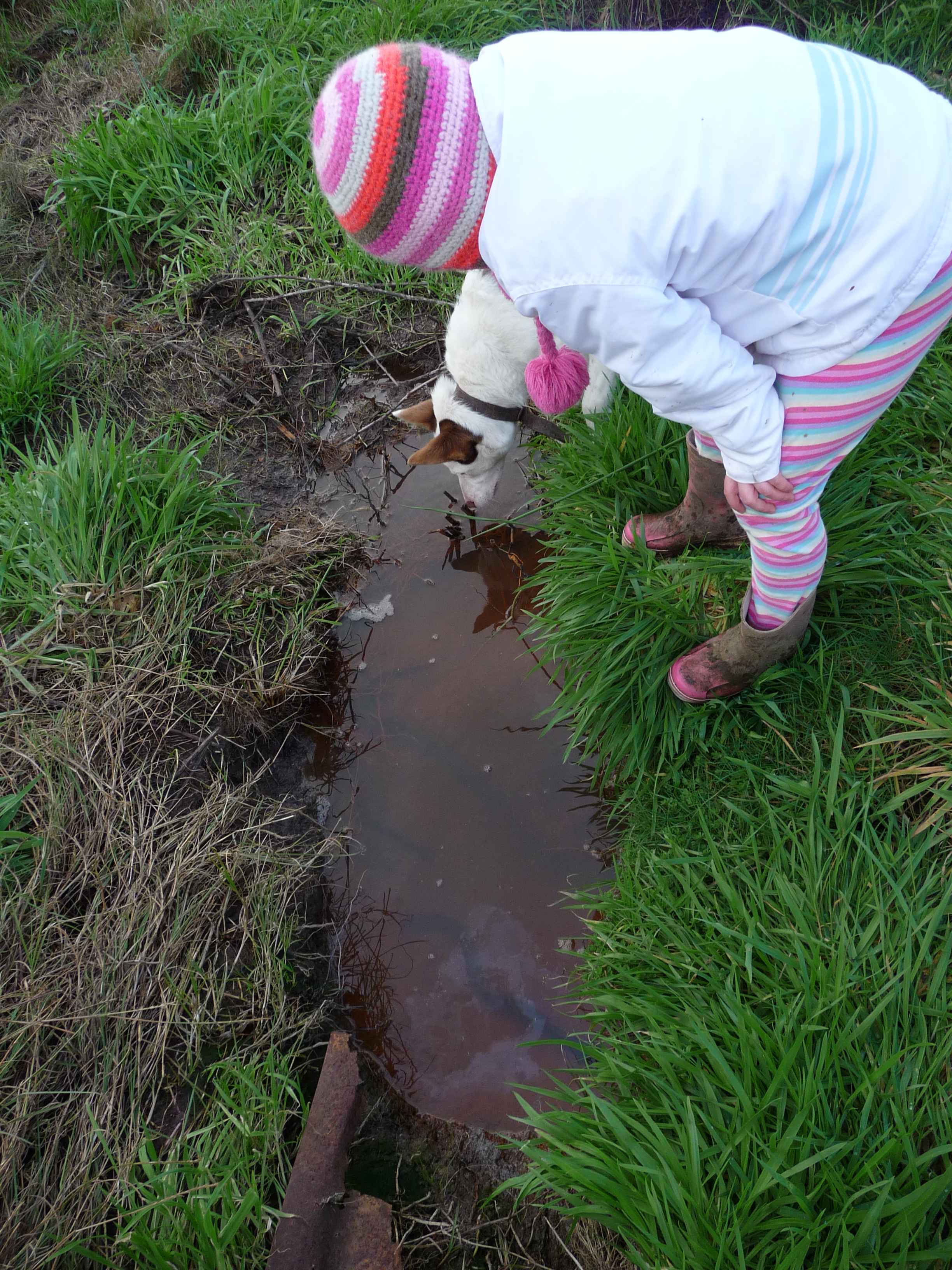
Zoe and Patch inspect a pool of writhing eels

But they are incredible creatures and, instinctive fear aside, I have a lot of respect for them. You see, the eels in our dam have actually come all the way from the tropics – New Caledonia perhaps – travelling thousands of kilometres to reach our little patch of paradise.

They can live 50 years, “breathe” on land, grow up to 2 metres long and weigh 20kgs and eat everything from dragonfly larvae to small ducks.

Apparently, they’re tasty, too.

Read more about extreme eels – I guarantee you’ll be amazed!

Catalyst: Eel Migration – ABC TV Science.

Will Curtis Stone come to the rescue of Aussie farmers and foodies?

Coles is pushing prices down, down, down to help the Aussie battler, right?

Actually, it appears the driving force behind Australia’s supermarket wars is something much more prosaic – supermarket ROI. According to the Sydney Morning Herald:

“A report released in March by the Merrill Lynch analyst David Errington warns that the big three retailers, Coles, Woolworths and Metcash, will need to boost their earnings by $1.3 billion in the next three years if they are to make an acceptable return on the billions of dollars of investments made on acquisitions and capital expenditure. This is on a total earnings before interest and tax (EBIT) pool of $4 billion for the retailers.”

“In the past year, the profit growth of the entire sector has shrunk. Errington’s report says that in the first half of this financial year, the three food retailers delivered a combined EBIT growth of $150 million, a far cry from the $400 million-a-year earnings growth required to make an acceptable return. It will be interesting to see what the full-year earnings will be when the sector reports in the next few weeks.

“If Coles, Woolworths and Metcash fail to generate suitable returns on capital in the next couple of years, investors’ patience will run out and the groups will suffer a significant de-rating.

“It goes a long way to explaining the intensifying price war among the supermarket chains as they try to snatch market share to justify their investments.”

Doesn’t sound like the hostilities will ease up any time soon, does it? In the meantime, we can expect more and more private-label products – especially dairy – to flood the shelves of Coles and Woolworths.

Research by IBIS World Australia reported in the International Business Times showed that, already, “Up to 68 per cent of butter sold in the two supermarkets is private label, while for sugar it is 67 per cent, 56 per cent for bread, 55 per cent for fresh milk and 53 per cent for eggs”.

Alarmingly, the researchers predicted that “by 2017, the share of such products would make up one-third of total supermarket sales”.

Why am I alert and alarmed? Because this is bad news for anyone who cares about good food. When price becomes the only differentiating factor, quality must suffer right along the food chain and the ones who will ultimately feel the pain will be the little people – the farmers who grow the food and the consumers who eat it.

So where does this leave the foodies of Australia? I’ll let you draw your own conclusions.

No need to worry, I guess. Celebrity chef Curtis Stone will save us all. His spin doctors, Thrive PR, say this:

“And don’t think that Curtis is just a face when it comes to his partners like Coles. He is an active contributor behind the scenes to their business and marketing function. Their success is his success.”

Then again, maybe he’s blissfully unaware of the damage to Australian food caused by “his success”. I intend to appeal for help by emailing him at contact@curtisstone.com and am sure he’d love to hear from you, too.

While you’re at it, don’t forget to sign Lisa Claessen’s petition to Coles CEO, Ian McLeod by visiting http://www.change.org/en-AU/petitions/coles-up-the-price-of-generic-brand-milk-to-a-sustainable-rate-of-return-for-all

First day of spring and the bulls are a-leaping

It’s officially the first day of Spring in Australia and it feels like it, too. This was the view from the garden this morning. I almost wanted grass on my rice cakes!

House paddock

Welcome to Spring!

The cows seem to feel it, too. They play “butter-heads” (as Zoe calls it) at almost every turn and are shedding their scruffy winter coats, revealing glossy new hair underneath. The male of the species, I must say, is also enjoying himself.

We run three bulls with the herd while resting another group of four at any one time because it’s hard work jumping on cows all day (yes, I know what you’re thinking). There was a change of shift for the bulls this morning and I thought I’d capture a little of the courting game for you.

The first bull opened with an impressive display, enrapturing the cows, well not quite…Oh dear – I have a video but YouTube is taking all afternoon – sorry. Let me put it this way, while Buster bull roared, sang and dug up dirt, the cows simply continued to eat. I told you the grass was good!

The next step is to have a good sniff of everyone.

Sniffing bull

Ooooh, you smell gooooohd!

The curled lip is called the “Flehmen Response” and shows the bull thinks she might just be “in the mood”.

Sadly, she wasn’t. He got it wrong and she quickly scurried off. Oh well, Bully Boy, better luck next time!

Climate change: the gazillion-dollar question

Nick Minchin doesn’t stand a chance of changing my mind – I accept the evidence that climate change is real, along with (apparently) 97% of scientists.

In our part of the world, the long term trend is “dry, dry and drier” and the CSIRO’s State of the Climate Report confirms what many farmers here are dealing with right now.

What local dairy farmers are doing to cope with climate variability
We’ve been holding meetings and farm days to discuss how we can adapt. Here are some of the things locals are doing to help their farms cope with increased climate variability:

  • Changing the time of year calves are born
    On our farm, we are moving the start of calving from winter to autumn – a shift of almost two months. This allows us to take advantage of extra grass during milder winters while reducing our exposure to longer, hotter, drier summers.
  • Planting trees
    Trees aren’t just good for wildlife – they offer our cows shelter from uncomfortable weather and help to protect pastures from searing summer winds.
  • Trialling new pasture types
    Rye grass is the mainstay of dairy farming pastures around here but it has shallow roots that are quite vulnerable to heat and pests (which are expected to become more problematic). We’ve been sowing cocksfoot and fescue in some of our less productive pastures. Both have deep root systems that can tap into moisture lower in the soil. Other farmers are trialling chicory, plantain and other herbs too.
  • Shade and sprinklers at the dairy
    Lots of us have installed sprinklers and shade sails over the dairy yards and fans in the shed to help keep the cows cool while they wait to be milked, minimising the risk of heat stress.
  • Increasing energy efficiency
    Farmers have been flocking to seminars about green cleaning and water heating technology. For us, it’s meant a thorough audit of our dairy’s refrigeration, milking machines and hot water system.

In other words, local farmers are reading the tea leaves and, for us, the gazillion-dollar question is not whether climate change is real (or whether it’s caused by people) but what we should do about it. Consider us your canaries.

Cranky questions for the NFF about Woolies and the Blueprint

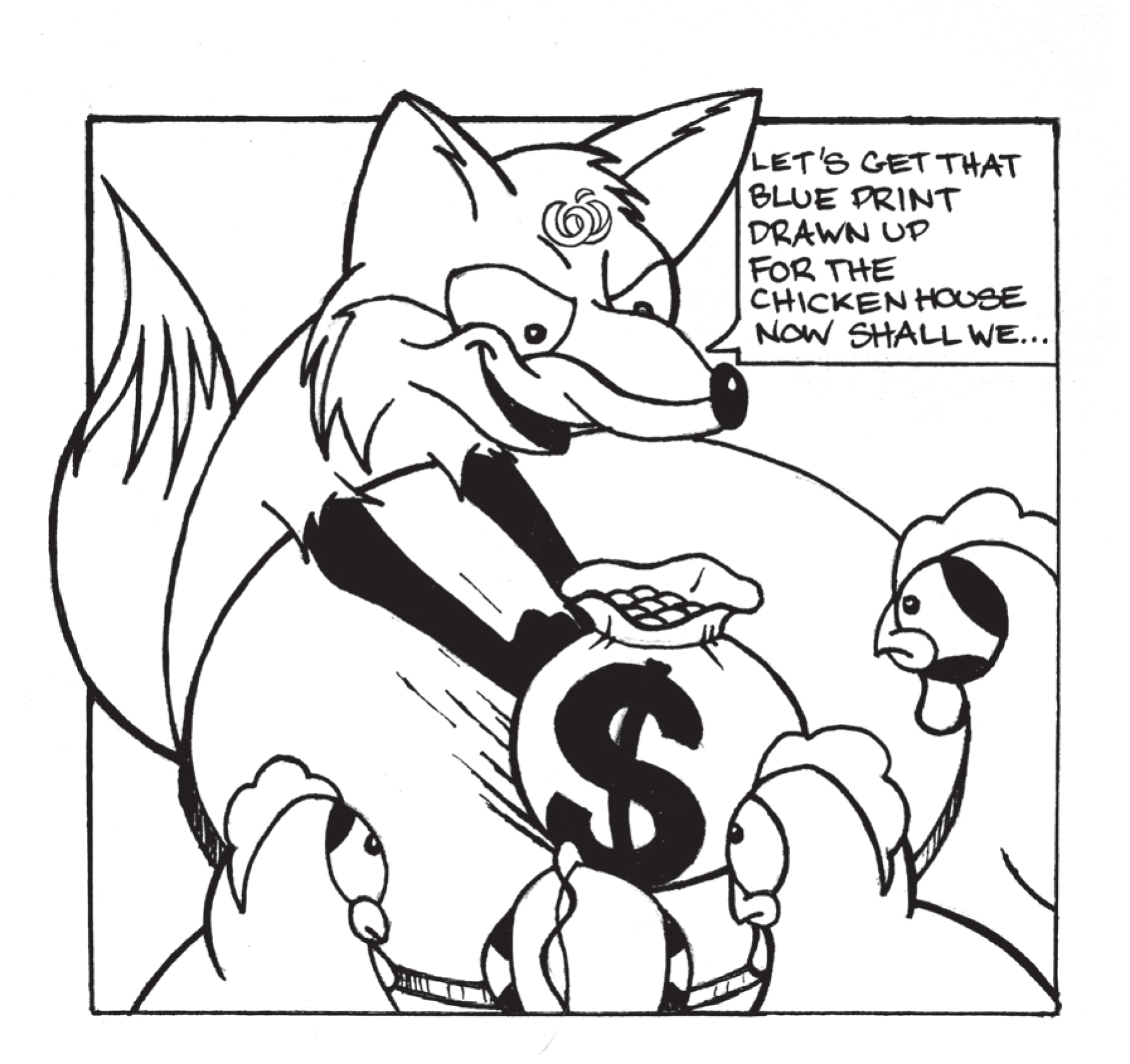
The NFF has “welcomed a new major partner in the Blueprint for Australian Agriculture: Woolworths”. Yes, one of the two giant supermarket chains that has slashed the value of milk to less than that of water is now helping to chart our farmers’ futures. My future, my children’s futures.
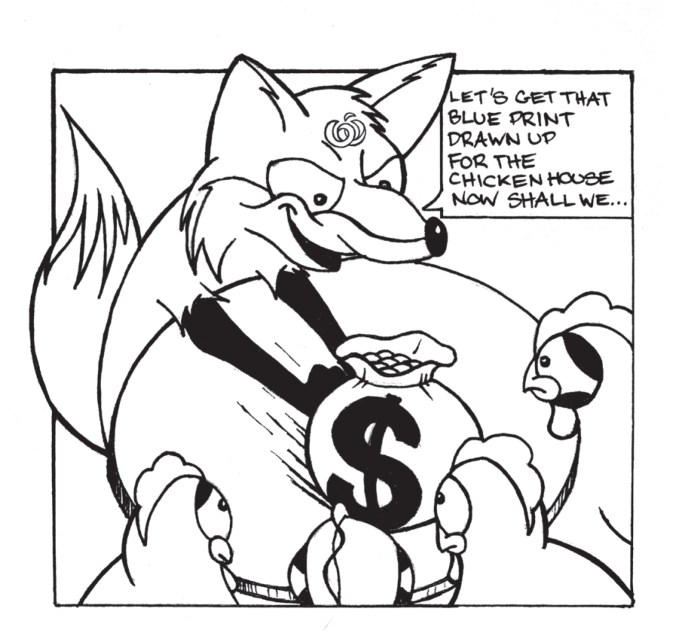
"It’s a matter of funding..."

In a media release, NFF president Jock Laurie said: “Having Woolworths on board will ensure that what consumers believe are the key issues for Australia’s food producers are captured in the Blueprint”. I felt betrayed. After the red mist settled, I wrote a list of six cranky questions and called the NFF. Admirably, the NFF’s Ruth Redfern has responded.

Would love to hear what you think! You can also participate in the Blueprint at http://www.nff.net.au/blueprint.html

1. How do you anticipate farmer reactions will be to Woolworths’ involvement as a “major partner” in the Blueprint for Australian Agriculture?
We hope that farmers see Woolworths’ involvement in the Blueprint as positive. From our perspective, having Woolworths on board as a partner means that we can reach more farmers and more people in the supply chain with what we believe is a very important project.

Importantly, being a partner in the Blueprint does not mean that Woolworths has any more input into the outcome than any other single participant in the process. They have the same amount of input and the same opportunity to contribute as you do – so if you’re a farmer or anyone else with an interest in, or involvement with agriculture, and you haven’t attended a Blueprint forum or completed the online survey yet, please do so – as the more input we get, the stronger the outcome will be for our sector.

2. What is the rationale for such high-level involvement of Woolworths?

Having Woolworths (and Westpac, our other major partner) on board will allow us to take the Blueprint to as many people as possible. It’s a matter of funding – running a project like the Blueprint requires money, and as the NFF is a not for profit organisation, we couldn’t do this without support. By sponsoring the Blueprint, Woolworths and Westpac are actually putting money back into agriculture by supporting a project that will help us achieve a strong and sustainable future.

The important thing is that the agricultural sector makes the most of this opportunity. Blueprint is about giving everyone that has an interest in agriculture the opportunity to say what they believe the sector should look like in the future, and what we need to change or do now to get there. If you don’t contribute, you’re missing the chance to say what you think our future should be, or to raise the issue/s that are of most importance to you and/or your business.

3. Has Coles been invited to participate and, if so, what has been its response?

Earlier this month, we posted letters about the Blueprint to 500 organisations and businesses in the agricultural sector – including Coles as they are part of the agricultural supply chain, and all the banks that work with agricultural customers – encouraging them to participate in the Blueprint and to pass information on to their staff, customers, suppliers and networks.

At this stage we haven’t heard back from Coles, but we do hope that they participate – just as we hope that all other people and organisations in agriculture and the supply chain participate. If they do chose to take part, they will have an opportunity to contribute that is equal to every other participant – be it a farmer, the owner of an agricultural supply business, a truck driver, a food manufacturer, or a retailer, like Woolworths.

4. Aren’t we already painfully aware of the demands supermarkets place on suppliers?

The Blueprint provides an opportunity for suppliers to raise these, and any other issues they see as critical for agriculture to overcome.

5. Why should a supermarket have such an important role in setting the agenda for Australian agriculture when so much of our produce is exported?

There are two important things to take into account here. The first is that Woolworths will have no more input into the Blueprint than any other single person, business or organisation that chooses to attend a forum or complete a survey. They are simply helping us make the Blueprint a reality. Setting the agenda belongs to everyone who takes part – so the more input we receive, the more representative and inclusive the outcome. It’s up to us, as an agricultural industry, to set our own agenda – that’s really what Blueprint is all about.

The second is that while 60 percent of our produce is exported, 40 percent of what our farmers grow is consumed domestically – so both the export and non-export supply chains are important stakeholders in the Blueprint process.

6. The two supermarket chains control 40% of Australia’s retail sales and are in the midst of a price war. How can Aus ag resist the push for lower and lower prices?

Having a strong and competitive retail sector is very important – for suppliers and for consumers. Ensuring farmers receive competitive prices for their produce – be it those farmers who are supplying their produce to supermarkets or those farmers who are shipping bulk commodities off-shore – is expected to emerge as one of the key issues in the Blueprint process.
John Mulvany tells how young dairy farmers can make it work

It’s official: buying your own dairy farm may no longer be affordable but some entrepreneurial young dairy families are finding other paths to prosperity.

The answer is to farm without the farm, says John Mulvany of OnFarm Consulting. Ahead of his address to the Australian Dairy Conference on Thursday 23 February, I invited John to write a guest post especially for young farmers.

All dairy farmers at the Australian Dairy Conference will be somewhere on this dairy farmer life curve: it’s about balance between skills acquisition, growth, life style and eventually discretionary involvement.

FarmerLifeCurve

SA – Stuffing Around

FTCF – Focus, tight cash flow

TAF – Tight arse factor

HD – High debt

HEQ – High Equity Cons – Consolidation

DI – Discretionary involvement

Many dairy farmers are asset rich and energy poor. At the same time, many young dairy farmers are energy rich and asset poor. With land prices increasing while profit margins fall, landowners will find it harder to find young farmers capable of buying their farms.

Three young dairy couples I’ll introduce at the Australian Dairy Conference have taken their cue from many successful retailers: they don’t own the farm. Instead, they lease land to operate profitable dairy businesses while investing the returns from their dairying in high growth assets beyond the farm gates.

Warren and Kerrie Redmond, for example, entered the dairy industry with no assets in 1989 on a third share of 167 cows. Today, they lease just under 1000 hectares with 486 hectares milking area for 900 cows over three farms. Off-farm investments include three houses, FMD’s and shares. Last calculated return on asset was in 2010/2011 at 22%. Lifestyle is now very much a priority.

Gems of Advice for Young People in Dairy

• Keep an eye on the big picture – it’s easy to get lost and discouraged in the daily crap.

• There will be a minimum 8 -10 years where the pressure will be on and you’ll wonder if you are going anywhere.

• Build your reputation so people seek you to rent their assets.

• Keep your bank informed; they are your best friend when investing in high-risk cows and plant at the start.

• Spending is restricted to sensible money making assets – no shiny red toys.

• Purchase off-farm capital growth assets as soon as your debt level allows.

• You will have to make some sacrifices and initially be prepared to work hard manually while balancing decisions.

• In re-working arrangements, think outside the square, keeping the interests of both parties in mind.

Quad bike manufacturers look like Big Tobacco

Quadbar

Crush protection devices will save farmers' lives

Just like Big Tobacco before it, the quad bike industry has been adamant its machinery is not responsible for the deaths of Australian farmers – rather that they got themselves killed.

The Weekly Times and SafetyOzBlog have reported the gyrations of the manufacturers and their representatives, the FCAI, which even included forcing some sponsored riders to remove crush protection devices. They claimed that the only answer was more rider education and that rider error was almost invariably the cause of the 23 deaths on farm ATVs in 2011 so far.

I thought it was all over bar the shouting match when The Weekly Times reported that the FCAI had dropped its opposition to Australia’s crush protection device, the Quadbar. Then I heard that at least one manufacturer has advised its dealers that its position is unchanged.

Now, the SafetyOzBlog carries this media release from the respected and independent Australian Centre for Agricultural Health and Safety tearing strips off the FCAI for failing to correct what the ACCC described as misleading and deceptive conduct.

“Embarrassing or not, the families of those people killed and permanently injured in such rollover events have a right to know why the FCAI, as suggested by the ACCC, has not only misrepresented the evidence but why they have not addressed this issue in a timely manner. The inaction and questionable approach of both the FCAI and manufacturers is showing complete disregard for the safety of their customers.”

People on our farms are dying. No matter who is responsible for the rollovers, the Quadbar is estimated to protect between one in four and one in three people. It’s worth it.

For more information on quad bike safety, call the Australian Centre for Agricultural Health and Safety (02 6752 8210) or visiting the website at www.aghealth.org.au

A typical summer’s day on our dairy farm

Summer is the laziest time of year on our farm and yesterday was a pretty typical day.

5am Wayne rounds up, Marian changes another nappy.

5.30 Milking starts.

8.30 Milking’s finished, clean-up begins.

9am Marian, Alex and Zoe head to see Papa.

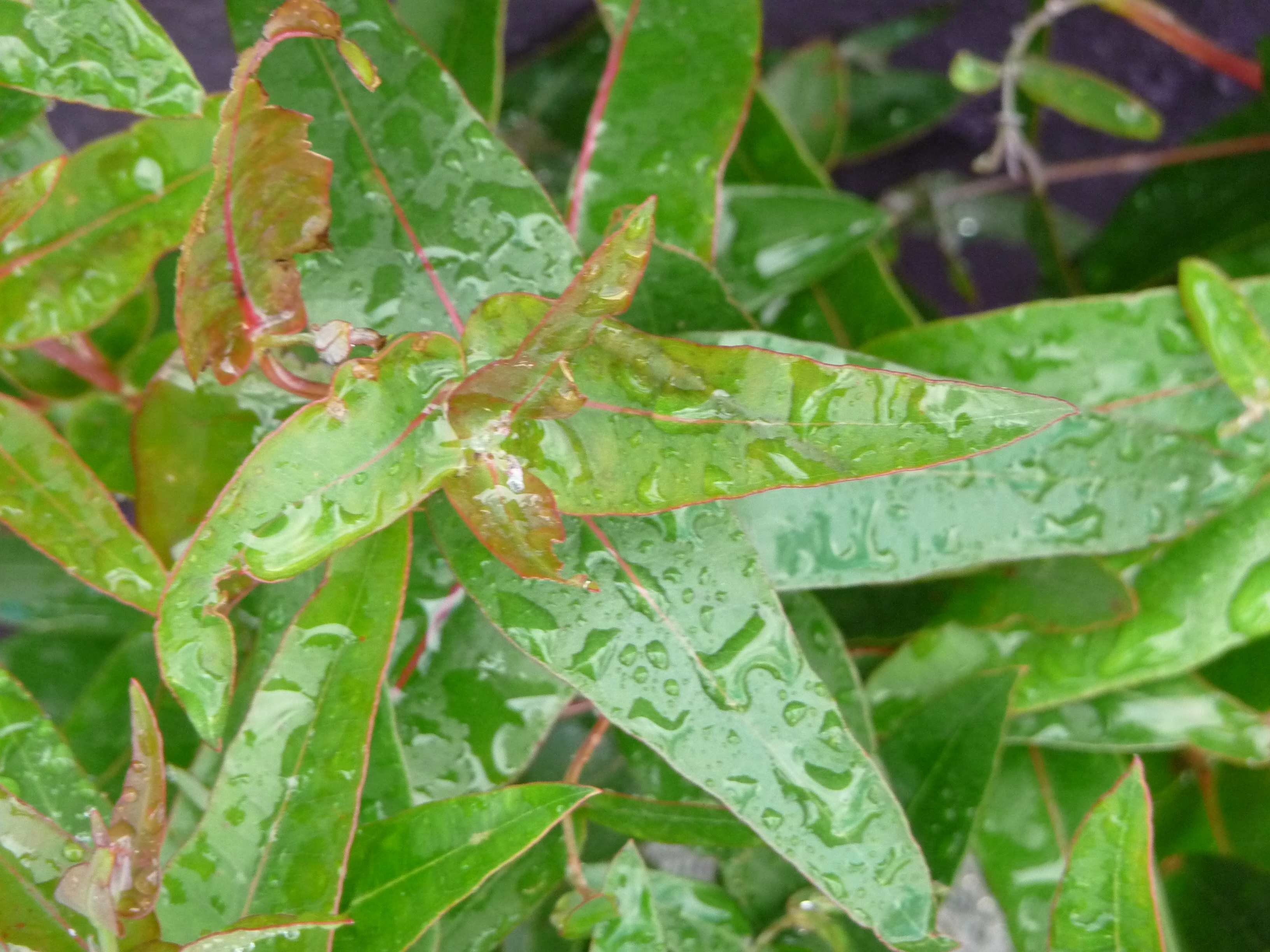
9.10 Zoe, Alex and Marian plant trees in the margins of the wetlands while Papa hoses the yard

Seedling leaves

Indigenous eucalypts

10.30 Papa’s finished hosing the yard and goes to feed the calves.

10.45 Emergency! Papa phones to say there’s a break in the fence and M, Z and A go to the rescue.

Fencing repair

"What a lovely morning for repairing fences, don't you think, Mama?" - Zoe

11.15 We all get back to the shed for a cool drink and catch-up. Tanker’s come and gone – same litres as the last pick-up, which is good news in summer!

11.20 Papa makes repairs to the dairy. Mama, Zoe and Alex head off to check the paddocks.

11.55 Alex is huuunnnggrrrry and wants to get out of the carrier NOW. Head to the house for lunch.

12.30 New neighbour, Garth, drops by to introduce himself and a young fellow looking for weekend work.

1.15 Back out to look at the paddocks and work out the week’s pasture rotation. Papa starts shifting silage.

Bringing in the silage

Papa busy bringing in the silage

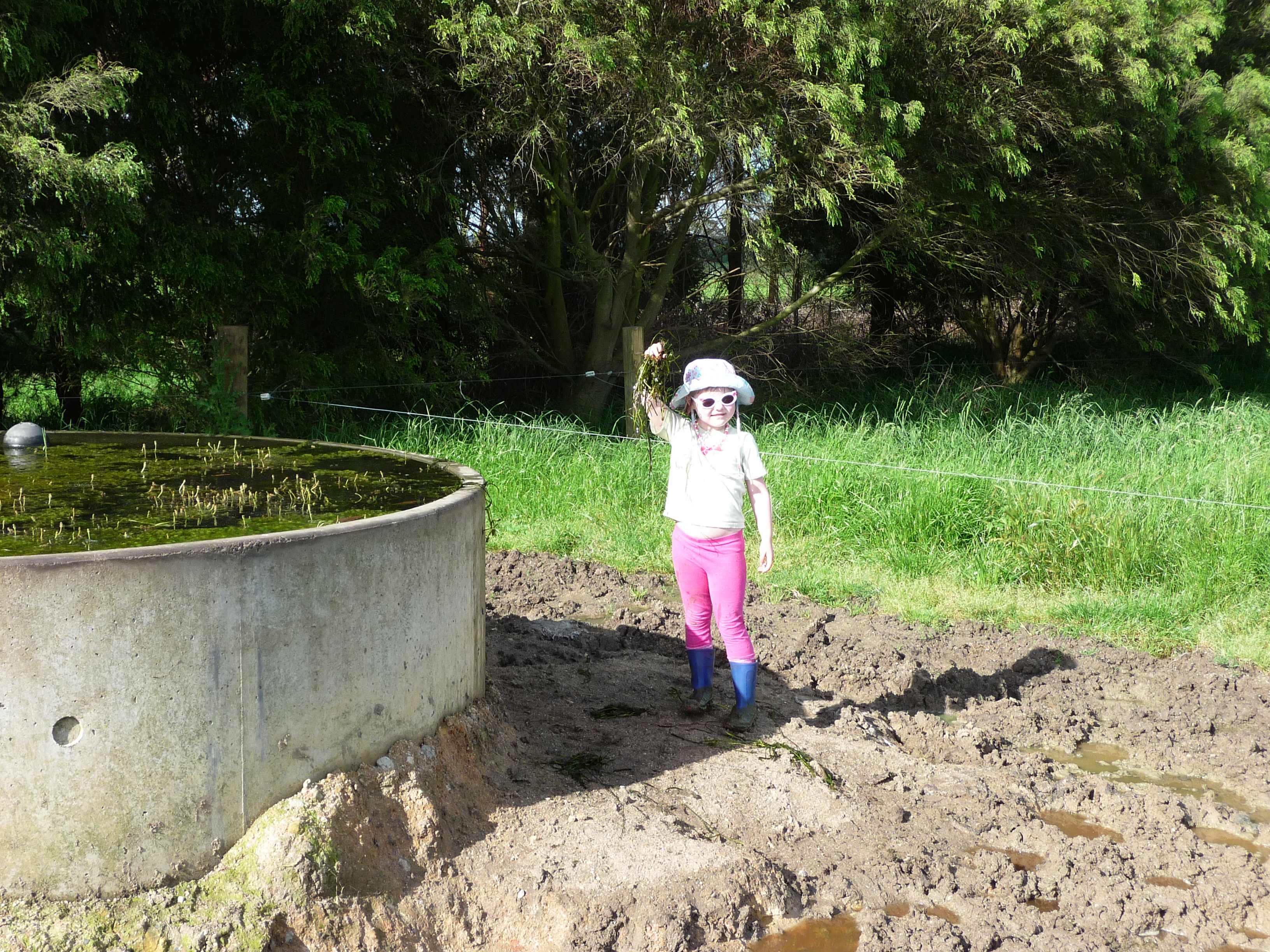
2.30 While setting up paddocks, stop to fix an overflowing trough

Trough algae

Oooooh, slimy algae!

2.45 Splat in the mud – must change pants and boots!

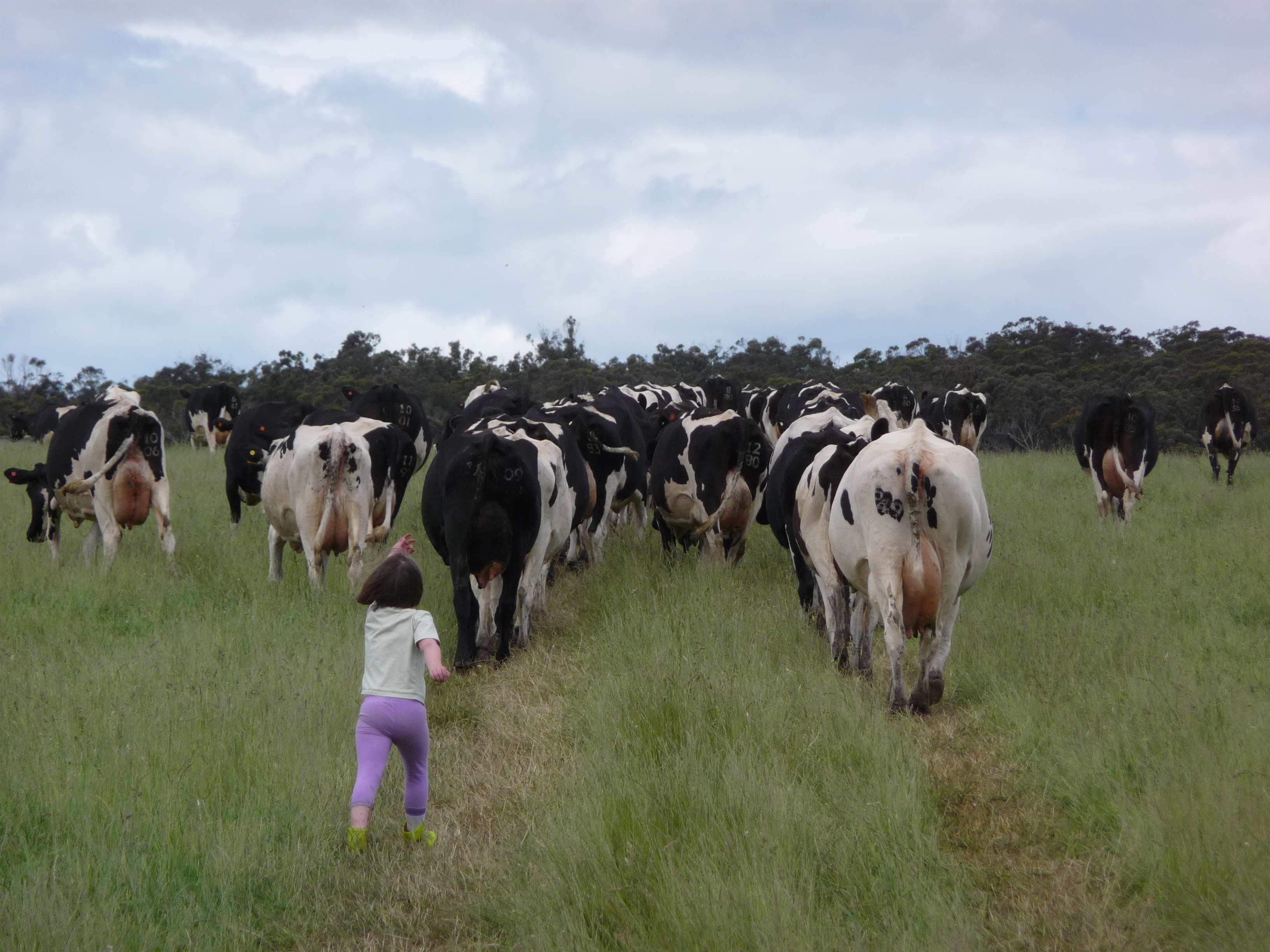
3pm Time to round up!

Rounding up

Ho up there!

3.35 Milking again.

3.40 Plant a couple more trees and then time out for Zoe and Alex.