Divided we fall: so where to from here?

After a nose dive

Don’t worry if you fall, just get back up again.

Wayne said the other day that the farm has taught him something about resilience: live in the moment when the sun is shining and, when the hail stings your skin, think of the big picture.

But the big picture right now is confusing for this Milk Maid. The WCB war has thrust the outlook for Australian dairy into the headlines and, with it, a lot of questions.

Our co-op has offered half a billion dollars for WCB, claiming that its loss to a global player would be “a tragedy”. In its statement to the ASX, MG Co-op said:

“The combination of MG and WCB is the only option available that delivers an Australian-owned and operated company with the scale, capacity, strength and momentum to service global growth opportunities, returning profits to dairy farmers and their communities.”

In the midst of all this, the UDV hosted a farmer forum on Monday where independent dairy analyst, Dr Jon Hauser, told farmers that supporting cooperatives is a “no brainer” but has also said the golden era of dairy in Asia was “largely rhetoric” and that real progress for Australian dairy would come through cost control and increased efficiencies at the farm and the factory.

He created a stir at the forum too, simply by saying that milk prices of 48 to 50 cents per litre could not be sustained. Not popular news.

So, now that Saputo is on the cusp of announcing a new offer, prompting WCB to ask for a suspension of trade, what if Helou’s tragedy does unfold? How will the General regroup?

MG will certainly have to work harder to woo those who harbour a co-operative spirit but supply other processors. And that, I’m afraid, is something the co-op has not done well to date, in my view. Perhaps the tide is beginning to turn, reading between the lines of Helou’s interview with The Weekly Times dairy writer, Simone Smith, headlined Divided we fall:

“There is nothing stopping our farmers rallying around a well-run farmer run company that is of scale and relevance.”

“There is no law in the land against that. That’s what we are advocating. This rally around the MG foundation to create a new farmer-owned business that is really relevant to the 21st century.

“The farmers will only benefit from direct ownership and direct influence in supply chain from the farm all the way to market.”

I guess we farmers are used to falling and getting back up again.


UPDATE: In response to a question asked below, Dr Hauser has kindly sent me this. I don’t know how to put it – complete with charts – in the comments section, so here it is instead:

Sorry Marian, It would take me a day to properly represent my position on the Asian growth story and even more to update my analysis to the most recent trade data.

Here is a snapshot of the important data:
JH1

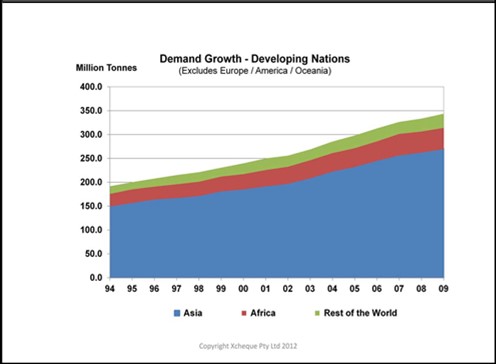
This is the demand growth for the developing nations. This comes from the FAO

Most of this growth has been serviced by internal development of their dairy industries.
JH2

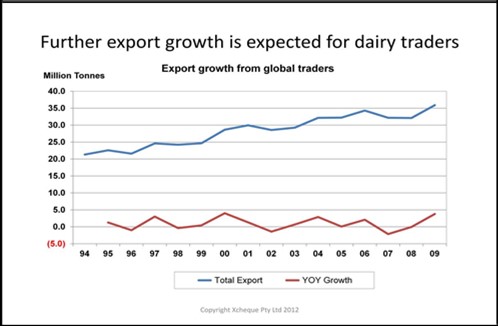
This the export growth from the key dairy traders – Europe, US, NZ, Argentina, Australia. The average is 2 – 3 billion litres / year. Even if this has been accelerating in the past few years it is unlikely that the opportunity is more than 4 – 5 billion litres / year. I believe the average growth opportunity for the global traders is 3 – 4 billion litres but I would need to review the more recent data to check this.

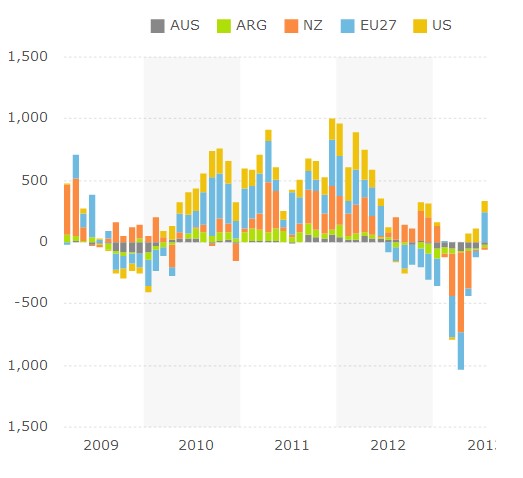
YOY Production milk production growth – Million Litres
JH3

This is the year on year growth that has come from the major traders. This chart shows 15 billion litres of growth from the EU, US, NZ and Argentina from July 2010 – June 2012. The total for the period from July 2009 – June 2012 is 12 billion. In other words we saw contraction in 2009 and 2012 and that is because the milk price was low. The US and Europe turn growth on or off according to commodity and milk price (New Zealand just keeps on trucking except when it doesn’t rain).

In summary:

  • The Asia growth story is not rhetoric but the suggestion that the hole can’t or won’t be filled is.
  • The US and Europe will turn on and off milk production according to demand and price. They had no difficulty growing supply at 5 billion litres / year in 2010 / 2011 and they are already gearing up to do it again in 2014.
  • No I don’t subscribe to the analysis that has been done for the Horizon 2020 report. I believe the “Supply Gap” analysis is a flawed way of assessing Australia’s future export opportunity.


Has the MG co-op fed Aussie dairy farmers to the wolves?

If $1 milk is unsustainable, how is the Coles deal locking in pricing with Murray Goulburn a good thing? Good question. Has MG made a giant mistake? Will it mean a mass exodus by NSW dairy farmers and will the big co-op do its socks on the deal, taking the hopes of dairy farmers down, down, down with it? Blair Speedy of The Australian certainly seems to think so.

I decided to ask some rather blunt questions of two men in the know: independent dairy analyst, Jon Hauser of Xcheque and Murray Goulburn big-wig and general manager shareholder relations, Robert Poole.

1. How can MG make a profit supplying fresh milk to Coles if Lion could not?
Robert Poole refused to comment on Lion’s circumstances but said the co-op’s new factories would be “purpose-built, state of the art and the most efficient milk processing plants in Australia”.

“We will make a good return supplying Coles and will have the capacity to supply other customers in time, too, making even higher returns.”

Jon Hauser goes further. “I can see how 10 cents per litre in costs can readily be taken out of the chain,” he says. “There is a view in the dairy community that milk should be sold for more than a dollar per litre when it’s being sold cheaper than that right now in the USA and the United Kingdom. The local processors have been retaining much more of the milk dollar than international processors.”

2. What risk is there to the $120 million of farmers’ funds that will be spent on the new factories?
Poole says quite flatly that the cost of the factories is well and truly covered by the 10-year Coles contract: “We have total security. There will be no cross-subsidisation of this investment – it will be fully funded by the agreement with Coles.”.

3. Why hasn’t MG sold fresh milk into supermarkets before?
“Historically, we would have had to submit a tender for milk supply. And what, build factories in the hope that we won?,” says Poole. “This was a golden opportunity. Nobody gets a 10-year contract like this but Coles came to Murray Goulburn because it wanted to work with farmers.”

4. How does it work for MG?
According to Poole: “Under the supply agreement, the price to Coles is based on a farm-gate price and the cost of processing plus a comfortable profit margin. There’s a rise and fall clause that means the price reflects the changing value of the milk on international markets.”

Hauser explains that the New Zealand and Australian dairy industries are “price takers”, unlike the Europeans and Americans, who have greater control over pricing.

“Australia can’t control the export price but, reading between the lines, Murray Goulburn is using the Coles deal to increase its control over the price it gets for its milk and will position itself for a much greater role in the 2 billion-litre fresh milk market. Because MG will slash the cost of delivering fresh milk to supermarkets, I predict the co-op will be selling supermarkets a billion litres of fresh milk a year by 2023.”

“Aside from milk, the deal also allows MG to range its cheese, butter and spreads in Coles, which makes it even more attractive.”

5. Has the Coles and Murray Goulburn deal devalued milk?
Poole was ever the diplomat on this one, saying the retail price of milk was “up to the supermarkets”. Hauser is a tad more direct. “For people to say milk will be devalued is absolute rubbish,” he says. “This is a great deal for MG’s farmer members. Is it MG’s responsibility to stay out of the market and let nonsense economics run the show?”

6. How will this affect NSW dairy farmers?
Hauser says many NSW dairy farmers will need to reassess their businesses. Milk price in both NSW and Victoria will be based on a mixture of domestic and export value with the export market being a major driver of that value.

The man himself, Robert Poole, says the NSW price will reflect “supply and demand, international prices and a premium that takes into account the added costs associated with supplying exact volumes of milk every month of the year”.

Will it shake up the NSW dairy sector, with its large number of very small farms? Undoubtedly, says Hauser. “NSW’s dairy farmers sold themselves into trouble when they handed over the responsibility for, and the value of, their products to private processors, who have no interest in their viability. Ironically, it is a Victorian farmer cooperative that is now reclaiming control in NSW.”

7. Why should Australians buy Devondale fresh milk rather than Coles homebrand milk?
“That you’ll have to wait and see,” teases Poole. “Seriously, it’s up to us to place Devondale in the market carefully, with the right price, packaging and provenance and other benefits that will appeal to shoppers.”