Who wants to sue who and who will pay?

DevondaleTwirl

One of the first things farmers asked about the Murray Goulburn and Fonterra announcements was: “Can they really do this? Is it legal?”.

The lawyers have duly arrived.

I know of three firms circling Murray Goulburn right now. While Slater & Gordon was the first to announce it was opening an investigation into a class action against MG, it has not yet confirmed whether it will proceed.

Last week, a so-called “maverick” lawyer, Mark Elliott, reportedly filed a class action against MG on behalf of unit holders who had bought shares in the listed part of MG.

At the same time, another lawyer, David Burstyner of Adley Burstyner working together with Harwood Andrews, is building a list of farmers affected by the sudden milk price collapse who might be interested in one or more of the three legal strategies:

  • a “group claim” against a range of processors to recover financial loss;
  • steps to change and take back control of MG management, and;
  • an urgent court order stopping the claw back.

The big question on farmers’ lips is: if MG gets sued, won’t farmers ultimately pay the price?

The stakes are high because MG farmers face a double whammy:

  1. Now more than ever, farmers are acutely aware that when processors don’t do well, the answer is to slash the price paid to farmers.
  2. Every farmer who supplies milk to MG must own MG shares, so its falling share price is robbing many retirement nest eggs. Some are even facing margin calls on loans they took out to buy more shares.

The targets
The Elliott class action is targeting the MG unit trust and its directors. The good news is that the trust and directors should already have insurance that deals with such a claim.

There’s likely, however, to be an excess they will have to pay, which the lawyers call “deductibles”, which means the insured party has to cover part of the loss out of its own resources as “self insurance”.

On top of that, director’s insurance is no silver bullet. This type of insurance is complex and it’s quite possible that out of court settlements won’t be covered.

The proposed action from David Burstyner could target any of the processors who stepped down: MG, Fonterra, Lion and NDP. Mr Burstyner expects to know in the next few weeks. If launched, class actions usually play out over several years, so buckle yourselves in.

Will it help farmers?
Because there’s likely to be plenty of coverage of the Elliott class action for unit holders, I’m concentrating on the Adley Burstyner proposal for farmers and its potential impact on MG, the hybrid co-op.

Speaking with Milk Maid Marian on the weekend, Mr Burstyner said his firm is investigating an injunction to halt the milk price drops.

“An injunction is difficult to secure but the situation is urgent,” he said. “We are prepared to try if it is achievable, but it depends on what we learn from farmers”.

He also plans a “group claim” against processor(s) funded by a litigation funder, which roughly works on what some people call a no win no fee arrangement (see more at http://www.adleyburstyner.com.au/group-claim-faq). This arrangement minimises the risk to participating farmers but, as a guide, around 30% of the proceeds after costs is likely to go to funders. Mr Burstyner said the participation of thousands of farmers is necessary but that it’s possible because more than 3000 supply MG and Fonterra alone.

At the same time, Mr Burstyner said he hopes there will be no need for “all-out war” and that a class action could be avoided with the processors reaching a settlement with farmers that could also improve the way milk prices are set in future.

MG, however, is not a normal company. The fundamental ways it interacts with farmers must be put to co-op members and voted on rather than hastily negotiated on the court house steps.

But what if “all-out war” is the only option? Mr Burstyner acknowledged the possibility of short-term pain for the processor (which may carry through to its supplier shareholders) but the long-term benefit would be a “clean up” of the industry.

Asked why farmer shareholders could not simply reshape their co-operative by voting on special resolutions rather than litigation, Mr Burstyner strongly agreed that strategies along those lines could be very useful, saying, “Although MG is no longer the cooperative it was prior to July 2015, we would like to assist farmers with the solutions which could be possible in the newly formed corporatised structure, using farmers’ significant rights as shareholders which we think could really improve their position.”.

In notes he offered to Milk Maid Marian, Mr Burstyner clarified his point:

o    Murray Goulburn Co-operative Co Limited ACN 004 277 089 is an unlisted public company. It is controlled by its shareholders who for present purposes are the farmers. MG is no longer the same cooperative structure it was before July 2015.

o    Shareholders with more than 5% of votes can call a meeting or ask the company to call one.

o    They can sack the board and appoint alternatives by ordinary resolution.

o    There is a 2-month notice requirement for certain resolutions, for example, sacking board members.

o    The Company (under new management) may even be able to bring a claim against former Directors for not satisfying their director’s duties.

Mr Burstyner is keen to hear from farmers who would like to be kept updated on these three types of potential legal action (in the short term an injunction or challenging management, or the long term solution of a class action to recover financial loss and bring about systemic changes).

You can register your interest at http://www.adleyburstyner.com.au/farmers-farm-gate-milk-price-action.

Mr Burstyner stressed that he has no interest in any legal strategies if farmers don’t want them. Without interest from significant numbers of farmers, Adley Burstyner and Harwood Andrews will close their file.

Important: this post is general commentary only, please seek legal advice before considering any action.



Why the system is broken

The interaction between processors and farmers is bizarre to outsiders. The way it works is this:

Out of a handful of processors in the district, you ask one to collect your milk, although, if you’re unlucky and live somewhere a little remote, you might not actually have a choice at all. We’ll call this processor “your” processor for convenience.

Whichever processor you choose, they tell you what they will pay for your milk on July 1 – sometimes after July 1. This “opening price” is meant to be the lowest anticipated price, the one you can budget on. The only other time the price has fallen below the opening price in the last couple of decades was during the global financial crisis and even then we had a couple of months’ notice.

The price generally goes up along the way from there, though, unless you are one of the very few farmers who gets a fixed price, nothing is actually guaranteed after that.

It all depends on the exchange rate, global commodity prices, the performance of the biggest processor in the market and the success of “your” processor’s particular product mix.

What’s the performance of the biggest processor in the market and the success of your processor’s particular product mix got to do with the amount farmers are paid, you ask? Everything.

And it’s a system that used to work brilliantly. Once upon a time – not too long ago for those sporting the odd grey hair – there were not one but two major dairy co-operatives in the southern states: Bonlac and Murray Goulburn.

Every cent of profit the two co-operatives earned was returned to their farmer-shareholders and, because their whole reason for being was to maximise profits for their farmers, they effectively set a base for the farm-gate milk price.

Neither co-op could get too lazy or arrogant because there was strong competition from the other. Then, disaster struck, as reported by The Age:

“Crucially, Bonlac is processing only 1.6 billion litres of milk. Over the past 10 years, its share of Victorian milk production has declined from about 40 per cent in 1992 to 16 per cent in 2002.”

“Bonlac’s milk plants are running at only 75 per cent of manufacturing capacity. Particularly underused are the factories at Darnum in West Gippsland and Stanhope in northern Victoria.

“Debt, the result of an ambitious expansion into value-adding branded products in the 1990s, is still crippling the company, despite asset sales creating paper profits in the last couple of years, and the repayment of $185 million of debt.”

Now, in the midst of an ambitious expansion into value-adding branded products on the back of a partial listing, MG is in turmoil. Its MD and CFO have resigned and the milk price has collapsed, triggering ASIC and ACCC investigations, at least one class action and a share price meltdown.

Bonlac is long gone and, in the eyes of many farmers, MG has lost the title of reliable pacemaker. The system is broken.

It’s no longer acceptable for dairy leaders to tell farmers to concentrate on their farm businesses and blindly follow their calls for growth. It’s time we actively forged a new era for Australian dairying.


What The Project didn’t have time for me to say

TheProject

The Project delivered a powerful story last night about the turmoil we face that included footage of Wayne recounting my unvarnished reaction to the price drop.

I’m upset and I’m anxious about the future but I’m okay.

The price drop felt like the last straw. We’ve been battling a horrid drought that has already drained much of my emotional reserves over the last year. To hear that we would now have to face this on top of what’s pretty much guaranteed to be a rotten milk price next financial year was just overwhelming. The light at the end of the tunnel suddenly became very dim.

But Wayne and I are a strong unit and we’re not giving up on anything.

We will get through this. We are luckier than many others and I am inexpressibly grateful to the people around me, especially Wayne.

I’m grateful to the generous dear people who have rung out of the blue just to ask “how’re you going?” over the last few weeks. I’m grateful to the strangers who have been moved to write notes of encouragement for farmers on Facebook forums. I’m grateful to the journalists who have helped share our stories.

What you didn’t hear me tell The Project was that we are resilient and we do this because we love it. That hasn’t changed.

What I do hope is that from this seismic shock will come seismic change. There has to be a better way both for our little family and the thousands of other farming families across the country. We cannot let the opportunity to reshape the future slip through our fingers now.


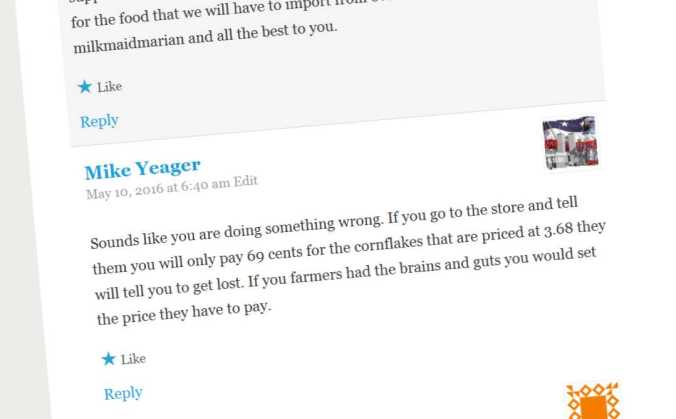
Why don’t dairy farmers just…?

Comment

Of course, Mike is right. You can’t walk into a shop and demand a box of cornflakes at a fraction of the cost.

You can’t cut someone’s wage because your business is losing money. Nor can farmers choose to pay less for stockfeed, electricity or shire rates just because the price of milk has fallen.

We dairy farmers are in a uniquely vulnerable position. We shoulder almost the entire risk in the dairy supply chain. It stinks. It’s grossly unfair. And when you read stories like Appreciating Australian Agriculture‘s below, it’s harrowing, too.


AppreciatingAusAg

So, if we have both guts and brains, why do we let others set the price for our milk? The reality is that dairy farmers have little choice in the matter.

Why not stop sending milk? You cannot switch cows on and off. You have to milk them every day, no matter what, and their milk needs to be sold within two days. It can’t be stockpiled until buyers offer a reasonable price. Of course, you could sell all your cows but then how would you pay your mortgage?

Why not find a buyer who will pay more? Because there are only a handful of buyers and they all offer about the same deal. They tell you the price of your milk. If their sales strategy goes sour, you get paid less. Anyhow, right now, few milk processors around here are willing to take on new farmers. You’re stuck right where you are.

Why not sell the milk direct? Yes, a few farmers do. It costs a six-figure sum to set up a processing plant and takes about a year to get it approved by the regulators. Running that plant and marketing your dairy products is another full-time job on top of dairy farming. It’s also another completely new skill set. In any case, not many farmers have deep enough pockets to establish the plant and endure the inevitable losses during the time it takes to become commercially successful.

Why not just sell the farm and do something else? Well, that’s a question plenty of farmers are asking, too, but it can take years to sell a farm and we do it because we are good at it and we love being farmers.

The reality is that when a few thousand small family businesses sell a highly perishable commodity to a handful of very large corporations, the playing field is anything but even.


Straight-talking UDV president Adam Jenkins on milk price cuts

In the confusion that’s followed the cuts to milk prices, I asked the president of the United Dairyfarmers of Victoria, Adam Jenkins, how the UDV was responding.

Adam had some very clear messages for milk processors, politicians and bankers. A big thank-you to Catherine Jenkins for filming Adam’s answers to my questions in their calf shed on a very windy day.

This video is the first in a short series addressing the milk price crisis.


Fonterra’s Judith Swales explains Theo’s thoughts on Aussie dairy farmers

Theo Spierings Fonterra chief executive Theo Spierings. Photo: Pat Scala, Sydney Morning Herald

Fonterra is one of the world’s biggest dairy companies with a glittering history. A cooperative in New Zealand, Fonterra is also Australia’s second-largest processor.

Just last year, Fonterra delivered a stellar Kiwi farmgate price far better than anything ever enjoyed by Aussie dairy farmers. Analysts enjoyed debating why Australia could not emulate its success. Today, the co-op is under intense scrutiny from its shareholders.

As I mentioned in the previous post, farmers in New Zealand are doing it very tough this year and Fonterra Australia chalked up losses last year.

Then, last week, Fonterra’s chief executive Theo Spierings​, was quoted in the Sydney Morning Herald  in a story headlined Aussie farmers being overpaid amid global dairy rout, says Fonterra boss.

After quoting Mr Spierings as saying the current price of $5.60kg MS could not be supported, the Sydney Morning Herald reported:

Mr Spierings said the method on how Australian farmers were paid needed to change so it wasn’t based just on the farm-gate price and matched other processors.

“It’s loyalty and skin in the game that can lead to an upside. You can call it a dividend, or whatever, a bonus per kilogram milk solids,” he said.

“But we need to have the conversation now about what the endgame looks like. What is the value being created – what’s the size of the cake? Then we need to have a good debate with farmers … about how are we going to share – how are we going to cut the cake?

The comments raised a lot of questions for a Fonterra Australia supplier like me, especially in respect to the “Bonlac Agreement”, which extends until 2019 and commits Fonterra to paying its Australian suppliers a price that equals or betters the dominant processor.

I put some of those questions to Fonterra Australia and am grateful to managing director, Judith Swales, for answering them.

Judith Swales, Fonterra Australia managing director. Pic source: Australian Dairy Farmer

MMM: Why has Theo chosen to telegraph a change in Fonterra’s dealings with Australian farmers via the media rather than by opening a conversation with farmers?
JS: Theo was commenting on the global dairy situation and its impacts for Australia. He was putting a voice to issues that many in the industry are well aware of. These are difficult issues and shouldn’t be shied away from, and as an industry we need to address them.

MMM: Are there any inaccuracies in the article you would like to correct?
JS: The headline was unfortunate. The main issue to point out is that the problem is not around Australians dairy farmers being overpaid – as stated in the headline – but rather the impact global volatility is having on the sustainability of current dairy pricing in Australia. What’s important, is that we’re sending the right price signals to our farmers to avoid any surprises and so that they can budget for various scenarios.

MMM: Theo appears to cast doubt on the Bonlac agreement that ensures farmgate prices match or better the dominant competitor. Will Fonterra honour that agreement this year?
JS: We remain fully committed to honouring the Bonlac agreement. We are focussed on giving our farmers line of sight to the price we can pay this year as quickly and accurately as we can. The price we pay this year must be sustainable. We do not want to sacrifice investment in our long term strategy, which aims to deliver returns above the Benchmark price, in response to short term, tactical pricing pressures.

MMM: Does Fonterra remain committed to the Bonlac agreement in the medium to long term?
JS: We view the BSC Milk Supply Agreement as a baseline. We always strive to aspire to more – whether it be with our SupportCrew services, price risk management tools or our suppliers receiving the highest milk price (as found in an independent report by Ian Gibb for the 2013/14 season). We expect our relationship with our suppliers to continue to evolve over time.

MMM: “It’s loyalty and skin in the game that can lead to an upside. You can call it a dividend, or whatever, a bonus per kilogram milk solids,” says Theo. Does this mean special pricing that favours long-term contracts and large farms?
JS: Achieving a mechanism for determining milk price that drives behaviours that support the success of Fonterra’s strategy for all suppliers is our aim. This work is always evolving and we will continue work with BSC on this.

MMM: Farmers who supply milk to Fonterra Australia are suppliers rather than shareholders. What does Theo mean by “sharing the cake”?
JS: We have always said that the best dairy industry model is the one where everyone can get a sustainable return. Farmers need to be able to make money, processors need to make money and so do customers, like retailers. And that’s what he means by sharing the cake.

MMM: Does Fonterra continue to have a long term commitment to Australia?

JS: Absolutely we are committed long term to Australia; and our Board continues to voice this commitment. Australia is one of our four key strategic markets for Fonterra. It is a key plank to our global multi-hub strategy, which complements our Retail and Foodservice business. We continue to invest: we are progressing our Beingmate partnership; we have plans to rebuild our cheese plant in Stanhope; and only this week we commissioned a multi-million dollar Beverages plant in Cobden.

Thank you very much, Judith Swales!

The calm before the perfect storm for one nervous dairy farmer

A perfect storm is brewing. Collapsing global dairy markets, a fodder shortage, and a strengthening El Nino.

Milk price uncertainty

Just across the ditch, NZ dairy farmers are drowning in despair after the dominant Kiwi milk processor, Fonterra, this week cut its farmgate price forecast to $3.85 per kilogram of milk solids, down from $5.25. The announcement followed hot on the heels of yet another set of disastrous Global Dairy Trade auction figures.

The Global Dairy Trade auction results of 4 August

The Global Dairy Trade auction results of 4 August


Most NZ milk is sold via the Global Dairy Trade auction and an article from Stuff.co.nz neatly explains the situation for NZ dairy farmers:

DairyNZ chief executive Tim Mackle said the news was grim, but not unexpected and many farmers would now be in survival mode.

The drop in milk price would result in $2.5 billion dropping out of rural economies, Mackle said. 

“Milk price is now half what it was in 2013/14. We calculate around nine out of 10 farmers will need to take on extra debt to keep going through some major operating losses,” Mackle said. 

“For the average farmer you are looking at covering a business loss of $260,000 to 280,000 this season but for many it will be a lot more than that.”

It would have a big impact on rural servicing businesses. Drops like this had a cascading effect through rural economies, Mackle said.

DairyNZ analysis showed the average farmer now needed a milk price of $5.40 to break even.

Just a few months ago, dairy industry analysts were forecasting a return to better international commodity prices at the end of this year but opinions seem to be changing, suggesting that there will be not one but two years of pain ahead.

What does this mean for Australian dairy farmers like me? Well, the largest processor of Australian milk, Murray Goulburn, forecast a closing (or end of year) price to farmers of $6.05kg of milk solids just before its partial ASX float. It hasn’t yet revised that closing price but its biggest competitor, Fonterra Australia, says it will announce the results of its own July price review this week.

The big difference between NZ dairy and Australian dairy is this: NZ exports 95% of the milk it produces, while Australia exports just 38% of its milk.  The Australian domestic milk market is much more stable than international commodity prices, so we don’t get the dramatic highs and lows of Kiwi farmgate milk prices. At least, that’s how it’s meant to work.

I’m certainly relieved to have locked in a bottom to the price we are paid for 70% of the farm’s milk. We now supply Fonterra Australia, which accepted our bid to join “The Range” risk management program that sees our price bob about between an upper and lower pair of prices. If the milk price does collapse, we’ll go backwards at a rate of knots but will still be farming next year.

El Nino: more feed needed and less to go round

Sadly, I can’t lock in even a portion of our rainfall. With a strengthening El Nino predicted to persist into next year, the Bureau of Meteorology calculates just a 30 to 35 per cent chance of at least average rainfall for our region from August to October. That means we’re likely to have less surplus Spring grass to conserve as hay and silage. It’s a double whammy because the El Nino also suggests we’re likely to need more fodder than normal over summer and autumn.

To top it off, hay prices are already unaffordable and quality hay is scarce.

The perfect storm

In other words, we’ll need more conserved feed than normal with less than usual to make ourselves and, very likely, starved of cash flow to pay for extra loads from far flung places.

A milk maid’s survival plan

So, what do we do? We’ve already begun adapting by selling off our less productive cows to limit our demand for feed. Thankfully, cattle prices are high right now and the sale of those 13 cows will feed the rest of the herd for three weeks. I’m also spending more time hunched in front of the computer looking for any opportunities to cut costs and keeping an eagle eye on our budget.

A brainstorming and planning session with agronomist, Scott Travers, has helped us plan for extra on-farm cropping with brassicas over summer.

Cows grazing forage rape

The cows will be grazing more brassicas this summer

We’ll be planting several types of brassicas (which belong to the same family as broccoli and cabbage) that mature at different times in a bid to have leafy greens available for the cows throughout summer. The big risk, however, is that the weather will be too tough, even for summer crops.

To deal with this, we are planning another infrastructure project inside the bounds of our new kangaroo fence. Water from our freshwater dam will be mixed with effluent from the dairy yard and pumped over the crop paddocks. It will help the brassicas survive a dry sprummer and summer then help re-establish pasture during an unreliable autumn.

This modest irrigation system will cost money but it will slash the cost of spreading the effluent and should pay for itself quite quickly during a year when visits from the hay truck could spell the difference between make or break.

A perfect storm is brewing and, here on the farm, we are trimming our sails to suit.


How processors decide the opening price for our milk

Piggy Bank

With the anticipation of shoppers pressed against the doors of a Boxing Day sale, farmers look forward to the “opening price” for our milk every season. This year, the hype was bigger than ever.

Last season’s prices were high enough that many farmers have recovered from the year before, commentators continue to gush about the future of dairy and processors are on the hustings looking to poach supply. On the other hand, global dairy commodity prices are tumbling and the Australian dollar remains stubbornly high. Uncertain times.

The first of the major processors to announce its (edit: this post applies to the south eastern Australian states only) opening price was Fonterra, the giant NZ co-operative, at $5.80 per kilogram of milk solids, only to be trumped hours later by Australian co-op Murray Goulburn at $6.00. The two forecast closing prices were in the range of $6.10 or $6.15 to $6.30, making this year’s buffer between the start of season price and the forecast close one of the narrowest ever, suggesting an increased risk of a historically rare and confidence-busting mid-season price “step down”.

Opening prices are a little contentious, with United Dairyfarmers of Victoria president Tyran Jones, labelling them “misleading“. I invited the two big processors to answer some questions about how the opening prices are set. Thank you to Matthew Watt of Fonterra and Robert Poole of Murray Goulburn for their explanations.


Q1. How do you arrive at an opening price?

A: Matthew Watt, Fonterra:

We look at multiple information sources. The most important one of these is the market intelligence we get from the Fonterra Global insights team. I expect that others in the market take a lead from our and Fonterra NZ pricing to leverage this information as well. Other information sources include GDT futures, Fonterra Treasury (FX), Rabo Bank.

  • We extrapolate these information sources into a number of different commodity and currency scenarios (this season we ran in excess of 15 pricing futures through our model)
  • Model looks at weighted returns based on forecast milk flows.
  • Sensitivities are completed at different commodity prices and currency
  • Following this, we establish the most likely estimate of closing price – this becomes the forecast close range.
  • We then compare the forecast close to our lower price scenarios & calculate an opening price that is paying what we can to farmers but also ensure there is a level of protection from any market/forecast downside.

A: Robert Poole, MG:
At a high level:

Milk Price = Total Revenue less Total Non-milk Costs less Profit. As stated below the 2014/14 milk pool grew to $1.7 billion up from approximately $1.2billion in 2012/13.

An extensive budgeting process occurs across the business. We estimate milk intake volumes and composition, determine product mix, budget sales revenue (sales and other), budget company-wide costs, determine profit requirements (to manage balance sheet and funding needs, and dividends) which provides for a milk price. Throughout this process we make certain assumptions such as pricing, volumes, product mix, foreign exchange and sales channels for revenues and savings initiatives, efficiencies, wages and working capital for company costs.

Improvements in the budget position as the year progresses are usually passed through as step-ups.


Q2. How have the margins between opening price and forecast close changed since 2008?

A: Matthew Watt, Fonterra:
The traditional rule of thumb was that opening price was 85% of forecast closing although published forecast closing prices are a relatively recent addition. This year our forecast opening is 94% of midpoint of forecast close range. To actually track this is difficult because published forecast closing prices are a relatively recent introduction.

A: Robert Poole, MG:
Yes, these are slightly different each year. In determining the amount of buffer required, allowance is made for those areas where the co-operative is exposed to volatility; upwards, downward  and other adverse conditions or potential risks.  Generally MG has an opening price between 90 and 95% of its initial forecast.


Q3. Given the uncertainty of the exchange rate and falling commodity prices, is there an increased risk of a step down this year?

A: Matthew Watt, Fonterra:
As the variance between opening and forecast close narrows, there are an increased number of potential scenarios that provide a number that is on or lower than opening price.

  • Our current forecasts suggest that commodities will improve which is factored into our forecast close price. However, these are subject to global economic conditions and global production – both can move quickly and can impact commodity prices either way
  • The exchange rate has been anticipated to fall for some time but it remains high and a number of forecasts suggest that this could increase. As a rule of thumb, every 1 cent move in the exchange rate (across a full year) will have a 5 c/kg MS impact on milk price
  • At this stage of the season, we have limited volumed that is priced and sold. This means that, any moves in the commodities or exchange rate have a large impact on the actual, final milk price. As we move through the season, we get more priced and sold, meaning that movements that happen later in the season have a lower impact on the farmgate milk price.

A: Robert Poole, MG:
The difference between the opening milk price and the budgeted milk price allows for adverse variances to budget and a step down in price is historically very unlikely.


 Q4. What percentage of your Australian suppliers receive a price that is equal to or above the published opening price?
A: Matthew Watt, Fonterra:
All of our published pricing is based on best quality milk. The greater the level of penalty/incentive built into the pricing construct and the relative achievability of the premium quality standard will impact the difference between average quality and premium quality.

On our new, simpler pricing construct, between 25 & 50% of our farms will be at or above average quoted price, (assuming premium quality). Given we also have a transition payment in place from old pricing system to new, the number that will actually receive more than the published number will be over 50%.

60% of our suppliers are within +/- 0.15 cents per kg MS of average price, based on premium quality. Naturally, the poorer the individual farms actual quality that is delivered, the further they get from average price due to penalties incurred.

A: Robert Poole, MG:
Approximately 50% of milk supply is above the average and 50% below – hence the weighted average.  The majority of suppliers are within 2 cents per litre of the average.

[NOTE from MMM: I did follow up with Robert to clarify his answer in terms of the percentage of farms but the information was not available for the blog.]


Q5. Aside from the opening price, what do you think are the top three reasons farmers are attracted to supply your business?

A: Matthew Watt, Fonterra:

  • As a broader comment on price, I would like to think that farmers look past opening price as a reason for choosing a processer, particularly on opening average quoted numbers. On the price aspect, whilst opening is an important indicative number, what is really important is how that pricing construct suits an individual farm and, what the actual as opposed to projected or opening price performance is.
  • However, the three key reasons that we think farmers value are
    1. Leveraging our Global Leadership for Local Benefit – this means giving the best market information to our farmers to help better decision making on farm and, as a key extension to this, introducing fixed base milk price to enable farmers to better manage price risk. The other aspect of this is the multiple product streams, brands, domestic and global markets that we are active in. This provides access to the best and emerging opportunities in the market as well as a balanced group of customers and products which serves to reduce risk.
    2. Supporting Profitable Farmers – Profitability in farming is fundamental to industry success and our success if we are going to have long term, secure milk supply. We clearly don’t control all of the profitability factors. However, there are some that we do and some we can influence. These include simplifying our pricing structure. A critical aspect of this was ensuring we were aligning the value that we could extract from the value chain into  a clear construct, enabling suppliers to farm profitably to their set of circumstances and available resources. We be believe it is now better understood, reduces risk to farm business profitability and enables better decisions around optimising margin to be made by our farmers. It also includes our support crew work, where we assist where we can with specific opportunities within business to increase bottom lines – this year we have identified well over $1M of profit that has been generated by specific farmers through this program.
    3. Partners in Asset creation – this means getting to a stage of sustainable profitability and then leveraging that for future growth. Again, our fixed base milk price program plays an important role in helping to provide the certainty and confidence required for a farmer to make an investment decision to growth. We are also leveraging our support crew team to identify opportunities to support the growth of our farmers, where it makes sense for them. The support can come in many ways – technical, helping prepare information for banks, direct finance assistance and the like.

A: Robert Poole, MG:

Our suppliers are attracted to MG for a number of reasons. If I had to limit these to the top three they would be:

  • The strong understanding that whilst opening price is very important that having a Co-op that has the objective of growing the pool of money available to farmers. For example in 2013/14 we have grown the pool paid to farmers from $1.2 billion to approximately $1.7 billion.
  • A desire to supply the last Australian farm owned dairy Co-op, controlling the milk supply process from end to end and passing benefits to farmers.
  • Stability – MG has a proven performance, reliability and track record of successfully running a large and complex dairy company for 64 years and we have a clear strategy to improve business performance
  • Service and support


“Bring on the cows” demands a new routine

“Bring on the cows” trumpets The Australian, headlining a story about MG Co-op managing director, Gary Helou. In response to rumours that the co-op might purchase a large Tasmanian dairy farm, Mr Helou reportedly says:

“We are not farmers; MG is a global dairy food processing and milk company, and we will not be buying farms directly; that is not our business,” Helou says adamantly.

“The only way to get extra cows and milk is to up the farm gate price enough that farmers will want to invest (in more cows) themselves. So that’s what I have set out to do, maximise the farm gate price and reduce the cost of processing and the supply chain and then efficient production will follow.”

Here’s the problem: MG is not a global dairy food processing and milk company. It is a co-operative of Australian dairy farmers who are members because they expect MG to, first and foremost, maximise their profitability. Not by investing in a processor (they could just buy ASX shares if that was what it was all about) but by looking after farmers directly.

They don’t just supply MG, it’s not just their MG, farmers ARE MG.

Am I being hopelessly idealistic? I don’t think so. This focus on being a processor has flowed through to the co-operative’s milk price system.

The final milk price only tells half the story. The quoted “average weighted” milk price is skewed to favour farms with flat production curves (mirroring those of the processor) at the cost of farms whose milk supply matches the natural ebb and flow of cow and pasture. For the vast majority of Australian dairy farmers, the way our co-operative pays us is at odds with efficient milk production.

MG must remember what being a cooperative really means before its farmers will be ready to “bring on the cows”.