Protecting farmers from ourselves

Apparently farmers cannot be trusted with anything. Not even to want the highest farm gate milk price for ourselves.

Bega has just sold its stake in Warrnambool Cheese & Butter to Saputo, putting the Canadian billionaire on the brink of controlling WCB even though a higher price was on offer from Aussie farmer co-op, MG.

This happened because our co-op hasn’t been allowed to bid during the bidding period.

Australian farmers who want to invest in their own futures and who are willing to pay the highest price for WCB have been stymied by a government artifice in the name of protecting…you guessed it…farmers from themselves. Apparently, another processor that thrives on a low farmgate milk price is better for us farmers than having an efficient farmer-owned co-op.

This Aussie dairy farmer will never forgive Joe Hockey for sitting by and watching.

So, where to now? That, my fellow source of low-cost milk, is up to us, for although Saputo can buy WCB’s stainless steel, it cannot buy our future. Only Australia’s dairy farmers decide where our milk flows and our fortunes lie.

What the cold, cold heart of Coles reveals

The man who directs the face and voice of Coles must have become a little overconfident. In a breathtaking display of arrogance, Coles’ general manager of corporate affairs, Robert Hadler, addressed an audience of spin doctors with this presentation: http://www.documentcloud.org/documents/800088-reputation-coles.html#document/p5

Plenty of people have discussed why this presentation was in such bad taste. Callous, even.

But the part that really caught my attention was the role of our co-op, Murray Goulburn, in Hadler’s “case study”. The gloating Hadler describes the deal with Murray Goulburn as “The game changer”.

Hadler’s right about this but not in the way he means, I suspect. The Hadler case study goes to show just one thing: no matter how Coles tried to spin $1 milk, Australians knew it stank and none of their ads, infographics or appearances by Curtis Stone could fix it. Until, finally, Coles actually did something to address the damage caused by the milk war: an unprecedented 10-year deal that was too good for the co-op to refuse.

Now that’s not a case study in spin, Mr Hadler, that’s a case study in people power.

PS: If you would like to keep up the pressure for Coles to do the right thing, add your voice to this petition by Queensland ag teacher, Lisa Claessen, who was compelled act after her students became casualties of the ColesWorths milk war.
 

Never say die

When analysts talk about softening milk supply, there’s a whole other layer that’s anything but soft. It’s uncomfortable chats in the dairy about next week’s roster, sleepless nights worrying about where the next load of hay is going to come from, and long, long hours.

He spends more time in the tractor, she spends more time off-farm to pay the bills. The office is a mess, the kids watch a little more TV than usual and the mummy guilt rises with it. They all get snappy.

He comes in from the chilly night air long after the children have gone to bed. She’s in the office doing the books. Farms are not selling. There is no light at the end of the tunnel and there’s no way out, either.

Then one afternoon, the farm consultant brings a welcome dose of encouragement: the place is in great shape, poised to take advantage of any recovery, and the gossip around the traps is that an upbeat announcement from the co-op is imminent.

That night, as she takes her little boy out to check on the maternity paddock, the farmer is drawn by a ruckus at the dam. A moorhen hangs about a metre above the water, caught by one leg in a twist of wire and flapping its glossy blue-black wings desperately even though there’s clearly no hope of escape.

The farmer cannot stand and watch any more than she can walk away. With toddler on her shoulders and Blundstones squelching through the shallows, she wades towards the struggling bird. There is blood on the wire but with a deft spinning wrench, the fence springs back to shape, releasing the bird which, to the farmer’s astonishment, paddles away seemingly unhurt.

In the morning, the most anticipated email of the year arrives. To the farmer’s astonishment, the milk price will open 24 per cent higher than last year and the co-op has a little rescue package in the shape of a pre-payment for those prepared to pledge their loyalty. She reads the email twice more, just to be sure.

Never say die.

How to rescue dairy – from the nutty to the tricky

Dairy farmers gathered in their hundreds in south-west Victoria last night for a crisis meeting. What makes it a crisis? Very simply, dairy farmers are working seven days a week for free and petrified of losing our shirts.

Local agribusiness bankers tell me they are busy refinancing and arranging extra debt but land sales are at a standstill around here. Reporting on last night’s dairy crisis meeting, Simone Smith of The Weekly Times, described a “dire picture”:

“Warrnambool-based Coffey Hunt farm accounting specialist Garry Smith said across his client-base, farmers milking mostly between 450-500 cows, average feed costs were up 15 per cent – a $150,000 rise – with the cost of power for the first quarter of the year up 50 per cent.”

“He estimated across his client-base earnings would be 10 per cent down on last year with a combination of cash-flow and income down $260,000.

“Charles Stewart real estate agent Nick Adamson said better quality farms had dropped in value between 8-15 per cent, while others were up to 45 per cent down on peaks of several years ago.”

None of this is pretty and astonishingly, Peter Reith decided to appear on ABC’s The Drum website with a six-point plan that, at first, I thought was a spoof. Take a look and make up your own mind.

It’s not as simple as cutting petrol taxes and municipal rates. It’s tricky because of this conundrum: milk and dairy foods are considered so important that nobody wants to pay what they are worth to produce.

Every day I read comments on Twitter that go something like this: “My kids drink three litres of milk every two days, so I can only afford to buy $1 milk”. I know first-hand how tough it is to feed a family when you’re on struggle street, so I have a lot of sympathy for people in this predicament and it’s impossible to respond with anything other than compassion.

It’s hardly surprising, then, that there is no political appetite for an increased milk price. But the truth is this: dairy farmers should not and cannot fund an ersatz Australian welfare system by subsidising the cost of food. Welfare is the role of government.

So, while my dander is up, here’s a simple list of five tricky things that would make a big difference to this dairy farmer:

1. Deal with the supermarket duopoly
Down, Down, Down is not about you, dear milk drinker. The real reasons for the supermarket war are expressed in corporate ROIs rather than family budgets. At the end of the day, it will be the little people with the least market power – you, the shopper, and me, the farmer – who will pay.

2. Level the global playing field
Julia Gillard announced that Australia would be Asia’s food bowl but guess what? Unlike the world’s most powerful dairy exporters, the Kiwis, we do not have a free trade agreement with China, putting Australian dairy at an immediate 15% disadvantage. Nor do we receive the government subsidies that support our European and North American competitors.

3. Assist with the impact of the carbon tax
Australian dairy farmers are suffering a double whammy under the carbon tax. First, processors are passing the extra cost onto us in the form of lower farm gate prices (because the consumer won’t pay extra and nor will global commodity markets), reducing our incomes by around $5,000 each per year. At the same time, our costs – especially electricity and refrigerants – are rising in quantum leaps each quarter.

4. Support smart farming
Long exposed to the blow-torch of global export markets without subsidisation, Australia’s dairy farmers are among the most efficient in the world, according to research body, Dairy Australia. We can produce very high quality milk at a very low cost because we have invested in research and development. No longer. We are spending less and less on R&D and the Victorian government has just made massive staff cuts to our brains trust, the Department of Primary Industries.

5. Remember, I am the goose that lays the golden egg
I will not be able to continue to deliver high quality milk at such a low price while enhancing the environment and caring for our cows without sacrificing the basic wellbeing of my family and that, I refuse to do.

Whose fault is it?

Lots has changed since 1980. Milk production in Victoria has more than doubled despite cow numbers remaining the same and 35% per cent less land to graze.

Since then, we’ve had massive advances in cow genetics, understanding how to grow grass and exactly what cows need to eat. But we farmers are no better off. Despite it all, we’re very much poorer.

Everyone seems to have an opinion on why that is and just whose fault it is. Pretty much everyone has copped it online: the government, supermarkets, milk processors, agri leaders, farmers and consumers. What strikes me, though, is just how similar our situation is to that of farmers around the globe.

Milk has been sprayed at icons in France, the Brits have hit the barricades in desperation, and outgunned riot police in Brussels. Things are miserable in the US, too.  I think the reality is that affluent societies consider high-quality food a right. And you don’t value your rights until they are threatened.

Very few urban Australians would believe their access to fresh milk is at risk and, until they do, unsustainable food pricing will be “someone else’s problem”. I wonder whether it will be me or my children who will one day staff the barricades, wield the “milk cannon” or simply quietly try something else that’s truly valued by Australians.

Sustainable dairy farming

Sustainability isn’t about the environment, animal welfare, profitability, business succession or manageability. For me, the definition of sustainability is all of them.

Australia’s dairy farmers are good at environmental sustainability – we are the front line environmentalists behind the Landcare movement. I like to think we are also exceptional when it comes to caring for our animals too. Profitability, not so good. Business succession, woeful. Manageability, well that’s debatable.

City friends think I live an idyllic life, frolicking among the cows but this lifestyle can bring stressors urban Australians would never imagine. According to the University of South Australia:

UniSA Psychology PhD student Alison Wallis knows what can drive a dairy farmer to cry over spilt milk.
For the past four years Wallis has been investigating the work stress of South Australia’s dairy farmers.
It’s a group she says at the time of the research had one of the highest incidences of work-related stress in the nation.
“There hasn’t been a lot of research done on the stress levels of those who are self-employed,” Wallis said.
“But we found that dairy farming produced some of the highest distress scores of many Australian occupations.”

Reading Tom Phillips’ excellent dairy blog, Pasture to Profit, I discovered we are not the only ones. Our trans-Tasman counterparts are also studying dairy farmer burnout.

It’s all amplified in times like these – when the rain won’t stop falling here in the south and when the prices won’t stop falling up there in New South Wales and Queensland – and so much of your success or failure seems to be in the laps of the gods (whether Thor or Coles).

On the other hand, it’s times like these that faith in human nature is restored by the generosity of people who care. People like Queensland ag teacher, Lisa Claessen, who, seeing the distress of her students, has taken to social media to petition the Coles CEO for a sustainable milk price. If you would rather not have UHT on your cornflakes, please add your name to her cause.

Design a warning label for cheap milk

The people who make milk and the people who drink it are on the same side. We all want safe, high quality food at a reasonable price without compromising the way we care for our animals or land. Put simply: sustainable food.

But when you stand in front of the supermarket fridge, there’s no way of telling what is sustainable. There’s nothing on the label that says: “WARNING: Buying milk at $1 per litre will mean your fresh milk will soon be flown to China“.

My advice is to keep it simple and steer clear of plain label milk. It’s looking after the interests of the big end of town and all the little people – milk producers and milk lovers – are the ones who will ultimately pay the price. It’s time for us all to make a stand – please tell everyone who will listen.

I asked UDV president whether dairy farmers should tip their milk down the drain

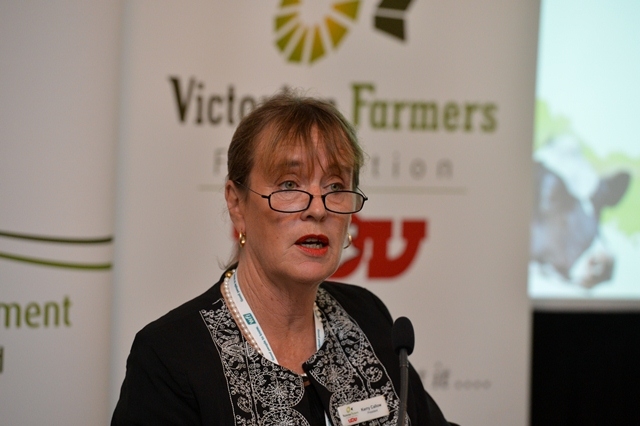
I’ve been asked a few times why dairy farmers don’t just refuse to supply supermarkets or tip our milk down the drain in protest at the unsustainable price of milk. Meanwhile, the actions of the Brits in blockading milk processors has been spectacularly successful. I thought I’d put a few “burning” milk price questions to the president of the United Dairy Farmers of Victoria, Kerry Callow, who kindly offered the following replies.

Kerry Callow

UDV president, Kerry Callow

MMM: We’ve all heard that $1 milk is a big deal for farmers but what about consumers? It sounds like a great deal, especially for families doing it tough!
KC: Milk at $1 is obviously attractive to consumers. Especially those with limited incomes and young families to feed. Dairy farming families understand limited incomes. They have had a cut in prices they receive – like having a salary cut. But this is not just about the here and now. It’s also about what’s sustainable. What will consumers have in years to come? Milk at $1 a litre retail is not sustainable for dairy farmers to produce. In Queensland it is reported that already 30 farms have left the dairy industry and more will follow. And consumers will have noticed the challenge in finding non-supermarket brand full cream milk in the dairy sections. This is a strategy for the supermarkets to dominate the supply of milk products industry. It is hard to see how consumers will keep the choices they currently enjoy. Farmers cannot afford to produce milk at the current price.

MMM: Why don’t farmers simply refuse to sell the milk at such low prices?
KC: Dairy farmers also have families to feed, children to educate and bills to pay (power has gone up 16% since the end of June, refrigerant gases required to cool milk have skyrocketed). And dairy farmers also have contracts to supply milk to processors to fulfil. The financial penalty to not supply is greater than the financial penalty to supply at a loss.

MMM: What about tipping the milk down the drain for a few days?
KC: Tipping milk out for a few days doesn’t fix the problem. (Disposing of milk that way does create added management challenges on farm). The problem is that supermarkets have decided to use milk as a ’loss leader’ and hold the price of milk down to ridiculous levels.

MMM: Is the VFF/UDV considering action like the farmers took in the UK? Would it work here?
KC: There is also discussion in New South Wales and Queensland about taking direct action. Because dairy farmers in those states rely heavily on the fresh milk market they are more exposed to the supermarkets pricing actions. Taking direct action is difficult because in this case the focus of dairy farmers angst is not a government or agency or authority, it is a commercial entity that has shown limited capacity to hear farmers concerns or acknowledge that their actions are directly and adversely impacting dairy farming families. That said, farmers are getting frustrated with the current situation.

MMM: Is there a silver lining to the $1 milk campaign?
KC: Not really. The supermarkets will point to milk consumption being higher now than before the retail milk price was slashed. But we think the consumer is heading down the road of less choice for milk products. And now we have other products like cheese and butter being marketed heavily on price. That is not a positive outcome.

“MG understands dairy farming profitably…will be very challenging…”

Yesterday, Murray Goulburn Co-op, which buys and processes our milk announced how much we will be paid from next week. It equates to roughly 33 cents per litre.

In the letter announcing the farm-gate milk price, Murray Goulburn CEO, Gary Helou, writes:

“MG understands that dairy farming profitably at these opening and forecast prices will be very challenging
and we will do everything possible to increase farmgate returns in the short and long term.”

I appreciate Mr Helou’s frankness but, to be honest, it sent shivers up my spine. It reminded me of 2009, when it was clear that no matter how long, hard or smart we worked, we would lose money. In fact, the average dairy farmer took on $220,000 extra debt. This year, it looks like we’ll lose about 3 cents for every litre of milk we supply. Ironically, that could mean we try to produce more milk in an attempt to offset our fixed costs or a lot less milk if we instead decide to sell cows. It will also mean I spend more time trying to earn an off-farm income to reduce the impact on our family.

This is essentially what makes dairy farming a very tricky business: we have one product that we sell to one customer at a price they set. No wonder we’re a resourceful bunch.

Would you like ethics with that?

A consultant once told me: “My services can be described as cheap, good and quick but you can only have two of the three at once.”

When it comes to milk, the choices are: cheap, good and ethical. Under the umbrella of “ethical” comes animal wellbeing, the environment and the welfare of farming families.

I don’t have any input on which pair wins out – you and the thousands of others who drink our milk or eat our cheese do. At the moment, with prices falling and consumers celebrating milk that’s cheaper than water, it seems “ethical” is the loser.

As someone who farms because she loves the land and her animals, this is very, very sad news. Currently, it is my family that is missing out rather than land or animal. Eventually though, we won’t be able to carry the burden and we will be the ones facing three choices:

1. Find a way to fund niche value adding for ethical products;
2. Industrialise our farming practices and see a fall in animal wellbeing and environmental outcomes; or
3. Leave farming.

Only time will tell.

With this in mind, it was interesting to read this comment in response to Lynne Strong’s point that consumers have a role to play in animal welfare standards following a story on The Conversation:

“Is it the case that, in buying a $5.00, 2L carton of milk in Australia, I can be assured that the product was sourced more ethically than the $2 Coles brand?”

Of course not but you can be sure that by purchasing unsustainably priced milk, you will be putting pressure on ethical standards right across the country.