“Bring on the cows” demands a new routine

“Bring on the cows” trumpets The Australian, headlining a story about MG Co-op managing director, Gary Helou. In response to rumours that the co-op might purchase a large Tasmanian dairy farm, Mr Helou reportedly says:

“We are not farmers; MG is a global dairy food processing and milk company, and we will not be buying farms directly; that is not our business,” Helou says adamantly.

“The only way to get extra cows and milk is to up the farm gate price enough that farmers will want to invest (in more cows) themselves. So that’s what I have set out to do, maximise the farm gate price and reduce the cost of processing and the supply chain and then efficient production will follow.”

Here’s the problem: MG is not a global dairy food processing and milk company. It is a co-operative of Australian dairy farmers who are members because they expect MG to, first and foremost, maximise their profitability. Not by investing in a processor (they could just buy ASX shares if that was what it was all about) but by looking after farmers directly.

They don’t just supply MG, it’s not just their MG, farmers ARE MG.

Am I being hopelessly idealistic? I don’t think so. This focus on being a processor has flowed through to the co-operative’s milk price system.

The final milk price only tells half the story. The quoted “average weighted” milk price is skewed to favour farms with flat production curves (mirroring those of the processor) at the cost of farms whose milk supply matches the natural ebb and flow of cow and pasture. For the vast majority of Australian dairy farmers, the way our co-operative pays us is at odds with efficient milk production.

MG must remember what being a cooperative really means before its farmers will be ready to “bring on the cows”.

MG capital raising program raises plenty of questions

Farming is all about taking risks. Our businesses rise and fall largely on the backs of increasingly volatile international commodity price cycles, exchange rates and the weather. Plenty of really good farmers have come unstuck through no fault of their own, other than taking a good risk at a bad time.

On the other hand, our co-op, Murray Goulburn, has always been considered a pretty safe bet. It was formed more than 60 years ago by a group of Victorian dairy farmers seeking a better deal for their milk and has grown to become Australia’s third-largest food and beverage company – dwarfed only by Coca Cola Amatil and Lion.

Our managing director, Gary Helou, doesn’t want to stop there. At a supplier meeting this week, he spoke about the need to move at “break-neck speed” with new products to capture new markets within the next three to five years, swallowing competitors along the way.

They’re exciting times for this once risk-averse co-operative. The proposal being put to farmer shareholders is to list a chunk of the co-op on the ASX so that anyone can buy a piece of the action. Farmers with excess shares will be able to sell to non-farmers but these external investors, however, wouldn’t have voting rights.

Am I in favour? Yes, if the new capital structure can:

  • Enshrine farmer control
  • Maximise farmer profitability
  • Treat all farmer shareholders equitably
  • Allow the co-operative to provide great opportunities for new generations of farmers

Those are big “ifs” and there just isn’t enough detail yet to know whether any of them are satisfied. It is incredibly heartening though that the MG Board has listened to member concerns that the initial start date of the program of July 1 was far too soon to consider the complex implications of the proposal.

That’s the beauty of a co-operative: members have a real say in their own futures. And that’s why those of us who cherish it must have no fear of asking questions.

Dairy pawn

Image from http://enos.deviantart.com/art/Cow-Chess-1353853 by enos of Deviant Art

These days, I feel a little like a chess piece; more pawn than queen.

The Australian federal government has rushed into a free trade agreement with Japan that does next-to-nothing to help Aussie dairy break through tariff barriers, even though Japan is hardly known for a growing dairy industry of its own that deserves protection. I don’t know why we were overlooked but a Sydney Morning Herald story quotes Warren Truss as citing “compromises”.

It’s been an interesting few days for dairy. Coincidentally, the ACCC forced supermarket superpower, Coles, to confess that it was lying when it claimed the $1 milk had not hurt dairy farmers.

At the same time, the media is littered with references to milk as “white gold” and so on, while our co-op, Murray Goulburn, contemplates a partial sell-off to raise capital.

And the milk maid? Yes, I’ve almost recovered financially from last year now but not emotionally.

A Kiwi who’s now dairy farming here in Victoria tells me that one of the differences he’s noticed is that there’s just not the “buzz” around our farmers in a good year that you get in NZ.

Why? First, we’re more battle-weary and risk averse after a decade of drought knocked us around. Second, we’re rightly a little more cynical. In NZ, dairying gets a lot of encouragement from a government that understands dairy’s huge economic impact on the entire nation. The sector accounts for about 3% of NZ’s GDP. Have a look at this economic statement:

“Rebounding dairy production drove a 1.4 percent increase in gross domestic product (GDP) for the September 2013 quarter — the biggest quarterly increase since December 2009, Statistics NZ (SNZ) said.”
The New Zealand Herald, 19 December 2013

Here in Australia, the dairy sector contributes $13 billion to our economy but that’s considered small fry, accounting for less than 1% of our GDP, which totalled $1451.1 billion in 2011–12.

If we are to realise our potential, we need a government that helps dairy grow rather than considering it as a tradeable concession. All eyes are now on the FTA negotiations with China.

Nine tricky questions for MG, answered

Today, Murray Goulburn Co-op stepped up its offer for Warrnambool Cheese and Butter again, to a staggering $9.50 per share. In a year where most dairy farmers are still playing catch-up from a horror stretch, it’s no surprise that some of us are getting nervous about how the deal stacks up.

I wanted to put the top nine the questions I’ve heard from farmers to one of MG’s most senior people, general manager shareholder relations Robert Poole. His responses have just arrived. Let me know what you think!

1.    Where is the money for the bid coming from?

Murray Goulburn has committed financing facilities available from its existing lenders to fund the Offer.  A further $350 million of new facilities have been provided by National Australia Bank (NAB), Australia and New Zealand Banking Group (ANZ) and Westpac Banking Corporation (WBC) in order to finance the transaction and assume Warrnambool’s facilities to the extent required.  The support of the financiers in providing these facilities re-enforces Murray Goulburn’s views that the rationale and financial metrics implied by the offer are sensible.

It also confirms MG management and the Board’s view that the level of leverage in the business is appropriate for a co-operative structure particularly in its current phase of significant growth and investment.

2.    MG’s balance sheet is described by commentators as “over-stretched”. Gary Helou countered by saying cooperatives are different. In what way?

Our offer is financially prudent and has been well considered. Our gearing will increase to around 57.2% – a level that our Board is comfortable with taking into account that we are a 100% farmer controlled cooperative with a range of options. At the financial year just ended our gearing was 43%. Based on a successful transaction, our FY14 gearing is estimated to be around 57%.

Co-ops are generally well supported by banks and this is the case with MG. Our bid for WCB is fully funded by NAB, Westpac and ANZ. Co-ops are not listed and are backed by their farmer suppliers. The capacity of the co-op model to sustain debt is well established and is evidenced by offshore examples most recently and notably Fonterra prior to their raising of non-voting equity capital. Co-ops traditionally have a higher level of debt. For example, Fonterra reached gearing levels of over 60% during growth phases.

3.    How can you justify paying so much more than WCB’s stated “fair value”?

MG has carefully assessed the value of WCB, and our Offer is financially prudent and well considered. MG would NOT proceed with any bid unless the result added to the overall milk price and our analysis shows that a combination of WCB and MG will do just that.

This is an extremely complex and ever changing situation. However what is clear is that the industry needs consolidation to improve the efficiency of the supply chain and create a larger scale globally relevant Australian dairy food company, uniquely positioned to capture the unfolding long-term opportunity in international dairy markets. We believe it is vital that the co-operative has a central role to play in this – to build a strong farmer-owned business that can compete on a global scale against the other giant dairy co-operatives like Fonterra, Dairy Farmers of America, Friesland Campina and Arla – not to mention multi-national giants like Nestle and Kraft.  MG is the only partner for WCB that has the scale and co-op structure to invest, grow and maximise farmgate returns for farmers, and ultimately regional communities.  We remain committed to acquiring WCB, satisfying our conditions and delivering the benefits of the combination back to the farmgate.  This can only be good for local investment, jobs and communities.

4.    Can MG guarantee that its WCB bid will not damage the farm gate milk price? If so, how?

MG would NOT proceed with any bid unless the result added to the overall milk price and our analysis shows that a combination of WCB and MG will do just that. MG itself is entering an exciting phase of growth and has identified a series of strategic capital investments that will target a $1.00 per kilogram of milk solids lift underlying farmgate milk prices over a five year period from FY12 to F17.  MG will deliver these benefits to supplier shareholders including those WCB suppliers who join the co-operative regardless of the outcome of the WCB bids.

5.    Competition is often said to be healthy for businesses. Doesn’t a strong competitor for milk supply help to keep MG on its toes?

I would counter that it is MG that keeps competitors on their toes, as we traditionally lead the market on farmgate pricing.  As a 100% farmer controlled co-operative MG’s primary objective will always be to maximise farmgate returns for our supplier/shareholders. As opposed to competitors who have the primary objective of maximising profits to their shareholders.

MG is the only partner for WCB that has the scale and co-op structure to invest, grow and maximise farmgate returns for farmers, and ultimately regional communities.

The current structure has not served the industry well over the last decade. The Australian industry has gone backwards while Asian demand has grown significantly – Australia is now a less relevant player in the international markets than it was in 2002. This has coincided with the drought, deregulation of the dairy industry and investment by foreign players.

Increased participation by foreign players has not lead to a restructure of the processing industry – the processing structure remains extremely fragmented. While foreign players have been in Australia for some time, they have not driven growth for Australian dairy products in the international markets.

MG’s own strategic plans and the proposal for WCB will assist in leading the Australian dairy industry to recovery and growth over the longer term. Our proposal is the one that creates a larger-scale globally competitive Australian dairy company uniquely positioned to capture growth in international dairy markets. Our plans involve investing and growing the businesses to meet the opportunities.

6.    Why do you think farmers tend to be polarised in their attitudes towards MG?

I can’t comment on why. However, what I can say is that in recent years MG has been committed to improving and building relationships with dairy farmers and this has been underpinned by meaningful, in depth engagement and transparency. We believe this is yielding some very positive long term results for both the farmers and their co-operative.

We respect that people will have differing opinions however we welcome the opportunity to talk with any farmers to clarify questions, share our plans and our vision for the industry, as we did this week in Warrnambool and Mt Gambier.

We will continue to work hard to demonstrate to WCB and other dairy farmers the benefits and importance of becoming a supplier/shareholder of the co-operative. We believe we have a compelling story and look forward to talking to WCB dairy farmers about our offer and the opportunity for them to become part of the co-op.

7.    How has MG’s culture changed in the last few years?

Over the past few years MG has been on a journey to become a more efficient and effective co-operative that can return more, and contribute more to its supplier shareholders, their communities and the industry as a whole. There is no doubt this has been reflected in the culture of our business, while remaining true to the co-ops core objective of maximising total farmgate returns.  In addition, to a focus on improving and building relationships with dairy farmers, corporate governance has also been a priority, including developing Board and Committee Charters and formalising policies such as Public Disclosure, Risk Management and a Code of Conduct.  Over the past couple of years MG has also had Board renewal with a number of new supplier Directors being appointed, appointing two specialist Directors; as well as the appointment of a new executive management team, including Managing Director, Gary Helou.

8.    How differently do you expect to run the Allansford factory? Can its workers feel secure?

Foremost our bid is about investing and growing the MG/WCB business to increase scale and maximise farmgate returns. We see significant potential and this can only be good for local investment, jobs and communities. Both the MG and WCB processing facilities are already operating at or near capacity and they are making different products which makes them complementary. Down the track, we may identify operating efficiencies and if we do, these will flow through to the farmgate price and ultimately to farmers and their communities. That said we believe there will be substantial opportunities for existing employees in an enlarged group with national and global reach.

Our proposal is the one that creates a larger-scale globally competitive Australian dairy company uniquely positioned to capture growth in international dairy markets. Our plans involve investing and growing the businesses to meet the opportunities.

9.    Aside from size, how would MGW compare to Fonterra?

Fonterra has become a highly successful global dairy giant and we believe that MG now has a similar opportunity before it. The combined business will be positioned to capture the unfolding long-term opportunity in international dairy markets. A combined MG/WCB would create one of the largest Australian owned food and beverage businesses, 100% controlled by dairy farmers, making us a top 20 global dairy producer.  To put it another way when combined we’ll have forecast revenues (FY14) of $3.2b and be one of Australia’s top 5 food and beverage businesses, behind Lion and Coca-Cola Amatil, Fonterra and JBS Australia.

The combination will give us the necessary scale, market reach and efficiencies, and like Fonterra, we will have far greater relevance in export markets to be able to grow the brands and products from each business.

The combined business will have over 3000 suppliers, approximately 4 billion litres of milk processed annually, a diverse product range and market reach, forecast revenue of $3.2 billion (2014), diverse operations and a strong production base in Australia’s best producing dairy regions.

So this is an historic opportunity for Murray Goulburn and WCB suppliers and shareholders to create a larger scale, globally competitive Australian dairy food company that they own and control.  Importantly, it will retain the primary objectives of a co-operative in maximising farmgate returns for farmer owners.  It will also support on-farm and industry investment, and in turn grow the Australian dairy industry for the benefit of regional communities.


Dear Joe, how will you be remembered?

Dear Joe,

Why have you betrayed me so cruelly?

You came to me in September with promises of fatherly love and affection. You described me as your pillar and that, after mining’s bloom had faded, I would be your everlasting rose. You said you needed me and that, without me, you would forever be insecure.

But now that my fate lays in your hands, you act swiftly to hasten the courtship of WCB by Saputo whilst locking me in the cellar, dressed in rags. I implore you to at least allow me to attend the ball so that I may win the hand of my beloved.

Your faithful Milkmaid

Okay, I never really fell for you, Joe, but here it is:

  • Before the election, you described agriculture as one of the five pillars of the economy and said that food security was important. I’ll hold you to that.
  • For Australia to have a dairy sector, it must be able to compete with the international goliaths. That means we need a big processor with scale.
  • Australia’s dairy farmers are sticking together and want to grow so we can be more resilient. We absolutely have to because we don’t have the subsidies, FTAs, cheap labour or government support enjoyed by most of our competitors.
  • Our 100% Australian farmer-owned cooperative exists to maximise farm gate prices and consolidation rather than competition is what’s needed. We are prepared to step up to the plate and invest in our futures.
  • You gave the giant, privately-owned, foreign Saputo a huge leg-up with swift clearance, declaring Australia “open for business” with a grin on your face.
  • Don’t hide behind the ACCC or the slow-as-a-snail tribunal. Where there’s a political will, there’s a way. Your Kiwi counterparts knew that doesn’t make sense and cast their equivalent aside to allow the much-admired Fonterra to take shape.
    To pin us to such a protracted process while ushering though our foreign competitor is to drive a stake through the heart of the co-op’s bid.
    You surely understand the irony of thwarting MG’s bid based on competition policy when it is Australian farmers themselves desperate to become more competitive who are driving this bid and, in turn, are being rendered non-competitive in this fight to keep WCB Australian-owned by you, our own government!
  • You are the biggest impediment to Australian farming families taking a greater stake in our own futures by keeping WCB Australian owned.
  • If you insist on holding us back, you will be remembered as the man who sold Australia’s dairy farmers down the river. And for what? The love of Lino?

Joe, it’s time you stepped out of the way and gave us a fair go.

Divided we fall: so where to from here?

After a nose dive

Don’t worry if you fall, just get back up again.

Wayne said the other day that the farm has taught him something about resilience: live in the moment when the sun is shining and, when the hail stings your skin, think of the big picture.

But the big picture right now is confusing for this Milk Maid. The WCB war has thrust the outlook for Australian dairy into the headlines and, with it, a lot of questions.

Our co-op has offered half a billion dollars for WCB, claiming that its loss to a global player would be “a tragedy”. In its statement to the ASX, MG Co-op said:

“The combination of MG and WCB is the only option available that delivers an Australian-owned and operated company with the scale, capacity, strength and momentum to service global growth opportunities, returning profits to dairy farmers and their communities.”

In the midst of all this, the UDV hosted a farmer forum on Monday where independent dairy analyst, Dr Jon Hauser, told farmers that supporting cooperatives is a “no brainer” but has also said the golden era of dairy in Asia was “largely rhetoric” and that real progress for Australian dairy would come through cost control and increased efficiencies at the farm and the factory.

He created a stir at the forum too, simply by saying that milk prices of 48 to 50 cents per litre could not be sustained. Not popular news.

So, now that Saputo is on the cusp of announcing a new offer, prompting WCB to ask for a suspension of trade, what if Helou’s tragedy does unfold? How will the General regroup?

MG will certainly have to work harder to woo those who harbour a co-operative spirit but supply other processors. And that, I’m afraid, is something the co-op has not done well to date, in my view. Perhaps the tide is beginning to turn, reading between the lines of Helou’s interview with The Weekly Times dairy writer, Simone Smith, headlined Divided we fall:

“There is nothing stopping our farmers rallying around a well-run farmer run company that is of scale and relevance.”

“There is no law in the land against that. That’s what we are advocating. This rally around the MG foundation to create a new farmer-owned business that is really relevant to the 21st century.

“The farmers will only benefit from direct ownership and direct influence in supply chain from the farm all the way to market.”

I guess we farmers are used to falling and getting back up again.


UPDATE: In response to a question asked below, Dr Hauser has kindly sent me this. I don’t know how to put it – complete with charts – in the comments section, so here it is instead:

Sorry Marian, It would take me a day to properly represent my position on the Asian growth story and even more to update my analysis to the most recent trade data.

Here is a snapshot of the important data:

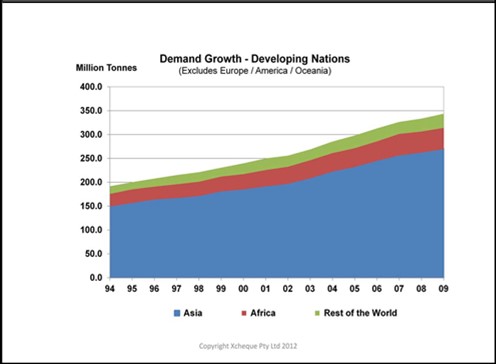
JH1

This is the demand growth for the developing nations. This comes from the FAO

Most of this growth has been serviced by internal development of their dairy industries.

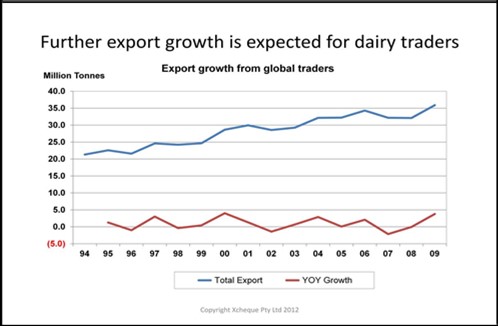
JH2

This the export growth from the key dairy traders – Europe, US, NZ, Argentina, Australia. The average is 2 – 3 billion litres / year. Even if this has been accelerating in the past few years it is unlikely that the opportunity is more than 4 – 5 billion litres / year. I believe the average growth opportunity for the global traders is 3 – 4 billion litres but I would need to review the more recent data to check this.

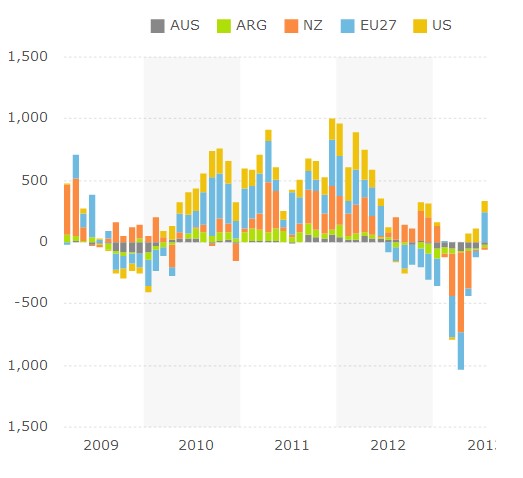
YOY Production milk production growth – Million Litres
JH3

This is the year on year growth that has come from the major traders. This chart shows 15 billion litres of growth from the EU, US, NZ and Argentina from July 2010 – June 2012. The total for the period from July 2009 – June 2012 is 12 billion. In other words we saw contraction in 2009 and 2012 and that is because the milk price was low. The US and Europe turn growth on or off according to commodity and milk price (New Zealand just keeps on trucking except when it doesn’t rain).

In summary:

  • The Asia growth story is not rhetoric but the suggestion that the hole can’t or won’t be filled is.
  • The US and Europe will turn on and off milk production according to demand and price. They had no difficulty growing supply at 5 billion litres / year in 2010 / 2011 and they are already gearing up to do it again in 2014.
  • No I don’t subscribe to the analysis that has been done for the Horizon 2020 report. I believe the “Supply Gap” analysis is a flawed way of assessing Australia’s future export opportunity.


MG makes its move

I used to think of our co-op as a bit like the ABC: your favourite aunty. Comfortable, dowdy, trustworthy and a little quirky.

But Aunty MG has undergone a transformation.

Since it acquired a new CEO, Gary Helou, in October 2011, Murray Goulburn has embarked on lancing $100 million of costs, opened up in Dubai, restructured the way farmers are paid for milk, revamped its retail trading store network, developed assistance packages for the next generation of farmers and forged the spectacular Coles fresh milk deal. At least, these are the “headline acts” that come to mind.

Now, MG is making a $420 million bid for its rival, Warrnambool Cheese & Butter, gazumping Bega Cheese and Canadian dairy giant, Saputo.

According to MG, (if the bid is successful) the new Murray Goulburn Warrnambool:

“Creates a new 100% Australian farmer-controlled dairy food company with over 3,000 supplier shareholders delivering more than 4 billion litres of milk to nine processing sites annually. The business will be positioned for strong growth in both domestic and international dairy markets with forecast revenues in financial year 2014 of $3.2 billion including export sales of $1.4 billion to over 60 countries.”

This, Gary Helou wrote in a letter to MG’s farmer shareholders yesterday, would bring the coop, “…the necessary scale, market reach and competitive strength to capture the benefits of the historic growth opportunity resulting from the consumer affluence of developing Asian economies.”

MG’s triple-jump

The bid is in, it’s the most lucrative on offer and it’s Australian, yes, but there are three serious hurdles for MG:

1. A bidding war

What will Saputo and Bega do next? WCB traded higher yesterday, closing at $7.89, a sign that markets believe MG’s $7.50 isn’t enough to win the bidding war.

2. Shareholder seduction

WCB rejected a takeover offer from MG in 2010. At the time, there was quite a bit of anti-MG sentiment. It’ll be interesting to see if the reinvention of Aunty and a bigger bucket of cash will make a difference.

The Sydney Morning Herald reported Mr Helou said yesterday that farmers supplying WCB needed to consider the future of the Australian dairy industry when deciding on the take-over bid.

“For farmers generally, they are at a fork in the road today.”

“If they sell out to a private company, that they have no control over … they will be spectators.”

“What we are putting on the table is an offer for them to take a stake in every step in the value chain.”

“It’s a fundamental, philosophical different point of view.”

3. The competition watchdog

Back in 2010, the ACCC was loathe to allow MG to acquire WCB. As reported in the SMH at the time:

THE competition regulator says its preliminary view is to oppose Murray Goulburn’s proposed acquisition of Warrnambool Cheese & Butter on the grounds it would cut competition in some markets for raw milk.

The Australian Competition and Consumer Commission said yesterday it was concerned the proposed deal “would substantially lessen competition for the acquisition of raw milk from farmers in the relevant markets within South Australia and Victoria”.

“The potential effects in the relevant markets include a significant reduction in farm-gate prices paid to farmers for raw milk; and reduced competition in the offer of non-price terms such as finance, field advice services and discounted hardware and grain supplies.”

The irony of the ACCC’s 2010 statement is that Murray Goulburn’s mission, as a 100% farmer-owned co-operative, is precisely to return the maximum price to farmers — something to which the listed Bega Cheese nor the privately owned Canadian giant Saputo cannot lay claim.

I hope it takes a broader perspective this time. A serious exporter battling subsidies and tariffs around the world, MG needs scale so that its processing can be as efficient as its farmers. The Australian government does not afford our dairy farmers the protections enjoyed by most of our competitors. The least it can do is allow us to grow.

UPDATE: See this article and extended AFR interview with MG CEO Gary Helou: http://www.afr.com/p/national/the_battle_for_warrnambool_kxxm78XXLgfsAJ6y7ARaVJ

What the cold, cold heart of Coles reveals

The man who directs the face and voice of Coles must have become a little overconfident. In a breathtaking display of arrogance, Coles’ general manager of corporate affairs, Robert Hadler, addressed an audience of spin doctors with this presentation: http://www.documentcloud.org/documents/800088-reputation-coles.html#document/p5

Plenty of people have discussed why this presentation was in such bad taste. Callous, even.

But the part that really caught my attention was the role of our co-op, Murray Goulburn, in Hadler’s “case study”. The gloating Hadler describes the deal with Murray Goulburn as “The game changer”.

Hadler’s right about this but not in the way he means, I suspect. The Hadler case study goes to show just one thing: no matter how Coles tried to spin $1 milk, Australians knew it stank and none of their ads, infographics or appearances by Curtis Stone could fix it. Until, finally, Coles actually did something to address the damage caused by the milk war: an unprecedented 10-year deal that was too good for the co-op to refuse.

Now that’s not a case study in spin, Mr Hadler, that’s a case study in people power.

PS: If you would like to keep up the pressure for Coles to do the right thing, add your voice to this petition by Queensland ag teacher, Lisa Claessen, who was compelled act after her students became casualties of the ColesWorths milk war.
 

Devondale’s new TV ads spread the love, but who to?

Well, you saw it here first. MG’s new ads will air on TV from tonight but they’re already up on its Devondale website.

I can’t help but wonder if this ad is a direct consequence of the much-despised Dev and Dale commercials that presented the co-op’s own farmer-shareholders as bogans. The deeply unpopular ads set MG directors’ phones alight and were pulled early in response.

Watching it reminds me of Dairy Australia’s own embryonic Legendairy campaign and even the Dodge “God Made a Farmer” Super Bowl ad that unashamedly pandered to a despairing target audience in desperate need of some moral support.

What do you think? Will this ad sell more Devondale cheese, milk and butter? Is it just too cynical of me to suggest that perhaps I and my fellow dairy farmers are the real targets? Or maybe it’s not me they have in mind but the NSW suppliers MG needs to woo in order to meet its Sydney Coles contract.

While you’re having a think about it, check out another new Devondale product ad!

Never say die

When analysts talk about softening milk supply, there’s a whole other layer that’s anything but soft. It’s uncomfortable chats in the dairy about next week’s roster, sleepless nights worrying about where the next load of hay is going to come from, and long, long hours.

He spends more time in the tractor, she spends more time off-farm to pay the bills. The office is a mess, the kids watch a little more TV than usual and the mummy guilt rises with it. They all get snappy.

He comes in from the chilly night air long after the children have gone to bed. She’s in the office doing the books. Farms are not selling. There is no light at the end of the tunnel and there’s no way out, either.

Then one afternoon, the farm consultant brings a welcome dose of encouragement: the place is in great shape, poised to take advantage of any recovery, and the gossip around the traps is that an upbeat announcement from the co-op is imminent.

That night, as she takes her little boy out to check on the maternity paddock, the farmer is drawn by a ruckus at the dam. A moorhen hangs about a metre above the water, caught by one leg in a twist of wire and flapping its glossy blue-black wings desperately even though there’s clearly no hope of escape.

The farmer cannot stand and watch any more than she can walk away. With toddler on her shoulders and Blundstones squelching through the shallows, she wades towards the struggling bird. There is blood on the wire but with a deft spinning wrench, the fence springs back to shape, releasing the bird which, to the farmer’s astonishment, paddles away seemingly unhurt.

In the morning, the most anticipated email of the year arrives. To the farmer’s astonishment, the milk price will open 24 per cent higher than last year and the co-op has a little rescue package in the shape of a pre-payment for those prepared to pledge their loyalty. She reads the email twice more, just to be sure.

Never say die.