How Gallipoli put Grandpa on the land

Grandpa is the little boy in the gateway

Grandpa is the little boy in the gateway

My grandfather, Harry, first saw Melbourne on his way to Gallipoli. I imagine it felt like a ticket to a new life after a childhood framed by tragedy.

When his mother died giving birth to his brother, little Harry was left in the care of his Irish grandmother. He worked her hillside farm hard and, at one stage, never left the property for the good part of a year. The stories my own father passed down to me spoke of a Harry abandoned by his father and shown little pity.

When war came, Harry became an ANZAC light horseman and carried water to the front line. My aunt Heather says dysentery “saved him” from the Western front and nearly a year later, he was home and regarded as a man.

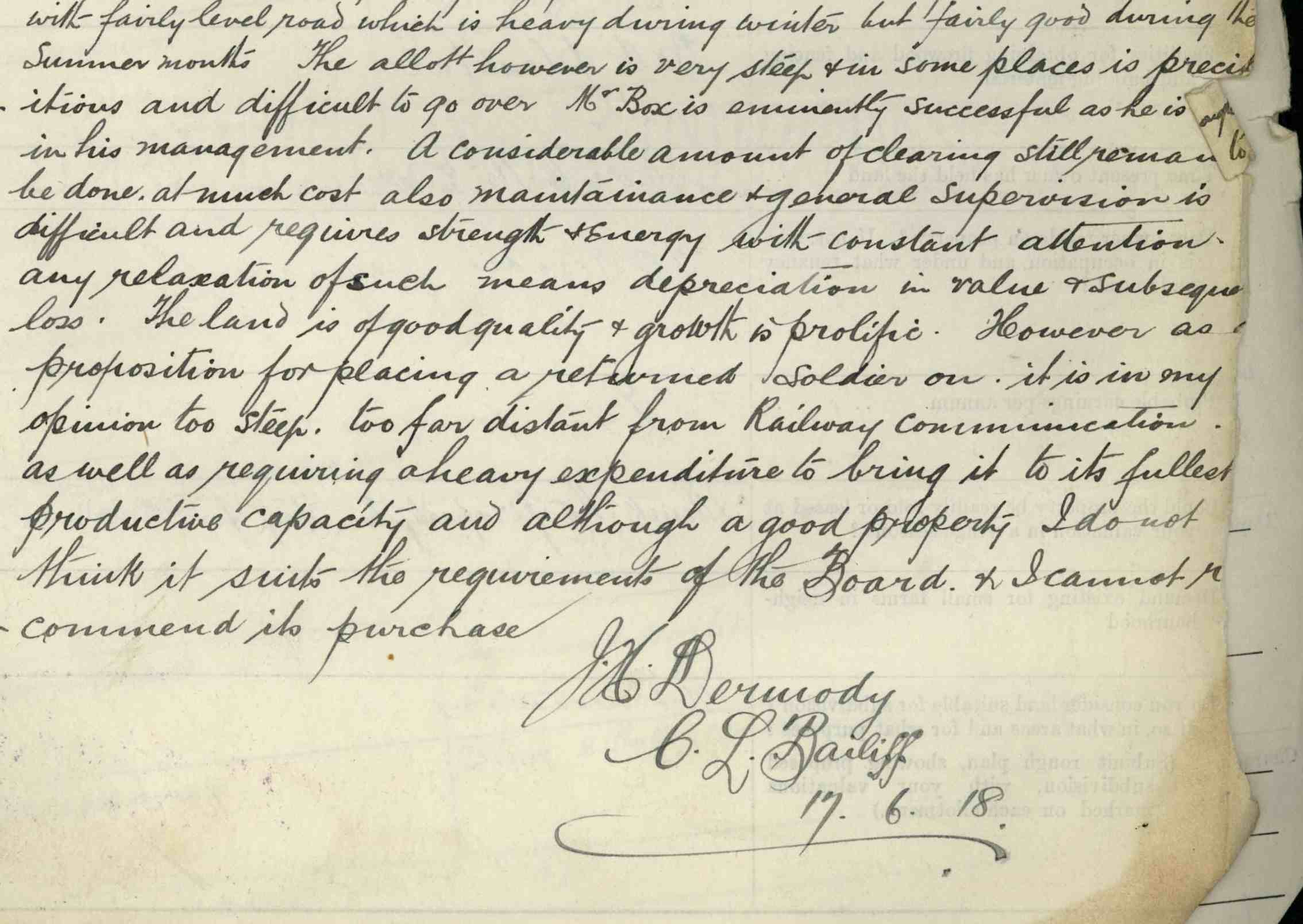
In 1917, Harry applied to secure a parcel of land under the soldier settlement scheme. The inspector recommended against it and his report forewarns of a battle too great for a returned soldier.
GrandpaSoldierSettler4cropLoRes

Mr Dermody’s advice made sense. I’ve been there many times and tried to imagine how it must have been 100 years ago. The valley is sweet but the property, known as Yosemite, does indeed reach up “precipitous” faces lined with cattle track terraces. Impossible country to farm with a tractor, nigh-on impossible with a fern hook and crosscut saw.

Although still recovering from dysentery and the psychological damage of war that he called “neurasthenia“, Harry’s ambition is palpable in his own submission.

GrandpaSoldierSettler6crop

Against the odds, Harry made it. And after his first two children were born around 15 years later, he built a new house with his bride, Pearlie, in the foothills down the valley.That is the place I remember when I think of Grandpa. Heather recalls her father wanting to sign up again in 1939 only to be told farmers were to remain on the land. So, she says, he resolved to buy the land we farm now in order to “do his duty and grow more food”. A notion almost incomprehensible in this era of plenty.

It’s to that lonely boy’s courage in the face of battle – both on the shores of Gallipoli and later in the hills of Gippsland – that I owe this farm. I will not forget.

The politics of Easter eggs

kids_spring06_egg_cow.jpg

Easter eggs are now a political football with Animals Australia is using them as an opportunity to spread the word – and the guilt – about eating food laced with dairy cruelty.

At the same time, the Australian Raw Milk Movement is preaching the gospel of Vicki Jones, the woman behind the recalled milk associated with the death of a toddler. Apparently cows being treated with antibiotics when they fall ill are “paying the price” for the milk we conventional farmers provide. Better to assume no animal on an organic farm ever falls ill (or can simply “disappear” if she doesn’t respond to a massage with magic cream).

It disheartens me tremendously that treating a sick animal with the best medicine available can be dressed up as some form of cruelty but I think I’d better get used to it fast. Why? Because there are two movements gathering pace in Australia: “food fear farming” and “orthorexia nervosa”.

Food fear farming for product differentiation
You can make money from frightening mums and dads in the supermarket.

Milk that contains added permeate (which is an ugly name for milk’s natural sugars and vitamins), is pasteurised, comes from cows fed some grain or is not organic can be made scary. And non-scary milk gets a lift!

This is a basic marketing principle called “product differentiation” and is used by marketers in every consumer goods category from toilet paper to life insurance to gain market share or justify a higher price.

“When we were conventional dairy farmers I felt so frustrated at being powerless in the industry but now we are price setters and have security. It actually feels like we are running a business.”
– Vicki Jones, raw milk farmer, The Weekly Times, 17 September 2014

The reality is that as the margins around milk become tighter and tighter, we can expect to see increasingly desperate attempts to differentiate milk brands from the mainstream.

Orthorexia nervosa
Nutrition lecturer at UNSW Australia, Rebecca Charlotte Reynolds, wrote in The Conversation recently, that:

Orthorexia nervosa, the “health food eating disorder”, gets its name from the Greek word ortho, meaning straight, proper or correct. This exaggerated focus on food can be seen today in some people who follow lifestyle movements such as “raw”, “clean” and “paleo”.

Of course, food-centric righteousness comes in many forms and I’m watching as animal activists and food activists come together.

That quest for purity teamed with the need to differentiate what is otherwise a commodity product is perfect for farmers and food marketers desperate to make a dollar. Sadly, it’s often at the expense of everyday farmers and shoppers like you and me. And, if they could have their way preventing the use of basic medicines like antibiotics, the wellbeing of innocent cows.

Time to turn out the lights, together

Farmers and environmentalists have finally come out of the closet, holding hands. As Landcarers, farmers have been practising “greenies” for decades, we’ve just never embraced the label.

Greenies are often seen as the enemy and, sometimes, some of them have been. We’ve been blamed for global warming, the blanching of the Great Barrier Reef and the land clearing sins of our forefathers; the rapists of the land.

But tonight, it’s the greenies themselves, WWF’s Earth Hour, who are showcasing Australian farming. Tune in to the Appetite for Change documentary on Channel 10 tonight or watch it online anytime.

The Earth Hour cookbook tells my family’s story and the stories of farmers around the country to inspire action. And it’s all constructive because Earth Hour understands that farmers, foodies and greenies belong on the same page.

We all need to eat, drink and breathe.

Nobody understands what the impact of a changing climate means better than farmers do. So embrace your inner greenie and turn off the lights tonight from 8.30 for Earth Hour.

After all, what’s the worst that could happen?

How much listening to farmers is okay?

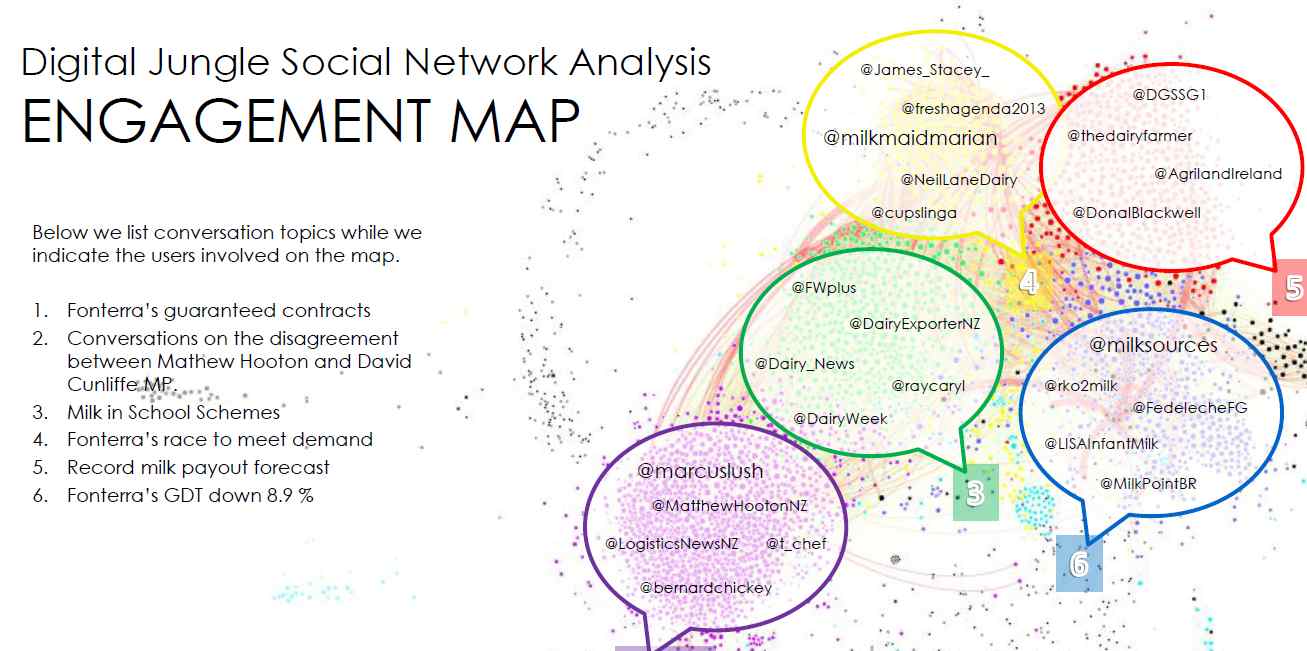
"Fonterra on Twitter" by Digital Jungle

Excerpt from “Fonterra on Twitter” by Digital Jungle

I don’t need to tell you how much of a stir a report tracing Twitter conversations surrounding Fonterra made when it was tweeted by farmer Shelby Anderson (@cupslinga) yesterday. The extensive 54-page document monitored just one week of Twitter conversations and looked to be a sample of what the social monitoring service could provide rather than a commissioned routine report. Still, as Shelby tweeted, it was a veeeerrry interesting report all the same. Continue reading

Skeletons in the dairy case

CowsDairyTrack

We know we are not perfect, we realise we must do better and we are proud of how far we have come.

Our cows live better lives than they did when I was a girl. Careful breeding has reduced the incidence of mastitis and lameness, while a new understanding of bovine nutrition has reduced the risk of calving trouble and helped us insulate the cows from the impact of both drought and flood. Our first generation of naturally polled (hornless) calves has just been born.

Even so, dairy farmers will one day earn a prime-time feature for all the wrong reasons. It could be someone doing the right thing that looks like the wrong thing: Continue reading

Social media campaign to support a ‘fair go’ China FTA

FTA4Dairy

The Kiwis already have one. We need one too and Aussie dairy farmers are calling on people power to win it next Monday.

A free trade agreement with China is the difference between being truly competitive, or not, in one of the world’s most important markets for Aussie dairy. The peak body for Australian dairy farmers, appropriately named Australian Dairy Farmers (ADF) is leading a social media campaign to get the deal done.

ADF CEO Natalie Collard answered some questions on the campaign. Continue reading