Imagine if dairy farmers were paid like Qld cane growers

QSL

Most Australian dairy farmers have just one customer for our milk – the processor. It is the processor who adds value to the raw milk, who markets it and, importantly, it is the processor who decides how much the farmer will be paid.

I don’t need to tell you how vulnerable this leaves us.

If the processor makes a mistake or suffers any form of economic headwind – whether it be increased gas prices or decreased whole milk powder prices – it is free to simply pass that problem on to the farmer.

We accept this state of affairs because we feel there is little choice. We can’t store milk on the farm for more than two days and it’s illegal to sell unprocessed milk directly.

Cane growers have a lot in common with dairy farmers

Cane growers are in much the same boat. Like us, they cannot store their produce for long (it needs to be processed within eight hours of being harvested) and can’t sell it directly. But rather than having a handful of processors nearby – as most (though certainly not all) dairy farmers do – many are only in a workable distance from just one miller.

Cane growers use millers as service providers, not just customers

Unlike us, though, Queensland cane growers are determined to row their own boat.

As Queensland Sugar Limited’s Cathy Kelly told Milk Maid Marian, how much Queensland cane growers are paid for their crop is based on the sugar produced from their cane, rather than the cane itself.

“This payment arrangement is detailed in the Cane Supply Agreements growers hold with their local sugar mill, with the miller generally taking one-third of the sugar produced from each grower’s cane as a processing fee, leaving the grower to make the pricing decisions for, and receive payment on, the other two-thirds of the sugar,” Cathy says.

“So, while the growers may not own the sugar produced by their local mill, they are deemed to have an ‘economic interest’ in it.  It is this – the Grower’s Economic Interest in sugar (GEI Sugar) – that is at the heart of the recent sugar marketing issue.”

Cane growers can market sugar collectively
While the sugar is processed by private millers, the two-thirds of the refined sugar in which growers have an economic interest isn’t necessarily marketed by the millers.

After numerous government investigations at a state and federal level (sound familiar?), the Queensland Parliament introduced Marketing Choice legislation in December 2015, forcing Queensland sugar millers to provide their growers with a choice of marketer. It’s been a success, despite the best efforts of the biggest miller of Australian sugar cane, Singaporean-based Wilmar, to stymie arrangements as recently as last week.

Growers have access to their own not-for-profit public company, Queensland Sugar Limited (QSL), which is owned by Queensland growers and millers and started life back in 1923 as the Sugar Board, selling sugar from Queensland farmers under a single desk arrangement.

Today QSL, Cathy Kelly explains, provides four major areas of service:

Pricing: QSL is a member of the global raw sugar marketplace, the #ICE 11 exchange, based in New York. QSL uses its membership to conduct pricing on behalf of Queensland growers and millers, covering margin calls and associated fees so that its members can lock in sugar prices up to three years in advance.  QSL also operates a sophisticated pooling system, where growers can elect to have QSL manage and price GEI sugar on their behalf.

Financing: QSL uses its access to low-cost finance to provide year-round cash flow to members through a monthly proportional payment system called Advances. Under this system, QSL borrows approximately $150m each year to start paying members as soon as they start delivering sugar to the state’s terminals, even though that sugar may not be sold until up to a year later – hence the term Advance payment. As QSL is a not-for-profit, it also returns any net corporate profits to its members at the end of the financial year via the Advances system.

Marketing: QSL coordinates the physical sale of sugar, aiming to maximise returns to its members by optimising sales timing and customer premiums. They are highly regarded by their long-term clients in the Asian market, who pay strong premiums for Queensland’s reliable, high-quality sugar, last year coordinating the successful receipt of $1.9 billion in customer payments.

Logistics: QSL operates Queensland’s six Bulk Sugar Terminals on a cost-recovery basis, (i.e QSL doesn’t charge a margin), providing safe and efficient storage, handling and shipping of raw sugar as well as overseeing a strong quality management program. QSL’s delivery record is world-class, with over 98% of shipments delivered on time and in full last financial year.

While our circumstances might be a little different and it’s not been without its challenges, the sugar marketing model shows that there are other alternatives to the status quo for dairy.

Following the money – where your DA dollars go

da-levies

The fabulous UDV infographic in the last post got me thinking about how the biggest chunk of farmer levy funds are spent – with Dairy Australia.

Just how much does an average farm pay for DA? I did some sums based on figures from the 2016 Australian Dairy In Focus report and, for the average Australian dairy farm producing 1,563,258 litres of milk, the annual DA levy came to $5,523.

Are we getting good value? I asked Dairy Australia some basic questions about what it does and where our money goes. After discussing it amongst themselves for a few weeks, the DA staff were most forthcoming. This is one of the longest posts ever likely to appear on Milk Maid Marian but it’s very useful. Thank you, DA!

1. What are the sources of DA’s funding?

For 2016/17:

Payments from levy payers:                                                               $32.0 million
Matching Federal Government funding for R&D projects:      $20.4 million
Other (Interest on reserves, royalties on IP)                                  $0.7 million

Total                                                                                                   $53.1 million

DA project expenditure is also able to leverage additional State & Federal Government funding by investing jointly in projects, this adds approximately $10 million a year.

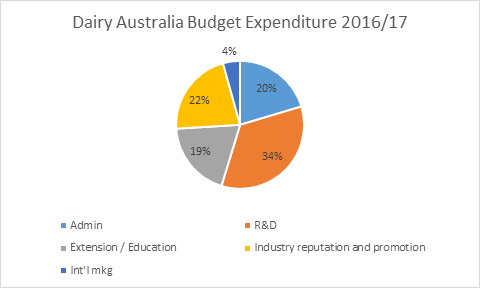
2. What percentages of DA’s budget are accounted for by admin, R&D, extension, promotion, and reputation protection? (I’m imagining a pie chart here)

da-funding-sources

3. How does DA set its priorities?

DA follows a process each year to refresh its strategic priorities as part of its rolling three-year plan.

Each year, the starting point is to review the performance of existing/current projects and whether they are achieving what they set out to do. An environmental scan of the operating environment helps to identify any new risks or challenges the industry will need to address.

Once these two steps have been completed, then comes the key measure to the whole process – extensive consultation with representative bodies, Regional Development Programs (RDPs) and farmers. This provides a focus of effort and expenditure on those matters that are not only seen as important, but necessary for a profitable and sustainable sector. Out of this DA is able to clearly define its key investment priorities.

From here, budgets are set and project expenditures are revised to help complete the new plan. Once finalised the plan is presented to industry and Federal Government for ratification.

The underlying, big industry challenge is to profitably grow farm production to fully take advantage of regional potential over the next decade. The current plan retains its focus on building the foundations to support resilience and growth.

Our core priorities are clear and concise: making farm businesses more profitable and competitive; growing people skills and capability; and protecting and promoting our industry.

4. Can you offer a list of the main projects delivered over the last 3 years and those slated for 2017 in R&D, extension, promotion and reputation protection?

The main projects delivered over the last three years are as follows – many of which are ongoing:

  • Regional Development Programs – extension activities to fill the gap left by state governments, discussion groups (now 107 groups up from 80, nationally) and focus farms (a total of 12 nationally).
  • Herd Improvement – Good Bulls Guide, ABV’s, Breeding Indices
  • Dairy Bioscience, Forages – DairyBio (formerly Dairy Futures CRC), hybrid breeding, endophytes
  • Dairy Bioscience, Animal Improvement – DairyBio, tracking genetic progress, Feeding the genes
  • Integrated Feedbase R,D&E – Feeding Pastures for Profit
  • Animal Nutrition & Feed Systems – Feed planning and budgeting, cow nutrition manual, purchasing grain resources, feed additives resources
  • Forage Improvement – Fert$mart, perennial ryegrass management, TopFodder silage management, quality pasture silage booklet
  • Industry Education – NCDE, Young Dairy Network, Picasso Cows, Discover Dairy, Cows Create Careers
  • Attracting & Retaining People – the People in Dairy website and resources like the Employee Starter Kits (ESKi), Stepping Stones, Stepping Up/Stepping Back, Farm Safety Starter Kit
  • Marketing – Foods that Do Good (promoting dairy alongside fruit and vegetables to health professionals), Australian Grand Dairy Awards, Legendairy Capital

Projects underway for this financial year, some of which are ongoing from last year, include:

On-farm

  • Animal health and fertility – Raising awareness and adoption of new Cattle welfare standards (Animal Health & Welfare), improving herd fertility and supporting farmers to phase out calving induction (InCalf), improving mastitis management through new Milk Quality adviser training and better practices at drying off (Countdown), publishing a new edition of the calf rearing manual (Rearing Healthy Calves), improving dairy hygiene to reduce milk price penalties due to bacterial counts (Better Hygiene Better Milk)
  • Genetics and herd improvement – Data Gene (including a centralised data repository), DairyBio
  • Feedbase and animal nutrition – Forage Value Index, DairyBio
  • Farm business management – Dairy Base training, Taking Stock, Standard Chart of Accounts
  • Farm systems and modelling – Precision dairy, virtual fencing
  • Land, water and carbon – Fert$mart, More Profit from Nitrogen (cross sector), Waste to Revenue (cross sector), Phosphorous efficient pastures (cross sector), Stocktake of the Nutrient Loss to Water Risk for the Australian Dairy Industry, feed additives to reduce methane emissions (led by Canadian research institutions), Sustainable Pasture Systems under climate extremes, Profitable Dairying in a Carbon Constrained Future program (Australian Government funded), Cool Cows heat alert service and Cool Cows workshops, Smarter Irrigation for Profit (cross sector) and technical support for industry contributions to the design and implementation of the Murray Darling Basin Plan

Post-farmgate

  • International market support – China, Japan and South East Asia scholarship programs and in market programs across China, Japan, South East Asia and the Middle East
  • Manufacturing innovation and sustainability – Technology Transfer Scheme, Transfer Dairy Fund, Small Dairy Network, Dairy Manufacturers Sustainability Council, Dairy Industry Sustainability Framework
  • Marketing – Legendairy Capital, Foods That Do Good (for health professionals)

5. DA has explained that some programs have been trimmed or cut to meet the expected downturn in income this financial year. What are they?

 Internally, DA has reduced its workforce by about 10% and reduced overhead costs by ~15%. Efforts have been made to preserve core internal programs (RD&E) but most programs have experienced some cuts.

The larger changes have been:

  • Post-farm-gate R&D and educational initiative expenditure has been cut by $3 million per annum.
  • Mass market advertising (TV based advertising) has been cut by $2.5 million per annum.

6. How much has DA spent on post-farmgate R&D over the last three years? Why are farmers’ funds on post-farmgate R&D? How will this change?

Post Farm Gate R&D – Manufacturing Budget

2014/15 – $3,157,500 (DIAL)

2015/16 – $1,293,800 (DIAL)

2016/17 – $414,000 (Supporting Manufacturing Innovation & Sustainability)

Up until the past year, our main investment in post farmgate R&D was core funding for DIAL to produce cultures for cheese companies and also undertake post farm pre-competitive R&D to help companies move up the value chain and improve the return for farmers via milk price.

DIAL was established in 2008 and since that time we were contributing about $3 million/year and most of the processors (MG, Bega, Lion, Parmalat, WCB) were contributing proportional amounts, as were commercial investors so that DIAL had an annual budget of about $7-10m/ year. DIAL also undertook a number of projects to help companies improve operating efficiencies in their factories.

Over the past 2-3 years DA has been scaling back its investment due to a number of factors. 1) with the reduction of co-ops over time, being able to demonstrate to farmers the value of levy dollars into DIAL became more difficult 2) a number of the processing companies had developed strategic alliances and partnerships with overseas R and D organisations or global dairy companies who had very large R and D capability. So the value proposition for DIAL came into question.

After a thorough review it was decided to wind up DIAL. The cultures business was sold to a commercial company already producing cultures and all the remaining IP from DIAL has now been shifted to DA and we will continue to assist processing companies adopt the existing IP.

Following the decision to wind-up DIAL, the strategic direction of the investment as well as the level of investment has changed dramatically. DA’s strategy in this area is now a more targeted post farm gate investment approach focused on technologies ready for adoption rather than idea inception.

We are looking to take commercially mature technologies or practices and see them through to implementation in an Australian context so that our processors and farmers see the value sooner rather than later.

Ultimately it will aim to increase the profitability of the Australian dairy industry by ensuring that our supply chain is keeping pace with global developments in dairy production innovation.

Key focus points of the current Supporting Manufacturing Innovation & Sustainability program:

·         Accelerating technology uptake into the Australian dairy processing sector by supporting commercially-relevant technology assessment and assisting processors to access larger buckets of available government funding sources

·         Enhancing the sustainability of the dairy processing sector by supporting the processors to both track and make progress against industry targets to reduce GHG emissions intensity, consumptive water intensity and waste to landfill. Each of these environmental targets are coupled with clear commercial drivers in that energy, water and waste disposal costs are increasing at a rate which requires rapid industry respond in order to maintain any sort of international advantage in terms of cost of production.

·         Ensuring that the value of current and previous DA research is realized for the benefit of Australian dairy farmers

As part of this new program, Dairy Australia has already completed three pilot-scale technology transfer projects that investigate the economic feasibility of innovative technologies designed to:

a) provide a non-thermal, low energy process to extend the shelf-life of dairy products as well as improve pathways for value addition to whey;

b) enhance the recovery of clean-in-place chemicals and reduce environmental discharge; and

c) optimise spray dryer control and reduce energy use.

Post Farm Gate R&D – Health and Nutrition Research and Science Budget

The Budget has progressively been rolled back in the last few years but is now dominated by the Fractures Trial Commitments.  This funding will continue to contract over the forward estimates as the fractures trial comes to completion.

2014/15 – $584,000

2015/16 – $430,000

2016/17 – $495,000

DA invests in Human Health and Nutrition Research to ensure that dairy nutrition science is strong enough to support industry communication activities designed to improve consumers’, key influencers’ and policy makers’ confidence in dairy foods while highlighting evidence of the benefits of dairy. 

This research has been vital in helping industry to counter the anti-dairy sentiment and fad diets (eg: Paleo) using the most up to date science.  This research also provides real opportunities to enhance the health and nutrition benefits of dairy in the diet with a view to increasing consumer demand for dairy (eg: Fractures Trial working to provide strong scientific evidence that dairy foods help to reduce the risk of fractures in adults).

7. What are the alternatives for farmers to provide DA with feedback?

Aside from contacting DA by phone and email, many of our staff, board directors and RDP extension people are often out in the regions on farm or at various industry events and forums so there are plenty of informal opportunities to approach us face to face.

Farmers are able to provide us with feedback via our stakeholder tracking survey which contacts about 600 farmers twice a year. Farmers are asked directly about their satisfaction with levy investment, what’s working and not working and ideas/advice on how to meet the needs and expectations of farmers.

Also, every three to five years, the Federal Government requires an independent performance review of DA. This process collects feedback from stakeholders about DA’s effectiveness, efficiency, and achieved value for money and return on investment to the industry. Workshops are held in all dairy regions for all levy payers to attend or farmers can email a submission to the agency conducting the review.

Farmers can contact their RDP directly or attend organised events, workshops and local discussion groups. Farmers are also encouraged to join local or industry boards and committees (such as their local RDP).

Or there is also the Australian Dairy Farmers (ADF) and the state dairy farmer organisations which farmers can contact or join to provide feedback which will then be given to DA.

***Agri-political activities or lobbying on behalf of dairy farmers is led by the state dairy farmer organisations – UDV, TFGA, SADA, Dairy Connect, NSW Farmers, QDO and WA Farmers, who are members of the national body, the ADF.

Following the money – where farmer levies go

payments1

Every farmer knows that each time we sell a litre of milk or send a cow to market, we pay some sort of compulsory levy or fee. But where does that money go and what does it do for us?

Well, the UDV has created a very lovely infographic to follow the money as it trickles down to a plethora of bodies. The biggie is Dairy Australia but there are plenty of others less familiar to the average milk maid.

The infographic is so chock-a-block full of useful information that it simply doesn’t fit on the page but I have lopped the right hand side off so you can get the gist of it. To see the whole thing, click on the link below.

dairyfarmer-representation-and-dairy-farm-statutory-payments-2016

The front follows the money and the second page explains our convoluted system of representation.

Bon appétit! For the next course, Milk Maid Marian will serve a short but sweet distillation of how DA spends our precious funds.

Kiwi dairy leader on pricing system

As part of its farm gate pricing system review, Murray Goulburn is studying the way farmers are paid overseas, including in New Zealand. So, how are Kiwi dairy farmers paid for their milk and what are the pluses and minuses of the NZ system?

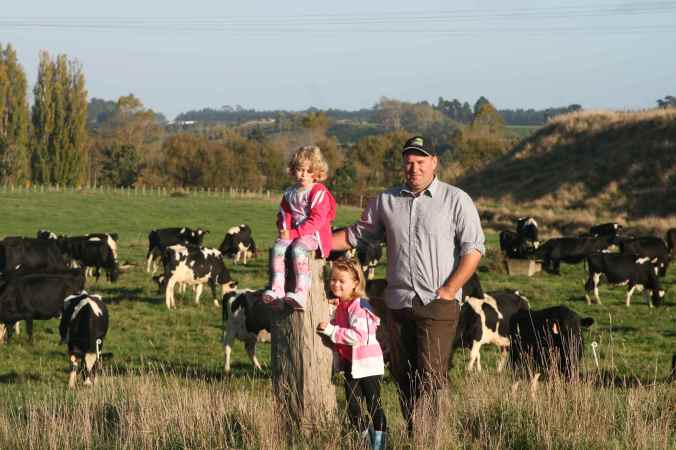
I’m very grateful to Andrew Hoggard, the National Dairy Chair of NZ’s peak farmer body, the Federated Farmers, for writing this explainer post for us.
andrew-hoggard

In New Zealand there is no “one” way that the milk price is calculated, we have many different companies.

Fonterra is obviously the largest at around 78% of milk supply, but you also have two other Co-ops, and then several private processors, the largest of which is Open Country Dairies.

Generally, in most countries the unwritten rule is that the largest Co-op in the market sets the milk price.

In New Zealand’s case that is Fonterra, while the other Co-ops will return all profits they make (after any retentions) back to the farmers as milk price, so they sit outside that rule to a degree.

The private companies will pay a price based on the Fonterra price, so it might be a few cents more to attract supply, or a few cents less to retain supply.

Often the way these companies have attracted supply is through the fact that farmers can leave Fonterra, sell their Fonterra shares which for most farmers is a tidy sum, and then get a similar milk price supplying someone else and use that capital for something different.

So, in a practical sense, the Fonterra milk price is often viewed as the New Zealand Milk Price. Fonterra was created as a result of the two largest Co-ops merging with the NZ Dairy Board back in 2001.

The Government passed special legislation to bypass the Commerce Commission (our version of ACCC). This legislation, the Dairy Industry Restructuring Act (DIRA), set many rules that Fonterra had to follow to allow for domestic competition and transparency.

This led to the development of the milk price manual. In the early days the manual was slightly different to how it works now, with the Global Dairy Trade are a key component of it these days.

That said during the Dairy Board days, we have always had a system of forecast payout, advance rates, retro payments, and final payout.

This system continues today with most companies in New Zealand following the milk price manual and that methodology for calculating the payout (for Fonterra).

How does it work for Fonterra farmers?
At the start of each season (June) Fonterra will advise stakeholders what the forecast payout for the season will be.

This is essentially a speculative assessment as to where the market is heading. In announcing the forecast payout, they also reveal the advance rate and payment schedule (see link to schedule below).

advance-payment-rates-single-season-181120161

Something also unique to New Zealand, which the rest of the world perhaps does not follow, is all bills are expected to be settled on the 20th of the month, for the preceding month.

Today, I’m writing this on February 20, so I’m being paid for all the milk I produced in January.

The Advance rate is the amount I will be paid in the first months of the season; this is usually 60-70% of the forecast payout.

The schedule then shows how that advance rate lifts throughout the season. For example, today I am being paid $4.20 as the advance rate for all the milk that was produced in January, is worth $4.20.

Now the previous month the advance rate was $4.15, that was all the milked produced to the end of December. Thus this month I also get a retro payment of five cents on every kg of milk solids produced up to the end of December.

Next month the advance rate lifts to $4.30, so every kg produced in February will be paid at $4.30, and then I will get 10 cents on every kg produced up until the end of January.

So basically, every time that the advance rate lifts then I get a retrospective payment for all the milk produced up to that point to ensure that everything produced until that point in time has been paid at the advance rate.

If the Board of Fonterra however, at any time during the season feel that the forecast needs to be altered, they will do so and amend the schedule.

Should the payout have to be revised down then they may well scrap several lifts in the advance rate. Very rarely as this occurred in New Zealand where a company has had to claw back payments from a farmer.

That’s why we have a lower advance rate than the projected payout, so that if the market turns, you don’t end up taking money back off farmers. Kiwi farmers don’t get upset by much, but claw backs would have us reaching for our pitchforks!

When the season ends on May 31, the full payout is still outstanding at that stage, with retro payments due in June, July, August and September, with final payment in October.

This provides a good cashflow over the dry period. It also helps the company in making all the final sales and collecting payments for that season’s products.

Calculating payout
The milk price manual sets the benchmark. Basically, it takes the prices from the Global Dairy Trade, for a basket of commodity goods, heavily weighted for WMP.

The manual determines what a hypothetical, efficient competitor to Fonterra, might be able to pay for raw milk and still make a dollar, using a mixture of Fonterra’s actual data around transport and manufacturing costs along with some assumed costs. That’s effectively your milk price.

Any margin that Fonterra makes above that then goes into a Dividend, which because it is a Co-op then goes back to the farmers.

This way the farmer gets to see what the base value of their milk is worth, and can be responsive on-farm to changes in the world milk price. The Dividend otherwise shows me how good my Co-op is at adding value to my milk.

If these two streams were bundled together, you would have to assign a hard-core forensic accountant to pick through the annual report to work out how well the Co-op is doing.
For example, if it was bundled together and we had a milk price of $7.50, we might think cool, everything is sweet, but that could just be that the raw milk is worth $7.45, and the Co-op is only adding five cents.

Whereas unbundled, you would see that straight away and start asking some hard questions. Likewise, if we got a milk price of $4, but a dividend of $3.50, some may blame the Co-op for the milk price.

But in actual reality they should be doing high fives for the excellent dividend, and for not pushing any milk production because it’s not worth it.

Ideally every Kiwi dairy farmer should be trying to base their system on being profitable on the milk price alone. Because the dividend isn’t a financial reward from how well you look after your cows, it’s from investing your co-op.

One other key point in New Zealand, no one can jump ship mid-season. At around this time of the year you advise your company if you are staying with them for next season, though some of the private companies have three to five year contracts.

What you do find here is that we don’t have much in the way of chopping and changing between milk companies, compared to Australia.

Alternative Payout Models
Two independent New Zealand co-ops differ from Fonterra through combining the milk price with a dividend. Synlait and Miraka offer premiums for farmers who operate their farms on best environmental practice. But they still use the schedule like Fonterra.

The only real point of difference exists with Open Country, who have three payment periods, and the prices vary over those periods, with usually the final period at the back end of the season having a higher price.

In terms of managing risk, we have recently had the launch of milk price futures here in NZ, it is still in its infancy, and farmers will need to be very carefully in using these tools.

Some companies have also offered a guaranteed milk price, where they match a customer wanting a certain amount of product at a certain price over a time period, and farmers willing to take that price.

However, probably the best way to manage risk is to be aware of what’s happening. That’s why so many Kiwi farmers pay attention to the fortnightly GDT auction, because that trend we know will show up in our milk price.

Other things to watch are the world markets, will President Trump’s proposed ‘Border Wall’ hurt American milk production, increasing demand from Mexico for other suppliers.

Generally, we are at the mercy of geopolitics when it comes to milk prices, while domestically the politics involve on-farm rules and regulations, which also impact on the milk price. Being aware of something before it hits should enable you prepare better for it.

One obvious thing in Australia to watch will be the New Zealand milk price, because of our greater exposure to world markets we will respond to big shifts in supply and demand quite quickly in terms of milk price.

Australia ultimately does follow, as your domestic market will only insulate you for a short period of time. Anyone that claims different probably studied trade theory at Trump University.

New Zealand has long standing Free Trade Agreements with Australia, thus there will come a point if either of our domestic milk prices get too far removed from one another, the reality is that dairy products will move across the Tasman, and even out prices.

There are plenty of economic theories that back up that assertion. If you view the New Zealand milk price as clear de-facto for the world price, then simply applying the NZ/AUS exchange rate to that will tell you the value of the milk in your vat is worth on the world market.

The Aussie price might not exactly match that but it will follow it. I think the key thing to remember, no one owes you a living just because you’re a farmer. You are a businessperson, you need to recognise your own risks and have plans for dealing with them.

Thanks very much to Andrew Hoggard, National Dairy Chair, Federated Farmers, for explaining the NZ farm gate milk price system so thoroughly. Milk Maid Marian appreciates your generosity!

What it will take to get this farmer growing

Confidence.jpg

The last two years – a drought and the infamous dairy debacle – have taken their toll and not just on my hip pocket. Unless there’s change, my cheque book is likely to grow cobwebs for up to a decade. Sounds melodramatic? Not really.

My reasoning is this: first, we need to recover the equity lost over the last two years.

Second, we need to catch up on the maintenance we couldn’t afford to do over the last two years.

Third, I want at least another $100,000 in equity as extra protection. Interest rates won’t always be this low and, when they rise, another shock of this magnitude could be devastating rather than debilitating.

It all adds up to roughly $300,000 in profit to make up before I have an appetite to invest in any project that takes more than a year to break even. And that will take me years and years to accomplish.

If other farmers have the same attitude, we will continue to see Australian milk production stagnate.

The problem with this is that the processors have been investing in hundreds of millions of dollars worth of new stainless steel that requires enough milk flow to make it efficient. Time and time again, they have said growth is the only way to return the maximum price to farmers.

Do we have the start of a vicious circle? I hope not to hear the processors blaming a low farm gate price on inadequate utilisation of bloated stainless steel created by a low farm gate milk price.

Making me even more risk averse is the lack of definitive action to prevent this happening all over again.

Both the big processors, MG and Fonterra, have pledged to be more transparent and that’s a good first shuffle. I say “first shuffle” because to call it a good first step would be overstating its importance. We need a game-changer.

MG has commissioned a price review that will consider farm gate price models from around the world. At the same time, the Bonlac Supply Company, which represents farmers supplying Fonterra, also announced it would present alternatives early this year. Will these be the game changers we need?

I suspect not. The game changer we need is one where risk is shared along the supply chain rather than simply shifted onto farmers.

After all, while the current system is a legacy of an industry dominated by strong co-operatives, it’s also a marvellous “magic pudding” business model for corporate processors.

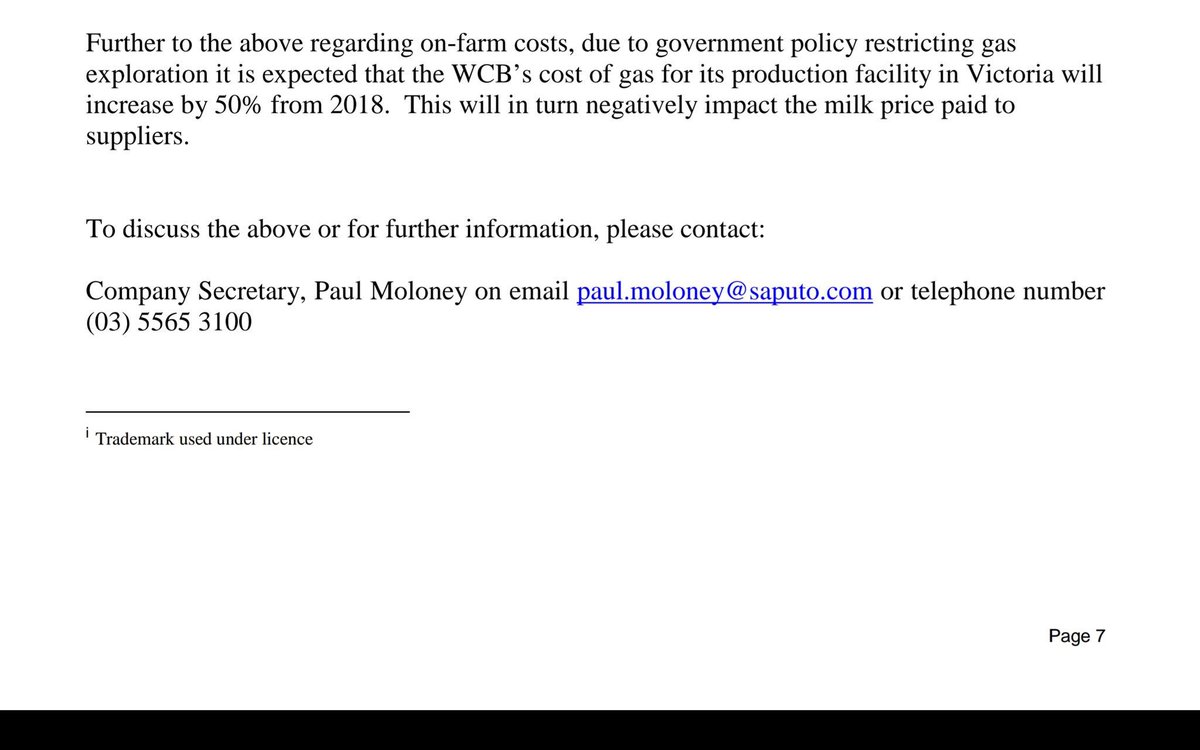
Consider this recent ACCC submission by Warrnambool Cheese & Butter‘s new owners, Saputo:

In February, Saputo announced a quarterly profit of C$197.4 million. I’m not sure why it feels it is appropriate to make Australian farmers responsible for its inability to negotiate a better energy contract. But it does because it can.

It serves as a timely reminder that the push for farmer prosperity has to come from farmers.

Calves teach farmer a lesson in stakeholder engagement

movingthecalves

Every milk maid has to be part kelpie. We spend so much of our time herding cows from place to place every day, it’s almost instinctive. Without thinking, I move just far enough into the cow’s field of vision to urge her left or right without worry or fuss (most of the time!).

But, when it comes to moving young calves, it all goes out the window.

A new group was ready to graduate from the hay-shed paddock out into the rising one-year-old area. It’s about a 500 metre walk past half-a-dozen paddocks. My first challenge: to get them out of the paddock.

Walking around behind the poddies, I try the conventional arm waving to get them moving towards the wide-open gates. Nope. Find myself surrounded with curious muzzles at every quarter.

Next attempt is to whistle a merry tune and hope they’ll follow the Pied Piper. A handful do. The rest, meh. Apparently not that curious.

I have a brainwave. The calfeteria is undergoing repairs at the moment but what about the trailer? Hook it up, partially fill with calf bait (aka pellets) and arrive full of fresh hope. A handful follow. The rest, meh. Apparently not that hungry.

The phone rings. I slump on the Bobcat seat and leave the little blighters to their own devices. One tip-toes out the gates with all the quivering daintiness of Bambi. Oblivious to the talk about whitepapers and indices, out struts another with the confidence of a young and innocent Simba.

While I struggle to comprehend the basics of futures and options, out come Mowgli, Nutsy and Cottontail. Before I know it, the whole cast is wandering off up the laneway.

True, Alex and I later have to rescue some who strayed a little too far. But maybe this was the way it should have been all along. Stakeholder engagement on the farm is often something that has to happen strictly on someone else’s terms.

Dairy Australia directors need to roll up their sleeves

daemail

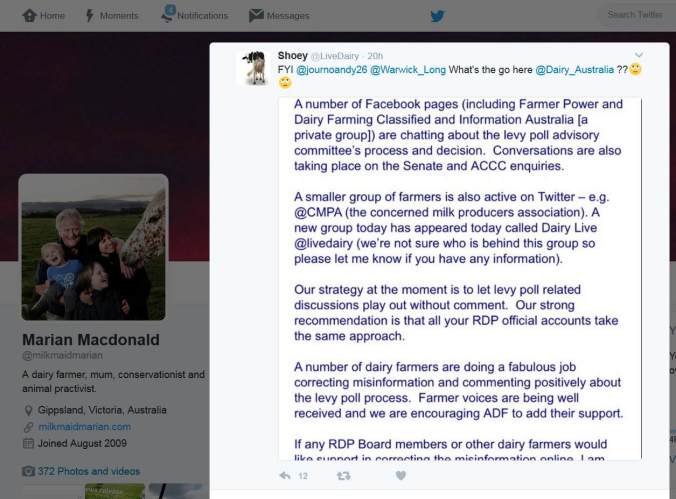
It’s sad to say but, clearly, Dairy Australia is scared of farmers.

I returned from a few hours in the paddocks to find screens and screens full of comments on Twitter from fellow farmers on the leaked DA email above.

It’s been explosive because DA is accused of protecting its own turf first rather than being transparent with and accountable to the farmers it serves and who pay compulsory levies to fund its operation.

Contrary to Barnaby Joyce’s wishful pronouncements, farmers are still in a world of pain and the DA levies amount to tens of thousands of dollars per year for many of us. It’s no surprise then, that the way DA spends farmer funds is highly scrutinised.

I’m a believer in the work DA does. The knowledge I’ve gained from DA programs has made an enormous difference to our farm and we’d be a lot worse off without it. But not everyone agrees.

Some farmers are even pushing hard for a halt to the DA levy, irate that the opportunity for a routine poll on whether the levy should be maintained, changed or scrapped altogether was passed up by a committee.

That committee had farmer members and the DA board has farmer members, too. You might think that something run by farmers for farmers would be great at communicating with farmers, but it’s not.

I’m embarrassed to say that, until I Googled them, I couldn’t even recall the names of DA’s long-standing farmer directors. And there are only one or two visible DA HQ staffers on Twitter. While DA maintains its silence, it’s hard to understand how it can accuse upset farmers of spreading misinformation.

It’s time DA’s farmer directors rolled up their shirt sleeves and had frank conversations right from the start. There was a time we had a director on Twitter who knew how to take the sting out of almost any issue by being ready to chat, quick to crack a joke and unfailingly real.

DA can never control the message but, if it wants farmer respect and understanding, it must first join the conversation.

Dairy love and why it’s lacking on St Valentine’s

“Imagine you decided to stay and defend your home from a bushfire, while your neighbour flees.”

“You save your home but the mental scars are deep.”

“Your neighbour’s place is burnt to the ground and sympathy floods in for the family and, in time, they move into a beautiful new home.”

This was the scenario clinical psychologist Rob Gordon put to me explaining why rifts often open in any community after a disaster. He pointed out that because everyone’s experience of a disaster is different, misunderstanding and resentment brew under the pressure of recovery.

I’ve seen it in dairy social media forums. While thousands of farmers are finding ways to support each other on forums like the Show Some Dairy Love Facebook page, there are some cranksters out there who need to kick heads.

I’ve felt the heat of that anger first-hand, ironically from a non-farmer, who says I was one of those with a secretive “special deal” shielded from the infamous claw-back, accusing me of having no morals.

The truth is that, in May 2015, I had chosen to sign up for one of Fonterra’s “risk management products” available to all suppliers. It meant the price for 70 per cent of our milk during the 15/16 financial year bobbed about in a range with upper and lower limits.

Sure, we would have missed out badly if prices did get to MG’s much-vaunted $6.05kgMS forecast close but it felt like good insurance.

When Fonterra cut its price in May 2016, the price for 70 per cent of our milk dropped to its floor. The remaining 30 per cent tumbled the whole way down.

Lots of people were much worse off than we were. Others were much better off.

That’s the thing. Just like a bushfire, the milk crisis has affected everyone differently. So many factors come into play, like:

  • the size of your farm,
  • the time of year your cows calve,
  • which processor your farm supplies,
  • whether you have/had a contract, and
  • which stage your business is at.

On top of all this, there is loyalty and trust.

Hundreds of farmers swapped processors for the first time in years or decades. For many, it was a matter of survival. Others have not been able to switch and some consider leaving the last big co-op nothing short of treacherous desertion.

Add to all this that farmers have now been battling to pay bills for 10 months (actually, a lot longer if you were in one of the drought-affected regions) and it’s not surprising that people are feeling rather cranky, to say the least.

To make matters worse, change for the better seems an aeon away. The senate, ACCC and ASIC inquiries have revealed little to date, other than that the unrepentant Helou had not been interrogated.

I’m spending St Valentine’s Day at the Gippsland ACCC farmers’ forum. I hope that out of this comes a bit of the dairy love we all need.


Time to wisen up on water

When it comes to survival here on the farm, the three things with the potential to make or break are:

  1. Our health
  2. Mother Nature
  3. The milk price

I only truly understood the health thing and the worst possible price scenario last year but Mother Nature has been playing me like a marionette since the day I took the reins. Just take a look at this mess:

Pasture growth rate (tDM/day)

Pasture growth rate (kgDM/day)

If it looks too technical, don’t worry, it’s just a graph showing how fast the grass can grow by mapping its production over the last 14 years.

As you can see, from May to August the growth rate is consistently low, irrespective of what falls from the sky. I guess the days are just too short to grow a lot.

Come September, the grass begins to take off. After that, it’s anyone’s guess what will happen but that’s when – if there’s enough soil moisture – we harvest the grass we need to feed the cows over summer and winter.

Make or break hinges on reliable water during 12 critical weeks of the year from October to December.

So, while this is the time we need it to rain the most, it’s also the time where the whole thing can shut down. Like it did in 2015.

pfs2015

Right when we should have been turning waves of excess grass into silage, we began feeding the cows to make up for bare pasture. It was a financial and emotional disaster. I found myself suffering panic attacks as I stood in the browning paddocks.

The models show that, in an average year, we can grow 13,432 kilograms of feed per hectare, while in a good year like 2011, we can grow 19,068. In 2015, we could manage just 6,279kg/ha. That’s less than half the average or a mere third of a good year’s growth.

On a 200-hectare farm, that’s a loss of 1430 tonnes of feed valued at, let’s say, $280 per tonne to replace. It adds up to a $400,000 feed deficit. Enough to send me scurrying off to the bank for a new mortgage.

pfstdm

Desperation is the mother of innovation
Thanks to the unquenchable thirst of the resources sector and some rather curious water policies, we are locked out of tapping into the vast aquifer under the farm.

Nonetheless, we do have some water in a farm dam and the dairy effluent ponds. Last summer, we installed a small irrigation system to get that precious water onto the paddocks.

It’s enough to properly water a fraction of the farm during those 12 weeks, so we’re keen to maximise its value, watering only the most water efficient crops.

What we’re learning fast is that, unlike rye grass, which shuts down in the heat, millet luuuurves a heatwave, so long as it has enough moisture. Our experience has been supported by new Australian research, which shows that millet is almost three times more water efficient than rye grass.

There are other benefits, too. Unlike brassicas, which invite repeated attacks by every bug under the sun from mites to moths, millet is pretty much indestructible. And, unlike sorghum, which can be toxic if fed too early, it’s safe for everything from calves to milkers.

Contrary to the traditional wisdom that you can’t milk off millet, you can, so long as you graze it when it’s short. Just like any grass, it gets too fibrous when it’s long and loses quality. Because it can grow visibly in 24 hours under the right conditions, that means you need to graze it often. Not a bad problem to have in my book!

Expect to see more millet planted here to make the best use of every drop of water we can offer, especially as climate change makes the seasons less and less reliable. Now, if only we could get access to that aquifer…

Helou tells the Senate he’s a hero

While he might not have used the word “hero” exactly, former Murray Goulburn managing director Gary Helou was in complete denial when he fronted the Senate inquiry today.

Helou told senators he had the right plan, a plan that had delivered for two-and-a-half years. “The strategy was working and we were getting the right results,” he railed. Only one “unforeseeable” thing had derailed MG’s plans. That thing?

Not the global dairy commodity prices that had been falling steadily for month after month or the inattention of the board to the reportedly growing alarm of senior management. It was a Chinese regulatory change regarding cross-border trade via e-commerce. I gather this is code for selling milk powder and UHT milk on the equivalent of eBay into China.

As Gary explained it, he and the board were aware of the falling global commodity prices but selling these dairy foods – which he described as “our biggest sellers” – had been mitigating those losses.

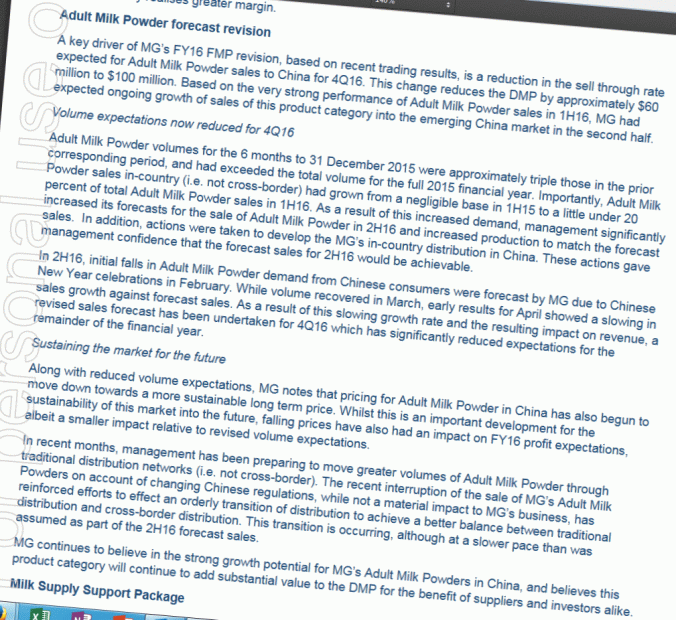
The Chinese seemed to be tightening up on that, err, “cross-border e-commerce” and MG made two ASX announcements in response to media reports, the first on April 12, followed by this update on April 18.

mgcasxapril18

Both announcements concluded that the regulation did “not have a material impact on MG’s business”. Totally in contradiction to everything Gary Helou said today.

Just four days later, MG entered a trading halt. When it emerged from that trading halt on April 27, here’s what the announcement said about those big sellers:

asxmgcapril27

MG was still saying the Chinese announcement had no material impact on MG’s business. So, where does the truth lie?

With MG facing at least one class action, the Senate inquiry and under investigation by both the ACCC and ASIC, farmers have been hopeful of finding answers to the debacle that cost some their livelihoods.

But asked twice by senators whether he had been questioned by authorities investigating if MG had misled investors, Gary Helou said “no”. Both times he paused for several seconds before answering that one very simple question and, incredibly, each time it was an unequivocal “no”.

This is one witness to the Senate Inquiry who raised more questions than were answered.

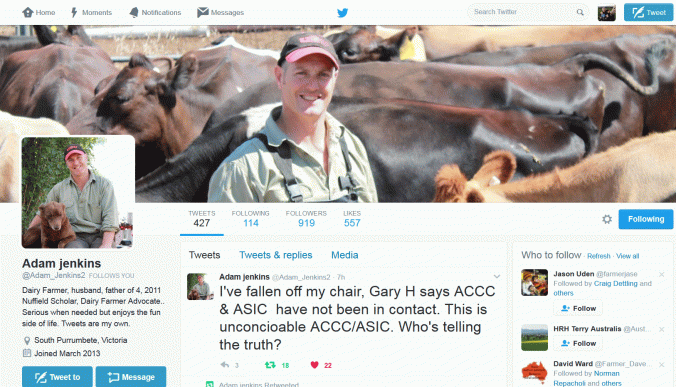
United Dairy Farmers of Victoria president, Adam Jenkins summed up the sense of disbelief that followed perfectly. If it was possible, the ACCC farmer consultation forums that roll into town over the next couple of weeks just got that bit more important to attend.

adamjenkinsheloutweet