This is a post written purely for my fellow dairy farmers in light of the MG announcement today. After speaking with the people at MG, this is what I have learnt:
Why the price must fall MG opened at $5.60/kgMS. Its lower than expected sales, the rising Australian dollar and the fall in the value of its larger than normal (which are routinely high anyway) inventories mean it has a shortfall of between $170 and $200 million. This means the price paid to farmers must fall.
How far the price must fall
Depending on how the last two months of this financial year pan out in terms of sales and exchange rates, Murray Goulburn will finish the season between $4.75 and $5.00.
But the price can’t fall that far in two months…
To do that, it would need to pay farmers virtually nothing for milk supplied in May and June. Some rough numbers sent to me by an industry analyst puts those figures at about 4.75 cents per litre. Clearly, that would be disastrous for many suppliers. It would also cripple MG because farmers would have little choice but to leave MG and supply any other processor that would take their milk.
…so, here’s what will happen
MG will pay farmers for milk supplied in May and June as if the price was $5.47 all along. In other words, the price for May milk will be $3.38 for fat and $7.42 for protein. For June’s milk, it will be $3.45 for fat and $7.59 for protein.
If MG’s sales and the currency fall in line with the worst case scenario and MG really should have paid farmers just $4.75 for the year, it will mean there is a shortfall of 47 cents for every kilogram of fat and $1.03 for every kilogram of protein.
This money will be deducted from the price paid to farmers evenly over the next three years. It means the milk price will be lower for each of the next three years than it otherwise would have been by about 15 cents for fat and 34 cents for protein.
But it’s NOT a debt carried by individual farmers
The money to be deducted over the next three years will simply come out of the milk price. If a farmer leaves MG and moves to a different supplier during the next three years, no debt will follow that farmer. If a farmer joins MG in the next three years, that farmer will have a lower milk price than they would have received in a normal year.
MG will not apply a loan against an individual supplier and will not respectively apply terms and conditions to suppliers.
About this post and me: I am a former MG supplier who still holds some MG shares and currently supply Fonterra Australia. This post is not designed to do anything other than clarify confusion surrounding the situation because I am fearful for the mental health of my fellow farmers. This post has been checked by MG for accuracy.
Him (distracted by his new iPhone 6): A litre of milk, please.
Me: That’s $1.20, thanks.
Him: $1.20? No way, I can’t afford that. We go through four litres of milk a week. I’ll get it at $1.00 down the road. Me: But $1.00 isn’t enough!
Him (wanders off, still looking at the iPhone)
Me (in 10 years): I’m tired of trying to make ends meet. I’m retiring.
Him (looks up from new iPhone 60): You’re selling the farm?
Me: Yep. Got a good price from a guy who says he can see the farm’s potential. I’m finally able to retire.
Him: But where will I get my milk from? Me: The new owner, I guess.
Him: But he might sell it to someone else! Me: Just get it from down the road then, like usual.
Him: But what if they decide to retire as well and sell it to this bloke? Me: Relax.Not everyone’s going to sell to the same bloke.
Him (waving arms, stamping feet): But what if they do? It’s not fair. You are not to sell to him. This is MY milk. I demand food SE-CU-RI-TY!!! Me: Maybe you could just offer him $1.20 for it?
Banning foreign ownership of Australian farms sounds nice in theory but it’s just not fair. Not to the farmers who want a fair price for their land and not to international investors who appreciate the true value of our farms.
There are two main arguments against foreign ownership of farms: ethical practices and food security.
Ethical practices are important and Australia has stringent rules governing almost every aspect of farm operations. In 2014, I wrote about my concerns regarding an overseas firm publicly railing against those laws but, even so, am dismayed to see Milk Maid Marian used as a rationale for preventing any foreign ownership. Farming well, no matter who by, should be supported. Farming badly, no matter who by, deserves concern.
Food security, on the other hand, is a privilege, not a right. Australians – among the globe’s wealthiest people – are in a great position to compete for our share of the world’s abundance of food. And there is no place for a peasant underclass here in Australia.
It’s dazzlingly hypocritical to gleefully buy cheap, high quality electronics from poor nations on one hand but refuse to allow them to buy affordable, high quality food from us in return. If Aussies really want food security, they need to start putting their money where their mouths are.
This new helmet for quad-bike-riding farmers will save lives because it works. Not just because it’s tough and protective but because it’s not the sort of helmet you rip off as soon as you’re out of sight of the boss.
Most farmers refuse to wear helmets and I can understand why. I’ve tried wearing a road bike helmet (in line with official expectations) to bring the cows home on a sweltering Sunday afternoon. A road bike protects your head alright – that is, for the few minutes before heat exhaustion sets in.
Road bike helmets are made for riding motor bikes on a road, fast. Not at 2km/hr behind 250 cows, each throwing out the same body heat as a 1500kW hair dryer (I’m not joking, they do).
As a result, we’d decided to wear equestrian helmets compliant with AS/NZS 3838. Designed to protect a rider from a nasty fall at speed, they provide more protection than a pushbike helmet and better ventilation than a motor bike helmet.
Why hadn’t we chosen a helmet rated for agricultural quad bike use, you ask? Because there wasn’t one. New Zealand has developed such a standard – NZS 8600 All Terrain Vehicle Helmets – but, for reasons I can’t fathom, Australia has not adopted it or chosen to follow suit. Australian inspectors will still expect you to wear a road bike helmet, unless you can prove you have done a proper risk assessment.
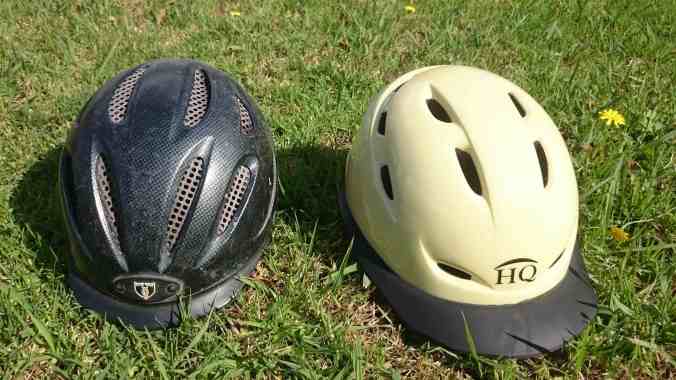
Despite it all, the Quadbar people have finally designed and made a helmet especially for Australian farmers, the HQ Stockman 2. We were sent a complimentary sample helmet to test on the farm. Suffice to say, Wayne’s old equestrian helmet is gathering dust and we’ll be buying another Stockman.
The helmet is light and comfortable enough to forget you’re wearing it and the ventilation is just as good as the equestrian helmets we’ve been using.
Equestrian helmet (left) vs Stockman (right)
What it has over the equestrian helmets is added protection. The HQ Stockman 2 meets NZS 8600 standard as recommended by both the Queensland and NSW coroners.
The helmet is so strong, it passes the test used to gauge the protectiveness of road bike helmets, although only based on one impact, rather than two, as Quadbar’s Dave Robertson explains:
“The ‘Impact energy attenuation test’ is the same test for the Australian motorcycle (and USA DOT motorcycle) standards however the test is repeated a second time on each location on the helmet for motorcycle helmets,” Mr Robertson said.
“Helmet expert, Dr Terry Smith form California USA, at the Qld coroner’s inquest went to a lot of trouble to explain that the second test is to ensure protection in a case where the ‘head strikes twice in the same location’ and MUST not be interpreted as providing double the protection. The speed impact is the same on both tests and the protection must be below 300g. The level of protection of a motorcycle helmet is in the fact that it can withstand a second impact on the same location on the helmet which is more likely at higher speeds. It (motorcycle helmet) is not tested at a higher speed than NZS 8600 however will most likely withstand multiple impacts.”
If you’re riding a quad on the farm without a helmet, get a Stockman. It’s the sort of helmet you forget to take off and it might just save your neck.
EDIT: A helmet compliant with NZS 8600 called the AgHat came on the market a couple of years ago but we didn’t adopt it at our farm because it had no ventilation.
“Charolais” is such a romantic word but it can be enough to strain a dairy farming marriage, especially on a husband’s birthday.
Yes, it is Wayne’s birthday today. No doubt anticipating a showering of treats and charming kindergarten-style presents, he was up extra early.
He’ll be home extra late, too.
Wayne had set off to round up for the afternoon milking an hour later than usual after being delayed by another helping of blueberry birthday cake.
Retrieving the cows from the far paddock, he found them reluctant to go around the corner that heads towards the gully.
Furious tooting of the quad bike horn simply had them packed up tight. The blockage, it emerged, was in the form of a large cream-coloured beef bull at the front. Apart from the obvious traffic jam, this brought two more issues: it’s not mating season and we don’t have a cream-coloured beef bull.
Testosterone-charged interlopers are very unwelcome guests in the country. Feuds involving firearms have been had over such things in days of yore.
So, it was the Milk Maid and kids to the rescue. Enraged by the sight of the blonde beast riding one of our favourite black-and-white cows, I armed myself with the only weapon that came to hand – a straw broom.
Now, straw brooms are powerful arms indeed if you are a genuine witch. But, as it turned out, the bull sensed that this was a witch only in name rather than by profession.
With me hollering a war cry and brandishing the broom like a ninja, the bull rolled an eye away from the cow in front of him to take in the show. He was clearly unconvinced but the cow had never seen anything like it before and shot forwards with the randy B in hot pursuit.
I was winning. With a smirk, I deftly sent her off into the yards, leaving him stranded up the side lane.
Sadly, the sense of heroic triumph proved short lived.
Bonny Prince Charolais simply hopped over two fences, burying himself deep in the herd, which, in a huge tidal wave, swept back past Wayne and headed north into the night paddock lined with fresh hay.
As every farming couple knows, this is when the arm waving starts. Suffice to say, we got the debauched Frenchman into the yard for speedy collection by his apologetic and obliging farmer.
Suffice to say, it’s almost 9pm and Wayne’s still milking on his birthday. Charolais has become quite the “c-word”.
Too many of us had been dying so, at last, something had to be done.
“…if a duty holder (normally an employer) wants to use a quad bike in the workplace – and there is a risk of rollover – WorkSafe will require a suitably designed and tested operator protective device (OPD) to be fitted.”
– WorkSafe Victoria, March 1, 2016
Finally, WorkSafe Victoria has made an unequivocal statement about quad rollovers and what we must do to reduce the risk of getting squashed to death by 300kg of upturned bike. I urge you to click on the link and read it.
Essentially, it means you need to fit something like the Quadbar on the back of our bikes. Such crush protection devices are not “mandatory” but (and it’s a BIG but), continues the WorkSafe Victoria statement:
“If the quad bike is at risk of rollover, and the risk is not eliminated or appropriately controlled, then a WorkSafe inspector may issue the duty holder (often the employer) with an improvement notice which will require them to eliminate or control the risk. The inspector will return to the workplace at a later date to confirm that the requirements of the notice have been complied with.”
“Non-compliance with an improvement notice could lead to an investigation by WorkSafe and ultimately prosecution through the Courts.”
You’d be surprised how reticent OHS regulators are to act. Before they make public statements about the need for new safety measures they need to see dead bodies. In fact, quite a few. Once, a regulatory staffer once explained to me a “pile of dead bodies on the concrete” was pretty much necessary. So this is a big deal.
The biggest problem with quad bikes is that they look safer than they are. People think that if you roll a well maintained quad, it was probably just because you’re a reckless idiot in need of training or an injection of common sense up the jacksy.
The reality is that you only need to drop a wheel into a new wombat hole while rounding up in the dark. Or, you could just be human and make a human error, like Wayne did last week.
As you can see, the bike was one jiggle of the accelerator from rolling. He’d been reversing while talking to someone else and forgotten about the little trough in the crush paddock. In the blink of an eye, the four wheeler simply climbed up the concrete.
Brain-fade, yes. Reckless idiot, no.
We all have brain fades from time to time, so let’s accept they’re going to happen and protect ourselves as best we can. That’s why cars have seat belts. And, hell, wombats don’t follow the rules.
What do we do on our farm to make quads safer, you ask?
We start at the beginning. If you come to work for us, we’ll sit you down to watch the FCAI’s ATV Safety video and discuss the hazards on our farm. Next, we show you all the controls on our bikes if you haven’t ridden our model before. Then, we put your skills to the test on the farm. Finally, we have a questionnaire based on a WorkSafe checklist to check you’ve understood it all.
There are signed speed limits and people are encouraged to take their time.
Wearing a helmet (at least equestrian standard) is non-negotiable.
Having fitted Quadbars to our two bikes in 2011, I can vouch for them. They’re light, foolproof to fit and they are a darn sight smaller than the elephantine footprint of an upturned quad. Just as ROPS saved the lives of farmers on tractors, crush protection devices on quads will spare farming families unnecessary tragedy. Their time has come.
Tough gear for a tough gig.
Newly installed Quadbar in action on the farm back in 2011
Watching the sun rise behind the War Memorial yesterday, I had a sudden realisation: there is no drought on the St Kilda Road boulevard.
For one of the few times since our children were babies, I was on my own in the city, gazing dreamily at the traffic, trams and people below the hotel balcony.
It occurred to me that if you were one of the people whose lives pulse with the number 8 tram from the heart of the city to leafy Toorak and back every day, you’d never know it was dry. You might catch Landline and wonder what all the cockies were whinging about this time.
Unless you were a gardener, of course. Or the volunteer caretaker of the local sports ground. Or a bushwalker. Or, even, a concrete cowboy with a weekender on the Peninsula. Maybe you just had childhood holidays on an uncle’s farm that left you with a deep-rooted, almost subconscious, connection.
Actually, I realised, there are probably a lot of you speeding by down there who know and who care. I saw it in the comments following my plea for the CSIRO in The Guardian. There were so many who saw the same threats and shared the same hopes.
Others wondered aloud whether farmers were to blame for their own demise by voting for the National Party. I’m not sure but I suspect so many farmers do because we fear being forgotten in the city.
Perhaps it’s time we stopped emphasising the differences between city and country. I promise to work harder to weave my writing with threads common to us all.
Meet Deb Poole, dairy farmer’s daughter and professional waterslide tester, and her husband/coach Gary. Incidentally, she fronts Dairy Australia’s latest appeal to “balanced mums”, like me.
“People look at me and they see an ordinary woman. But what they don’t know is that I’m a…ah…pretty intense waterslide tester and there’s nothing ordinary about it.” – Deb Poole
Deb and Gary’s appearances were slotted in around the top-rating Molly miniseries.
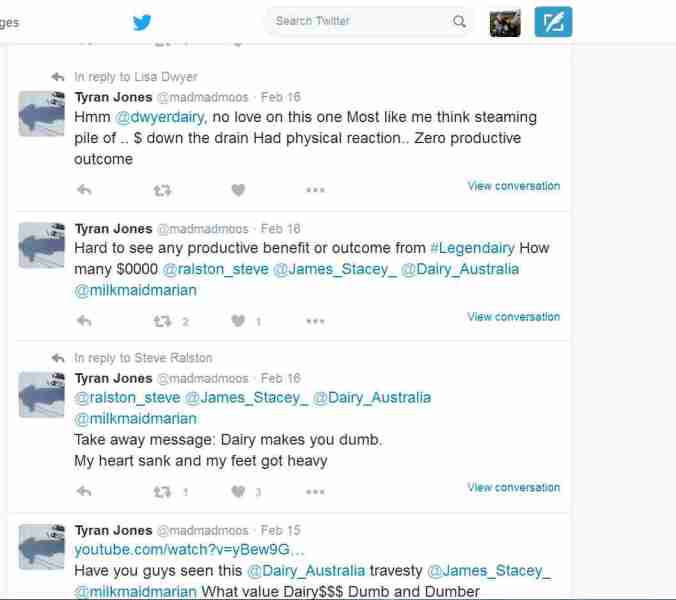
Unsurprisingly, not all of the 6,000 or so dairy farmers whose levies pay for DA’s marketing are delighted with the ad and took to social media this week to vent their spleen. A board member of peak body Australian Dairy Farmers, Tyran Jones, was just one of them.
In the face of such criticism, it’s important there’s transparency and accountability around what must be a significant investment of levy-payer’s funds. So, I asked Dairy Australia’s marketing team to answer some questions about the campaign and veteran ad creative, Rod Clausen of Red Creative for an independent expert’s take on the ad (his thoughts follow below). DA’s Isabel MacNeill was quick to respond.
MMM: What are the objectives of the campaign and who is the target audience?
IM: The overall marketing objectives are to:
Improve perceptions of dairy products and the industry
Decrease the percent of women who agree “I’m concerned dairy foods will increase my weight”
Increase the percent of women who agree “dairy foods are essential for good health and wellbeing”
Increase the percent of women who agree “I trust the dairy industry”
Increase proportion of women who make an effort to consume enough dairy.
Currently, 8 out of 10 Australian adults don’t consume their recommended serves of milk, cheese and yoghurt each day as advised by the Australian Dietary Guidelines.
Research shows, while consumers generally believe it’s okay to enjoy dairy (as it is relatively natural and healthy), they see it as something they should have in moderation. With new dairy alternatives claiming to offer a healthy choice and a plethora of fad diets generating confusion, mums and women have become uncertain about dairy’s essentiality in the diet.
Dairy Australia, through its consumer marketing program, aims to positively influence attitudes and perceptions around dairy. If attitudes towards dairy’s essentiality in the diet track positively then it can be anticipated that this will hold up consumption behaviours and/or drive increased consumption.
The key target audience is “Balanced Women”, (with a specific focus on mums with children between 5-12 years), who take a practical approach to food, with “everything in moderation”.
With the unifying tagline: “It’s amazing what dairy can do“, the current campaign, which has been specifically created to appeal to women, will reinforce the benefits of having dairy every day to women, who are searching for the best health and wellbeing choices for themselves and their family.
MMM: We’ve seen the waterslide ad aired during Molly. Are there other elements to the campaign? IM: The television commercial is part of a much broader marketing program. ‘It’s amazing what milk can do’ combines a range of awareness building advertising that will run nationally, combining television, print, radio, mobile and on-line executions.
To coincide with the campaign launch, February was renamed ‘Februdairy’ across a range of Australia’s most popular magazines, with titles including Australian Women’s Weekly,
An extensive range of promotions is also planned including a media partnership with the Logies and the announcement of new Legendairy Ambassador, Chef and TV personality, Karen Martini, who will join Michael Klim as public supporters of the Australian dairy industry.
Dairy Australia is partnering with this year’s Melbourne Food and Wine Festival Hub from 4-13 March, which will see the creation of an interactive ‘Urban Dairy’ presented by Legendairy. The Urban Dairy provides the opportunity right in the middle of the city to bring the industry to life, from show casing producers to highlighting the quality of Australian dairy products.
The Legendairy media activity has been planned in consultation with dairy manufacturers and allows the overall category to benefit by linking in to media buying cycles of the major brands. The launch activity for Legendairy will focus on broadcast and high reaching media channels rather than more targeted health and wellbeing spaces.
MMM: What was the rationale for the creative approach? IM: Recent quantitative research has told us women are likely to consume more milk, cheese and yoghurt when they understand it is:
Rich in nutrients, such a protein and calcium;
Good for maintaining and building bones and muscles; and
It provides natural nutrition
To cut through the increasing ‘nutrition noise’ and deliver these messages, we required a creative approach that was disruptive. Being noticed is key; and creating fun characters is extremely powerful when it comes to getting people talking, sharing messages, and eventually changing behaviours.
Formulative research told us that the creative concepts and corresponding characters developed as part of the ‘It’s amazing what dairy can do’ campaign were appealing to our primary audience, in the same way that the character of ‘Rhonda’ cut through for AAMI.
The concept centres on women who do real, but very unique occupations, and the unifying factor is that dairy makes this possible. Memorable characters have been developed, such as Deb Poole the waterslide tester, who relies on the unique combination of nutrients in milk to give her energy and strength to perform her job. By using humour in a documentary style approach, we hope to engage consumers emotionally through entertainment, while delivering rational messages about dairy through the story.
Because the reasons and barriers to consume milk, cheese and yoghurt differ between products, as do usage behaviours and consumption occasions, the creative executions will be targeted around milk, cheese and yoghurt, rather than dairy as a category.
MMM: The waterslide ad has been accused of portraying milk drinkers as stupid. Was this considered by Dairy Australia? IM: People like to be entertained and like characters with personality. Humour helps us create a natural affinity with the audience – ordinary Australians. By using humour, we’re saying, ‘we’re one of you, Australia’.
Deb is an ordinary mum of three. She may have an unusual job, but she is just like one of us. She is relatable, in her very unpretentious way and because of her very simple values she is inspiring.
The tone is humorous and down to earth. Milk is a very basic down to earth product and the tone helps remind us about the good, simple, healthy values milk stands for. It’s the ordinary things in life that are sometimes the most special, they can even be Legendairy.
Our research on the concepts show the campaign style and messages resonated with mums and will motivate more consumption of dairy, while positioning it as a simple, natural, and nutritious food.
MMM: How are creative concepts assessed by Dairy Australia during the selection process?
IM: The creative process was concept tested with the target audience. The research showed the campaign style and messages resonate with mums and will motivate more consumption of dairy, while positioning it as a simple, natural, and nutritious food. Key outtakes from the research were:
“Broad appeal of idea for most, with family focus or message and context appearing to drive connection and engagement.”
“Quirkiness and uniqueness felt to be distinctive for the category, and create talkability.”
“Implied ‘elite athlete’ status considered very funny.”
MMM: What is Dairy Australia’s budget for consumer advertising and media this year?
IM: The consumer advertising and media budget is approximately $3.4M for this year. This is for all production and media placements across TV, radio, magazine and digital channels.
MMM: How does Dairy Australia gauge success?
IM: We set clear KPIs for our marketing program each year which we track and report on. These include attitudes and perceptions of dairy foods and the industry that we aim to shift.
In addition to the annual tracking, we recently commissioned baseline research with our target audience to establish awareness of the key messages that will be delivered through the milk campaign. We will test them again in six months’ time to see if there has been cut through and uptake of our messages through the campaign.
MMM: Will evaluative metrics be available to levy payers?
IM: Yes. Dairy Australia reports on its marketing metrics through the annual report each financial year.
You can download Dairy Australia’s 2015 annual report here. The only reference I could find to the effectiveness of DA’s mass media advertising was this one on page 54:
“Mass media advertising delivered through television, digital and outdoor channels maintained awareness, but was limited to one major burst due to significantly smaller budgets. Digital advertising ran from February – April 2015, achieving 20.7 million views. Last year’s popular multivitamin television commercial was updated to include the Start and End Your Day With Dairy call to action airing on prime time television, reaching 1.4 million mums at an average frequency of 7.6 times. Outdoor advertising saw 641 billboards featured in bus shelters across metro areas nationally, strategically located around schools, shops and retail centres.”
Unfortunately, the number of people who watched an ad is no gauge of its effectiveness, so this is very disappointing. The good news is that there were much more encouraging measures of other DA marketing activities.
RC: “Interesting ad. Creatively I like the ‘Chris Lilley’ style documentary approach and the professional waterslide tester story. It’s definitely entertaining and it’s got reasonable cut through. I ran it past a few of the target audience and it makes people smile.”
“I have to admit if I was a Dairy Australia levy payer, the long version of the ad (the back story) would make me cringe. Especially with Deb being portrayed as the ‘slightly thick’ daughter of a dairy farmer. I’m sure this is meant to make her character appear down to earth and resonate with the average mum. But I can see how this would be seen as a negative stereotype, particularly if you were part of the industry. Do I think viewers will take this away from the ad? Not really, I don’t think people analyse ads that deeply. In any case, her husband is from the city and he’s also a bit of a ‘plonka’.
“Do I remember the benefits of milk or that it’s essential for health and wellbeing? I get that protein and calcium gives me strong bones and that’s definitely the take out people get, even if it is buried amongst the entertainment. The 30sec version of the ad does push the product benefits – Phosphorous, Riboflavin, Vitamin A and four more. And the 15sec promotes nutrients, simple and natural. Presumably these ads are meant to build on and reinforce the original story and push more the rational benefits. They are a good reminder, but they’re not telling me anything I didn’t already know. So I don’t think it will change perceptions or increase the proportion of women who make an effort to consume more dairy.
“I can’t help comparing this ad with the ‘Anchor Dairy – the journey to beautiful milk’ film I saw when I was researching this piece. If I was looking to improve perceptions of dairy products and portray the industry as innovative – this film really hits the spot – even if is answering a different brief. To be fair it also doesn’t have the entertainment value of Legendairy Deb. It’s a catch-22. Be more entertaining and you get slammed for not talking about product benefits. Focus on the rational benefits and no-one takes it in.
“In a nutshell, Legendairy Deb is more entertaining than informative. It says milk is good for active people and will make me strong – which is true, but nothing new. It’s not improving my perception of the dairy industry or milk. But it’s not detracting from it either. Do I think mums will take the message seriously and consume more milk? – I’m not sure. But with $3.4 million worth of media spend behind it they are bound to get the key messages. Time will tell. We won’t know its true effectiveness until the usual tracking reports are done after the campaign.”
But how many farmers will consider the tracking reports, if they are indeed available? With this in mind, I asked Isabel one final last-minute question yesterday afternoon.
MMM: When you were testing the consumer facing ads – were they also tested on farmers?
IM: Our advertising campaign is directed at balanced mums, and last year we conducted qualitative and quantitative research to understand the key barriers and opportunities to promote consumption of dairy products.
These insights have been used to develop the campaign approach. The creative concepts were also tested with the balanced mums by a specialist agency prior to production.
While famers are our most important stakeholders we didn’t test creative with them as the campaign has a very defined audience.
We did of course present the creative concepts to the DA board (where there are a number of farmers) and also the marketing teams of the major dairy processors.
To me, this answer gets to the very heart of the problem. As every advertising suit knows only too well, no concept – however brilliant – flies without client approval. And in this case, there are 6,128 clients sprinkled across Australia. In this respect, it seems DA has not learned from Devondale’s infamous “Dev ‘n Dale” campaign. Farmers may not be advertising experts but DA can ill afford to put them offside.
Perhaps, just perhaps, DA could add one more element to its ad agency brief: your creative pitch must remember the dignity of the farmer and test its appeal to this other vital audience because dairy farmers are the ultimate client and they have TV’s too.
This is one of the worst seasons on record around here and the only thing that has made it survivable has been good, early planning.
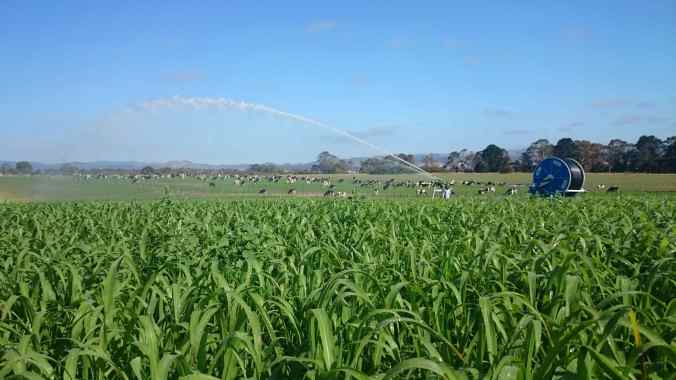
We sold 10 per cent of our cows and planted our summer turnips in the second week of Spring to give them a chance of survival. We pushed bloody hard to get an irrigator up and running so we could create a lush oasis of millet with water from our farm dam.
Most importantly, we were quick to speak with our bank manager and buy hundreds of tonnes of extra hay and silage. It was not a pretty plan. It was a survival plan in the teeth of a failed season and a milk price that is below our break even point.
We are still a long way from next Spring but the survival plan is getting us through. I can’t imagine how we would have managed without it.
Central to our planning were the CSIRO’s soil moisture maps and Pastures from Space. Combining the two tools, we could see that not only were our pastures not growing in the peak of Spring, there was little chance they could. The soil was powder dry all the way down to a couple of metres. That can only be fixed by weeks and weeks of rain.
In other words, we knew we were stuffed early enough to do something about it, thanks to the CSIRO. It’s survivable if we plan early, plan well and it doesn’t happen too regularly.
The big question still remains for this farmer: how common will this type of season be in the future? The climate modelling is just not detailed or accurate enough. All we know is that it will be drier, warmer and more unpredictable than ever. And that’s nowhere near enough information to make good decisions.
To be frank, we don’t even have a worthwhile forecast for the next fortnight or the three months ahead. The Bureau of Meteorology’s oft-reported seasonal outlook is so unreliable here, it is literally the equivalent of tossing a coin – by the Bureau’s own admission.
We need more climate information, not less. If this type of season begins to roll around every five to 10 years rather than every 20 to 50, it’s no longer going to be viable to keep doing what we’re doing.
Farmers are innovators by nature. Rather than simply howling to the wind when it’s all too late, I will do something about it. What, for sure, I don’t know. Cuts to the CSIRO’s climate and land and water divisions will make finding the answers ever more difficult.
So bang the dairy drums. Column inches gush with talk of rivers of white gold while the Hot Copper share market forum’s “most discussed stocks” list is topped by a dairy proposition and includes another two dairy stocks.
I may be a mere farmer but the dairy proposition in question, Carbon Conscious, seems ambitious at best and fanciful at worst. The company has a 12-month lease on a farm (with an option to extend it if it can pull off plans for intensive housing facilities) and has bought 418 cows. It appears from the announcement document that it hopes to:
find a processor that will buy its milk at a locked in premium price
the processor will then process and package it specially for the company
then the milk is sold to the farm landlord
the farm landlord exports the milk to China
the farm landlord sends some of the profits back to the farm tenant.
Sounds like a great plan but it will face a few challenges. First, the investors believe they can milk 2,500 cows three times a day in a 60-stand rotary. Whew!
Lost you? Well, according to rotary dairy maker, Daviesway, “A 60 unit rotary dairy with an average 10 minute rotation should milk 300 cows per hour with an average production of 30 litres per cow.”
That would mean the proposed herd of 2,500 cows would take more than eight hours to milk, three times a day. In other words, non-stop milking. Hope they have a crack team of milkers and mechanics on hand! You may call this a mere technical problem but dairies aren’t cheap (a few hundred thousand) and it seems somebody’s overlooked a pretty basic calculation or that this is less farm and more factory.
On the topic of factories, getting the project off the ground will require a great deal of sensitivity. The “system 5” style of farming described in the announcement is the most intensive type of dairy farming in the world. Cows are housed year-round and do not graze grass.
Only a few months ago, public opposition thwarted the development of a dairy farm in the small hamlet of Kernot by Chinese investors. The Carbon Conscious farm is in a far more sensitive “lifestyle” location and will be more intensive than the developments planned for Kernot.
On top of that, the announcement makes no mention of an arrangement with any of the three processors in Western Australia capable of the job.
Yes, at this stage, it’s really just a plan with a rented farm. Even so, Carbon Conscious is laughing all the way to the bank. Its shares opened at 20.5 cents this morning, up from just 7.8 cents on Christmas Eve.
The dairy stratosphere is now littered with investor thought bubbles. Here are my top four:
Mining millionaire, Bill McDonald set the typewriters rattling in 2014 when he said his new Camperdown Dairy International company would build a $120 million plant but The Weekly Times reports the site is largely building rubble,
Ningbo Dairy at Kernot, where public opposition has forced the Chinese investors to put the property back on the market,
the company formerly known as Linear Capital – Aerem – has flirted with purchasing 50 farms and failed to meet one self-imposed deadline after another, while taking the once-excited farmers for a merry ride, and
Gina Rinehart on the other hand, flirted only briefly with dairy, putting her $500 million project on hold when she realised dairy prices go down as well as up.
“Why?” I asked an investor friend this morning. I don’t understand. Robobank’s analysts have been forecasting a return to health for global dairy markets for what must be a year now. They’ve pushed out any forecast recovery until late 2016, blaming the delay on stronger than expected European production.
Dairy farming is complex. You must be able to manage people, animals, pastures, machinery and cash with precision to make a profit. To make the money that investor shareholders typically demand, everything has to go right, too.
While farmers are often characterised as lacking the professionalism of big business, I’ve been disappointed for the farming friends treated so shabbily by would-be investors in 2015. I really hope 2016 will be different.
It’s not just the live animals you’ve got to be wary of here on the farm. Aside from the copperhead that kept Wayne company during milking the other week, perhaps our most memorable wildlife encounter of 2015 was actually with a dead animal undoubtedly new to science: the man-eating wallaby.
One rainy winter’s night, Wayne called a halt to cooking the evening meal when he drew me aside to check out a mysterious shape wrapped in a tea towel.
Bent low and unwrapping the tea towel slowly, he said in hushed tones, “I found this outside the pump shed. Take a look at the fangs on it.”
“Wow,” I gasped, “see how they hook together. Looks like they could tear a nasty hole in your leg.”
“F*@&ing scary wallaby,” whispered Wayne with a poker face.
After nearly choking on a mouthful of water, I came up for air, and wondered if I saw the faintest of smirks on Wayne’s face as he retaliated with: “It’s a bloody wallaby alright, you should see its tail!” Was the joke on me or City Boy? I’ll never know for sure.
Life and death
It was raining too, when the kids and I discovered a dead kangaroo along the boundary fence. Her eyes were dull, legs immobile.
While I worked on the fence, the kids took a closer look and announced a miracle! “Mama, Mama, it’s alive, it’s alive,” they shouted, arms flailing wildly as they ran towards me.
They were right, almost. The kangaroo had killed herself in an impact with the fence but her pouch rolled and wriggled with life. Oh my god. The kindest thing might have been to euthanase the squirming joey right there but I couldn’t bring myself to do it.
Luckily, we had latex milking gloves in the Bobcat and, with my heart in my mouth, I reached deep into the still-warm pouch. After a few tries, out came a weeks-old hairless male joey, plop, into a towel we carry around in case of mud pie catastrophes.
Joey in front of the fire
Wrapped in the towel and my raincoat, joey was held close to Zoe’s tummy for the chilly trip back to the warm of our hearth. We got him off to wildlife rescue volunteers, who told me just the other week that he’s soon to be released back into the forest. ‘Til we meet again!
Reptilian gatecrasher
In general, I’m not a big fan of reptiles on the farm but Blueys are different. Why, we even had one as a class pet in primary school. So, when this fellow appeared at home, I was keen to introduce him to the kids.
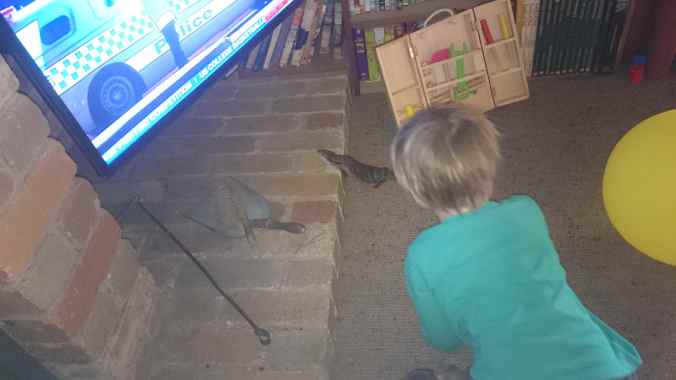
As with the cicada conditioning calamity, it seemed my introduction may have backfired a little. But all was forgotten later when Bluey unexpectedly appeared out of nowhere to watch the evening news with us.
Bluey obviously likes to be well informed
Beast becomes beauty before our eyes
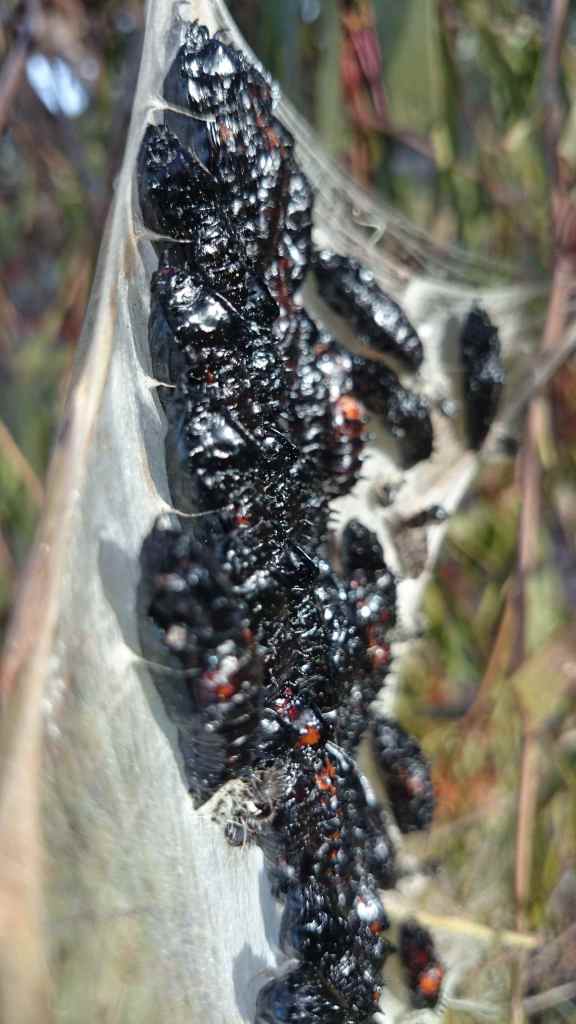
Not every creature we see makes such an exciting entrance but we marveled every day as we walked to the bus stop during Spring, watching a web of monsters transform themselves.
From this
To this
To emerge as the gorgeous Northern Jezebel
A motley crew!
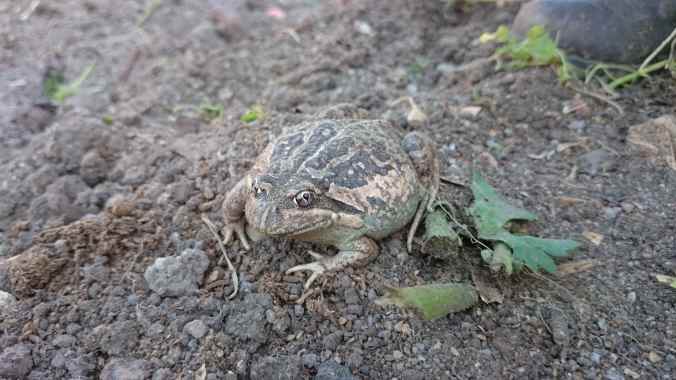
There were plenty of other beauties along the way, too. Enjoy just a selection of what the farm offered up to us in 2015!





 Boom! Boom! Boom!





 The Milk Maid Marian