OHS inductions for the city cousins?

“City cousin season” is fast approaching for many farmers. It’s a time we look forward to here but we do have to be extra careful. With new safety laws emphasising the need to include volunteers and visitors to the farm in safety systems, I asked Kevin Jones, OHS consultant, freelance writer and editor of the award-winning SafetyAtWorkBlog.com what it all means.
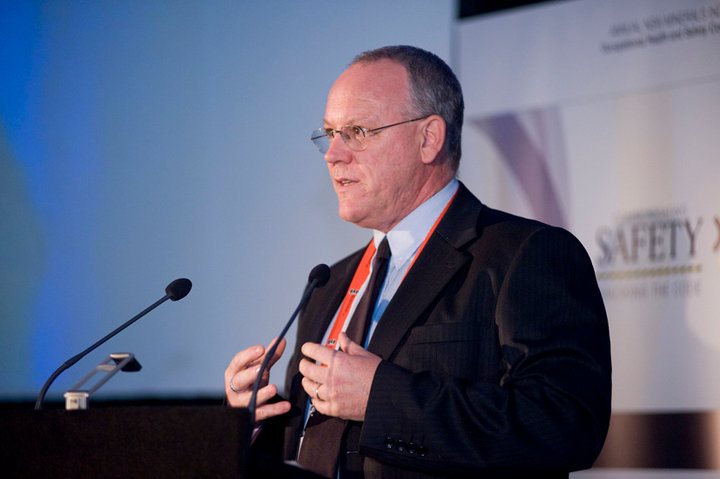
Kevin Jones

Kevin Jones

Some media has been reporting anger and outrage about the Government imposing new work health and safety duties on small business, volunteers, farmers and many others. There are new safety laws in many States but largely these reflect the moral and safety responsibilities that have always existed. If farms have been doing the right thing in the past, they are likely to be doing the right thing in the future.

OHS laws are always going to be seen as an imposition from the city when things were pretty good the way they were. Things may have seemed to be pretty good but plenty of families lost relatives in farm accidents, many lost limbs or struggle to cope with economic stress. There is plenty of statistical evidence to show that things in the country weren’t as good as many thought and the Government felt obliged to act. Perhaps the original work health and safety laws, developed in the cities in the 1980s, were not suited to the country or the application of these laws needed a different approach from that in the city. But the intention of these laws is always to reduce harm, injury, death and the related impacts on farming families.

These occupational health and safety (OHS) laws may also require paperwork but so does public liability insurance, Business Activity Statements, and a range of other paperwork all businesses are obliged to provide. Paperwork has always felt to be a major distraction to why we set up our businesses in the first place.

Over the last twenty years OHS laws have broadened from the physically-defined workplace to include the impact of work on others such as visitors, neighbours and customers. But the workplace has also changed to an extent where it is hard to know where a workplace starts and a workplace ends. Many in the city struggle with these laws but farming communities have always worked with an almost invisible delineation between a workplace and a home. Where others went outside for a smoke, farmers often went for a smoke and checked on the animals. Farmers are hardly ever not working, and this means that farms are almost always workplaces, so when visitors come to the farm for a weekend break, they are visiting a workplace and so OHS laws will apply.

This unreal demarcation is a major reason why the new laws focus on Work and not the workplace. Dealing primarily with the work activity focuses on the reduction of harm to the worker rather than making a workplace safe. Often the best, most tidy, most organised workplaces still had unsafe work being done.

Do the new laws mean that all visitors require a safety induction before entering the farm and to sign a document saying they understand the rules? Usually, no, but if they come to undertake farming activities (ie. work), maybe there should be an introduction to the farm – where to go, where not to go, what to touch, what not, what to drive, what to keep away from. Maybe the signs in the milking shed need to be written for visitors instead of in family shorthand. Maybe pits should be covered instead of assuming the pit will be in the same state next morning.

If WorkSafe is called to a farm, for whatever reason, showing the inspectors that you know about your OHS obligations and apply basic safety procedures to equipment, tractors, quad bikes, and industrial and agricultural chemicals is going to reassure them that you know what you’re on about and that you are active about managing the safety of your workers, visitors and family. Will you be found to be in compliance with the OHS laws? Probably not, but neither are most of the small businesses in the cities either.

OHS is often dismissed as only common sense. But OHS is almost always common sense, after an incident. Why didn’t we cover that pit? Why did I leave the keys in the quad bike? Why didn’t I chain up the dog when I knew kids were coming over? These and many other daily questions are all made safer through the common sense of covering or fencing the pit, hanging up the keys, chaining the dog. If safety is only common sense why then don’t we apply it?

The new Work Health and Safety laws are not yet active in all States and Safe Work Australia, or your local OHS regulators, are a good place to watch and see if and when these laws apply to specific circumstances and industries.
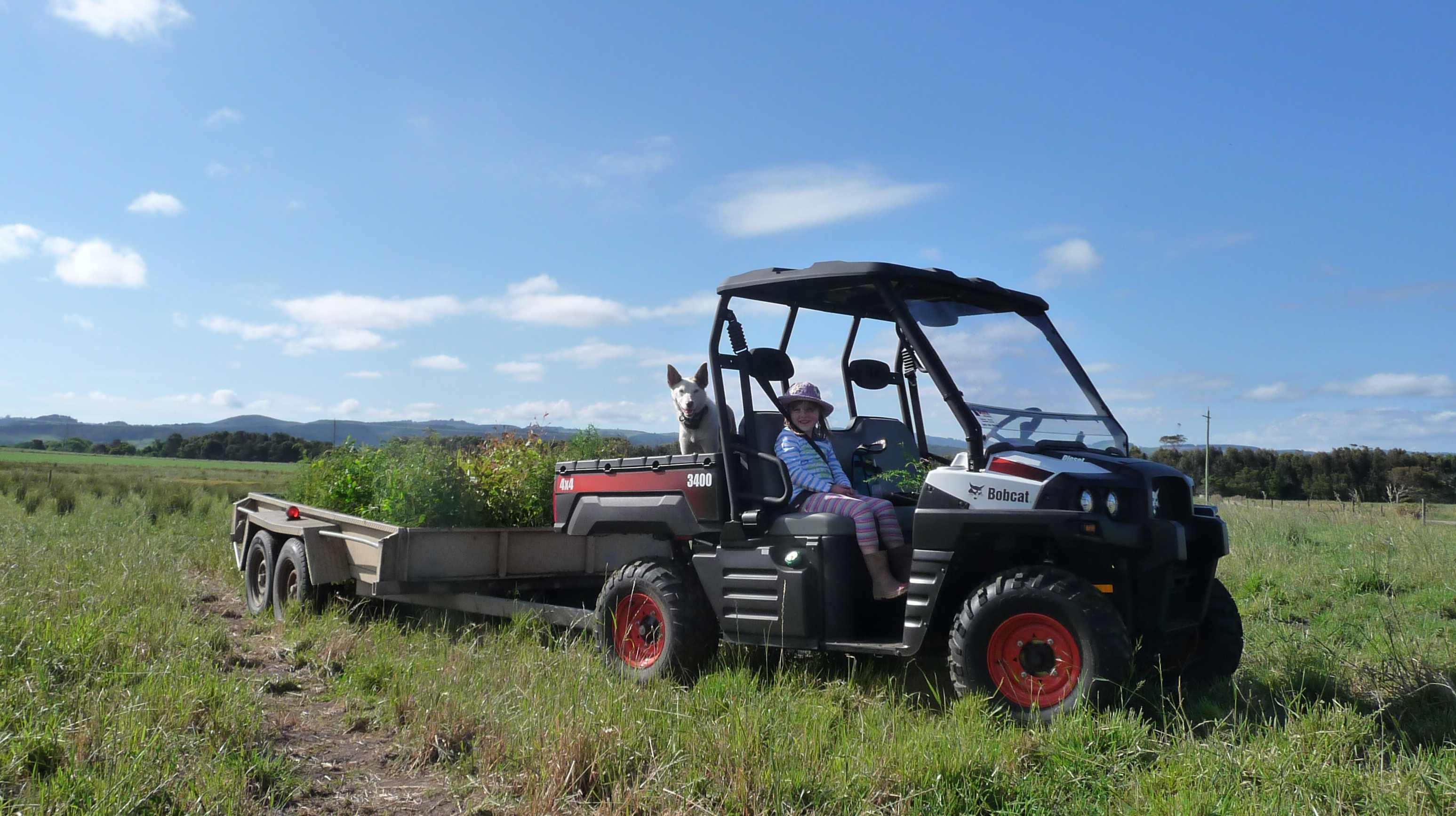
Big girl’s toy (my Big Rig)

UTV towing tandem trailer

Well, it’s not just a toy

This is a seriously fun way to get the farm work done. And, now, in relative comfort thanks to the posh roof and screen that came with my new beast on Friday.

WorkSafe and a consortium of others have been running a big campaign to move farmers from quads to UTVs like our Bobcat and, yes, they’re great. You can get the family (parent, two kids and dogs, at least) around the farm safely with a whopping toolbox and all the bits and pieces you need to tackle maintenance chores or major emergencies. It also has the grunt to carry about half a tonne in the box and tow another half tonne behind.

But there are limitations and we won’t be selling our two quads any time soon. Although difficult to bog, these machines do not float on excessively soft pastures, nor do they have the tight cornering needed to thread a wily heifer through a gate.

A UTV like this is a fantastic piece of farm transport that sits somewhere between a quad, a tractor and a ute. Just try taking mine away from me!

Who are these billabong refugees and what are they doing?

The job had got to that point where you have to stop for a minute and stare at it, just to ‘process’ its sheer enormity. Before me was a truly terrifying tangle of high tensile wire that had pleased the contractor by wrapping itself around the ploughing discs.

The knot was about the same size as the Bobcat and, without safety glasses for little Alex (do they make safety glasses for toddlers?), I had to accept that the wretched thing was going to beat me.

With the dawning realisation of defeat came the sound of something equally beyond the realms of reality: a babbling waterfall coming from the gully billabong. A very nice and very timely distraction.

The fish had gaping golden lips and flashy golden bellies to match. Each seemed about 2-feet long and oh-so-muscular. I may be a piscean but I know nothing about fish. Perhaps this group of half a dozen or so monsters are the dreaded carp, washed into the gully during one of this year’s floods. And what are they doing? Breathing or breeding?

Carp are considered the lowest of all fish around here: categorised as “noxious fish” by the Department of Primary Industries for the environmental damage they cause while being pilloried by cooks and anglers for their muddy taste.

But perhaps Charlie Carp deserves better. The big fish make excellent organic fertiliser and, according to one account on ABC Radio, might be alright on the menu if we Aussies learned the secret to eating carp.

Anyhow, the whole fishy dancing performance went on for five minutes and would have lasted longer if not for Patch. Yes, our most accident prone pooch had to investigate and was so intrigued, he forgot he couldn’t walk on water. Turns out he’s not that good at swimming, either. Crazy dog!

Patch had to come and take a look

Shame I missed the “after” pic. The memory card was full of fish video and photos. Patch isn’t the only silly one.

Angry mob stages a mootiny

They were right. There simply wasn’t enough grass left in the paddock for a repeat visit and, in the wash up of a riotously great 6-year-old birthday party, we were late on the scene.

We arrived on the river flats to find the first 50 or so cows out of the dairy staging a “stand-in” outside the entrance to the rejected paddock. I turned to set up an alternative just 100 metres the other direction and they marched towards us, disgusted to find I had taped off the lane behind us. While I set everything up and my little party-goer took a siesta, a few members of the mob broke ranks and began to filter in to graze the drabs.

After the party

She’d partied hard.

Of course, that meant we had to get them out and that’s when the trouble really started. Everyone else followed us in and were totally confused when we wheeled around and tried to push the surging mob back out from whence they came. Well, it took five minutes and a lot of determination to move them 40 metres.

Then they went the wrong way up the lane and it was my tough little farmer who convinced them to, very reluctantly, turn once again.

Angry mob of dairy cows

The ragged party goer came to life when presented with a challenge and was there behind them in the dust

A heartbeat after I took this pic, the leaders saw the opening to the fresh paddock and, like a stampede of New Years’ Day shoppers, they were off.

Friendly fire from the milk co-op

I don’t think MG’s chief banana, Gary Helou, was expecting its farmer shareholders to be pleased with the co-op’s rebranding exercise. Referring to the Dev ‘n Dale ads, he writes to his farmers:

“We have received several comments about the adverts in relation to farmer image. It is important to note that the Dev and Dale adverts have been carefully designed to achieve consumer cut-through to drive brand recognition and sales volumes.”

“This strategy is based on humour and the comic characters were designed to be over-the-top so they could not be construed as real representations of our farmers.

“The Dev and Dale characters were also developed to create greater recollection of the brand. Earlier market research found that consumers did not have strong recollection of the Devondale name or brand, and this means consumers are not often enough considering our products for purchase.

“We will monitor consumer response carefully to ensure there are no negative connotations for industry image.”

In earlier letters, the co-op had explained that the old branding was associated with a low-cost positioning and it was important to add value to the brand. I guess Dev ‘n Dale is their interpretation of “upmarket” then.

Please let me know – are the ads funny, memorable and indicative of a premium brand?

PS: For an alternate approach, check out Yeo Valley’s UK dairy promo.

How a girl becomes a cow-girl

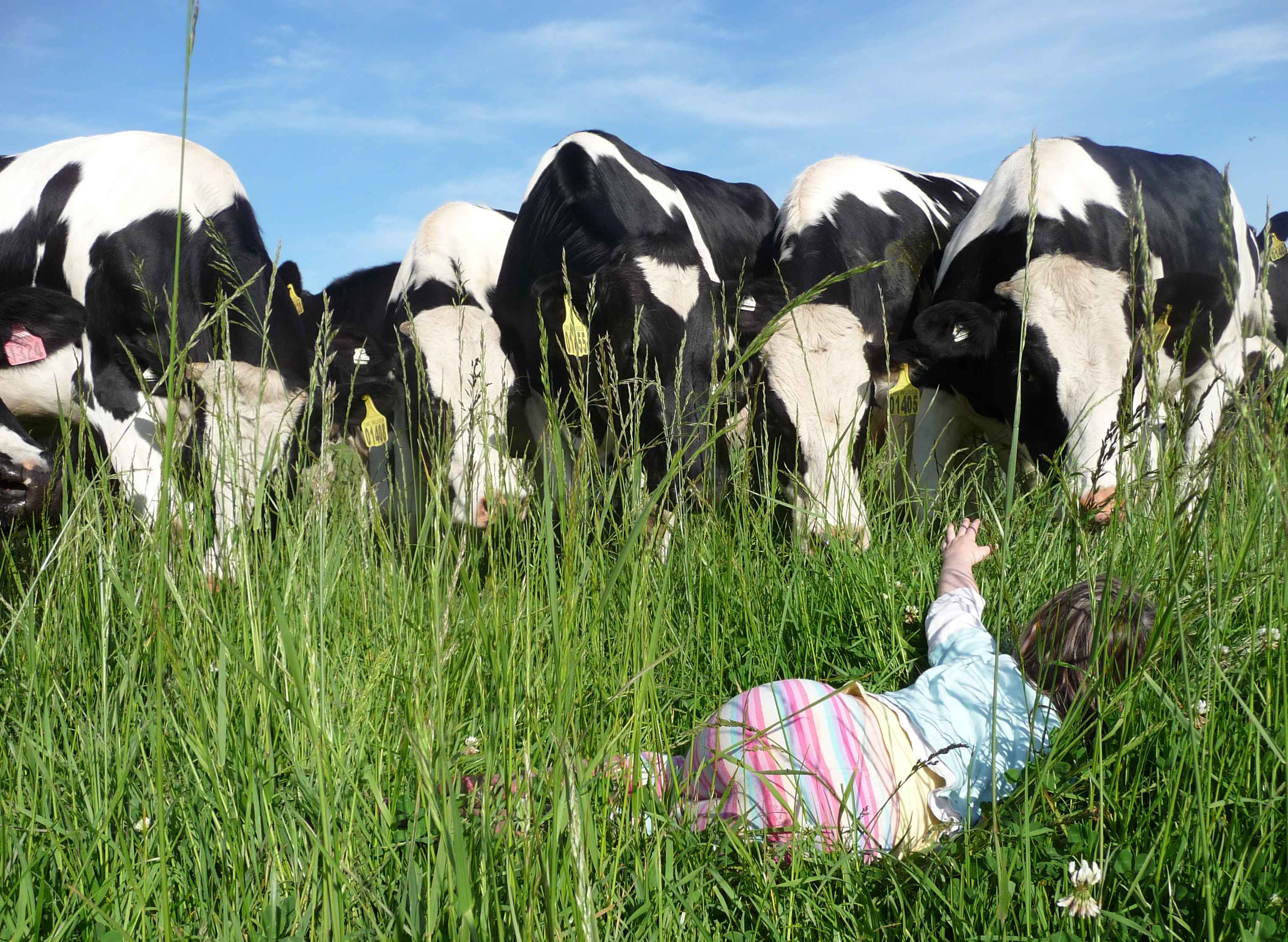
Zoe gets cows. She really undersands them but there’s still lots to learn and, early this morning, we had a fun little lesson with the “teenagers” on the farm.

Step one is to lie down nice and still in the grass. Step two is to stay still (and quiet). Step three is to wait a little bit longer.

Heifers and Zoe reach out

“You can trust me”

If you’re patient enough, they’ll come. Snuffling, chewing their cud and nudging forward little by little with unbridled curiosity. It’s not exactly “Gorillas in the Mist” but it is an awesome, humbling experience and everybody should try it.

Tragic irony

I cannot imagine finding a child killed on the farm yet this is perhaps Australia’s most dangerous backyard. One of the things we do to keep Zoe and Alex safe is to keep them off quad bikes.

According to Safety Around Farms:

“ATVs are the most common cause of death for children 5-14 yrs on farms. Between 2001-2004, 12 children died on ATV’s in Australia and many more were hospitalised with serious injuries, 50% of these children were visitors to farms. (National Farm Injury Data Centre, 2007)”

That’s why I have a Bobcat UTV. Problem is, it’s only a two-seater and Alex is getting to the stage where he likes to stand in his child carrier and give me loving kisses on the face while I am driving. Hardly ideal.

I’m in the process of upgrading to a three-seater so little man can be strapped in more safely beside me rather than on me. Among the options is the Polaris Ranger Diesel and here’s the promo for it:

Buy this big machine to keep your kids safe and we’ll give you a small machine to keep your kids #%@

Do you see the irony of it? I rang Polaris HQ to see if I could get more family-friendly Ranger accessories – like a roof and windscreen – instead of the dangerous machine for little children. No, certainly not.

I asked the marketing manager a raft of quite pointed questions about the safety of the little machine. He couldn’t answer them. It seems certain he hadn’t read this from the Canadian Paediatric Society:

“While industry guidelines suggest that children under 16 years of age should only operate youthsized models, these vehicles are still heavy and can travel at significant speeds. Also, a higher centre of gravity contributes to instability, making ATVs prone to flips or rollovers.”

“Currently,there is little evidence to suggest that smaller youth models are safer when used by children. US CPSC injury data from 2001 showed that the risk of injury per number of driving hours for an operator under the age of 16 is reduced by only 18% when driving a youth-model ATV with an engine size of 200 cc.

“In addition, the level of risk for a child or adolescent operating a youth-model ATV is still almost twice as high as for an adult on a larger machine; the risk of injury to a youth using a smaller machine is also five times higher than the risk to an adult on a machine of the same size.”

In other words, don’t think your child is safe on a quad bike of any size.

The Polaris kids’ quad may be free but it could be Aussie kids who pay the ultimate price for this corporation’s cynical grab for market share.

Monsters in the farm dam

There’s a creature on the farm that I find simply repulsive – eeeeeeels! Their hideous faces are teamed with swishing slippery bodies so readily mistaken for snakes. And we have them by the tonne.

It seems almost every time I set the dam siphon running, I get a hair-raising encounter with these ugly things.

Eels

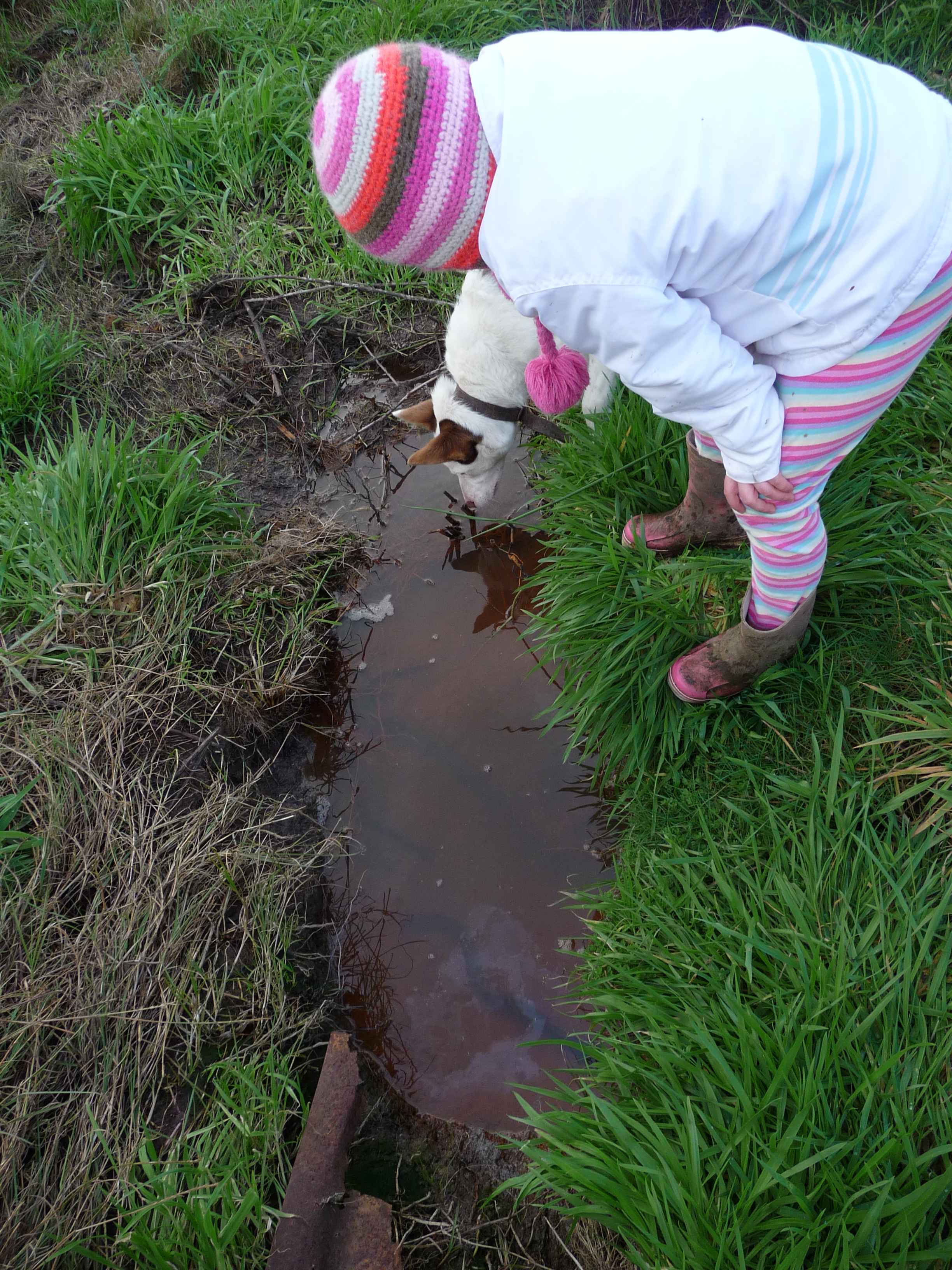
Zoe and Patch inspect a pool of writhing eels

But they are incredible creatures and, instinctive fear aside, I have a lot of respect for them. You see, the eels in our dam have actually come all the way from the tropics – New Caledonia perhaps – travelling thousands of kilometres to reach our little patch of paradise.

They can live 50 years, “breathe” on land, grow up to 2 metres long and weigh 20kgs and eat everything from dragonfly larvae to small ducks.

Apparently, they’re tasty, too.

Read more about extreme eels – I guarantee you’ll be amazed!

Catalyst: Eel Migration – ABC TV Science.

Please can we do some more farm jobs?

Apparently, Australian agriculture needs to be made more “sexy” to attract young people. I don’t think so. While you can get paid ridiculous amounts of money to work in mining, the call of the land is strong for those who really love it.

Already, I can see it’s in Zoe’s blood.

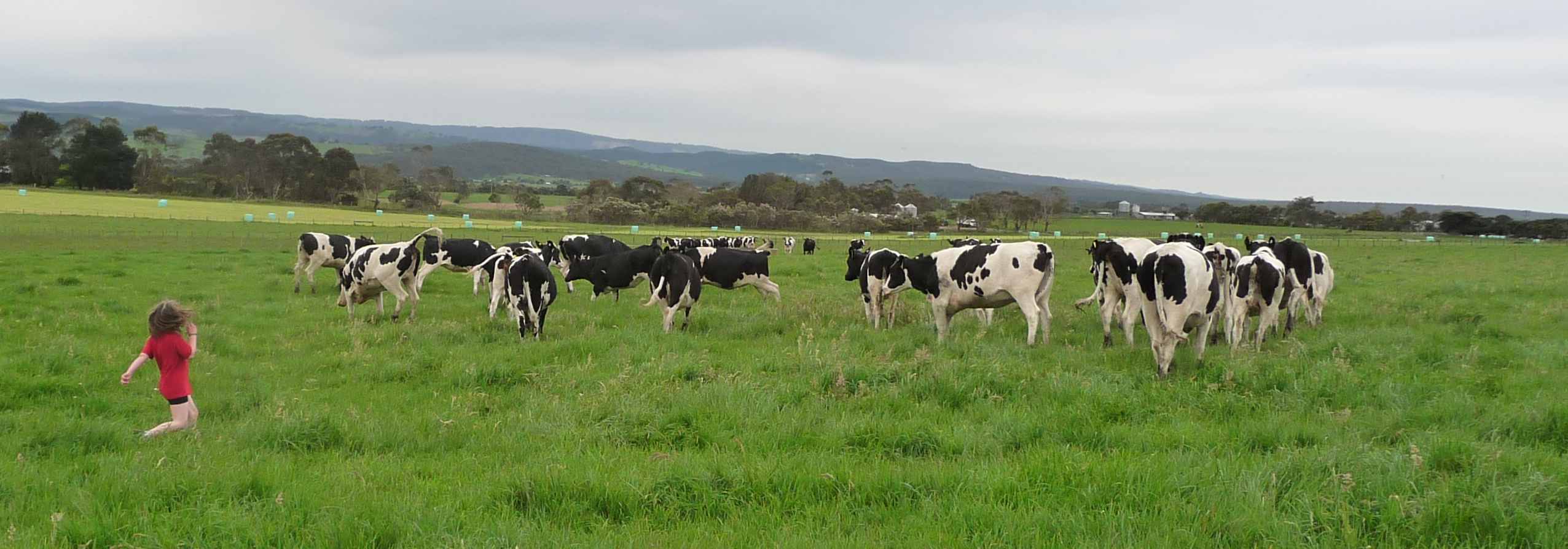
Zoe chases the heifers

“I’ll get them, Mum, I can do it, you watch!”

Straight off the school bus, she launched into moving the yearlings with great gusto. It was like watching Patch. She ran around them in circles first, then made some crazy dashes right through the centre of the mob. Pure unadulterated fun!

We got them all out a few minutes later, with flushed cheeks and the wind in our hair. “Please, Mum, can we do some more farm jobs before we go home?”

My gut tells me Australian farming and fresh food has a great future. My head tells me that’s so too, with one caveat: before they can feed the world, there has to be a sustainable return so they have confidence there’ll be enough to feed themselves.

Will Curtis Stone come to the rescue of Aussie farmers and foodies?

Coles is pushing prices down, down, down to help the Aussie battler, right?

Actually, it appears the driving force behind Australia’s supermarket wars is something much more prosaic – supermarket ROI. According to the Sydney Morning Herald:

“A report released in March by the Merrill Lynch analyst David Errington warns that the big three retailers, Coles, Woolworths and Metcash, will need to boost their earnings by $1.3 billion in the next three years if they are to make an acceptable return on the billions of dollars of investments made on acquisitions and capital expenditure. This is on a total earnings before interest and tax (EBIT) pool of $4 billion for the retailers.”

“In the past year, the profit growth of the entire sector has shrunk. Errington’s report says that in the first half of this financial year, the three food retailers delivered a combined EBIT growth of $150 million, a far cry from the $400 million-a-year earnings growth required to make an acceptable return. It will be interesting to see what the full-year earnings will be when the sector reports in the next few weeks.

“If Coles, Woolworths and Metcash fail to generate suitable returns on capital in the next couple of years, investors’ patience will run out and the groups will suffer a significant de-rating.

“It goes a long way to explaining the intensifying price war among the supermarket chains as they try to snatch market share to justify their investments.”

Doesn’t sound like the hostilities will ease up any time soon, does it? In the meantime, we can expect more and more private-label products – especially dairy – to flood the shelves of Coles and Woolworths.

Research by IBIS World Australia reported in the International Business Times showed that, already, “Up to 68 per cent of butter sold in the two supermarkets is private label, while for sugar it is 67 per cent, 56 per cent for bread, 55 per cent for fresh milk and 53 per cent for eggs”.

Alarmingly, the researchers predicted that “by 2017, the share of such products would make up one-third of total supermarket sales”.

Why am I alert and alarmed? Because this is bad news for anyone who cares about good food. When price becomes the only differentiating factor, quality must suffer right along the food chain and the ones who will ultimately feel the pain will be the little people – the farmers who grow the food and the consumers who eat it.

So where does this leave the foodies of Australia? I’ll let you draw your own conclusions.

No need to worry, I guess. Celebrity chef Curtis Stone will save us all. His spin doctors, Thrive PR, say this:

“And don’t think that Curtis is just a face when it comes to his partners like Coles. He is an active contributor behind the scenes to their business and marketing function. Their success is his success.”

Then again, maybe he’s blissfully unaware of the damage to Australian food caused by “his success”. I intend to appeal for help by emailing him at contact@curtisstone.com and am sure he’d love to hear from you, too.

While you’re at it, don’t forget to sign Lisa Claessen’s petition to Coles CEO, Ian McLeod by visiting http://www.change.org/en-AU/petitions/coles-up-the-price-of-generic-brand-milk-to-a-sustainable-rate-of-return-for-all