This cow cannot take a trick

The last cow into the dairy on Friday morning had Wayne stumped. It had been an uneventful milking, she’d gobbled up her ration of grain for breakfast but, when Wayne turned to spray the teats, there she was calmly sitting underneath her neighbour. No matter what we tried, there she stayed, refusing to budge. This little cow is only five years old, six months in calf and in great health. We didn’t want to lose her.

SheShallNotBeMovedFriday

Sarah the vet was duly called but could find nothing wrong. We figured she’d just slipped and was gathering her nerves before trying to get back up. She didn’t. She wouldn’t, even to follow a tempting trail of wheat.

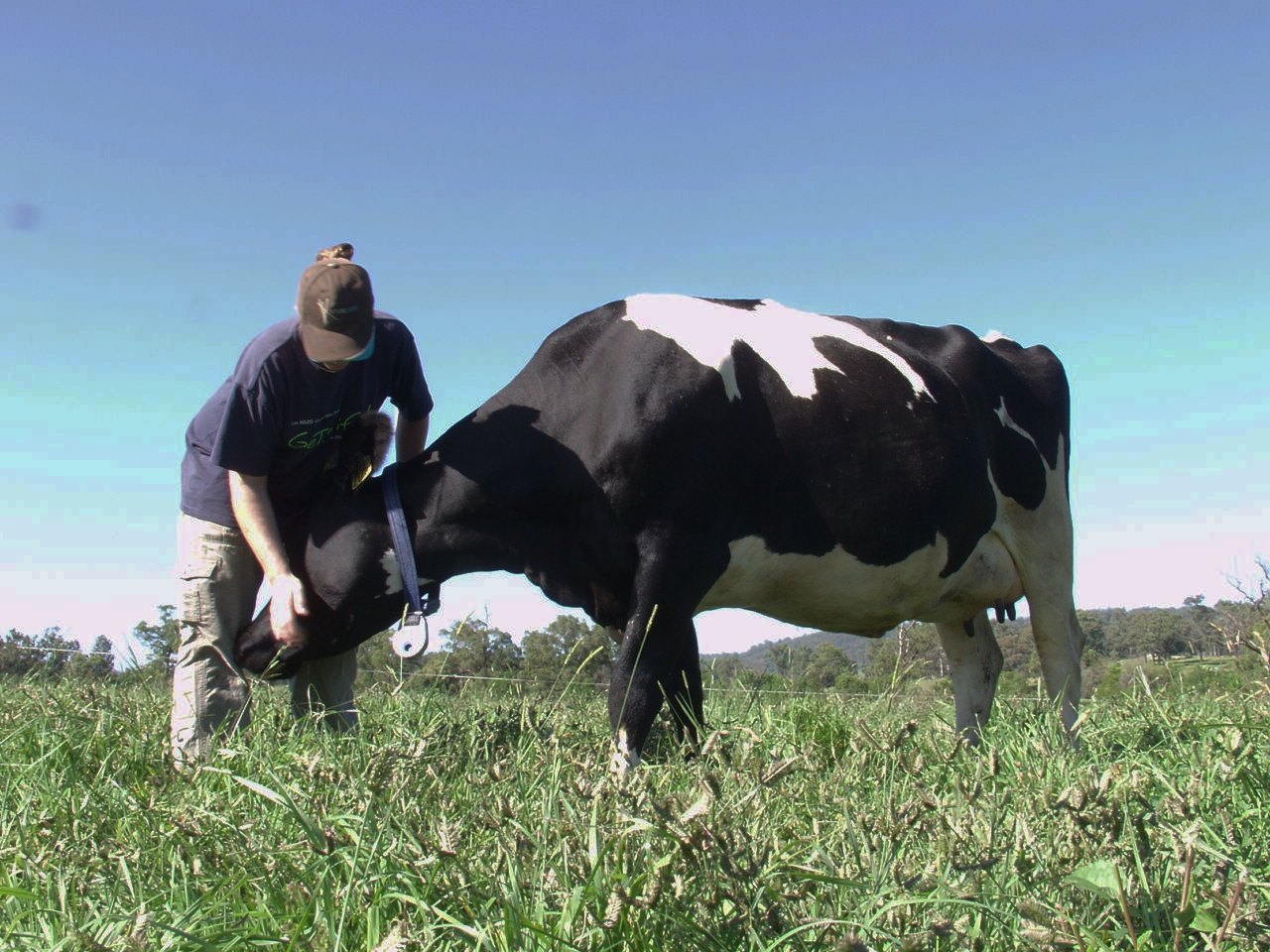
Mmm, you smell nice

Mmm, you smell nice

When the time for afternoon milking came around, Wayne had to slither her along the platform and then lift her over a fence with the hip clamps. We sat her in the shade with grass, silage and water. She ate well, looked bright and feisty but her legs just wouldn’t work. It was an enormous relief to see her up and about at daybreak on Sunday morning, pushing against the gate to get back with her herd mates.

She still looked a bit tottery yesterday afternoon, so we let her have the afternoon off but felt really confident she was going to be alright.

So when I had to move the cows unexpectedly at lunchtime and saw her being pushed backwards down a slope towards the gully by a big bully cow, my heart leapt into my mouth. With the bully heaving low under her belly, the poor little cow toppled sideways – seemingly in slow motion – into this ignominious position.

UpsideDown

Now, this crazy-looking pose called “dorsal recumbency” is deadly for a cow. I had minutes to get her upright. For emergencies like this, I carry a heavy drag chain in the Bobcat and had her sitting upright again in less than five minutes. It’s a delicate job that has to be done with a lot of grunt and that’s always a risky combination.

Thank goodness, it worked. After some gentle coaxing from me and enthusiastic yapping from Patch, she struggled to her feet and joined the herd. Fingers crossed, little cow.

Suck it up, princess and a farmer’s election year wishlist

There’s been a bit of biffo on Twitter and on dairy farming forums of late. Some people are clearly very angry with our leaders. Others are polite but rather bluntly say “suck it up, princess”.

I’m in between.

I want to be among the top 10 per cent of Australia’s dairy farmers. Not because I am a nutty type A personality but because only the top 10 per cent make a good living. So, tonight I’m up late wrangling spreadsheets, casting a sharp eye over our budgets and trying to benchmark our performance.

That doesn’t stop me from wanting better from our politicians so that Victorian dairy farmers get a fair go. We’re not subsidised like our US or European competitors and we don’t have a free trade agreement with China like the world’s best dairy farmers across the Tasman, so we need to be lean, efficient and smart to survive.

To do that, we need:

  • relief from the carbon tax that puts us at an instant disadvantage
  • a more level playing field. Forget subsidising cars and get on with the China FTA.
  • to deal with the duopoly
  • most of all, to invest in ag R&D.

Being smart has historically been our strength, but no longer. Sue Neales of The Australian reports that:

“Australia’s spending on agricultural R&D has also dropped internationally from 9th to 16th place, according to a global study presented at the same conference.”

“Treasury last year predicted the value of agriculture to the nation could grow from its current size equivalent to 2.5 per cent of national gross domestic product, to 5 per cent by 2050, surpassing the manufacturing sector.”

If we are destined to become agricultural dunces, dairy farmers battling to survive on a tilted playing field will never manage the growth needed to make Australia Asia’s food bowl.

Whose fault is it?

Lots has changed since 1980. Milk production in Victoria has more than doubled despite cow numbers remaining the same and 35% per cent less land to graze.

Since then, we’ve had massive advances in cow genetics, understanding how to grow grass and exactly what cows need to eat. But we farmers are no better off. Despite it all, we’re very much poorer.

Everyone seems to have an opinion on why that is and just whose fault it is. Pretty much everyone has copped it online: the government, supermarkets, milk processors, agri leaders, farmers and consumers. What strikes me, though, is just how similar our situation is to that of farmers around the globe.

Milk has been sprayed at icons in France, the Brits have hit the barricades in desperation, and outgunned riot police in Brussels. Things are miserable in the US, too.  I think the reality is that affluent societies consider high-quality food a right. And you don’t value your rights until they are threatened.

Very few urban Australians would believe their access to fresh milk is at risk and, until they do, unsustainable food pricing will be “someone else’s problem”. I wonder whether it will be me or my children who will one day staff the barricades, wield the “milk cannon” or simply quietly try something else that’s truly valued by Australians.

Friendly fire from the milk co-op

I don’t think MG’s chief banana, Gary Helou, was expecting its farmer shareholders to be pleased with the co-op’s rebranding exercise. Referring to the Dev ‘n Dale ads, he writes to his farmers:

“We have received several comments about the adverts in relation to farmer image. It is important to note that the Dev and Dale adverts have been carefully designed to achieve consumer cut-through to drive brand recognition and sales volumes.”

“This strategy is based on humour and the comic characters were designed to be over-the-top so they could not be construed as real representations of our farmers.

“The Dev and Dale characters were also developed to create greater recollection of the brand. Earlier market research found that consumers did not have strong recollection of the Devondale name or brand, and this means consumers are not often enough considering our products for purchase.

“We will monitor consumer response carefully to ensure there are no negative connotations for industry image.”

In earlier letters, the co-op had explained that the old branding was associated with a low-cost positioning and it was important to add value to the brand. I guess Dev ‘n Dale is their interpretation of “upmarket” then.

Please let me know – are the ads funny, memorable and indicative of a premium brand?

PS: For an alternate approach, check out Yeo Valley’s UK dairy promo.

O-week for a young cow

The first member of the class of 2012 has calved and she’s lovely! To help her learn the ropes, we’ve had her with the milking herd for a couple of weeks prior to calving. The noises of the dairy are already familiar and the dinner served during milking must have been divine because she only kicked at the cups once – even though it’s the first time anyone’s handled her teats, let alone milked her.

That’s a big deal for us as farmers. A quiet cow is a happy cow and that means she lets down her milk readily and is less likely to suffer mastitis. And we are less likely to get hurt. In the dairy, we have to reach between the powerful hind legs of 550 kg cows, 500 times a day. Getting kicked can mean broken fingers, hands, arms and faces.

Anyhow, this young cow is a pretty cool customer, even when being pestered by a silly pup who wants to slurp up some delicious cow poo (never let a farm dog lick your face).

Milk money makes the town go round

They say our local town has a heart that beats on the 15th of every month – pay day for the milk co-op. While 98 per cent of Australian dairy farms are small family-owned businesses, they do turn over significant sums. My own books show it was almost $900,000 last year. It’s a shame we keep so little of that turnover (the average dairy farm enterprise makes 1 to 2% returns) but it’s great for the town.

Dairy Australia notes that: “Dairy is also one of Australia’s leading rural industries in terms of adding value through downstream processing. Much of this processing occurs close to farming areas, thereby generating economic activity and employment in country regions. ABARE estimates the regional economic multiplier effect to be roughly 2.5 from the dairy industry.”

Here on the farm, we employ one full-time local and two casuals directly but I think the biggest contribution our little business makes to the community is through our purchases. We spend a lot of money on grain, fertiliser and pasture renovation but there are also the vets, rural produce store, hay and silage baling, mechanics and even excavators.

This year will be a little different. I have to save almost $150,000 at a time when the price of grain is on the rise, sell silverware in the form of cows or borrow more money. Suffice to say, I will be as tight as a Yuletide Grinch.

It will be essential repairs only and the tractor will simply not be allowed to blow its gaskets like it did last year.

Robotic milking: the gentle touch of machine on moo?

FutureDairy project leader Dr Kendra Kerrisk is something of an icon in her field of milking automation and so it’s very exciting to have her write this guest post for Milk Maid Marian. There are already a handful of robotic dairies in Australia and this looks to be the way of the future. Ironically, Kendra explains, it may allow dairy farmers to spend even more “quality time” with their cows.

Robotic milking is a relatively new concept for Australian dairy farmers even though our European counterparts are well accustomed to the idea. It is a technology that I have had the honour of working with for 10 years now and there a lot to be send for this new way of milking cows.

To the less informed, the concept may conjure up images of metal on flesh that are less appealing than the tender human touch. In fact the contact with the cow is every bit at gentle as the conventional approach and one of my fondest observations is that robotic milking farmers have an increased ability to enjoy the time that they spend with their cows when they no longer have to attach milking cups to every teat of every cow twice every day. It seems that the saying “quality not quantity” has a place when it comes to farmer/cow interactions.

Robotic milking farmers are unanimous in their opinion that the technology creates a farm system that results in very relaxed and laid back cows. The idea of robotic milking is that milking occurs 24 hours per day and that the process is voluntary (i.e. the cow completes the process without human intervention). Whenever I spend time with visitors at a robotic dairy (either our research facility or on commercial farms) the visitors are always deeply influenced by how quite and calm the milking process is with robots.

With robotic milking the cow chooses when to be milked and moves around the farm system at ‘cow pace’.

Cows in paddock with robotic milker in background

The cows are moving one by one hoorah hoorah…

Whilst I have been involved in researching the application of robotic milking I have also had the pleasure of being involved with many commercial farmers as they adopt this new way of farming. The farmer must learn a new management style whereby the farm is managed in such a way that the cows makes choices that suit the farmer and the farm targets. Cows move around the farm to gain access to incentives and by default can find themselves at the dairy for milking when their time is due.

Cow walks through robotic gates

With robotic milking the cows bring themselves to the dairy (they even operate specially designed one-way gates themselves) and take themselves back to the paddock.

The concept of robotic milking is creating a work environment that allows farmers and their employees to focus on higher level management tasks. In this manner they have the opportunity to manage their herd through an increase in the level of real time data that becomes available to them allowing them to focus on individual cows that require attention. The real attraction is the more flexible working hours that reduce the need for the early morning starts and commitment to milking cows twice a day. And the bonus for the cows is that they can now manage themselves in a manner that best suits them as individuals or as social groups.

Robotic dairy

These ladies know exactly how to manage the system to ensure they don’t miss out on the “treats” and “rewards” that are available to them.

Cows are creatures of habit and they truly appreciate a predictable environment. Robotic milking is exactly that and the outcome is a herd of cows that are very easy to work with since they become extremely calm and ‘chilled out’. With all of my experience in the area of robotic milking I have absolutely no doubt that this is a way of farming that is going to be increasingly adopted on commercial dairy farms in Australia and around the world.

Possibly one of the greatest bonuses is that I reckon dairy farming is going to increase in appeal with the younger generation which is exactly what our industry needs if we are to remain sustainable far into the future. If we achieve that they we are all winners because it goes a long way to securing our ability to continue to provide Australians with fresh, safe and nutritious dairy products that are produced in our own backyard!

There’s always time for a good scratch!!

There’s always time for a good scratch!!

Cow in the naughty spot

Cow in the Naughty Spot

In the naughty spot


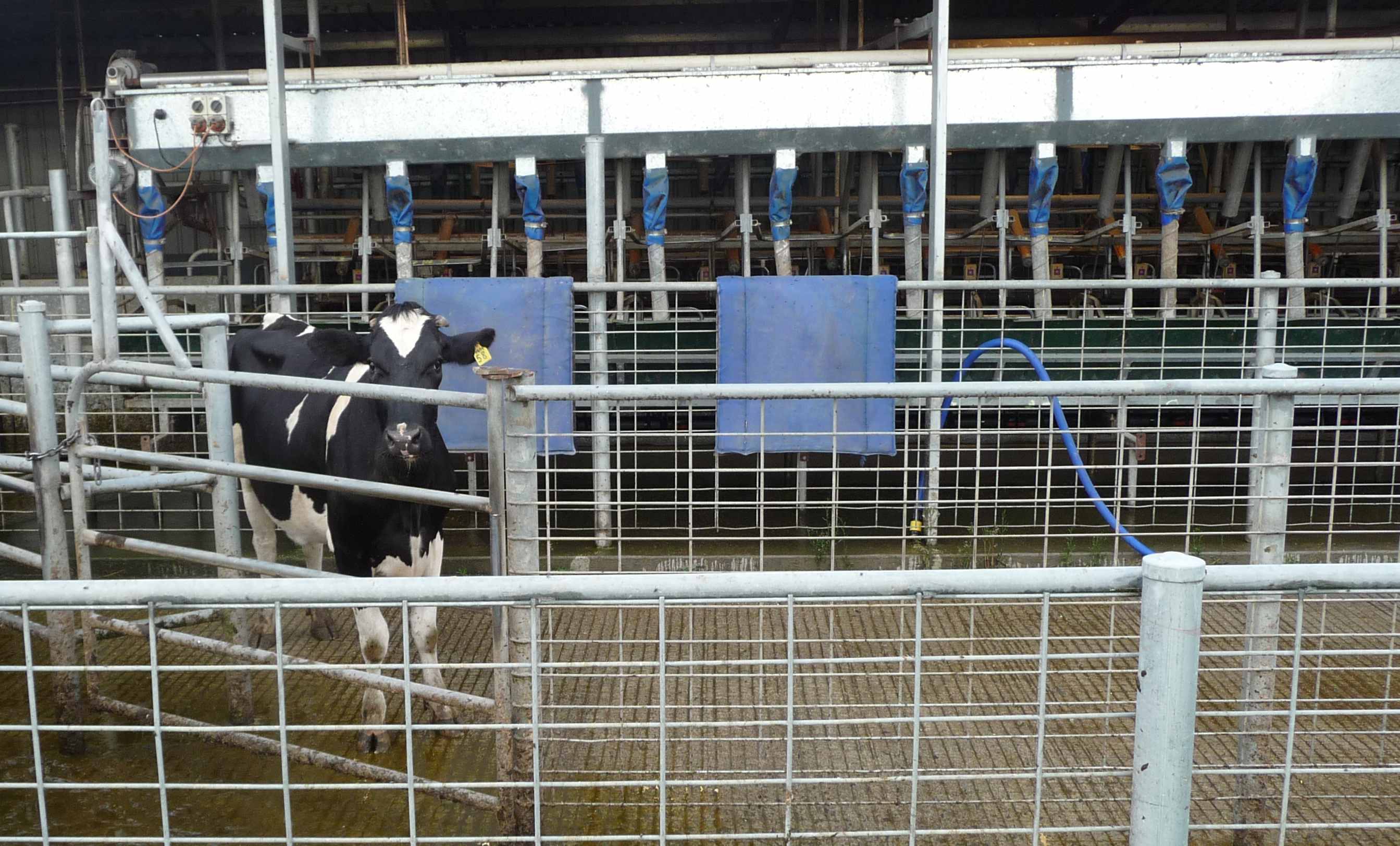
This is the dairy’s naughty spot and this cheeky young cow spends a lot of time there.

She’s a clever little thing and has noticed that there’s often grain under the feed bails when her sisters become a tad overenthusiastic tucking into breakfast. She lurks in the exit race waiting for her chance to quite literally “clean up”. The problem with this is that nobody else can get past her and a traffic jam ensues.

This morning, Wayne’s shooed her away three times and tried squirting her with the hose but her behaviour has continued to be “not acceptable”, so here she is in the “naughty spot” (with apologies to Super Nanny). She’ll be allowed out when she writes “I will not get in the way” 50 times and all her sisters have left the dairy.

A most unlikely frog habitat

An automatic wash system keeps our milking machines spotless and hygienic. A series of warm, hot, hot and cold water cycles swish through all the stainless steel night and morning, carrying with them powerful alkali and acid detergents. Milk is very sticky stuff and we need to keep the pipework clean for high quality milk and to look after the health of the cows.

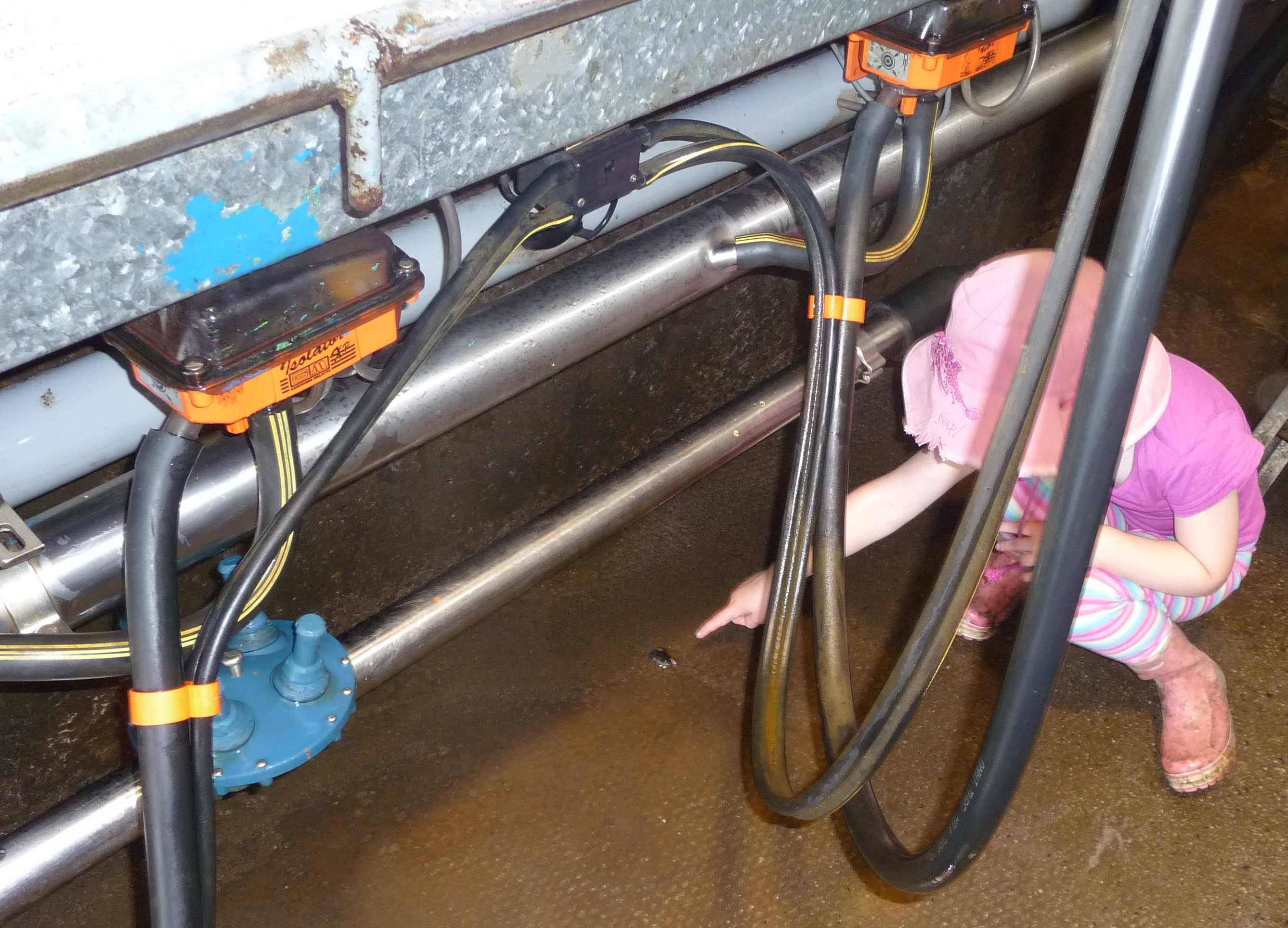
At the same time, we are all told that frogs are one of the first creatures to succumb to chemicals in waterways. The dairy pit, then, must be the most unlikely of frog habitats yet Freddy and Freda call it home.

Frog habitat like you've never seen it before

Frog habitat like you've never seen it before

Freddy and Freda are long-term residents of the dairy and make a journey from under the milk receival can at the north end of the pit to a dark spot under the steps at the south end as milking progresses. If anyone can tell me a little bit more about these tiny little frogs, please do!

Freddy frog

Freddy and Freda blend in beautifully with their concrete habitat

The perfect poo – a noble quest

Just like the mother of a newborn babe, dairy farmers spend a lot of time examining the poo of their charges.

The perfect patty?

Perfection in poo is a noble quest

It’s not easy to live on grass. The stuff is very hard to digest and that’s why cows have developed an amazing digestive system that this really nice little video explains beautifully in a little over a minute. As you’ll see, the rumen and its helpful bugs play a vital role.

Manure is the dairy farmer’s window into the rumens of the cows. If their diet gets out of balance, they can get “acidosis”, which means the bugs die off and the cows find it very hard to digest their food. Not surprisingly, this is bad news! If it gets bad enough, the cows get extremely sick but it can also be subclinical, only affecting milk production. One of the first signs is the wrong type of poo.

According to Dairy Australia’s informative Feed Fibre Future Quick Checks Fact Sheet D (c’mon DA, couldn’t you have come up with a more friendly name?):

“Manure has a porridge-like consistency. Forms a soft pile 40–50 mm high, which may have several concentric rings and a small depression in the middle. Makes a plopping sound when it hits concrete floors and will stick to the toe of your shoe. This is what you are aiming for.”

Because we’ve increased the cows’ grain ration with the onset of spring, we’ve matched that with extra fibre in the form of silage to prevent acidosis and I’ve been Chief Manure Monitor to check we’ve got it right.

I thought that when our farm consultant, Matt, arrived earlier this week he’d be proud of me. Well, he was but said that, if he was to be really picky, perhaps the poo was slightly too firm. As a consequence, we’ve upped the grain a little and backed off the silage by one roll.

Oh, the road to perfection has no end!