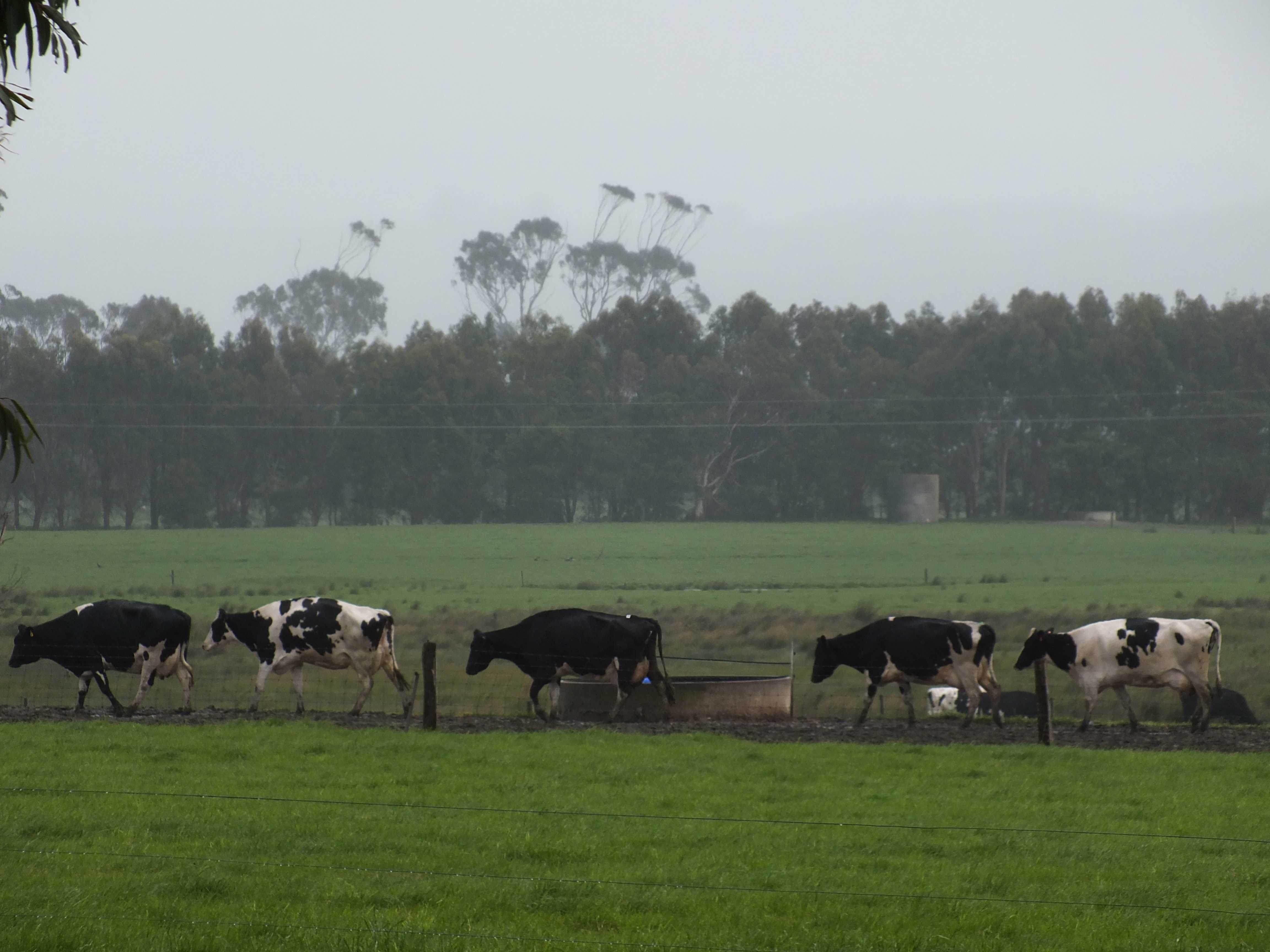
For our children

Have you seen this?

Yes, it’s by Unilever. Yes, you’re entitled to be cynical and yes, I love it.

The global manufacturer and ice-cream maker has just accredited Australian dairy production as meeting its Sustainable Agriculture Code – a huge accomplishment, which is also a world first. Of course it doesn’t mean Australian dairying is perfect and Dairy Australia has published a Sustainability Framework that will nudge us all to do better.

Here on the farm, our family does a bite-sized project for the environment every year. We have:

When I say “our family”, I have to stress that we haven’t been able to do all this without help. Grants from Landcare, Greening Australia and the Wellington Shire, work by the West Gippsland Catchment Management Authority, together with the hard yakka of volunteers from the Victorian Mobile Landcare Group and some of our friends have made the tree planting possible.

It just goes to show what we can do when everyone pulls together.

Goanna

Nine tricky questions for MG, answered

Today, Murray Goulburn Co-op stepped up its offer for Warrnambool Cheese and Butter again, to a staggering $9.50 per share. In a year where most dairy farmers are still playing catch-up from a horror stretch, it’s no surprise that some of us are getting nervous about how the deal stacks up.

I wanted to put the top nine the questions I’ve heard from farmers to one of MG’s most senior people, general manager shareholder relations Robert Poole. His responses have just arrived. Let me know what you think!

1.    Where is the money for the bid coming from?

Murray Goulburn has committed financing facilities available from its existing lenders to fund the Offer.  A further $350 million of new facilities have been provided by National Australia Bank (NAB), Australia and New Zealand Banking Group (ANZ) and Westpac Banking Corporation (WBC) in order to finance the transaction and assume Warrnambool’s facilities to the extent required.  The support of the financiers in providing these facilities re-enforces Murray Goulburn’s views that the rationale and financial metrics implied by the offer are sensible.

It also confirms MG management and the Board’s view that the level of leverage in the business is appropriate for a co-operative structure particularly in its current phase of significant growth and investment.

2.    MG’s balance sheet is described by commentators as “over-stretched”. Gary Helou countered by saying cooperatives are different. In what way?

Our offer is financially prudent and has been well considered. Our gearing will increase to around 57.2% – a level that our Board is comfortable with taking into account that we are a 100% farmer controlled cooperative with a range of options. At the financial year just ended our gearing was 43%. Based on a successful transaction, our FY14 gearing is estimated to be around 57%.

Co-ops are generally well supported by banks and this is the case with MG. Our bid for WCB is fully funded by NAB, Westpac and ANZ. Co-ops are not listed and are backed by their farmer suppliers. The capacity of the co-op model to sustain debt is well established and is evidenced by offshore examples most recently and notably Fonterra prior to their raising of non-voting equity capital. Co-ops traditionally have a higher level of debt. For example, Fonterra reached gearing levels of over 60% during growth phases.

3.    How can you justify paying so much more than WCB’s stated “fair value”?

MG has carefully assessed the value of WCB, and our Offer is financially prudent and well considered. MG would NOT proceed with any bid unless the result added to the overall milk price and our analysis shows that a combination of WCB and MG will do just that.

This is an extremely complex and ever changing situation. However what is clear is that the industry needs consolidation to improve the efficiency of the supply chain and create a larger scale globally relevant Australian dairy food company, uniquely positioned to capture the unfolding long-term opportunity in international dairy markets. We believe it is vital that the co-operative has a central role to play in this – to build a strong farmer-owned business that can compete on a global scale against the other giant dairy co-operatives like Fonterra, Dairy Farmers of America, Friesland Campina and Arla – not to mention multi-national giants like Nestle and Kraft.  MG is the only partner for WCB that has the scale and co-op structure to invest, grow and maximise farmgate returns for farmers, and ultimately regional communities.  We remain committed to acquiring WCB, satisfying our conditions and delivering the benefits of the combination back to the farmgate.  This can only be good for local investment, jobs and communities.

4.    Can MG guarantee that its WCB bid will not damage the farm gate milk price? If so, how?

MG would NOT proceed with any bid unless the result added to the overall milk price and our analysis shows that a combination of WCB and MG will do just that. MG itself is entering an exciting phase of growth and has identified a series of strategic capital investments that will target a $1.00 per kilogram of milk solids lift underlying farmgate milk prices over a five year period from FY12 to F17.  MG will deliver these benefits to supplier shareholders including those WCB suppliers who join the co-operative regardless of the outcome of the WCB bids.

5.    Competition is often said to be healthy for businesses. Doesn’t a strong competitor for milk supply help to keep MG on its toes?

I would counter that it is MG that keeps competitors on their toes, as we traditionally lead the market on farmgate pricing.  As a 100% farmer controlled co-operative MG’s primary objective will always be to maximise farmgate returns for our supplier/shareholders. As opposed to competitors who have the primary objective of maximising profits to their shareholders.

MG is the only partner for WCB that has the scale and co-op structure to invest, grow and maximise farmgate returns for farmers, and ultimately regional communities.

The current structure has not served the industry well over the last decade. The Australian industry has gone backwards while Asian demand has grown significantly – Australia is now a less relevant player in the international markets than it was in 2002. This has coincided with the drought, deregulation of the dairy industry and investment by foreign players.

Increased participation by foreign players has not lead to a restructure of the processing industry – the processing structure remains extremely fragmented. While foreign players have been in Australia for some time, they have not driven growth for Australian dairy products in the international markets.

MG’s own strategic plans and the proposal for WCB will assist in leading the Australian dairy industry to recovery and growth over the longer term. Our proposal is the one that creates a larger-scale globally competitive Australian dairy company uniquely positioned to capture growth in international dairy markets. Our plans involve investing and growing the businesses to meet the opportunities.

6.    Why do you think farmers tend to be polarised in their attitudes towards MG?

I can’t comment on why. However, what I can say is that in recent years MG has been committed to improving and building relationships with dairy farmers and this has been underpinned by meaningful, in depth engagement and transparency. We believe this is yielding some very positive long term results for both the farmers and their co-operative.

We respect that people will have differing opinions however we welcome the opportunity to talk with any farmers to clarify questions, share our plans and our vision for the industry, as we did this week in Warrnambool and Mt Gambier.

We will continue to work hard to demonstrate to WCB and other dairy farmers the benefits and importance of becoming a supplier/shareholder of the co-operative. We believe we have a compelling story and look forward to talking to WCB dairy farmers about our offer and the opportunity for them to become part of the co-op.

7.    How has MG’s culture changed in the last few years?

Over the past few years MG has been on a journey to become a more efficient and effective co-operative that can return more, and contribute more to its supplier shareholders, their communities and the industry as a whole. There is no doubt this has been reflected in the culture of our business, while remaining true to the co-ops core objective of maximising total farmgate returns.  In addition, to a focus on improving and building relationships with dairy farmers, corporate governance has also been a priority, including developing Board and Committee Charters and formalising policies such as Public Disclosure, Risk Management and a Code of Conduct.  Over the past couple of years MG has also had Board renewal with a number of new supplier Directors being appointed, appointing two specialist Directors; as well as the appointment of a new executive management team, including Managing Director, Gary Helou.

8.    How differently do you expect to run the Allansford factory? Can its workers feel secure?

Foremost our bid is about investing and growing the MG/WCB business to increase scale and maximise farmgate returns. We see significant potential and this can only be good for local investment, jobs and communities. Both the MG and WCB processing facilities are already operating at or near capacity and they are making different products which makes them complementary. Down the track, we may identify operating efficiencies and if we do, these will flow through to the farmgate price and ultimately to farmers and their communities. That said we believe there will be substantial opportunities for existing employees in an enlarged group with national and global reach.

Our proposal is the one that creates a larger-scale globally competitive Australian dairy company uniquely positioned to capture growth in international dairy markets. Our plans involve investing and growing the businesses to meet the opportunities.

9.    Aside from size, how would MGW compare to Fonterra?

Fonterra has become a highly successful global dairy giant and we believe that MG now has a similar opportunity before it. The combined business will be positioned to capture the unfolding long-term opportunity in international dairy markets. A combined MG/WCB would create one of the largest Australian owned food and beverage businesses, 100% controlled by dairy farmers, making us a top 20 global dairy producer.  To put it another way when combined we’ll have forecast revenues (FY14) of $3.2b and be one of Australia’s top 5 food and beverage businesses, behind Lion and Coca-Cola Amatil, Fonterra and JBS Australia.

The combination will give us the necessary scale, market reach and efficiencies, and like Fonterra, we will have far greater relevance in export markets to be able to grow the brands and products from each business.

The combined business will have over 3000 suppliers, approximately 4 billion litres of milk processed annually, a diverse product range and market reach, forecast revenue of $3.2 billion (2014), diverse operations and a strong production base in Australia’s best producing dairy regions.

So this is an historic opportunity for Murray Goulburn and WCB suppliers and shareholders to create a larger scale, globally competitive Australian dairy food company that they own and control.  Importantly, it will retain the primary objectives of a co-operative in maximising farmgate returns for farmer owners.  It will also support on-farm and industry investment, and in turn grow the Australian dairy industry for the benefit of regional communities.
 

Cooperation versus investor returns – the future of dairy farming in Australia

MMM: Below is the first paragraph of an article by Professor Tim Mazzarol that appeared in The Conversation this week and, while it’s a long read, it puts everything facing Australian dairy beautifully into perspective.

If you feel as strongly about this as I do, please contact the office of Treasurer Joe Hockey on 02 6277 7340 and ask to speak to an advisor, as well as your local MPs and even Barnaby Joyce on 02 6277 7520 (who has no direct authority in this matter but does have a cabinet voice). The pollies need to know what farmers think so that they can give us a fair go.

Cooperation versus investor returns – the future of dairy farming in Australia

By Tim Mazzarol, University of Western Australia

The battle is heating up between Australia’s Murray Goulburn Co-operative, Bega Cheese Ltd and Canada’s Saputo Inc. over the acquisition of Warrnambool Cheese and Butter Factory Ltd (WCB). Much of the discussion around who will end up buying WCB has focused on share price and investor returns, but there are much deeper issues at stake. These relate to the tensions between long term collective ownership of dairy supply chains by Australian farmers and the short term gains of shareholders. How this battle unfolds may decide the future of farmer control over Australia’s dairy industry.

Read the full article at The Conversation.

Dear Joe, how will you be remembered?

Dear Joe,

Why have you betrayed me so cruelly?

You came to me in September with promises of fatherly love and affection. You described me as your pillar and that, after mining’s bloom had faded, I would be your everlasting rose. You said you needed me and that, without me, you would forever be insecure.

But now that my fate lays in your hands, you act swiftly to hasten the courtship of WCB by Saputo whilst locking me in the cellar, dressed in rags. I implore you to at least allow me to attend the ball so that I may win the hand of my beloved.

Your faithful Milkmaid

Okay, I never really fell for you, Joe, but here it is:

  • Before the election, you described agriculture as one of the five pillars of the economy and said that food security was important. I’ll hold you to that.
  • For Australia to have a dairy sector, it must be able to compete with the international goliaths. That means we need a big processor with scale.
  • Australia’s dairy farmers are sticking together and want to grow so we can be more resilient. We absolutely have to because we don’t have the subsidies, FTAs, cheap labour or government support enjoyed by most of our competitors.
  • Our 100% Australian farmer-owned cooperative exists to maximise farm gate prices and consolidation rather than competition is what’s needed. We are prepared to step up to the plate and invest in our futures.
  • You gave the giant, privately-owned, foreign Saputo a huge leg-up with swift clearance, declaring Australia “open for business” with a grin on your face.
  • Don’t hide behind the ACCC or the slow-as-a-snail tribunal. Where there’s a political will, there’s a way. Your Kiwi counterparts knew that doesn’t make sense and cast their equivalent aside to allow the much-admired Fonterra to take shape.
    To pin us to such a protracted process while ushering though our foreign competitor is to drive a stake through the heart of the co-op’s bid.
    You surely understand the irony of thwarting MG’s bid based on competition policy when it is Australian farmers themselves desperate to become more competitive who are driving this bid and, in turn, are being rendered non-competitive in this fight to keep WCB Australian-owned by you, our own government!
  • You are the biggest impediment to Australian farming families taking a greater stake in our own futures by keeping WCB Australian owned.
  • If you insist on holding us back, you will be remembered as the man who sold Australia’s dairy farmers down the river. And for what? The love of Lino?

Joe, it’s time you stepped out of the way and gave us a fair go.

The heart of the co-op

Devondale

I have to share what I’d anticipated would be a fairly dry discussion, and was instead a conversation that I am unlikely ever to forget.

Ahead of today’s AGM where our co-op’s board is expected to announce it is considering a partial share market listing, I phoned Professor Tim Mazzarol to discuss the implications of different ownership structures for co-operatives. Around 18 months ago, the professor wrote a story for The Conversation about Fonterra’s restructuring, which may well become a model for our own Murray Goulburn Co-op and I wanted to learn more.

Tim’s title is but he and his team have done some remarkable research on the nature of co-operatives. What it reveals is that co-operative members wear four “hats”:

  1. Patron
    As patron, we are concerned mostly with the transactions we have with the co-op. In my case, that’s sending milk, buying goods at the trading store and so on.
  2. Investor
    As investor, I look at the financial returns offered by the co-op. Once the emphasis is placed heavily on this aspect, Prof Mazzarol notes, there’s often pressure to demutualise.
  3. Ownership
    Quite unlike the traditional investor (or shareholder of a listed company), I have a sense of ownership over the direction of the co-op and a much higher involvement with it.
  4. Effective community
    The co-op provides a feeling of belonging to a broader community.

In other words, a farmer co-operative is much, much more than just a farmer-owned company.

“Co-operatives need to keep reminding themselves of their original purpose,” says Professor Mazzarol. “When managers don’t share the vision, they can shift from a proper co-op to a farmer owned business. If you own the business and have substantial capital in it, you are interested in control.”

Professor Mazzarol believes the Fonterra TAF model, which allows farmers to trade their shares, weakens the role of the co-operative.

“If you separate investment from ownership, you raise the spectre of decisions being made by a board dominated by people with no interest in the members.”

In practical terms, he says, that could mean refusing to collect milk from less profitable suppliers, for example.

What co-operatives offer Australian farmers

“The average Australian farmer has increased productivity by 50% or more in the past decade but captured very little of that,” Professor Mazzarol says.

“The value of that investment is siphoned off by choke points in the supply chain, where there is a concentration of market power. The only way producers can deal with that is to circumvent those choke points by value adding and selling direct or belong to a co-operative with increased bargaining power that will return the value to farmers.”

“MG is acting like a pace-maker co-op, ‘keeping the bastards honest’, and if it disappeared from the market tomorrow, prices would start to fall. ‘Suppliers are treated with respect’ is very different from ‘we exist to maximise returns for our members’.”

The co-operative as community canary

The steady disappearance of co-operatives, Professor Mazzarol says, signals a change in Australian society.

“Co-operatives are a bellwether of social capital,” he says. “A co-operative needs three things: trust, reciprocity and a network. If these break down, so do co-ops.”

A gloomy observation, indeed. Let’s hope that when push comes to shove, trust, reciprocity and community are still alive and well among Australia’s farmers.

Life in the farm lane

Image courtesy of Dynamite Imagery / FreeDigitalPhotos.net

Image courtesy of Dynamite Imagery / FreeDigitalPhotos.net

Something has shifted in me. Standing on the footpath on a balmy Melbourne evening only last month, I was afraid.

Just a couple of metres and a shallow gutter was all that separated our tender little family from a roaring battery of motorbikes, cars, buses and even semis bouncing along the bitumen at 80km/hr. I gripped Alex’s still baby-soft hand protectively and found that despite his fascination with the unfamiliar lights, sounds and smells, I could take it no longer.

It wasn’t always like this. I lived in the city for a decade or so, growing my career and establishing a flourishing micro business that fed my curiousity. True, it always felt as though I were on a camping trip rather than at home but I had my bearings.

Perhaps it was the fear that comes with being a mother that propelled me to usher the little people back to our hotel room. Perhaps it was simply that I am now acclimatised to life in a different lane: the farm lane.

The background sounds tonight are the chorusing of frogs and the intermittent bellowing of bolshie bulls. The scent that wafts through my office window is pure freshly cut grass. Gentle, calming, natural.

But don’t be fooled. Nature sets the pace here, where a sense of urgency courses through the day. She demands the farmer rises before dawn to gather the cows, who must also be fed and protected from her vagaries, only to congregate once again at sunset. And if something goes awry, whether mechanical, physical or personal, Mother Nature is unforgiving.

We, too, know deadlines, budgets, the rat race and all the anxieties they bring. Like most parents, we worry that our children are somehow missing out, and, like most children thrust into the realities of adult responsibilities, we despair that so much is passing us by.

Don’t imagine we are so different: what binds us is so much stronger than that which divides us.

Rush hour in the farm lane

Rush hour in the farm lane

When even the paddock gets fleas

This November has been one out of the box: hail, bad hair and now, fleas.

The hail I didn’t photograph. The hair? I’ll let Alex show you:

MudDigger

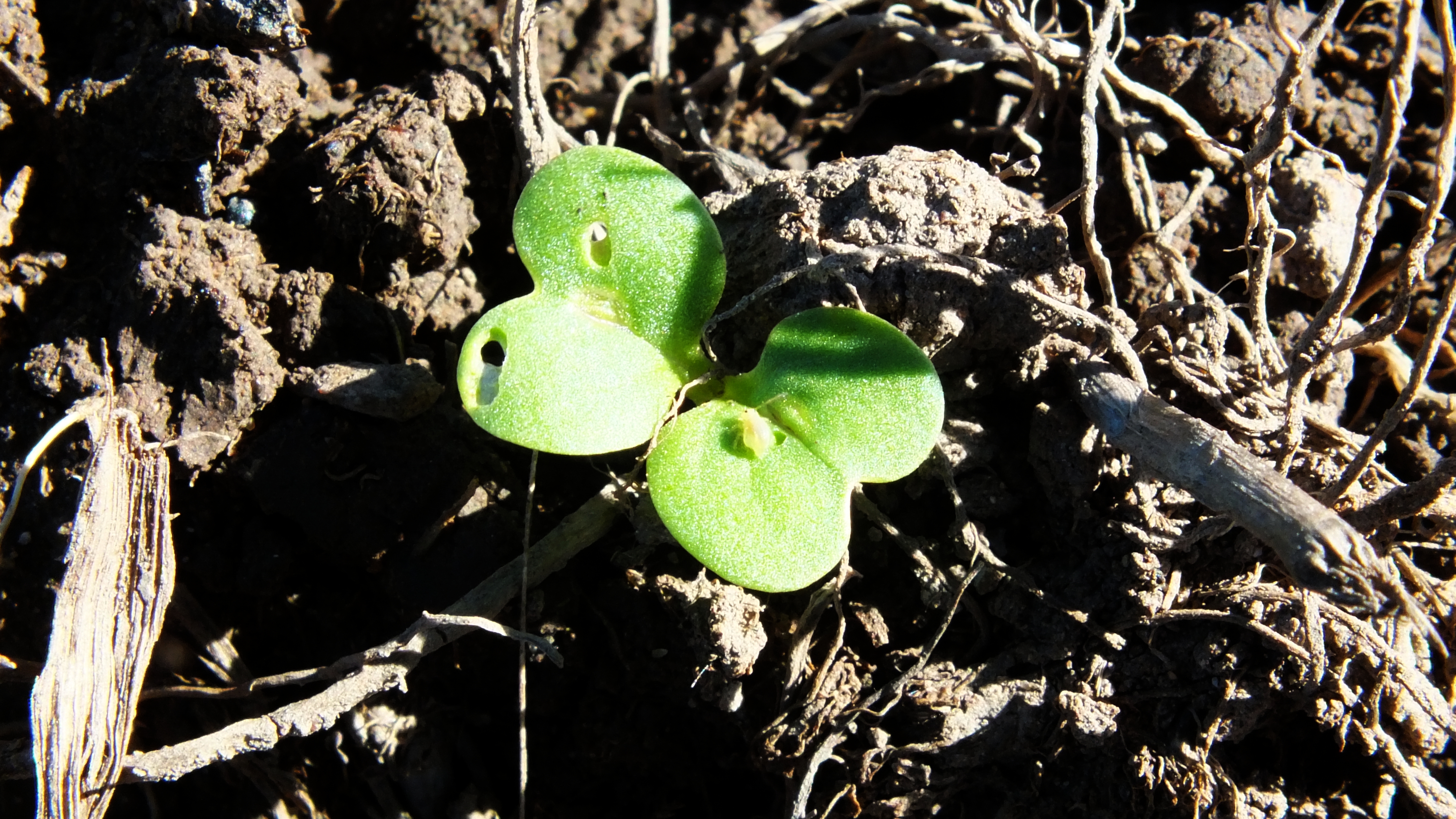
The fleas? Today, I was out crawling around in the paddock (as you do on a sunny Saturday afternoon), when I discovered someone had been out to lunch on the juicy new rape salad I’ve been growing for summer.

Yikes, there are fleas in my salad!

Yikes, there are fleas in my salad!

This little fella is tiny (see those wriggly twig things on the top right? They’re rye grass roots) but he and all his lucerne flea mates are marauders with super powers. Think I’m drawing a long bow? Watch the video.

We’ll have to do something about these microscopic pole vaulters in the next few days or be left with a lot of explaining to do when the cows are looking for their New Year’s Day dinner.

Fleas are not the only pests on the extermination list this November. To my shame, we’ve been harbouring three minibus-sized box thorns since I took over the farm. A member of the nightshade family, African box thorns are classified noxious weeds and are really nasty. This year, I decided these taloned monsters had to go.

You'd measure these thorns in inches

You’d measure these thorns in inches

The box thorns were so big and brutal, the only way to get rid of them was with a 12-tonne excavator. It only took Michael the Man in the Machine a few hours to uproot and squash all three. All I had to do was light a match so Alex and I sallied forth, armed with three plump copies of The Weekly Times (one for each of the crumpled behemoths) and a box of redheads.

Little Man against the mountain

Little Man against the mountain

Oh, what a pathetic figure I’d cut as a smoker. All three editions of The Weekly Times were waged against the first monster before it finally roared into oblivion.

Ablaze at last

Ablaze at last

The ridding of another fearsomely armoured yet fleshy menace was less flashy but no less spectacular.

We got more help in, this time to face a battalion of variegated thistles. Newly renovated pastures had stirred seed banks and the wet paddocks had made early access impossible. The result was chest-high walls of thistles up to 100 metres long.

Within days of spraying, they began to take on glorious, tremendously satisfying tortured shapes. Revenge is best served cold indeed.

ThistleUturnFrontLoRes

Divided we fall: so where to from here?

After a nose dive

Don’t worry if you fall, just get back up again.

Wayne said the other day that the farm has taught him something about resilience: live in the moment when the sun is shining and, when the hail stings your skin, think of the big picture.

But the big picture right now is confusing for this Milk Maid. The WCB war has thrust the outlook for Australian dairy into the headlines and, with it, a lot of questions.

Our co-op has offered half a billion dollars for WCB, claiming that its loss to a global player would be “a tragedy”. In its statement to the ASX, MG Co-op said:

“The combination of MG and WCB is the only option available that delivers an Australian-owned and operated company with the scale, capacity, strength and momentum to service global growth opportunities, returning profits to dairy farmers and their communities.”

In the midst of all this, the UDV hosted a farmer forum on Monday where independent dairy analyst, Dr Jon Hauser, told farmers that supporting cooperatives is a “no brainer” but has also said the golden era of dairy in Asia was “largely rhetoric” and that real progress for Australian dairy would come through cost control and increased efficiencies at the farm and the factory.

He created a stir at the forum too, simply by saying that milk prices of 48 to 50 cents per litre could not be sustained. Not popular news.

So, now that Saputo is on the cusp of announcing a new offer, prompting WCB to ask for a suspension of trade, what if Helou’s tragedy does unfold? How will the General regroup?

MG will certainly have to work harder to woo those who harbour a co-operative spirit but supply other processors. And that, I’m afraid, is something the co-op has not done well to date, in my view. Perhaps the tide is beginning to turn, reading between the lines of Helou’s interview with The Weekly Times dairy writer, Simone Smith, headlined Divided we fall:

“There is nothing stopping our farmers rallying around a well-run farmer run company that is of scale and relevance.”

“There is no law in the land against that. That’s what we are advocating. This rally around the MG foundation to create a new farmer-owned business that is really relevant to the 21st century.

“The farmers will only benefit from direct ownership and direct influence in supply chain from the farm all the way to market.”

I guess we farmers are used to falling and getting back up again.


UPDATE: In response to a question asked below, Dr Hauser has kindly sent me this. I don’t know how to put it – complete with charts – in the comments section, so here it is instead:

Sorry Marian, It would take me a day to properly represent my position on the Asian growth story and even more to update my analysis to the most recent trade data.

Here is a snapshot of the important data:

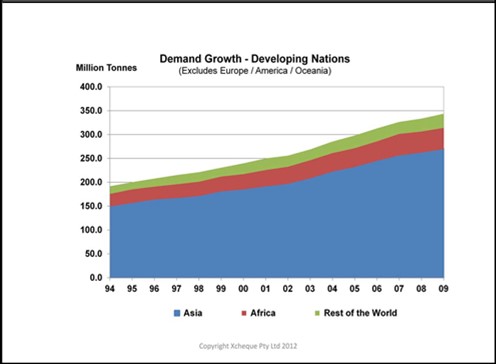
JH1

This is the demand growth for the developing nations. This comes from the FAO

Most of this growth has been serviced by internal development of their dairy industries.

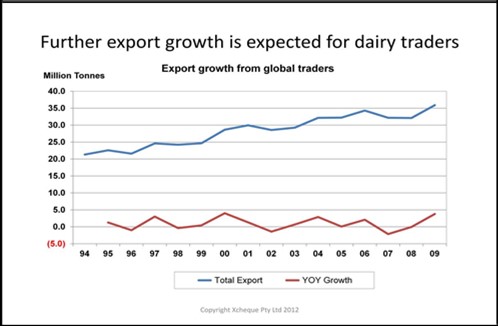
JH2

This the export growth from the key dairy traders – Europe, US, NZ, Argentina, Australia. The average is 2 – 3 billion litres / year. Even if this has been accelerating in the past few years it is unlikely that the opportunity is more than 4 – 5 billion litres / year. I believe the average growth opportunity for the global traders is 3 – 4 billion litres but I would need to review the more recent data to check this.

YOY Production milk production growth – Million Litres
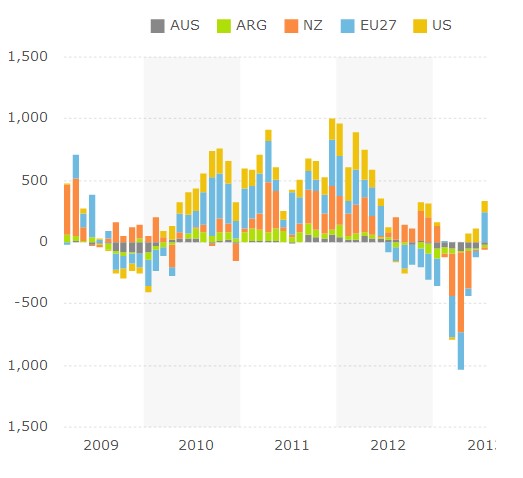
JH3

This is the year on year growth that has come from the major traders. This chart shows 15 billion litres of growth from the EU, US, NZ and Argentina from July 2010 – June 2012. The total for the period from July 2009 – June 2012 is 12 billion. In other words we saw contraction in 2009 and 2012 and that is because the milk price was low. The US and Europe turn growth on or off according to commodity and milk price (New Zealand just keeps on trucking except when it doesn’t rain).

In summary:

  • The Asia growth story is not rhetoric but the suggestion that the hole can’t or won’t be filled is.
  • The US and Europe will turn on and off milk production according to demand and price. They had no difficulty growing supply at 5 billion litres / year in 2010 / 2011 and they are already gearing up to do it again in 2014.
  • No I don’t subscribe to the analysis that has been done for the Horizon 2020 report. I believe the “Supply Gap” analysis is a flawed way of assessing Australia’s future export opportunity.


Feeling stressed? Come and sit in the grass with the cows

“What’s so special about that?” asked Zoe. “Nothing, and that’s why I thought we should put it on the blog.”

Apart from the twice-daily walk to and from the dairy, this is how our cows spend their time.

You won’t see footage like this anywhere else, I suspect, and certainly not on 4 Corners. There’s nothing sensational about it except perhaps that, right before your eyes, these cows are transforming grass into one of nature’s wonder foods (while wondering what the hell I’m doing sitting on their breakfast).

Dairy delight: silage supreme

The warm sweetness of fermented natural sugars swathed in the aroma of rich plum pudding make gourmet Silage Supreme irresistible.

Last weekend the conditions were perfect for the creation of a few thousand servings of this dairy delicacy.

Today, bunkered down in the office as water rattles down the drainpipes, I thought it was the ideal opportunity to relive the fleeting appearance of Spring by sharing the recipe with you.

So, next time you see cows eating “artificial, plastic food”, you’ll know the truth: it’s gorgeous, 100% pure luscious springtime grass lovingly preserved for a rainy day (or, perhaps, a scorcher).

Ah well, back to today…

WetHibiscus

WetOct