Poll: How much would you donate from your pay packet to promote your industry?

As we speak, Dairy Australia is touring the country rolling out the farmer side of the Legendairy campaign. Consumers will see it from late winter, when it hits magazines, radio, TV, supermarkets and bus stops around August.

The campaign is designed to build bridges between farmers and consumers, encouraging trust and an increase in claimed dairy consumption.

My question is this: how much would you personally spend on an industry branding exercise? And if you’re not a farmer, how much would you pay for a campaign aimed at portraying your trade or profession as “good guys”? Be honest, since there’s no way I (or anyone else) can see which way you vote.

Has the MG co-op fed Aussie dairy farmers to the wolves?

If $1 milk is unsustainable, how is the Coles deal locking in pricing with Murray Goulburn a good thing? Good question. Has MG made a giant mistake? Will it mean a mass exodus by NSW dairy farmers and will the big co-op do its socks on the deal, taking the hopes of dairy farmers down, down, down with it? Blair Speedy of The Australian certainly seems to think so.

I decided to ask some rather blunt questions of two men in the know: independent dairy analyst, Jon Hauser of Xcheque and Murray Goulburn big-wig and general manager shareholder relations, Robert Poole.

1. How can MG make a profit supplying fresh milk to Coles if Lion could not?
Robert Poole refused to comment on Lion’s circumstances but said the co-op’s new factories would be “purpose-built, state of the art and the most efficient milk processing plants in Australia”.

“We will make a good return supplying Coles and will have the capacity to supply other customers in time, too, making even higher returns.”

Jon Hauser goes further. “I can see how 10 cents per litre in costs can readily be taken out of the chain,” he says. “There is a view in the dairy community that milk should be sold for more than a dollar per litre when it’s being sold cheaper than that right now in the USA and the United Kingdom. The local processors have been retaining much more of the milk dollar than international processors.”

2. What risk is there to the $120 million of farmers’ funds that will be spent on the new factories?
Poole says quite flatly that the cost of the factories is well and truly covered by the 10-year Coles contract: “We have total security. There will be no cross-subsidisation of this investment – it will be fully funded by the agreement with Coles.”.

3. Why hasn’t MG sold fresh milk into supermarkets before?
“Historically, we would have had to submit a tender for milk supply. And what, build factories in the hope that we won?,” says Poole. “This was a golden opportunity. Nobody gets a 10-year contract like this but Coles came to Murray Goulburn because it wanted to work with farmers.”

4. How does it work for MG?
According to Poole: “Under the supply agreement, the price to Coles is based on a farm-gate price and the cost of processing plus a comfortable profit margin. There’s a rise and fall clause that means the price reflects the changing value of the milk on international markets.”

Hauser explains that the New Zealand and Australian dairy industries are “price takers”, unlike the Europeans and Americans, who have greater control over pricing.

“Australia can’t control the export price but, reading between the lines, Murray Goulburn is using the Coles deal to increase its control over the price it gets for its milk and will position itself for a much greater role in the 2 billion-litre fresh milk market. Because MG will slash the cost of delivering fresh milk to supermarkets, I predict the co-op will be selling supermarkets a billion litres of fresh milk a year by 2023.”

“Aside from milk, the deal also allows MG to range its cheese, butter and spreads in Coles, which makes it even more attractive.”

5. Has the Coles and Murray Goulburn deal devalued milk?
Poole was ever the diplomat on this one, saying the retail price of milk was “up to the supermarkets”. Hauser is a tad more direct. “For people to say milk will be devalued is absolute rubbish,” he says. “This is a great deal for MG’s farmer members. Is it MG’s responsibility to stay out of the market and let nonsense economics run the show?”

6. How will this affect NSW dairy farmers?
Hauser says many NSW dairy farmers will need to reassess their businesses. Milk price in both NSW and Victoria will be based on a mixture of domestic and export value with the export market being a major driver of that value.

The man himself, Robert Poole, says the NSW price will reflect “supply and demand, international prices and a premium that takes into account the added costs associated with supplying exact volumes of milk every month of the year”.

Will it shake up the NSW dairy sector, with its large number of very small farms? Undoubtedly, says Hauser. “NSW’s dairy farmers sold themselves into trouble when they handed over the responsibility for, and the value of, their products to private processors, who have no interest in their viability. Ironically, it is a Victorian farmer cooperative that is now reclaiming control in NSW.”

7. Why should Australians buy Devondale fresh milk rather than Coles homebrand milk?
“That you’ll have to wait and see,” teases Poole. “Seriously, it’s up to us to place Devondale in the market carefully, with the right price, packaging and provenance and other benefits that will appeal to shoppers.”

The co-op does a deal with the devil and keeps its soul

I never thought I’d say this but some of my milk will be sold on Coles’ shelves in both homebrand and Devondale cartons from next year. And I’m pleased.

You see, the co-op we supply, Murray Goulburn, is a giant too. It processes around 35 per cent of Australia’s milk and earns $1.17 billion in exports, making MG one of the largest container exporters from the Port of Melbourne. In other words, it doesn’t have to sell to Coles and Woolies, giving it much greater leverage with the supermarket duopoly. It also has the scale needed to be an efficient processor. Most importantly, its number one goal as a 100% farmer owned co-op is to maintain the profitability of its farmers.

All the same, it is confronting when “our” co-op does a deal with the devil. Has it sold out on us?

I asked dairy analyst, Jon Hauser of Xcheque for his thoughts. “My view is the news is very, very positive,” he said. “This is one of the few things that has the potential to lift the returns for farmers by maybe two or three cents per litre and, perhaps more importantly, it can reduce the volatility of farm gate prices.”

The thing is, while Murray Goulburn exports around half of its milk, reducing our reliance on the supermarkets, that exposure to international commodity prices and the exchange rate can be painful, too. International commodity prices rise and fall like a cork in a bottle and the average Aussie dairy farmer loses about $9,000 (according to my back of the envelope sums) with every cent the Australian dollar rises against the US dollar. Of course, it’s at record highs right now and not looking like falling below parity any time soon. The uncertainty that comes with that volatility makes it very hard for farmers to attract finance and invest with confidence in their businesses.

On the other hand, I wondered why Murray Goulburn could make a profitable $1 milk deal with Coles when Lion, the company currently processing Coles’ homebrand milk, cannot. Jon Hauser thinks it’s largely an issue of supply chain efficiency.

“Leaving aside the aberration of $1.00 discount milk, branded milk retails at about $1.60 per litre and supermarket private label at about $1.20 per litre,” Hauser says.

“Farmers are getting 25 – 35 % of the consumer dollar. In the UK and the US farmer share is closer to 50%. Direct supply by a farmer co-op removes the middleman that is adding cost in marketing and collecting additional value from their brands.

“It is true that the supermarkets will become ‘the brand’ but the farmer co-op should also able to retrieve some of this value. In the case of the Coles/MG deal, MG will get part of that return from the ranging of their own Devondale brand.

“What is most critical in maintaining a balance of commercial power is the ability of farmers to sell their milk to a range of alternate customers. Murray Goulburn has the diversity of product and markets to do that and can now genuinely claim that they have a balanced portfolio of domestic and export sales”.

It all sounds very positive for existing Victorian Murray Goulburn dairy farmers like me. But what about for farmers near Sydney, who have been supplying Lion and Parmalat and who traditionally get so much more for their milk than we do yet depend almost exclusively on supermarkets?

Mike Logan, the head of Dairy Connect, which represents the NSW dairy sector, describes today’s announcement as a “game changer” and in a letter to farmers, had this to say:

“We have three big changes on the table at once;
1. The manufacturing milk price rise
2. The drop in production so that NSW and Qld are now short of fresh milk
3. New models of supply to the supermarkets

“This all adds up to change.

“For the NSW dairy industry it may mean:
1. Investment in new processing capacity
2. A new pricing model for the whole fresh milk industry
3. Re-energising brands such as Devondale and Norco
4. Relocation of a large number of farmer dairy suppliers from one supplier to another
5. Changing role of the processors and processing capacity
6. A risk for the milk vendors as the processing sector changes.

“…the supermarkets have been true to their word and have been looking for new ways to create a sustainable future for the NSW dairy industry. We have to look past the $1/litre milk and build a new future.”

“However, these changes will be at considerable cost to some people. We need to be careful and respectful of the impact of these changes. We do not want to create a situation of winners and losers.”

The reality is, though, that there will be losers. Commenting on the future of the current processor of Coles’ milk, Lion, prominent NSW dairy farmer, Lynne Strong (@CHDairies) said on Twitter that “They have lost QLD plus NSW Coles contracts Cant see them surviving this one #sadbutrue”.

Lion is almost certainly not going to be the only loser in what all agree will be massive upheaval in New South Wales. But there will be winners and maybe, just maybe, represented by an increasingly powerful co-operative, dairy farmers will claw back a little dignity. And you, dear milk drinker, will soon be able to buy 100 per cent farmer-owned fresh milk knowing that all the profits stay right here in Australia.
Woolies the white knight unmasked by dairy defenders

Sometimes it’s what you read between the lines that’s the most important. In the cause of reporting about supermarket giant Woolworths’ formal announcement today confirming it’s arranging to directly contract dairy farmers to supply it milk, the most interesting comments are those that appear below the line.

Dairy farmers have shared their concerns about the move but now the ball is well and truly in the corner of Australian shoppers. If the comments from readers of Melbourne newspaper, The Age, are anything to go by, Woolworths’ attempt to mitigate the growing public distaste for supermarket ethics may have backfired.

I’ve picked out a few to summarise the tone of discussion online (my subheadings):

Squeezing the life out of the producers
“This is how they make the real money, had this explained by an insider recently to me. They find a producer and ask them to make their home brand for them along with their own branded premium product. People buy the cheaper version and the premium product disappears so they then just give them the second quality product in their packaging. Then supermarket owns them, they then turn on them and say, now we will pick it up, give u the packaging and labels you just give us the raw product. This means the producer the gets no profit on packaging, transport etc for the goods, and they are cut to the bare minimum of profit, this is how the supermarkets are squeezing the life out of the producers so they have no profit and no hope of improving. I won’t buy home brand, I like choice and supporting Aust companies.”
Commenter: Newcastle Gal

The admission of guilt
“Surprise, surprise I thought it was only several months ago that the supermarket giants (media) told us that the milk companies etc were not being disadvantaged and that the supermarket chains were picking up the losses, now it turns out that the supermarket chains are ripping off our suppliers after all..”
Commenter: Mik of Melbourne

Part of a bigger plan to screw consumers
“I ‘m sure the money that Woolies gets from their gaming machine can well and truly subsidies the milk (* bread). Instead, pay the real price for branded milk and cease this war. The only outcome will similar to Europe where fresh milk is now a luxury, mainly God awful UHT milk on shelves.”
Commenter: nm4047

It’s all about control
“Woolies and Coles will only rip off farmers because you let them. Note the success of Norco on the NSW North Coast, their milk is still selling for a fair bit more than $1 a litre and has withstood the “home brand” assault. Sales only dropped by 1-2% compared to the 25% drop of brands in the cities. Norco and the communities they support care for farmers, because they are farmers. Woolworths don’t care about farmers, by dealing directly with farmers they are hoping to break up the co-op models that are beating them in the rural areas and drive the farm-gate price down.”
Commenter: dude

And then there’s this from someone who obviously knows the dairy industry very, very well:

“Actually, it’s a combination of marketing ploy and the knowledge that Queensland and Western Australia are close to real domestic supply troubles if they keep losing dairy farmers.
Not being privy to Woolworth’s strategy in this move, this is what I suspect will occur.”

“(1) They’ll target large scale farmers or encourage investment in large scale farming for their direct supply. Good economics on their part but increases the exposure for the suppliers since return on their investment will be solely dependent on Woolworth’s assessment of a fair price.

“(2) They’ll concentrate on areas where they aren’t up against strong competition and where’s there’s excess manufacturing capacity available. Both WA and Queensland fit the bill here.
Victoria would be a less attractive option with its reliance on export markets and dominance by co-operatives and farmer owned supplier groups. South Australia has a small localised industry and is attracting interest from Victorian based co-operative Murray Goulburn. Tasmania has good production prospects but transport is an ongoing issue. So probably WA and Queensland.

“(3) Once they’ve got a foothold, it’ll be a balancing act. Do they squeeze their fresh milk suppliers or do they loss-lead and extend their range of products by trying to increase both their supplier base and their range of manufacturing options? More ‘supermarket own’ brands would probably be their ultimate goal but not at the cost of having to carry the brands for a long time before a return on investment. I’d say their ideal is complete vertical integration but they know that can backfire big time if you don’t control enough of the market.

“One thing for sure. This is about Woolworths not about the farmers. And let’s face it, that’s what all businesses are about- not just supermarket owners”
Commenter: David of Leongatha

All in all, I’d call it an unmitigated PR flop. On the other hand, those commenting online on a story in The Age are hardly a representative sample of Australians. It’s inevitable that farmers will be recruited by Woolies (and Coles, in turn, no doubt) but whether Aussies will buy either the rhetoric or the “fair” home-brand milk is far from a sure thing.

Inconvenient dairy truths

I am not a spokesperson for the dairy community. I’m simply an average dairy farmer who likes to write.

The way my family cares for our cows is very typical of what happens on farms right across Australia. It’s important that more of us share what we do, why we do it and why that matters with non-farming Australians because there is much to be proud of.

It’s equally important that average dairy farmers like me are constantly challenged to do better and that we, in turn, challenge others involved in dairy to improve the way we care for our land and cows.

I am ashamed when dairy spokespeople try to defend the indefensible actions of the minority of farmers who cling onto practices that the rest of us wouldn’t entertain. It’s embarrassing that I have done so little to try to influence them to represent (and lead) all of us.

Someone who has gone beyond the call in her role as Dairy Australia’s animal welfare manager is Bridget Peachey, who was never afraid to tell the good stories and work with farmers to lift our standards. Bridget leaves DA this week and I will miss her leadership, knowledge and sense of what really matters to farmers and the animals in our care.

Could you be suffering from cow envy?

CuriousHeifersRun

The ethics of food is so complex. Vegans following a conscientious diet are told they are inadvertently starving Peruvians, causing deforestation and even eating with blood on their vegetarian hands. It’s not easy being green and I don’t blame vegans for being so passionate about their choice.

Life on farm is a microcosm of those ethical dilemmas. Every day, we must make decisions that impact on the well-being of an animal. Often, there is no easy answer. Should we euthanase that cow now or wait although she’s in discomfort in the hope she recovers? Should we raise that calf away from her mother or risk deadly disease transmission? And the big one: should I send heifers to China if milking just won’t pay the bills?

If nothing else, it forces you to stare hard in the mirror and here’s what I see: yes, I am a commercial dairy farmer and, hell yes, I care about our animals and our land.

Although this is something vegans on Twitter seem to find inconceivable, in my experience, this mindset is not only possible but typical of dairy farmers. It’s what keeps us on the land for generations and I am incredibly grateful to be here. My farm may not be a “cow sanctuary” as one vegan put it but I’m doing my best to make sure the cows never realise.

(Special note to my vegan friends: I realise what a privilege this is and wouldn’t blame you for some serious cow envy!)

How to rescue dairy – from the nutty to the tricky

Dairy farmers gathered in their hundreds in south-west Victoria last night for a crisis meeting. What makes it a crisis? Very simply, dairy farmers are working seven days a week for free and petrified of losing our shirts.

Local agribusiness bankers tell me they are busy refinancing and arranging extra debt but land sales are at a standstill around here. Reporting on last night’s dairy crisis meeting, Simone Smith of The Weekly Times, described a “dire picture”:

“Warrnambool-based Coffey Hunt farm accounting specialist Garry Smith said across his client-base, farmers milking mostly between 450-500 cows, average feed costs were up 15 per cent – a $150,000 rise – with the cost of power for the first quarter of the year up 50 per cent.”

“He estimated across his client-base earnings would be 10 per cent down on last year with a combination of cash-flow and income down $260,000.

“Charles Stewart real estate agent Nick Adamson said better quality farms had dropped in value between 8-15 per cent, while others were up to 45 per cent down on peaks of several years ago.”

None of this is pretty and astonishingly, Peter Reith decided to appear on ABC’s The Drum website with a six-point plan that, at first, I thought was a spoof. Take a look and make up your own mind.

It’s not as simple as cutting petrol taxes and municipal rates. It’s tricky because of this conundrum: milk and dairy foods are considered so important that nobody wants to pay what they are worth to produce.

Every day I read comments on Twitter that go something like this: “My kids drink three litres of milk every two days, so I can only afford to buy $1 milk”. I know first-hand how tough it is to feed a family when you’re on struggle street, so I have a lot of sympathy for people in this predicament and it’s impossible to respond with anything other than compassion.

It’s hardly surprising, then, that there is no political appetite for an increased milk price. But the truth is this: dairy farmers should not and cannot fund an ersatz Australian welfare system by subsidising the cost of food. Welfare is the role of government.

So, while my dander is up, here’s a simple list of five tricky things that would make a big difference to this dairy farmer:

1. Deal with the supermarket duopoly
Down, Down, Down is not about you, dear milk drinker. The real reasons for the supermarket war are expressed in corporate ROIs rather than family budgets. At the end of the day, it will be the little people with the least market power – you, the shopper, and me, the farmer – who will pay.

2. Level the global playing field
Julia Gillard announced that Australia would be Asia’s food bowl but guess what? Unlike the world’s most powerful dairy exporters, the Kiwis, we do not have a free trade agreement with China, putting Australian dairy at an immediate 15% disadvantage. Nor do we receive the government subsidies that support our European and North American competitors.

3. Assist with the impact of the carbon tax
Australian dairy farmers are suffering a double whammy under the carbon tax. First, processors are passing the extra cost onto us in the form of lower farm gate prices (because the consumer won’t pay extra and nor will global commodity markets), reducing our incomes by around $5,000 each per year. At the same time, our costs – especially electricity and refrigerants – are rising in quantum leaps each quarter.

4. Support smart farming
Long exposed to the blow-torch of global export markets without subsidisation, Australia’s dairy farmers are among the most efficient in the world, according to research body, Dairy Australia. We can produce very high quality milk at a very low cost because we have invested in research and development. No longer. We are spending less and less on R&D and the Victorian government has just made massive staff cuts to our brains trust, the Department of Primary Industries.

5. Remember, I am the goose that lays the golden egg
I will not be able to continue to deliver high quality milk at such a low price while enhancing the environment and caring for our cows without sacrificing the basic wellbeing of my family and that, I refuse to do.

The perfect farmer’s body

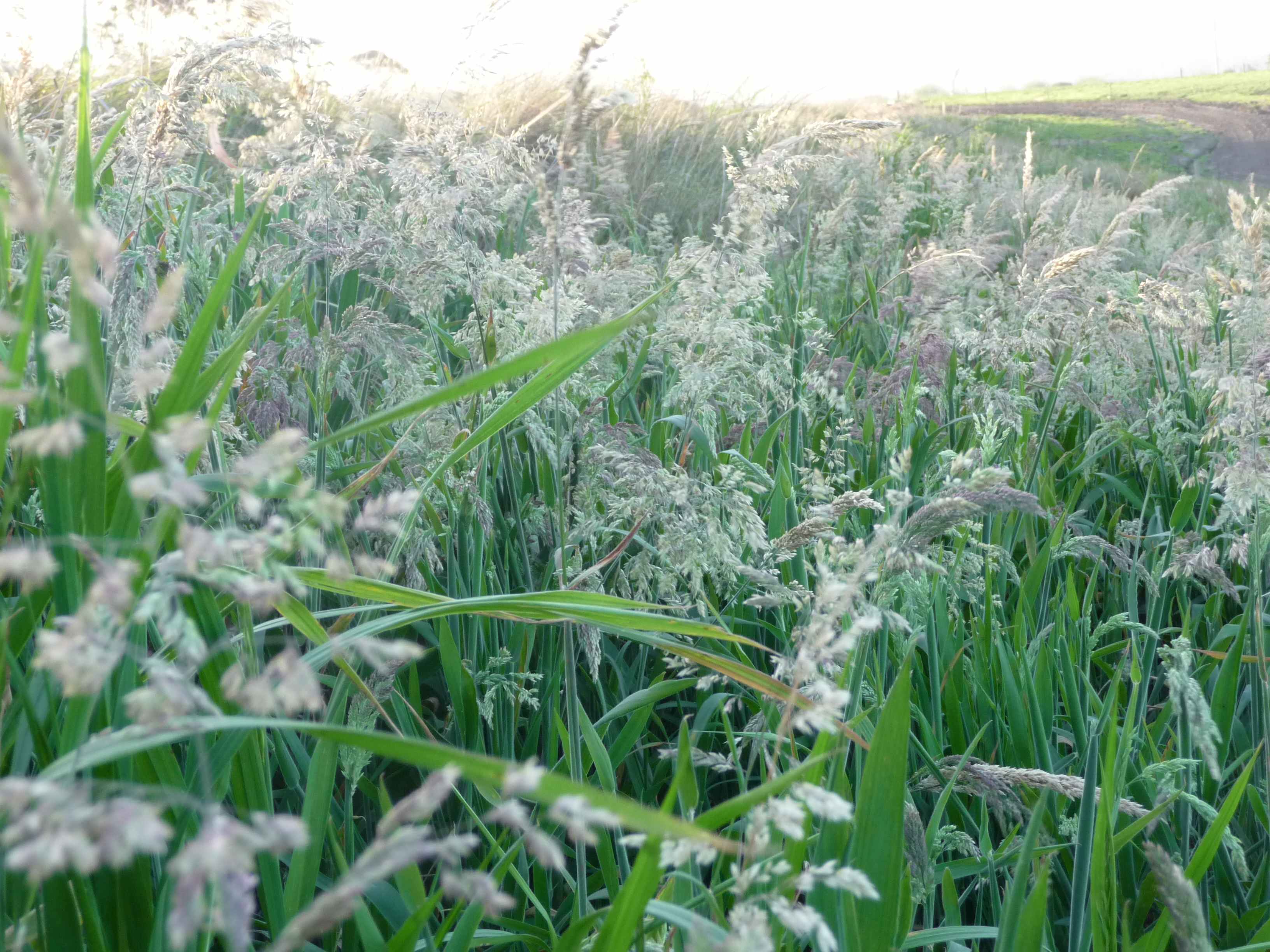
What does the perfect body look like? Not mine, that’s for sure! Yesterday, I was reminded just how bad my genes are for farming. Allergies run on both sides of my family and the worst irritant of all looks like this:

Yorkshire fog grass

Yorkshire fog grass: one UK expat we could do without!

I’m told it’s called “fog” grass because the pollen is released in such huge quantities, it makes everything go misty. Dynamite! Yesterday, I had to wander through thigh-high forests of it to get the dam siphon running again. My scalp, eyes, nose, mouth and arms are all still desperately itchy 15 hours later.

The cows don’t like it either. Fog grass is covered in thick velvety “fur” that understandably is most unpalatable.

Thankfully, we have a lot less of this hideous grass nowdays. It was everywhere when I was a girl but much better grazing management has seen it restricted to untouched pockets of dampness (like the dam wall).

Grass management is a big deal for Australian dairy farmers because it is the greatest predictor of profitability. We count leaves, we estimate the tonnes of pasture in paddocks and aim for the magic nexus of quality and quantity. Somehow, it’s reassuring to know that nothing beats the simplicity of grazing grass for high performance dairy farming, even in 2012.

No fresh milk for Australians? Is UHT the next big thing?

It’s been an amazing week. First, milk processor Lion, came right out and said the unthinkable – that a milk price below the cost of production was “fair” and that there need to be fewer dairy farmers in Queensland and New South Wales.

Then, yesterday, Sue Neales (follow her @BushReporter on Twitter) of The Australian reported that “Desperate Australian dairy farmers are looking to fly fresh milk directly into Asia to deprive Coles and Woolworths of their unassailable market power.”.

In Sue Neales’ story, Dairy Connect farmers’ group president Adrian Drury said: “We are telling the supermarkets that they mightn’t always have easy access to fresh milk and that they take us for granted at their peril in their push to force milk prices down.”.

What does that mean for you, the milk drinker?

To put it bluntly, you might find yourself drinking UHT milk rather than fresh milk sooner than I expected. Rumours are rife in dairy-land that Coles is keen to shift you from the fridge to the aisles when it comes to picking up your milk. Coles has quite a contingent of European executives these days, where the move from fresh to UHT has been spectacularly successful for the supermarkets. According to Wikipedia, 7 out of 10 Europeans regularly drink UHT rather than fresh milk.

Why UHT? For supermarkets, the benefits of stocking UHT are huge. It lasts longer, it doesn’t need to be refrigerated and, best of all, it can be sourced from far away, increasing their range of supply.

What’s wrong with that, you may ask? After all, there’s evidence that UHT is greener (given it doesn’t need to be refrigerated) and it is still good for you (read more about UHT here, if you like). Question is, do you want to be able to choose?

PS: If The Australian won’t let you read Sue’s story, Google the headline Farmers’ bid to end duopoly milk run and you should be able to read the lot.

I asked UDV president whether dairy farmers should tip their milk down the drain

I’ve been asked a few times why dairy farmers don’t just refuse to supply supermarkets or tip our milk down the drain in protest at the unsustainable price of milk. Meanwhile, the actions of the Brits in blockading milk processors has been spectacularly successful. I thought I’d put a few “burning” milk price questions to the president of the United Dairy Farmers of Victoria, Kerry Callow, who kindly offered the following replies.

Kerry Callow

UDV president, Kerry Callow

MMM: We’ve all heard that $1 milk is a big deal for farmers but what about consumers? It sounds like a great deal, especially for families doing it tough!
KC: Milk at $1 is obviously attractive to consumers. Especially those with limited incomes and young families to feed. Dairy farming families understand limited incomes. They have had a cut in prices they receive – like having a salary cut. But this is not just about the here and now. It’s also about what’s sustainable. What will consumers have in years to come? Milk at $1 a litre retail is not sustainable for dairy farmers to produce. In Queensland it is reported that already 30 farms have left the dairy industry and more will follow. And consumers will have noticed the challenge in finding non-supermarket brand full cream milk in the dairy sections. This is a strategy for the supermarkets to dominate the supply of milk products industry. It is hard to see how consumers will keep the choices they currently enjoy. Farmers cannot afford to produce milk at the current price.

MMM: Why don’t farmers simply refuse to sell the milk at such low prices?
KC: Dairy farmers also have families to feed, children to educate and bills to pay (power has gone up 16% since the end of June, refrigerant gases required to cool milk have skyrocketed). And dairy farmers also have contracts to supply milk to processors to fulfil. The financial penalty to not supply is greater than the financial penalty to supply at a loss.

MMM: What about tipping the milk down the drain for a few days?
KC: Tipping milk out for a few days doesn’t fix the problem. (Disposing of milk that way does create added management challenges on farm). The problem is that supermarkets have decided to use milk as a ’loss leader’ and hold the price of milk down to ridiculous levels.

MMM: Is the VFF/UDV considering action like the farmers took in the UK? Would it work here?
KC: There is also discussion in New South Wales and Queensland about taking direct action. Because dairy farmers in those states rely heavily on the fresh milk market they are more exposed to the supermarkets pricing actions. Taking direct action is difficult because in this case the focus of dairy farmers angst is not a government or agency or authority, it is a commercial entity that has shown limited capacity to hear farmers concerns or acknowledge that their actions are directly and adversely impacting dairy farming families. That said, farmers are getting frustrated with the current situation.

MMM: Is there a silver lining to the $1 milk campaign?
KC: Not really. The supermarkets will point to milk consumption being higher now than before the retail milk price was slashed. But we think the consumer is heading down the road of less choice for milk products. And now we have other products like cheese and butter being marketed heavily on price. That is not a positive outcome.